
Fly Fishing Rainbow Trout: Gear, Flies, and Techniques
Fly fishing rainbow trout becomes much easier when you stop treating gear, flies, and techniques as separate decisions. The useful sequence is simpler: find likely trout water, figure out where the fish are feeding, choose a fly that fits the available food, and present it at the right depth.
For many anglers, a versatile 5-weight setup can handle most everyday trout situations. From there, dry flies, nymphs, and streamers give you three different ways to reach fish depending on what they are doing.
This guide explains how to put those pieces together in rivers and lakes without turning your first setup into a collection of specialized gear.
Table of Contents
Fly Fishing Rainbow Trout: Quick Start
A practical starting approach to fly fishing rainbow trout looks like this:
- Start with a versatile trout outfit, such as a 9-foot 5-weight rod, matching reel, and weight-forward floating line.
- Watch the water before choosing a fly.
- Use a dry fly when trout are feeding at the surface.
- Use a nymph or emerger when feeding is happening below or just under the surface.
- Use a streamer when you want to imitate larger moving prey.
- Change depth and presentation before assuming the pattern itself is wrong.
A 5-weight is not mandatory. Small creeks, windy lakes, heavy streamers, and specialized nymphing can all justify different equipment.
The goal is to begin with a setup that handles the water and flies you expect to use most often.
A Simple Starting Setup
For general trout fishing, a 9-foot 5-weight rod paired with a matching reel and weight-forward floating line is a useful baseline.
That combination is versatile enough for many dry flies, common nymph rigs, and lighter streamers. It also gives a beginner enough rod length for line control and mending without forcing them into a highly specialized setup.
Add a tapered leader, suitable tippet, a small fly box, nippers, forceps, polarized sunglasses, and a landing net where useful.
For a deeper explanation of how every component connects, see FlyFishingScout’s fly fishing setup for trout.
Dry, Nymph, or Streamer?
Let the trout help make the decision.
If fish are rising repeatedly, start with a dry fly or an emerger that resembles the insects you see.
If there is little visible surface activity, a nymph is often a logical first choice because trout can feed extensively below the surface.
If fish are chasing minnows or you want to cover water with a larger moving profile, try a streamer.
The Basic Decision Process
Use this sequence on the water:
Water → Trout position → Food → Fly type → Presentation → Adjustment
This prevents random fly changes.
If the fly is at the wrong depth or dragging unnaturally, replacing it with another pattern may not solve anything.
Gear for Fly Fishing Rainbow Trout
The gear for fly fishing rainbow trout should match the water and technique rather than the species name alone.
A trout in a small creek does not require the same casting setup as a trout in a windy lake. A tiny dry fly does not place the same demands on a rod and leader as a weighted streamer.
Rod and Reel
A 9-foot 5-weight is a practical all-around starting point for many river and small-to-medium stillwater situations.
A lighter 3- or 4-weight can be enjoyable on small streams with short casts and modest flies.
A 6-weight may be more comfortable when wind, larger water, bulky rigs, or heavier streamers become a regular part of your fishing.
Choose a reel that is compatible with the rod and line and has enough capacity for the fly line and backing.
Ordinary trout fishing usually does not require an extreme drag system.
Fly Line
A weight-forward floating line is the simplest general-purpose choice for many trout anglers.
It can handle:
- dry flies;
- indicator nymphing;
- some streamer fishing.
When your fishing regularly involves deeper lakes or heavier streamer presentations, a sink-tip or sinking line may become useful.
Do not buy a specialty line simply because it exists. Add one when a real water type or technique gives you a reason.
Leader and Tippet
The basic connection is:
Fly line → leader → tippet → fly
A tapered leader helps transfer energy from the fly line toward the fly.
Tippet lets you maintain or adjust the fine terminal section as you change flies.
There is no one tippet size for all rainbow trout fishing. Small dry flies in clear water may call for a finer terminal section than a bulky streamer.
The fly, water clarity, current, abrasion, and fish size all affect the choice.
Small Fly Box and Essential Tools
You do not need hundreds of patterns.
Carry enough variety to cover surface feeding, subsurface insects, and larger prey.
Useful small tools include:
- nippers for cutting leader and tippet;
- forceps for hook handling;
- polarized sunglasses for visibility and eye protection;
- a rubber-mesh landing net when it makes landing and handling fish easier.
For beginners, keeping fly fishing rainbow trout simple also means carrying only gear that solves a real fishing need.
If you still need a complete first-trip checklist, FlyFishingScout’s fly fishing gear for beginners explains the basic rod-to-fly setup, tools, clothing, wading gear, and safety essentials.
Where Rainbow Trout Live and Feed
Understanding rainbow trout habitat helps you decide where to cast before you worry about pattern names.
Rainbow trout can live in streams, rivers, lakes, and reservoirs.
Adult fish have a broad diet that can include aquatic and terrestrial insects, crustaceans, mollusks, fish eggs, and small fish. That flexibility is one reason dry flies, nymphs, and streamers can all be useful.
Rivers and Streams
In moving water, look for places that combine food delivery with manageable current.
Useful areas can include:
- current seams;
- riffle edges;
- runs;
- pool heads and tails;
- pockets behind rocks;
- undercut banks;
- softer water beside faster current.
Trout often position themselves where they can intercept food without spending more energy than necessary.
Before wading into a river, fish the nearby water first.
Trout can hold surprisingly close to shore, and entering too quickly can disturb the exact area you should have cast to.
Lakes and Ponds
Stillwater changes the problem.
Instead of relying on current to deliver food, look for features such as:
- drop-offs;
- weed edges;
- inlets;
- shoals;
- cruising lanes;
- areas where insects or baitfish concentrate.
Depth becomes especially important because fish may move vertically as food, light, and water conditions change.
Food, Cover, Current, and Energy
A useful holding area often combines at least two or three things: food, protection, comfortable current, and access to deeper or safer water.
Do not assume the deepest water always holds the most active trout.
Feeding fish may move into shallower water, riffles, shoreline zones, or surface layers when food becomes available.
How Feeding Depth Changes Your Approach
Feeding depth should influence your fly choice before color or pattern popularity.
Surface activity points toward dries and emergers.
Fish feeding in the middle of the water column may call for lightly weighted nymphs or suspended presentations.
Fish holding close to the bottom may require additional depth control.
If trout are actively chasing larger prey, a streamer gives you a moving presentation that can cover different levels of the water column.
Best Flies for Fly Fishing Rainbow Trout
The best flies for fly fishing rainbow trout are the ones that represent food the fish are likely to encounter and that you can present correctly.
Instead of carrying a huge pattern collection, build around three functional groups:
- dry flies;
- nymphs and emergers;
- streamers.
Dry Flies
Useful starting patterns include the Parachute Adams, Elk Hair Caddis, and Stimulator.
The Parachute Adams provides a general mayfly-style profile.
The Elk Hair Caddis is useful around caddis activity and in broken water.
A Stimulator offers a larger, buoyant option where a more substantial surface fly makes sense.
Local hatch patterns should take priority when trout are clearly focused on a specific insect.
Nymphs and Emergers
Pheasant Tail and Hare’s Ear nymphs are useful general patterns because they cover common aquatic-insect shapes.
A Zebra Midge gives you a much smaller subsurface option.
An RS2 or similar emerger can help when fish are feeding close to the surface but not consistently taking fully emerged insects.
When nymphing, getting the fly into the feeding zone and controlling the drift often matters more than endlessly changing patterns.
Streamers
A Woolly Bugger is a practical starting streamer because it can be fished at different depths and with several retrieves.
Baitfish-style and leech-style streamers are also useful where those food forms make sense.
A floating line may handle small or lightly weighted streamers.
Deeper water or larger patterns can eventually justify a sink-tip, sinking line, or heavier rod.
Choosing the Fly From What You See
Look before opening the fly box.
Check for:
- rising fish;
- insects on the water;
- insects around vegetation;
- visible nymph activity;
- baitfish;
- feeding depth.
Then choose the fly category.
For a deeper general pattern guide, see FlyFishingScout’s best flies for trout fishing.
Fly Fishing Rainbow Trout With Dry Flies
Fly fishing rainbow trout with dry flies is most straightforward when you can see fish rising or insects actively riding the surface.
The pattern still matters, but a good imitation with poor presentation can be refused.
When Surface Feeding Makes a Dry Logical
Repeated rises are the clearest signal.
Watch the rise form as well as the frequency.
A fish taking an adult insect at the surface may produce a different disturbance from one feeding on an emerger just below the film.
Try to match the approximate size and profile of the food before worrying about tiny color differences.
Positioning and Casting
Your position affects the drift before you make the cast.
Approach carefully, avoid putting the fly line directly over the fish, and choose an angle that allows the fly to reach the feeding lane with minimal drag.
Long casts are not automatically better.
A shorter, controlled cast often gives you better line management.
Getting a Natural Drift
Drag occurs when the line or leader pulls the fly at a speed or direction that does not match the surrounding current.
Use positioning, slack, and mending to help the fly move naturally.
Different current speeds between you and the fish can make a seemingly good cast drag almost immediately, so watch the fly and nearby bubbles for comparison.
What to Change After a Refusal
If a trout rises but refuses the fly, do not replace everything at once.
First check presentation.
Then consider size and profile.
If the fish continues to refuse the fly, try a more appropriate pattern or an emerger.
One controlled change teaches you more than cycling through five unrelated dry flies.
Fly Fishing Rainbow Trout With Nymphs
Fly fishing rainbow trout with nymphs is a practical approach whenever fish are feeding below the surface.
The central problem is not simply choosing a nymph.
It is getting the fly to the correct depth while keeping the drift believable.
When to Fish Below the Surface
If there are few rises, do not assume the trout are inactive.
Aquatic insects spend substantial parts of their lives below the surface, and rainbow trout regularly feed on subsurface food.
Nymphing is therefore a useful option when visible surface clues are limited.
Depth Before Pattern
A good nymph drifting several feet above feeding trout may never be noticed.
Use fly weight, added weight where legal, leader setup, casting angle, or indicator position to reach the desired zone.
At the same time, avoid simply putting the fly on the bottom.
The goal is to drift through the feeding level rather than snag constantly.
Indicators and Basic Drift
A strike indicator can help control approximate depth and show subtle takes.
Cast upstream or quartering upstream, allow the fly to sink, and manage the fly line so it does not pull the rig across different currents unnaturally.
Mending can help, but aggressive mends can move the nymph in ways that do not resemble drifting food.
Detecting Takes
Not every take is a dramatic stop.
Watch for the indicator to:
- pause;
- hesitate;
- dip;
- move sideways;
- behave differently from the surrounding current.
Without an indicator, watch the leader and fly line for unexpected movement or tension.
Common Nymphing Mistakes
Common mistakes include:
- fishing too shallow;
- allowing excessive drag;
- making casts longer than you can control;
- adding so much weight that the rig constantly snags;
- changing patterns before checking depth;
- missing subtle takes.
When a nymph rig is not producing, adjust depth or drift before automatically changing the fly.
Fly Fishing Rainbow Trout With Streamers
Fly fishing rainbow trout with streamers allows you to imitate larger moving food and search water more actively.
Streamers can be useful in rivers and lakes, but the best retrieve depends on depth, current, prey, and fish behavior.
When a Streamer Makes Sense
Try a streamer when trout are chasing baitfish, when you want to cover more water, or when larger moving prey is a plausible part of the food supply.
Streamers can also be useful when stained water or depth makes a larger moving profile easier for fish to detect.
Where to Cast
In rivers, work:
- current seams;
- deeper runs;
- banks;
- structure;
- transitions between fast and slow water.
In lakes, target:
- drop-offs;
- weed edges;
- inlets;
- shoals;
- areas where baitfish may concentrate.
Cast where the fly can move through likely holding water rather than simply casting as far as possible.
Strip, Swing, or Slow Retrieve
A streamer can be:
- stripped;
- swung across the current;
- pulsed;
- retrieved slowly.
Start with a speed that fits the conditions and adjust deliberately.
Less-active fish may respond differently from aggressively feeding trout, so avoid assuming the fastest retrieve is always best.
Adjusting Depth and Speed
If fish follow without eating, change one variable.
Try a different retrieve speed, allow the fly to sink longer, or change the angle.
If the fly is obviously too shallow for the water you are fishing, depth may matter more than switching to another color.
Fly Fishing Rainbow Trout in Rivers vs Lakes
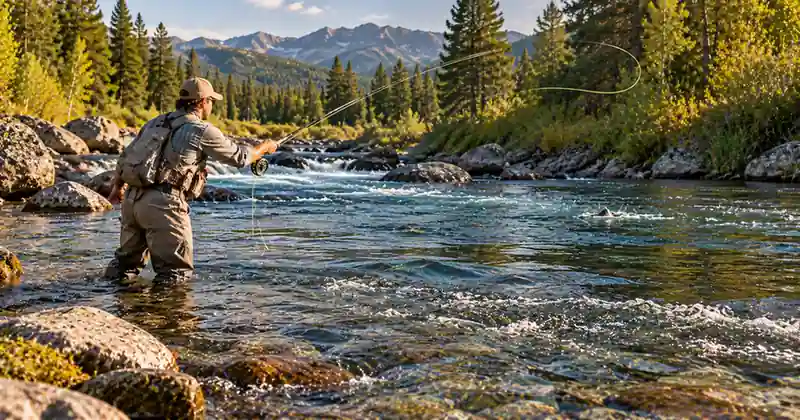
Fly fishing rainbow trout in rivers and lakes uses the same basic principles, but the way food moves is different.
In rivers, current creates feeding lanes and affects drift.
In lakes, you often need to identify structure, cruising routes, and productive depth without the same visible current clues.
Reading Riffles, Runs, Pools, and Seams
Riffles can provide broken surface cover and drifting food.
Runs often give trout a useful balance between current and depth.
Pools can provide deeper holding water, while current seams create boundaries where trout can intercept food.
Do not fish only the obvious deepest spot.
Cover transitions and edges where trout can move between feeding and resting water.
Stillwater Depth and Cruising Fish
In lakes, fish may cruise instead of holding in one narrow feeding lane.
Watch for:
- rises;
- moving fish;
- shoreline activity;
- insect concentrations;
- structure;
- changes in depth.
If there is no visible surface activity, work through depth systematically instead of changing flies randomly.
How Gear and Presentation Change
A 5-weight can work in both rivers and lakes, but wind, casting distance, larger flies, and deeper presentations can make a 6-weight more comfortable in some stillwater situations.
Likewise, a floating line covers many techniques, but deeper lake fishing may eventually justify a sinking system.
The correct setup follows the actual problem you are trying to solve.
Common Mistakes When Fly Fishing Rainbow Trout
Many problems in fly fishing rainbow trout come from making a decision too early.
The angler chooses a favorite pattern before locating fish, wades into productive water before casting, or changes flies repeatedly without adjusting depth or drift.
Changing Flies Before Fixing Depth or Drift
Pattern selection matters, but trout cannot eat a fly they never see.
Before changing patterns, ask:
- Is the fly reaching the feeding level?
- Is the drift natural?
- Is the fly moving too fast?
- Is drag pulling it away from the feeding lane?
Fix those problems first.
Fishing Only the Surface
Dry-fly fishing is visual and exciting, but surface activity is only one part of trout feeding.
If there are no rises, check subsurface options rather than waiting indefinitely for fish to look up.
Ignoring Local Food
A nationally popular fly may be less useful than a simple local pattern that matches the insects or prey currently available.
Observe the water and ask a reputable local fly shop when you need fishery-specific advice.
Using Gear That Does Not Match the Fly
A delicate dry-fly setup and a heavy streamer setup ask different things from the rod, line, leader, and tippet.
Do not force a light terminal setup to cast a bulky fly, and do not use unnecessarily heavy tackle when you need a delicate presentation.
Wading Before Fishing Nearby Water
Fish the edge first.
Stepping immediately into the river can spook trout holding close to the bank, in shallow seams, or near structure.
Move deliberately, and keep safety more important than reaching a distant casting position.
Ignoring Current Regulations
Fishing rules vary by location.
Before fishing, verify the current:
- fishing license requirements;
- seasons;
- closures;
- harvest rules;
- tackle restrictions;
- special regulations.
Do not rely on a general rainbow trout article for local legal requirements.
Fly Fishing Rainbow Trout FAQs
What Size Fly Rod Is Good for Rainbow Trout?
For general fly fishing rainbow trout, a 9-foot 5-weight is a versatile starting point.
It can handle many dry flies, nymph rigs, and lighter streamers.
Small creeks may favor lighter tackle, while windy lakes, bulky flies, or heavier streamers may make a 6-weight more comfortable.
What Flies Work Well for Rainbow Trout?
Useful starting patterns include Parachute Adams and Elk Hair Caddis for surface fishing, Pheasant Tail, Hare’s Ear, Zebra Midge, and similar nymphs for subsurface fishing, plus Woolly Buggers and baitfish-style streamers for larger moving prey.
Use local food and feeding depth to narrow the choice.
Are Dry Flies or Nymphs Better for Rainbow Trout?
Neither is always better.
Use dry flies when trout are feeding at the surface.
Use nymphs when fish are feeding below the surface or when surface activity is limited.
The better choice is the one that reaches the fish where they are feeding.
Can You Catch Rainbow Trout With Streamers?
Yes.
Rainbow trout can feed on small fish and other larger food items, so streamers can be effective when the presentation fits the water.
Adjust retrieve speed and depth before assuming the streamer pattern is wrong.
How Do You Find Rainbow Trout in a River?
Look for areas where trout can intercept food while avoiding the strongest current.
Current seams, runs, riffle edges, pool transitions, pockets behind rocks, and softer water beside fast current are all useful places to investigate.
Approach carefully and fish close water before wading farther out.
Can You Fly Fish for Rainbow Trout in Lakes?
Yes.
In stillwater, look for drop-offs, weed edges, inlets, shoals, cruising fish, surface activity, and changes in depth.
A floating line covers many situations, while deeper fishing can eventually make sinking or sink-tip systems useful.
Fly fishing rainbow trout successfully is less about memorizing dozens of patterns and more about making good decisions in the correct order.
Find likely fish first. Determine the feeding depth. Identify the most plausible food. Choose a fly that fits the situation, then present it naturally.
Use a versatile setup until your water gives you a reason to specialize. When the fish do not respond, change one variable at a time.
That process makes fly fishing rainbow trout easier to understand and gives you a repeatable approach for both rivers and lakes.
Sources Used
The U.S. Geological Survey’s Rainbow Trout (Oncorhynchus mykiss) Species Profile was used to verify rainbow trout dietary breadth, including aquatic and terrestrial insects, crustaceans, mollusks, fish eggs, and small fish.
The Orvis Learning Center’s Basic Nymph Fishing Techniques was used to verify guidance on nymph depth, natural drift, line control, mending, and keeping flies in the feeding zone.
The Orvis Learning Center’s Dry Fly Fishing was used to verify dry-fly guidance involving drag, emergers, rise observation, fly presentation, and adjustments when fish refuse a dry fly.
Trout Unlimited’s Chasing Rainbows: All About And How To Catch Rainbow Trout was used to cross-check general rainbow trout fly-fishing gear, the usefulness of 5- to 6-weight rods in common situations, floating lines, nymphing depth, streamer use, and the need to check fishery-specific regulations.
FlyFishingScout’s Fly Fishing Setup for Trout: Rod, Reel, Line, and Rig was used to verify the existing internal setup guide and its general 9-foot 5-weight, matching reel, and weight-forward floating-line baseline.
FlyFishingScout’s Best Flies for Trout Fishing: Essential Patterns was used as the verified existing internal resource for deeper trout fly-selection guidance.
FlyFishingScout’s Fly Fishing Gear for Beginners: Essentials for Your First Trip was used as the verified internal beginner-equipment resource.