
Fly Fishing Setup for Trout: Rod, Reel, Line, and Rig
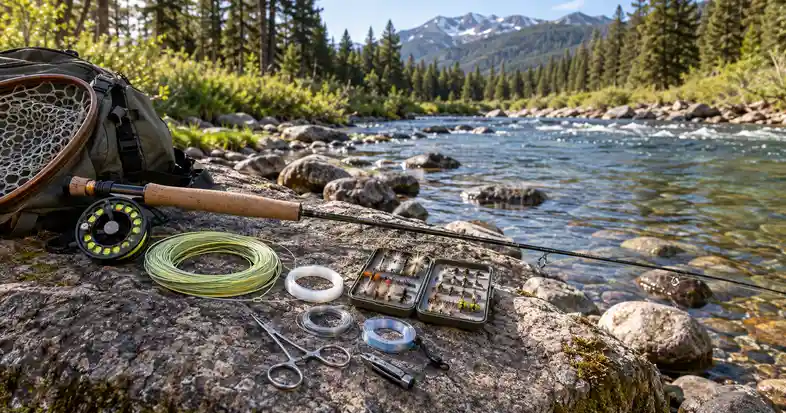
A fly fishing setup for trout is easiest to understand when you build it in the same order the components connect. Start with the rod, match the reel and fly line to it, then add backing, leader, tippet, and the fly. For many anglers, a 9-foot 5-weight rod with a matching reel and a weight-forward floating 5-weight line is the most practical all-around baseline.
That does not mean every trout angler should use the same outfit. Small creeks, large rivers, heavy streamers, stillwaters, and specialized nymphing can all justify different equipment. The goal is to begin with a versatile system, understand why it works, and specialize only when your water or technique gives you a reason.
A simple baseline looks like this:
9′ 5-weight rod → matching reel → backing → WF5F floating line → tapered leader → appropriate tippet → trout fly
Table of Contents
Fly Fishing Setup for Trout: Start With the Rod
The rod sets the framework for the rest of the fly fishing setup for trout. The number printed on a fly rod—3-weight, 4-weight, 5-weight, and so on—mainly tells you which fly-line weight the rod was designed to cast. It is not the physical weight of the rod itself.
Orvis currently recommends a 9-foot 5-weight as a strong beginner and all-around trout choice. The same general configuration can handle many dry flies, nymph rigs, and light streamers while remaining useful on a wide range of trout water.
Why a 9-Foot 5-Weight Is the Baseline
A 9-foot 5-weight offers a practical middle ground.
The 9-foot length gives you enough reach for mending and drift control without becoming overly long for general casting. The 5-weight line has enough mass to cast many common trout flies and modest indicator rigs while still allowing reasonably delicate presentations.
Orvis’ current Clearwater 9-foot 5-weight is one real-world example of this category. The company positions it for bigger trout water, drift control, attractor/dropper rigs, and light streamer work.
If you want a deeper comparison of rod weights, lengths, and actions, our guide to trout fly fishing rods explains how to choose the right rod for your water and fishing style.
When to Choose a 3- or 4-Weight
A lighter rod can make sense when most of your fishing happens on smaller streams with smaller flies and shorter casts.
Three- and 4-weight rods can feel more responsive with small trout and can make delicate dry-fly presentations enjoyable. The trade-off is that they have less line mass for wind, bulky indicators, larger nymph rigs, or heavier streamers.
Orvis currently groups 1- to 4-weight rods with smaller trout and other light freshwater applications, while describing the 5-weight as the more general all-around option.
When to Choose a 6-Weight
A 6-weight can make more sense on large rivers, windy lakes, or when you regularly cast heavier streamers and larger rigs.
Stillwater anglers in particular may benefit from the extra line mass. Orvis’ stillwater guidance notes that a 9-foot 6-weight is a common trout-lake choice because it handles wind and larger patterns more comfortably, although a 9-foot 5-weight can still work.
If you mainly fish ordinary rivers with dries, nymphs, and occasional light streamers, however, the 5-weight remains the simpler starting point.
Fly Fishing Setup for Trout: Choosing the Reel
The reel in a fly fishing setup for trout needs to match the rod and line, hold the fly line plus backing, and provide reliable line storage and retrieval.
For ordinary trout fishing, you usually do not need the most powerful drag system on the market. Many trout are landed without spending much time on the reel. Fit, capacity, smooth operation, and compatibility often matter more than extreme drag strength.
Choose a reel rated for the line weight you are using. For a 5-weight rod with a 5-weight fly line, use a reel that includes 5-weight line within its intended range.
For more detail on sizing, drag, arbor design, and capacity, our guide to choosing the right fly fishing reel covers each decision separately.
What About a Complete Trout Outfit?
A manufacturer-matched outfit can remove some of the compatibility work.
The current Redington Classic Trout Kit 590-4 is a useful example. Redington pairs a 9-foot 5-weight moderate-action rod with its Classic Trout reel, Dacron backing, RIO Gold XP fly line, and a tapered leader. The important lesson is not that you need this exact kit; it is that a complete outfit matches the rod, reel, backing, and line as one system.
That can be convenient for a first trout setup if you would rather learn the system before comparing every component separately.
Fly Fishing Setup for Trout: Backing and Fly Line
Backing sits on the reel first, with the fly line attached to it.
The connection order is:
reel → backing → fly line
Backing provides extra line behind the fly line if a fish makes a long run, and it also helps fill the reel spool to the intended level.
There is no useful universal backing amount for every trout reel. Check the reel manufacturer’s capacity chart because capacity changes with reel size, backing diameter, and fly line.
Why WF5F Is a Strong General Baseline
For a general 5-weight fly fishing setup for trout, a WF5F line is a simple starting point.
The code means:
- WF = weight forward
- 5 = 5-weight
- F = floating
A weight-forward floating line concentrates more of its casting mass toward the front of the line and stays on the surface. That makes it suitable for many common trout applications, including dry flies, indicator nymphing, and some streamer fishing.
The basic rule is to match line weight to rod weight unless the rod or line manufacturer gives you a specific reason to do something different.
If line weights, tapers, and floating versus sinking designs are still unfamiliar, our guide to choosing the right fly fishing line explains those differences in detail.
When You Need a Different Fly Line
A floating line is versatile, but it is not the only useful trout line.
You may eventually want:
- a sink-tip line for deeper streamer work
- a full sinking line for some stillwater situations
- a specialty nymph line
- a delicate presentation taper for technical dry-fly fishing
Do not buy those automatically. Start with the line that suits most of your fishing, then add specialty lines when a real technique or water type creates the need.
Fly Fishing Setup for Trout: Leader and Tippet
The terminal end of the fly fishing setup for trout connects like this:
fly line → leader → tippet → fly
The leader tapers from a thicker butt section near the fly line to a fine terminal section near the fly. Tippet is the fine, level-diameter material at the end of that system.
A new tapered leader already includes a terminal tippet section, so you do not necessarily need to add extra tippet before tying on the first fly.
A Simple Trout Leader Starting Point
A 9-foot tapered trout leader is a useful general starting format, but the correct terminal size depends on the fly and presentation.
Scientific Anglers currently offers standard Absolute Trout leaders in 7.5- and 9-foot lengths with terminal sizes ranging from 0X through 7X depending on length. Its current assortment includes common 3X, 4X, and 5X trout options.
That range is a good reminder that there is no single “trout leader” size for every application.
A larger or more wind-resistant fly may need a heavier terminal diameter. A small dry fly in clear, technical water may call for something finer.
How Tippet X Sizes Work
The key rule is:
Higher X number = thinner tippet diameter.
For example, 3X is thicker than 5X, while 6X is thinner than 4X.
That does not mean you should always use the finest tippet possible. Very fine material can be harder to cast with bulky flies and gives you less margin when fighting fish or dealing with abrasion.
For a complete explanation of X sizes, diameter, nylon, fluorocarbon, and fly-size matching, see our guide to choosing fly fishing tippet.
How to Rig a Fly Fishing Setup for Trout
Once the parts are chosen, assembling a fly fishing setup for trout is straightforward.
- Attach backing to the reel. Use the reel manufacturer’s guidance for capacity and setup.
- Connect the fly line to the backing. Many modern fly lines have a rear welded loop, but connection systems vary.
- Connect the leader to the front of the fly line. Loop-to-loop is common when both have loops.
- Add tippet if needed. A fresh tapered leader already has a terminal tippet section.
- Tie on the fly. Use a knot appropriate to the fly, tippet material, and technique.
Before fishing, inspect every connection. A perfectly matched rod and reel cannot compensate for a damaged leader, poor knot, or badly seated connection.
For beginners, it is worth assembling the entire system at home once before the first trip. That makes it much easier to recognize each connection when you are beside the river.
Fly Fishing Setup for Trout by Technique
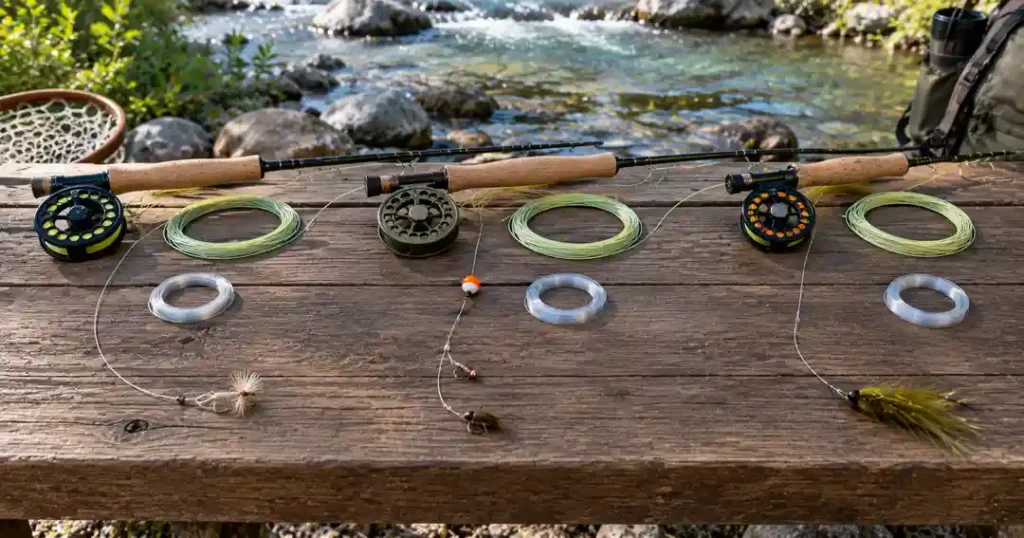
A general 5-weight fly fishing setup for trout can cover several techniques, but the terminal rig changes.
Dry Fly Setup
A basic dry-fly rig can be simple:
floating fly line → tapered leader → appropriate tippet → dry fly
Longer or finer leaders can help in clear water and with wary fish, but they also become more demanding to cast.
Scientific Anglers’ current Trout Presentation leaders extend to 11 and 14 feet for specialized delicate presentations, illustrating how leader design can become more specific once conditions demand it.
Nymph Setup
A basic nymph setup may use:
floating fly line → leader → tippet → nymph
Depending on the method, you may add a strike indicator, weight, or a second fly where regulations permit.
The exact leader construction, indicator position, weight, and fly spacing depend on depth, current, and technique. Specialized Euro nymphing systems are different enough that they deserve their own setup rather than being forced into this general guide.
Streamer Setup
A streamer rig often uses heavier leader or tippet than a delicate dry-fly rig.
With small or lightly weighted streamers, a floating 5-weight line may work well. Deeper water or heavier patterns can make a sink-tip or sinking line useful, and larger streamers may justify moving to a 6-weight rod.
Once your rig is ready, our guide to the best flies for trout fishing can help you build a practical selection of dry flies, nymphs, and streamers.
Fly Fishing Setup for Trout on Small Streams vs Big Rivers
The best fly fishing setup for trout changes with the water.
Small Streams
Small creeks often involve shorter casts, tighter vegetation, and smaller fish.
A shorter 3- or 4-weight can be enjoyable here because it is light, responsive, and easier to maneuver around brush. That does not mean a 9-foot 5-weight cannot fish a small stream—it can—but a lighter rod may feel more natural if this is where you spend most of your time.
Medium Rivers
This is where the 9-foot 5-weight baseline is especially useful.
It has enough length for line control, enough line mass for common trout rigs, and enough versatility to switch between dries, nymphs, and modest streamers.
For an angler who wants one outfit rather than a collection of specialized rods, this is the most straightforward general-purpose option.
Bigger Rivers, Lakes, and Wind
Large water may ask more of the setup.
A 5-weight can still work, especially with appropriate line and casting technique, but a 6-weight may be more comfortable when wind is persistent, flies are bulky, or streamer work becomes a major part of the day. Orvis’ current stillwater guidance specifically notes the value of a 6-weight when wind and larger patterns become important.
The point is not to buy a heavier rod because the river is famous or wide. Move heavier when the actual flies, wind, fish, or technique justify it.
Common Fly Fishing Setup for Trout Mistakes
Several common mistakes make a trout setup harder to use than it needs to be.
Mismatching the Rod and Fly Line
A 5-weight rod is normally designed around a 5-weight line.
Specialty lines can deliberately be heavier or use unusual tapers, but beginners should not assume those are necessary. Start with a line designed to pair appropriately with the rod.
Confusing Rod Weight With Physical Weight
A 5-weight is not a rod that weighs five ounces.
The number refers to the fly-line class the rod is designed to cast. This is one of the most important pieces of terminology to understand before buying equipment. Orvis likewise explains rod weight in relation to the fly line the rod is designed to use.
Overspending on the Reel Before the Line
For ordinary trout fishing, a functional reel with the right capacity is often enough.
The fly line directly affects casting and presentation, so putting the entire budget into a premium reel while using a poorly matched fly line usually makes little sense.
Buying a Specialized Line Too Early
A sink-tip or specialty taper can be excellent for a specific technique.
That does not make it a better first line. A weight-forward floating line gives beginners more flexibility across common trout techniques.
Ignoring Leader and Tippet
The last few feet of the setup directly affect fly presentation.
Even an excellent rod and line can perform poorly if the leader is too heavy for the fly, too light for the conditions, or badly damaged.
Using Tippet Too Light or Too Heavy Without Considering the Fly
Do not choose tippet only because the water is clear or because you want more strength.
The material must also turn over the fly and fit the presentation. A bulky streamer and a tiny dry fly rarely want the same terminal diameter.
Assuming One Setup Handles Every Trout Technique Equally Well
The 9-foot 5-weight is versatile, not perfect at everything.
Small-stream dry-fly specialists, Euro nymph anglers, stillwater anglers, and dedicated streamer anglers may eventually benefit from more specialized systems.
Fly Fishing Setup for Trout FAQs
Is a 5-Weight Fly Rod Good for Trout?
Yes. A 9-foot 5-weight is one of the most versatile general trout configurations and is widely recommended as an all-around starting point. It can handle many dry flies, nymph rigs, and light streamers.
Is a 4-Weight or 5-Weight Better for Trout?
A 4-weight can be excellent for smaller streams, lighter flies, and delicate presentations. A 5-weight is generally more versatile when you want one rod for a wider range of trout water, flies, wind, and techniques.
What Size Reel Should I Use for Trout?
Match the reel to your rod and fly line. For a 5-weight trout rod, choose a reel whose stated range includes a 5-weight line and that has enough capacity for the line plus appropriate backing.
What Fly Line Should I Use for Trout?
For a general 5-weight setup, a WF5F—weight-forward, 5-weight, floating—line is a practical baseline. Specialty fishing may justify different tapers, sink tips, or sinking lines.
What Leader and Tippet Should I Use for Trout?
There is no universal combination. A 9-foot tapered trout leader is a useful starting format for many situations, but the terminal X size should match the fly, presentation, fish, and water conditions.
Can I Use One Trout Setup for Dry Flies, Nymphs, and Streamers?
Yes, within limits. A 9-foot 5-weight with a floating line can cover many dries, standard nymph rigs, and lighter streamers. Heavy streamer fishing, specialized nymphing, or certain stillwater techniques may work better with different rods or lines.
Final Thoughts on a Fly Fishing Setup for Trout
For a versatile starting point, keep the fly fishing setup for trout simple:
9′ 5-weight rod → matching reel → backing → WF5F floating line → tapered leader → appropriate tippet → fly
That system can cover a large share of ordinary trout fishing without forcing you into specialized equipment too early.
Once you know whether you spend most of your time on tiny creeks, big rivers, stillwaters, technical dry-fly water, or streamer fishing, you can specialize with a lighter rod, heavier rod, longer leader, different line, or technique-specific rig. Start with compatibility first, then let the water tell you what to change.
Sources Used
Orvis — Beginner Fly Fishing Gear
Used to verify Orvis’ current recommendation of a 9-foot 5-weight as a beginner starting point and the basic rod/reel/line/leader/tippet equipment system.
Orvis Learning Center — Best Beginner Trout Rod
Used to verify the current 9-foot 5-weight recommendation for versatile trout fishing across streams, rivers, lakes, dries, nymphs, and lighter streamers.
Orvis — Fly Fishing Rods
Used to verify the relationship between rod weight and fly-line weight and Orvis’ current general weight ranges for trout and other freshwater species.
Orvis — Clearwater 9′ 5-Weight Fly Rod
Used to verify the current Clearwater 9-foot 5-weight configuration, intended trout applications, construction details, and current guarantee.
Orvis Learning Center — Stillwater Trouting
Used to support the distinction between a versatile 5-weight and a 6-weight when larger flies and windy stillwater conditions become more important.
Redington — Classic Trout Kit 590-4
Used to verify the current 9-foot 5-weight kit configuration with Classic Trout reel, Dacron backing, RIO Gold XP line, and matched trout setup.
Scientific Anglers — Absolute Trout Leaders
Used to verify current 7.5- and 9-foot trout leader options and the available terminal X-size range.
Scientific Anglers — Absolute Trout Leader Assortment
Used to verify current 3X, 4X, and 5X trout leader assortment options.
Scientific Anglers — Absolute Trout Presentation Leaders
Used to verify current 11- and 14-foot presentation leaders as examples of longer specialized trout leaders.