
Best Flies for Trout Fishing: Essential Patterns for Your Fly Box
The best flies for trout fishing are not one magic pattern. A useful trout box covers several feeding situations: surface insects, emergers in the film, subsurface nymphs, terrestrials, and larger food such as baitfish or leeches.
For most beginners, the smartest approach is to buy fewer proven patterns in several useful sizes rather than one of every fly in the shop. Build your box around this simple framework:
Surface → Film → Subsurface → Big Meal
Then adjust by size → depth → local food → presentation.
That gives you a practical starting box you can customize for the river, season, and hatch instead of relying on a universal “best” fly.
Table of Contents
Best Flies for Trout Fishing: Quick Answer
The best flies for trout fishing for a versatile starter box include Parachute Adams, Elk Hair Caddis, Stimulator, a foam terrestrial, Sparkle Dun, RS2, Pheasant Tail, Hare’s Ear, Zebra Midge, a rubber-leg stonefly nymph, Woolly Bugger, and a simple baitfish streamer. Carry several sizes, plus duplicates of the patterns you use most.
| Pattern | Type | Main Role | Good Starting Situation |
|---|---|---|---|
| Parachute Adams | Dry | General mayfly-style dry | Trout rising to small-to-medium insects |
| Elk Hair Caddis | Dry | Adult caddis / searching fly | Caddis activity or broken water |
| Stimulator | Dry / attractor | Large buoyant searching fly | Fast water, stonefly periods, dry-dropper use |
| Foam terrestrial | Dry | Ant, beetle, hopper-style food | Summer bankside fishing |
| Sparkle Dun | Emerger / dry | Emerging mayfly | Trout feeding in or near the surface film |
| RS2 | Emerger / nymph | Small mayfly or midge transition | Technical water and subtle feeding |
| Pheasant Tail | Nymph | Mayfly-style nymph | General subsurface trout fishing |
| Hare’s Ear | Nymph | Buggy general nymph | Mixed insect water |
| Zebra Midge | Nymph | Midge larva/pupa profile | Tailwaters, cold water, small-food situations |
| Rubber-leg stonefly | Nymph | Larger stonefly-style food | Faster water and larger subsurface meals |
| Woolly Bugger | Streamer | General larger prey | Searching, stained water, active retrieves |
| Simple baitfish streamer | Streamer | Small fish imitation | Trout chasing baitfish or larger prey |
This is a foundation, not a rulebook. A local hatch can make a more specific pattern the better choice on a given day.
How We Chose the Best Flies for Trout Fishing
The goal was not to collect famous names. The best flies for trout fishing should give a beginner broad coverage with as little unnecessary overlap as possible.
Water-Column Coverage
A useful box should let you fish on top, in the surface film, below the surface, and with larger moving patterns.
Versatility
General-purpose flies earn more space than highly specialized patterns in a first box. A beginner can add local specialists later.
Common Trout Food Forms
Trout commonly encounter aquatic insects in different life stages, terrestrial insects, and larger prey. A practical box should represent more than one of those food sources.
Beginner Fishability
The pattern should have a clear purpose that is easy to understand. A beginner benefits from knowing why a fly is being tied on, not just memorizing its name.
Pattern Overlap
Two flies that solve almost the same problem do not both need to dominate a starter box. Coverage matters more than collecting every variation.
Size and Weight Options
The same pattern in two or three useful sizes can be more valuable than several similar patterns in one size. For nymphs especially, matching general size and shape can be more important than chasing tiny color differences.
Regional Adaptability
A national starter box should work as a foundation across many U.S. trout fisheries, but it must leave room for local patterns. Western freestones, Eastern spring creeks, tailwaters, and small mountain streams can demand different additions.
Best Flies for Trout Fishing: Dry Flies
Dry flies belong among the best flies for trout fishing because they cover visible surface feeding and can also be used as searching patterns when trout are looking up.
Parachute Adams
The Parachute Adams is a strong general-purpose mayfly-style dry and one of the first flies worth adding to a trout box.
It is useful when you see mayfly-like insects on the water but cannot identify the exact species, or when trout are rising and you need a neutral starting pattern.
A practical beginner strategy is to carry it in several sizes rather than buying multiple colors immediately. Mid-range sizes are useful for general fishing, with smaller versions helping when the naturals are tiny.
Elk Hair Caddis
The Elk Hair Caddis is a classic adult-caddis pattern that floats well and is easy to see in broken water.
Use it when caddis are active, when trout are taking fluttering insects near the surface, or as a general searching dry on riffles and pocket water.
Its buoyancy also makes it useful when you want a visible dry that can support a light dropper in appropriate conditions.
Stimulator
The Stimulator is a larger, bushy dry that can suggest stoneflies and other big insects while also working as an attractor.
It is especially useful in fast water where a small, low-riding dry may be difficult to track.
A Stimulator can also work as the dry in a dry-dropper setup because its buoyant construction can support a small nymph better than many delicate dries.
Foam Terrestrial or Attractor
A foam ant, beetle, or hopper-style fly earns a place in a summer box.
Terrestrial insects become especially useful when warm-weather fishing puts ants, beetles, and grasshoppers near the water. Focus on banks, under overhanging vegetation, and other places where land insects can fall in naturally.
You do not need every terrestrial design. One compact beetle or ant pattern and one larger hopper-style option can cover a lot of situations.
Best Flies for Trout Fishing: Nymphs and Emergers
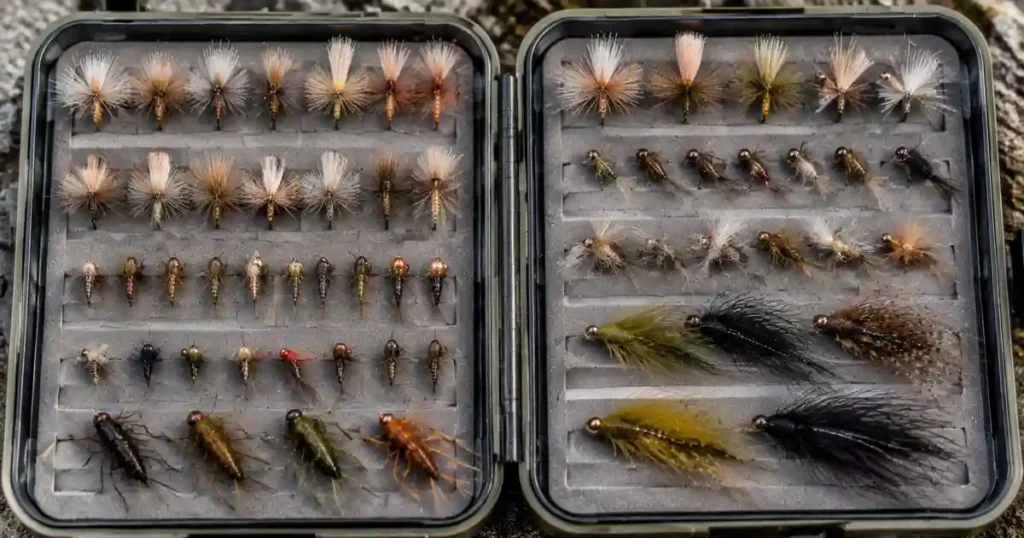
Nymphs and emergers make up some of the best flies for trout fishing because trout often feed below the surface or on insects struggling through the surface film.
Pheasant Tail
The Pheasant Tail is a slim mayfly-style nymph and a reliable starting choice when mayfly nymphs are part of the food supply.
Carry a few sizes and consider both weighted and lighter versions if your fishing regularly changes between shallow and deeper water.
Its job is straightforward: imitate a small, streamlined aquatic insect below the surface without relying on an extremely specific color or shape.
Hare’s Ear
The Hare’s Ear has a rougher, more “buggy” profile than the Pheasant Tail.
It can suggest several aquatic insects rather than one exact species, which makes it useful when you know trout are feeding subsurface but do not have a precise match.
A Pheasant Tail and Hare’s Ear overlap somewhat, but they give a beginner two different nymph profiles: slim and natural-looking versus rough and broadly suggestive.
Zebra Midge
The Zebra Midge is a small, simple midge pattern that is especially valuable on tailwaters, in colder periods, and anywhere tiny midges form an important part of the trout’s diet.
Because midges can be very small, this is one pattern where carrying smaller sizes matters.
Do not assume “small fly” means “easy fishing.” Fine tippet, drag control, and depth can become more important as the pattern gets smaller.
Rubber-Leg Stonefly Pattern
A rubber-leg stonefly nymph gives the box a larger subsurface option.
It makes sense in faster water, rocky rivers, or areas where larger stonefly nymphs are present. Weighted versions can help reach deeper current, but the amount of weight should match the water rather than being treated as a universal setup.
RS2
The RS2 covers the transition between nymph and emerger particularly well.
It can be fished below the surface or in the film and is useful when trout are feeding on small mayflies or midges but are not confidently taking a high-floating dry.
This is the kind of pattern that helps when you see subtle rises, bulges, or fish feeding just under the surface.
Sparkle Dun
The Sparkle Dun sits in the surface-film side of the box.
It represents an emerging mayfly with a trailing shuck and can be useful when trout refuse a conventional upright dry but continue feeding near the surface.
Rather than treating it as another “dry fly,” think of it as a tool for the awkward middle stage between underwater nymph and fully emerged adult.
Best Flies for Trout Fishing: Streamers and Larger Food
Streamers belong among the best flies for trout fishing when you want to imitate larger prey, cover water, or trigger fish that are not focused on small insects.
Woolly Bugger
The Woolly Bugger is one of the most versatile larger patterns you can carry.
Depending on how it is tied and fished, it can suggest:
- A leech
- A small baitfish
- A large aquatic insect
- Other moving prey
You can strip it, swing it across current, or dead-drift it in some situations.
Dark colors are useful in many conditions, but there is no need to buy every color. Start with one or two practical shades and learn how retrieve speed and depth change the presentation.
Simple Baitfish-Style Streamer
A straightforward baitfish streamer gives you a more obvious small-fish profile than a Woolly Bugger.
Use it when trout are actively chasing minnows, when you want to cover larger pieces of water, or when higher or stained water makes a larger moving target useful.
Do not assume a larger fly automatically produces a larger trout. Streamers simply give you another food category and presentation style.
Best Flies for Trout Fishing by Season
Season can help narrow the best flies for trout fishing, but local conditions matter more than a generic calendar. Water temperature, elevation, runoff, current hatches, and local insect populations can shift timing.
Spring
Spring boxes often lean heavily on nymphs and emerging insects.
Useful starting options include:
- Pheasant Tail
- Hare’s Ear
- Zebra Midge
- RS2
- Sparkle Dun
- Appropriate caddis or mayfly dries when adults are present
In colder water, the feeding window may be short and subsurface presentations can dominate.
Summer
Summer often expands dry-fly choices.
Useful additions include:
- Elk Hair Caddis
- Parachute Adams
- Stimulator
- Ants
- Beetles
- Hopper-style flies
- Small nymph droppers
Warm weather also makes terrestrial insects more relevant around grassy or wooded banks.
Fall
Fall can support a mix of nymphs, dries, and streamers.
Streamers often receive more attention as anglers cover water, while smaller mayflies and other insect activity can still create dry-fly opportunities depending on region.
Keep a core nymph selection rather than switching the entire box to streamers.
Winter
Winter often rewards smaller subsurface patterns and slower, deeper presentations.
Useful patterns can include:
- Zebra Midge
- Small Pheasant Tails
- Small Hare’s Ears
- RS2
- Other locally appropriate midge or tiny mayfly patterns
Fish can still rise during winter hatches, so do not leave all dry flies at home. Just expect small subsurface food to be important more often.
How to Choose the Right Trout Fly on the Water
The best flies for trout fishing are only useful when they match what the fish are doing. Even a box built around the best flies for trout fishing still depends on presentation, depth, and size. Before changing flies repeatedly, work through a simple decision process.
1. Are Trout Visibly Rising?
If trout are taking insects from the surface, start with a dry or emerger that resembles the size and general profile of the natural food.
If you are still learning the difference between dries, nymphs, emergers, and streamers, our guide to types of fly fishing flies explains the categories in more detail.
2. Look for Natural Food
Watch the water, streamside vegetation, and the surface.
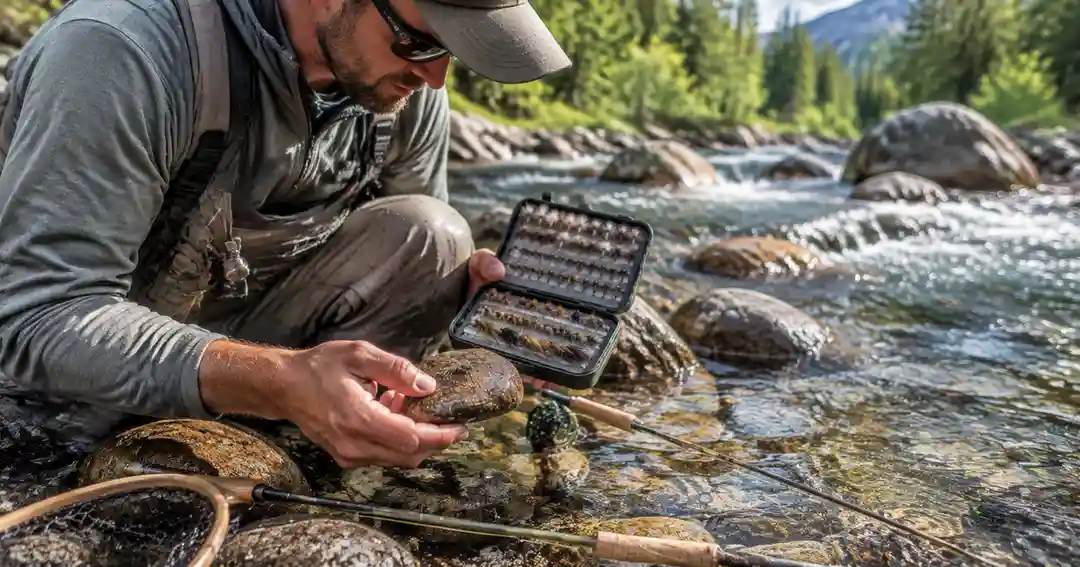
Where it is safe and legal, gently examine a submerged rock and return it to the same place. You are looking for general size and shape rather than trying to become an entomologist on the bank.
3. Match Size Before Tiny Color Differences
If the naturals are much smaller than your fly, changing from olive to brown may not solve the real problem.
Try to match the approximate size and silhouette first.
4. Decide Where Trout Are Feeding
A good pattern at the wrong depth can be less useful than a basic pattern presented correctly.
Ask whether fish are:
- On the surface
- In the film
- Mid-column
- Near the bottom
- Chasing moving prey
5. Consider Water Speed and Clarity
Fast water can favor more visible or buoyant dries and heavier subsurface flies.
Clear, slow water may require a subtler pattern, finer presentation, or smaller size.
Stained water can make a larger profile or moving streamer easier for trout to detect.
6. Check the Tippet and Presentation
A fly can drag unnaturally because of leader or tippet problems.
If you are unsure how terminal material affects presentation, see our guide to choosing the right fly fishing tippet.
7. Change One Important Variable at a Time
Instead of replacing the fly every few casts, change the variable that has the strongest reason behind it:
- Size
- Depth
- Weight
- Pattern category
- Retrieve
- Presentation
That teaches you more than random fly rotation.
How to Build a Practical Trout Fly Box
A useful trout fly box follows one buying rule:
Coverage before variety.
That rule matters because the best flies for trout fishing should cover different feeding situations instead of repeating the same job under different pattern names.
The best flies for trout fishing are more useful when you carry enough of the right roles and sizes instead of filling every slot with a different pattern.
Start With Core Patterns
Build the first box around:
- 3–4 dry-fly patterns
- 2 emerger patterns
- 3–4 nymph patterns
- 1–2 terrestrial patterns
- 1–2 streamer styles
You do not need a different fly in every compartment.
Buy Several Useful Sizes
For versatile patterns such as Parachute Adams, Pheasant Tail, Hare’s Ear, and Zebra Midge, buy more than one size.
This lets you adapt to changing insect size without changing the entire pattern concept.
Carry Duplicates
Confidence flies get lost.
Trees, rocks, fish, damaged tippet, and hook wear all remove flies from a box. Carry duplicates of the patterns you rely on rather than one precious copy of each.
Mix Weighted and Lighter Nymphs
If you fish both shallow and deeper water, carrying weighted and less-weighted versions of a few nymphs can help you control depth without collecting dozens of new patterns.
Leave Room for Local Flies
Reserve part of the box for patterns recommended for the specific river or region you plan to fish.
A local shop or current fishing report may point you toward an insect or size that a national starter list cannot predict.
Be Careful With Large Assortments
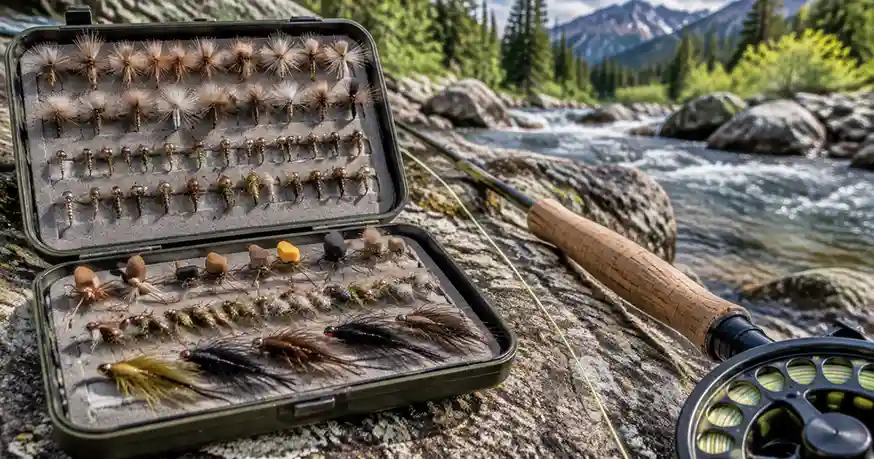
A pre-tied assortment can be convenient, but check the contents before buying.
A useful assortment should provide:
- Multiple fly categories
- Practical sizes
- Some duplicates
- Patterns relevant to trout
A box containing 60 flies is not automatically more useful than a smaller box with better coverage.
When you change patterns on the water, secure them with an appropriate connection. Our fly fishing knots for beginners guide covers practical terminal knots.
FAQs About the Best Flies for Trout Fishing
What Is the Best All-Around Fly for Trout?
There is no universal best fly, but a Parachute Adams is a useful all-around dry and a Pheasant Tail is a useful general nymph. A Woolly Bugger covers larger moving food. Together, those three patterns span very different feeding situations.
How Many Trout Fly Patterns Does a Beginner Need?
A beginner does not need dozens of patterns. A compact box of roughly 10–12 pattern families can cover surface, film, subsurface, terrestrial, and streamer situations. Multiple sizes and duplicates are usually more useful than constantly adding similar patterns.
What Are the Best Dry Flies for Trout?
Useful general dry flies include Parachute Adams, Elk Hair Caddis, Stimulator, and a foam terrestrial pattern. The best choice on a given day depends on the insects present, fly size, water type, and how trout are feeding.
What Are the Best Nymphs for Trout?
Pheasant Tail, Hare’s Ear, Zebra Midge, and a rubber-leg stonefly pattern make a practical starting group. Carry different sizes and, where useful, different weights so you can adjust depth.
What Are the Best Streamers for Trout?
A Woolly Bugger and a simple baitfish-style streamer give a beginner two useful options. Learn to vary depth and retrieve before buying many streamer designs.
Should You Buy Trout Flies in Different Sizes?
Yes. Carrying several sizes of a useful pattern gives you more flexibility when natural insects change. In many situations, getting the size and general profile close is more important than owning numerous color variations.
Final Best Flies for Trout Fishing Takeaway
The best flies for trout fishing are the patterns that give your box useful coverage, not the ones that create the longest shopping list.
Start with proven dries, emergers, nymphs, terrestrials, and streamers. Carry several useful sizes, keep duplicates of confidence patterns, and leave space for local additions.
Then pay attention to what matters on the water: size, depth, local food, and presentation. A smaller, better-organized box that helps you make those decisions is more useful than dozens of flies with no clear purpose.
Sources Used :
- Orvis Learning Center — Tom’s Top 10 Trout Flies — consulted for established general-purpose trout patterns, including Parachute Adams, Stimulator, Pheasant Tail, Zebra Midge, and Woolly Bugger, plus practical size-over-color guidance.
- Orvis Learning Center — Best Emerger Patterns — consulted for RS2, Sparkle Dun, emerger use, and representative emerger sizing guidance.
- Orvis Learning Center — How to Pick the Right Fly — consulted for matching the approximate size and shape of natural food before over-focusing on small color differences.
- Orvis — Fly Fishing Nymph Flies — consulted for current nymph-selection guidance, including matching river food, size and shape, carrying multiple sizes and weights, and representative trout nymph patterns.
- Fly Fishers International — Biology of Fly Selection — consulted for aquatic-insect life-stage context and the importance of nymph and emerging forms to feeding fish.