
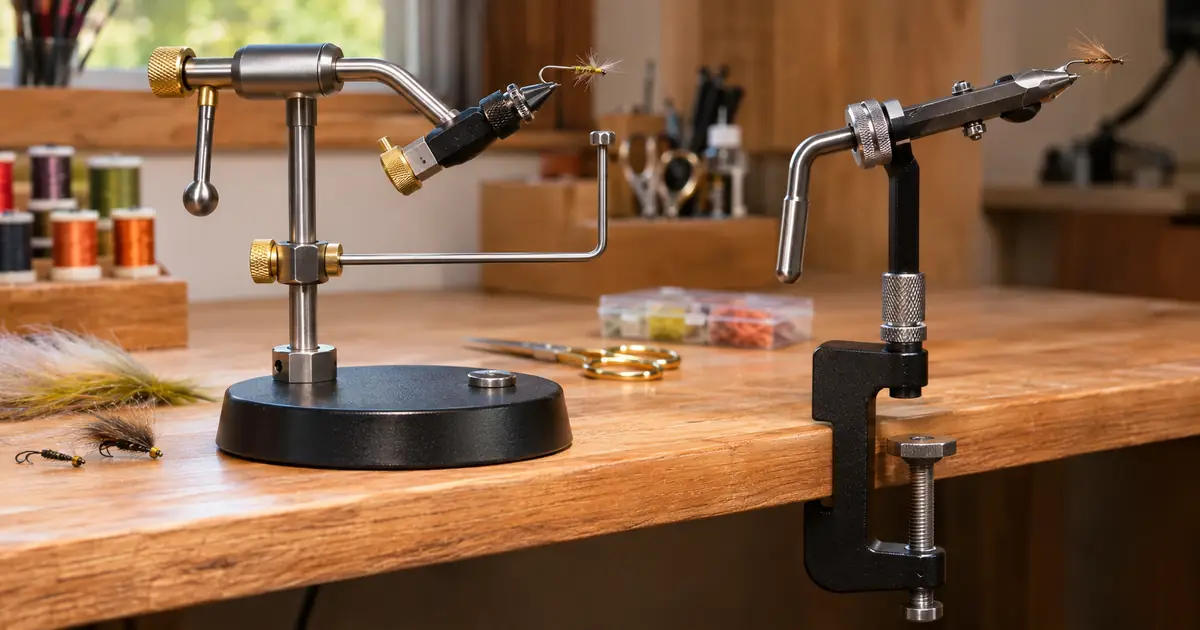
fly tying vice: Compare Jaws, Rotary Features and Upgrade Value
A fly tying vice is worth upgrading when the new model solves a problem you actually encounter: hooks slipping, insufficient space around the jaws, awkward rotation, or an unstable mount. A more expensive vise is not automatically a better tool for the flies you tie.
The important differences are not just brand names. A screw-adjusted jaw, a cam-operated jaw, and a spring-loaded jaw can change how you secure hooks. Similarly, a head that turns 360 degrees is not necessarily designed to keep the hook shank aligned with the axis of rotation.
Quick answer: Choose a fly tying vice by comparing your usual hooks, jaw design, rotation mechanism, mounting setup, and total configuration cost. Keep your existing vise if it holds your hooks securely and allows you to tie comfortably. Upgrade when a specific feature makes a meaningful difference to your tying.
This guide compares real configurations from Griffin, PEAK, and Regal. Rather than repeating the fundamentals covered in our guide to choosing your first fly tying vise, it focuses on what you gain—and what you might not need—when choosing a more advanced model.
Table of Contents
Fly Tying Vice: Quick Model Comparison
The following comparison uses documented product specifications rather than invented hands-on rankings.
| Model | Jaw System | Rotation | Mounting | Main Reason to Consider |
|---|---|---|---|---|
| Griffin Superior 1A | Dual-knob, adjustable | Fixed head | C-clamp | Straightforward tying without rotary features |
| Griffin Odyssey Spider | Adjustable jaws | True-rotating design | C-clamp | Entry into rotary tying |
| Griffin Odyssey Spider Cam | Cam-operated jaws | True-rotating design | C-clamp; other bundles vary | Faster hook changes |
| PEAK Rotary PRV-G2 | Cam-adjusted, hardened steel | Adjustable rotary resistance | Steel pedestal | Integrated pedestal workstation |
| Regal Medallion, Regular Head | Spring-loaded jaws | 360° rotation and tilt | Pedestal or clamp | Quick hook insertion and inspection |
The Griffin Odyssey Spider and Spider Cam have a published hook range of #28 to 4/0. PEAK lists the PRV-G2 for hooks up to 2/0 and down to very small hooks, with actual wire diameter affecting suitability. Regal’s traditional Regular Head has historically been specified for approximately #22 to 1/0; verify the current jaw configuration rather than assuming that every Regal head has the same range.
These specifications describe different designs, not demonstrated superiority.
A good comparison must also include the way you work. Someone tying occasional trout nymphs may have no reason to pay more for a rapid cam mechanism. Another angler tying dozens of identical flies could value that same feature considerably.
The useful question is not simply which model has more features. It is which fly tying vice makes your particular tying process easier without creating unnecessary expense.
Fly Tying Vice Jaws and Hook Range
Jaw design is one of the most practical differences between fly tying vices.
The jaws must hold a hook firmly while leaving enough room for thread, beads, dubbing, feathers, and other materials. A large published hook range is useful, but it does not guarantee that every hook within that range is equally convenient to work on.
Screw-Adjusted Jaws
A screw-adjusted mechanism lets you change jaw pressure mechanically.
The Griffin Superior 1A provides a basic example. Its fixed-head design uses a dual-knob arrangement and a C-clamp. Griffin specifies a solid 3/8-inch stem and a one-year warranty.
The Odyssey Spider offers a different step up: Griffin identifies it as an entry-level true-rotating vise, with the published #28–4/0 jaw range.
A screw-adjusted system can make sense when you tie a relatively consistent range of hook sizes or do not mind adjusting the jaws between different hooks.
The disadvantage becomes more noticeable if frequent hook changes interrupt your work.
Cam-Operated Jaws
A cam mechanism uses a lever to close or lock the jaws after the initial adjustment.
The Griffin Odyssey Spider Cam is an example. It combines a cam-operated jaw mechanism with the company’s true-rotating design and published #28–4/0 range.
Its practical appeal is the ability to change hooks with a lever rather than repeatedly operating a conventional screw closure.
However, a cam lever does not mean that jaw adjustment is unnecessary. When changing to a significantly different hook-wire thickness, you still need to set the jaws appropriately.
PEAK’s rotary vise also uses a jaw-adjustment system with a cam handle. Its mechanism and the Griffin Cam’s construction should be evaluated separately; they are not identical products just because both use cam controls.
Spring-Loaded Jaws
Regal’s Medallion uses a spring-loaded jaw system.
Instead of the same cam-and-screw adjustment routine, the user opens the jaws with a lever, positions the hook, and releases the mechanism.
This can appeal to someone who changes hooks frequently.
The trade-off is that the jaw head itself must suit the intended hook range. Regal offers different head designs for different tasks, including small flies, general-purpose tying, and larger hooks.
A spring-loaded system does not automatically provide better hook grip than a properly adjusted cam or screw system.
Hook Size vs. Hook-Wire Diameter
Here’s an important fly tying vice buying detail: hook size and hook-wire diameter are not interchangeable measurements.
A #12 light-wire dry-fly hook and a #12 heavy-wire nymph hook can have substantially different construction.
PEAK makes this distinction explicit in its manufacturer guidance. It states that its standard jaws can accommodate hook wire up to approximately 0.044 inches and that the usefulness of its midge jaws depends heavily on access around the hook.
Therefore, a nominal range reaching 2/0 does not mean every unusually heavy 2/0 hook will be equally suitable.
When evaluating jaws, check both the hook size and wire construction. Our guide to choosing fly tying hooks explains why nominal hook sizes alone cannot describe every pattern.
Access Around Small Hooks and Large Streamers
Holding a hook is only the first requirement. You also need room to work.
Small flies can be difficult to tie when bulky jaw tips crowd the bend or eye. PEAK’s midge jaws address that problem with a sculpted tip that improves access; the manufacturer explains that their purpose is not simply to grip a smaller numerical hook size.
Large streamers present a different issue. Heavy wire, long shanks, and substantial thread tension can require a more specialized jaw design.
Choose jaws around your most frequent patterns, not the largest advertised range alone.
Rotary Head vs. True In-Line Rotary
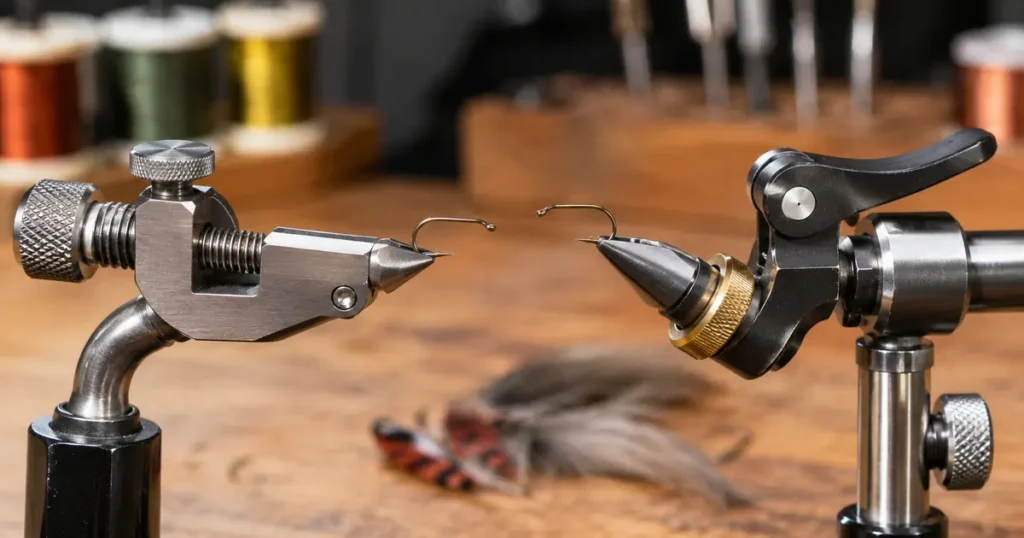
A fly tying vice can rotate without necessarily functioning as an in-line rotary tool.
This distinction matters because rotation serves two different purposes.
Rotation for Inspection
A rotating head can let you examine the other side of the fly, reach the hook bend, or check material placement without removing the hook.
For occasional tying, this may be all the rotation you need.
Regal’s Medallion series provides 360-degree rotation and tilt. It can be turned to inspect a fly, but Regal distinguishes it from the Revolution series, which is specifically designed for in-line tying.
This is why advertising that says “360-degree rotating” should not automatically be interpreted as “true in-line rotary.”
In-Line Rotation for Material Wrapping
In-line rotary tying involves positioning the hook shank so it rotates around its longitudinal axis.
That can be useful when applying certain materials, including ribbing and hackle, because the vise rotates the hook as part of the wrapping process.
The Griffin Odyssey Spider is marketed as a true-rotating vise, and PEAK provides adjustable rotary operation on the PRV-G2. However, the exact hook placement and setup still determine how closely the shank follows the rotation axis.
If continuous in-line wrapping is important to you, verify the mechanism and setup instructions for the exact vise—not merely whether the head turns.
When Rotary Function Adds Practical Value
Rotary functionality is most useful when it changes how you perform a repeated tying task.
If you frequently wrap materials along a hook shank, inspect the underside of complex patterns, or want to rotate a fly without removing it, a suitable rotary design may be worth considering.
If your current fixed-head vise holds hooks securely and you are comfortable wrapping materials by hand, rotary operation may be optional.
A more advanced mechanism does not replace accurate proportions, controlled thread tension, or good material preparation.
Fly Tying Vice Models Compared by Use Case
Comparing a fly tying vice by its actual configuration is more useful than comparing brand reputation alone.
The following models illustrate distinct buying decisions. They are not ranked as tested winners, and the published hook ranges come from manufacturers or retailers rather than independent grip measurements.
Griffin Superior 1A — Basic Fixed-Head Reference
The Griffin Superior 1A is a useful baseline for deciding whether more complicated hardware is necessary.
It features a fixed head, adjustable jaws, a 3/8-inch stem, and a C-clamp. Griffin lists a one-year warranty for this model.
Who should consider it: Someone who wants a straightforward vise for ordinary tying and does not need rotation as part of their process.
Main limitation: It lacks the true-rotary functionality found on the Odyssey Spider.
If you already own a similarly capable vise and it holds your hooks reliably, replacing it with another basic fixed-head model may provide little benefit.
Griffin Odyssey Spider — True-Rotary Comparison
The Griffin Odyssey Spider adds a true-rotating design with the manufacturer’s stated hook range of #28–4/0.
A standard C-clamp configuration makes it relevant to someone with an appropriate table edge. Retailer listings also identify a bobbin cradle, although package contents should be checked for the exact version purchased.
The practical advantage is the ability to rotate the hook during tying while retaining a relatively straightforward adjustment system.
⭐ Smart Rotary Choice: Griffin Odyssey Spider Fly Tying Vise
Want rotary functionality without automatically paying for a more elaborate vise package? The Griffin Odyssey Spider offers true 360-degree rotation and a manufacturer-listed #28–4/0 hook range, making it worth comparing for anglers who tie several different fly styles.
Its standard C-clamp configuration requires a suitable workbench edge. If quick cam-operated hook changes are your priority, compare the Spider Cam version before buying.
👀 See Griffin Odyssey Spider & Check Price on Amazon
PEAK PRV-G2 — Pedestal Rotary Setup
The PEAK PRV-G2 takes a different approach.
It includes a steel pedestal with non-marking feet, a hook-and-bead pocket, accessory mounting holes, and a height- and length-adjustable bobbin cradle. Its hardened tool-steel jaws are specified for hooks up to 2/0 and down to very small sizes, subject to actual wire dimensions.
PEAK also provides adjustable rotation resistance so the user can control how easily the head turns.
Who should consider it: Someone who wants a movable pedestal tying station with integrated rotary and accessory features.
Main limitation: The pedestal occupies desktop space, and optional accessory posts or specialty jaws may cost extra.
🔥 Standout Pedestal Option: PEAK Rotary Vise with Pedestal Base (PRV-G2)
Need a rotary vise that doesn’t depend on clamping to your desk? The PEAK PRV-G2 combines adjustable rotary resistance with a stable steel pedestal, an included bobbin cradle, and a convenient hook-and-bead pocket.
It’s worth considering if the pedestal arrangement suits your workspace. Check the exact hook-wire requirements and don’t assume optional accessory posts or specialty jaws are included.
👀 View PEAK PRV-G2 & Check Price on Amazon
Regal Medallion — Spring-Jaw Alternative
The Regal Medallion provides an alternative for tyers who prioritize convenient hook insertion and head positioning.
Its spring-loaded jaws avoid the same routine used with conventional screw-adjusted designs. The head rotates 360 degrees and tilts, but the Medallion should not be confused with Regal’s Revolution in-line rotary series.
The Regular Head is a general-purpose option. Other heads are designed for smaller hooks, larger hooks, or particular tying tasks.
Who should consider it: Someone who changes hooks frequently and values spring-loaded operation more than continuous in-line rotary wrapping.
Main limitation: The selected head determines the useful hook range, and changing the Medallion into a Revolution is not a simple head swap.
The manufacturer specifically advises against treating those two product families as interchangeable rotary systems.
Pedestal vs. C-Clamp: Complete Mounting Cost
The mounting system can change both the final cost and the usefulness of a fly tying vice.
A pedestal rests on the table. A C-clamp grips a suitable table edge. Neither provides an automatic performance advantage in every workspace.
Work Surface Compatibility
A C-clamp works best when the table has an accessible edge, suitable thickness, and enough clearance beneath the top.
Drawers, raised side panels, thick aprons, or unusual edge profiles may prevent proper installation.
Before purchasing, measure the actual table rather than assuming the word “universal” guarantees compatibility.
Pedestal Footprint and Stability
A pedestal avoids the need for an accessible table edge, but it occupies working space.
PEAK’s PRV-G2 pedestal includes non-marking feet and a removable vise stem. The base is designed to pack relatively flat for transport after disassembly.
A pedestal may be convenient for a shared desk or workstation that needs to be cleared after tying.
The important question is whether the complete base and vise remain stable for the tying tasks you perform.
Accessory and Mounting Differences
Some retailers sell a vise with a C-clamp, some with a pedestal, and others as packages with additional tools.
The Griffin Odyssey Spider Cam illustrates why this matters. Some dealers describe a C-clamp configuration, while others advertise a package containing both a clamp and pedestal.
Do not assume that two similarly named listings contain identical accessories.
Compare the exact contents before choosing the lower price.
Fly Tying Vice Upgrade Value
The strongest reason to upgrade a fly tying vice is an identifiable limitation—not simply the desire for a more expensive tool.
When a Cam Jaw Is Worth the Extra Cost
A cam-operated jaw can be useful when repeated hook changes interrupt your tying.
For example, someone producing several batches of flies may appreciate being able to open and close a properly adjusted jaw mechanism with a lever.
That does not make cam jaws necessary for everyone. If you tie a few flies at a time and your screw-adjusted vise works well, faster hook changes may offer limited additional value.
The Griffin Odyssey Spider Cam is a relevant comparison because it adds cam-operated jaws to the true-rotating Spider concept.
It has a stated hook range of #28–4/0, but buyers should verify the exact mounting accessories supplied with their chosen package.
A worthwhile cam upgrade should improve a repeated task you already perform.
🔥 Make Repeated Hook Changes Easier
Griffin Odyssey Spider Cam Vise
Looking for a practical vise upgrade? The Odyssey Spider Cam combines a cam-operated jaw system with true rotary operation and a stated hook range from #28 to 4/0.
⭐ Worth considering if you change hooks frequently. Check the included base or clamp before buying.
Check Price on Amazon →As an Amazon Associate, we earn from qualifying purchases.

When True Rotary Solves a Real Limitation
A fly tying vice with effective in-line rotary operation may be worth the cost when you regularly wrap materials by rotating the hook itself.
If your current vise has a rotating head but does not maintain the intended hook alignment, changing to an appropriate true-rotary system could improve that particular workflow.
If you rarely use rotation during tying, the upgrade may not matter enough to justify the expense.
When Specialty Jaws Are Necessary
Specialty jaws become relevant when the existing jaws cannot provide the combination of hook grip and working access you require.
PEAK’s midge jaws, for example, improve access around small hooks. Its saltwater jaws are intended for a different range of hook-wire diameters.
Before buying optional jaws, confirm that they fit your exact model. PEAK specifically states that rotary-vise jaws and non-rotary-vise jaws are not interchangeable between those two product families.
When Your Existing Vise Is Already Adequate
Keep your current fly tying vice if it securely holds the hooks you use, gives you enough working access, remains stable, and does not prevent you from tying your preferred patterns.
A new vise cannot automatically fix problems with thread control, fly proportions, or material selection.
Where possible, borrow or try the intended upgrade before buying. That can reveal whether the new mechanism provides meaningful value for your tying style.
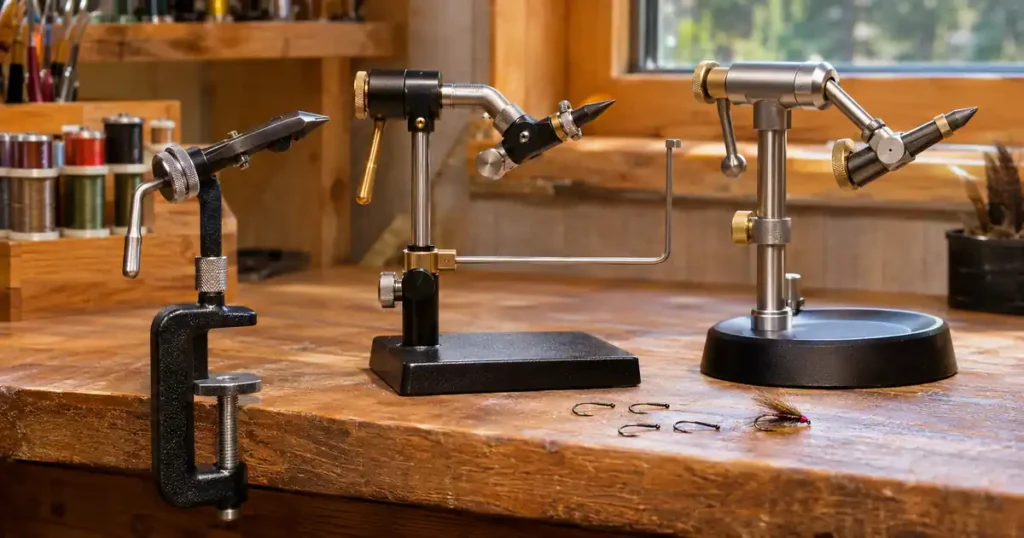
How to Compare the Full Fly Tying Vice Package
The advertised price of a fly tying vice may not represent the complete cost of using it.
When comparing models, check whether you are buying the vise alone, a vise with mounting hardware, or a package that includes additional tools.
Base, Cradle, and Included Accessories
The most useful comparison is between complete configurations.
For example, PEAK’s PRV-G2 includes a pedestal and adjustable bobbin cradle, but its accessory post is optional. Griffin sells separate vise models and travel packages with different contents.
A package containing a vise, bobbin, scissors, and a carrying case should not be compared directly against a bare vise without accounting for those items.
A fly tying vice should also fit your existing equipment. Before paying for accessories, determine whether you already own suitable tools or whether the package solves a genuine need.
For a broader explanation of starter packages and their contents, see our guide to choosing a fly tying kit.
Maintenance, Warranty, and Replacement Parts
Check the manufacturer’s instructions for cleaning, adjustment, and replacement components.
PEAK lists a limited lifetime warranty against defects in materials or workmanship for its rotary vise. Griffin’s Superior 1A has a one-year warranty, while its Odyssey Spider range has different published warranty terms.
Warranty length is only one factor. Confirm which parts are covered, what exclusions apply, and whether the manufacturer supports the exact model.
Never assume a lifetime warranty covers damage caused by misuse, incorrect jaw adjustment, or ordinary wear.
Complete Configuration Cost Checklist
As a research snapshot from November 5, 2026, the manufacturer or identified retailers displayed these approximate reference prices:
| Vise Configuration | Published Reference Price | Source |
|---|---|---|
| Griffin Superior 1A, C-clamp | $77.70 | Griffin |
| Griffin Odyssey Spider | $150.15 | Griffin |
| Griffin Odyssey Spider Cam | $193.10 | Griffin |
| PEAK PRV-G2, pedestal | $239.95 | Specialty retailer |
| Regal Medallion series | Starting at $220 | Regal |
These are not guaranteed Amazon prices, and they may change. The listings also come from different sellers or manufacturers, so taxes, shipping, optional accessories, and availability are not necessarily comparable.
Before deciding which fly tying vice offers better value, calculate the complete cost:
Total setup cost = Vise + required mounting hardware + missing tools or accessories + applicable shipping and taxes
Subtract the value of accessories you already own only when you would otherwise have needed to purchase them.
A seemingly inexpensive vise can become less attractive if it needs a separate base. Conversely, a more expensive package may offer little extra value when you already own suitable accessories.
The goal is to spend money on improvements you will actually use.
Common Buying Mistakes and Who Should Keep Their Existing Vise
Several common mistakes can turn a promising fly tying vice upgrade into an unnecessary purchase.
Mistake 1: Choosing by hook range alone. A vise advertising #28–4/0 still needs to hold your actual wire diameters and allow enough room around the hook.
Mistake 2: Confusing rotating and in-line rotary mechanisms. Always check the manufacturer’s stated design and setup requirements.
Mistake 3: Comparing incomplete packages. A model with a pedestal and bobbin cradle is not directly equivalent to a bare vise.
Mistake 4: Assuming expensive means better. A complicated system may add adjustments you do not need.
Mistake 5: Buying specialty jaws without checking compatibility. Similar-looking jaws from different model families may not interchange.
Mistake 6: Ignoring the tying desk. A C-clamp that cannot fit your table edge will not be a useful purchase.
Mistake 7: Replacing an adequate vise to solve a technique problem. Improved equipment may help, but it does not replace practice.
If your present vise holds hooks securely, gives you good access, and supports the patterns you tie, keeping it is a reasonable decision.
Upgrade only when you can explain which limitation the replacement will resolve.
Fly Tying Vice FAQs
Is a Cam-Operated Vise Better Than a Screw-Jaw Vise?
Not universally. A cam-operated fly tying vice may make repeated hook changes more convenient, especially when tying batches of similar flies. A properly adjusted screw-jaw model can still be completely suitable for occasional tying.
Is True Rotary Worth the Extra Money?
It depends on how you work. True in-line rotary operation can be useful when wrapping materials by rotating the hook. If you do not use that technique, a less complex vise may meet your needs.
Which Jaws Are Suitable for Small Hooks?
Look for jaws that hold the actual hook wire securely while leaving space around the bend and eye. Specialty midge jaws can improve access, but they are not always necessary simply because the hook is small.
Is a Pedestal or C-Clamp Better?
A pedestal provides flexible positioning on a suitable flat surface, while a C-clamp secures the vise to a compatible table edge. The better choice depends on your desk and how you organize your tying area.
When Should You Upgrade a Fly Tying Vice?
Upgrade when your current vise has a specific limitation that affects regular tying tasks, such as unreliable hook holding, insufficient access, unsuitable mounting, or a missing rotary capability you would genuinely use.
Final Thoughts
The right fly tying vice is the one that holds your usual hooks securely, gives you useful working access, and fits your tying space.
Start with the flies you tie most often. Compare jaw design, actual hook-wire suitability, rotation mechanics, mounting hardware, and the full cost of the configuration.
A fixed-head vise can remain useful for years. A rotary or cam-equipped model becomes worth considering when its additional functionality addresses a real limitation.
Choose the upgrade that improves your tying process—not simply the model with the longest feature list.
References
- Griffin Enterprises — Superior 1A Vise with C-Clamp
- Griffin Enterprises — Odyssey Spider Vise
- Griffin Enterprises — Odyssey Spider Cam
- Griffin Enterprises — Odyssey Spider Travel Kit
- PEAK Fishing — PRV-G2 Rotary Vise with Pedestal Base
- PEAK Fishing — PRVC-1 Rotary Vise with C-Clamp
- PEAK Fishing — Frequently Asked Questions
- PEAK Fishing — Midge Jaws
- Regal Vise — Vise Identification
- Regal Vise — Frequently Asked Questions
- Regal Vise — Product Range
- Sportsman’s Warehouse — Griffin Odyssey Spider Fly Tying Vise
- Sportsman’s Warehouse — PEAK Rotary Fly Tying Vise
- Trident Fly Fishing — Griffin Odyssey Spider Cam Vise
- AvidMax — Griffin Odyssey Spider Cam