
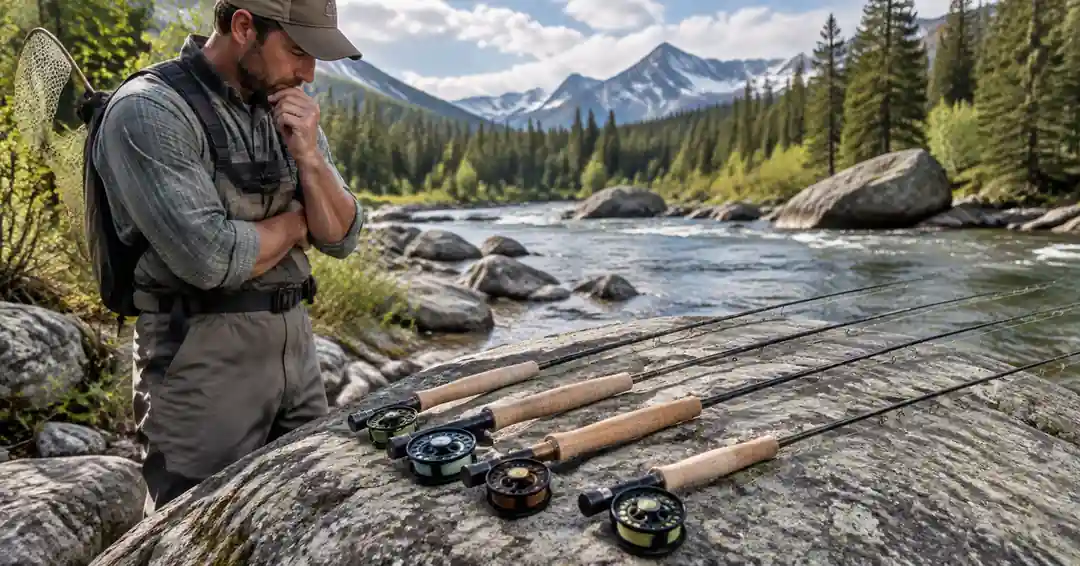
Trout Fly Fishing Rods: How to Choose the Right Weight and Length
Choosing trout fly fishing rods gets much easier when you stop asking which rod is “best” and start asking what job the rod needs to do. For many anglers, a 9-foot 5-weight is the most practical all-around starting point, but it is not the right answer for every stream, fly, or technique.
A better buying order is:
Flies → Water → Wind → Technique → Weight → Length
That approach helps you choose trout fly fishing rods based on what you actually cast and where you fish, rather than trout size or brand reputation alone.
Table of Contents
Trout Fly Fishing Rods: Quick Answer
For general trout fishing, a 9-foot 5-weight is the safest all-around starting point. Move to a 3- or 4-weight for smaller streams, lighter flies, and more delicate presentations. Consider a 6-weight when larger streamers, heavier nymph rigs, bigger water, or stronger wind are a regular part of your fishing.
A simple starting guide:
| Rod | Common Starting Use | Main Trade-Off |
|---|---|---|
| 3-weight | Small creeks, small dries, short casts | Limited with bulky flies, heavy rigs, and wind |
| 4-weight | Dry flies, smaller to medium trout water | Less versatile with heavier rigs |
| 5-weight | General-purpose trout fishing | Not specialized for tiny creeks or big streamers |
| 6-weight | Larger flies, heavier rigs, wind, bigger water | More line mass and less delicacy |
For length, shorter rods help in tight cover, around 9 feet works well for broad general use, and rods longer than 9 feet add reach for certain nymphing and line-control situations.
What Does Fly Rod Weight Mean?
The numbered weight on a fly rod is not the rod’s physical weight. A 5-weight rod is designed around a 5-weight fly-line system, while a 4-weight uses a lighter line and a 6-weight uses a heavier one.
That difference matters because the fly line supplies much of the mass used to cast the leader, tippet, and fly.
This is why rod selection should begin with what you need to cast. The right trout fly fishing rods are matched to the line, flies, and rigs they need to move.
A small trout caught on a windy river with a bulky streamer may justify a heavier setup than a much larger trout feeding on tiny dry flies in calm water. Fish size still matters when considering tippet, fighting pressure, and overall tackle, but it should not be the only factor used to choose a rod.
If you want the broader all-species selection process, see our guide on how to choose a fly rod.
Trout Fly Fishing Rods: Choosing 3, 4, 5, or 6 Weight
The most useful way to compare trout fly fishing rods is to give each line weight a job. None is automatically better than the others.
3-Weight: Small Streams and Light Presentations
A 3-weight can be an excellent choice when most of your fishing involves:
- Narrow creeks
- Short casting distances
- Small dry flies
- Light nymphs
- Delicate presentation
- Smaller fish where a lighter setup adds feel
Shorter 3-weight rods can be especially useful under trees or around brush because they are easier to move through confined spaces.
The limitations become obvious when you add wind, large indicators, heavy split shot, or bulky streamers. A light line simply has less mass available to turn over demanding rigs.
Do not confuse a short small-stream 3-weight with a long 10- or 11-foot 3-weight built for Euro-style nymphing. They share the same nominal line-weight category but solve very different fishing problems.
4-Weight: Light Trout Fishing With More Range
A 4-weight sits between small-stream specialty tackle and the all-purpose 5-weight.
It makes sense when you mostly fish:
- Small to medium trout rivers
- Dry flies
- Light nymph rigs
- Smaller terrestrials
- Situations where presentation matters more than throwing bulky flies
A 4-weight can feel more delicate than a 5-weight while still giving you more capability than a light creek rod.
Choose a 4-weight over a 5-weight when you already know that dries, lighter rigs, and smaller water make up most of your fishing. If you expect frequent indicator rigs, larger streamers, or strong wind, the 5-weight usually gives you more flexibility.
5-Weight: The General-Purpose Trout Choice
A 5-weight is the default recommendation for many trout fly fishing rods because it handles a wide range of ordinary trout flies and rigs without becoming highly specialized.
A typical 9-foot 5-weight can handle:
- Dry flies
- Basic nymph rigs
- Small to moderate streamers
- Terrestrials
- Medium trout rivers
- Lakes and ponds
- A useful range of casting distances
The biggest advantage is versatility. If you are buying one trout rod and do not yet have a specialized reason to choose something else, a 9-foot 5-weight is the strongest baseline for comparison.
That does not make it perfect everywhere. On a tiny brushy creek it can feel unnecessarily long and powerful. If you regularly throw large streamers or heavy rigs in wind, it may feel underpowered compared with a 6-weight.
6-Weight: More Line Mass for Demanding Rigs
A 6-weight is useful when the casting job becomes more demanding.
Consider one if you regularly fish:
- Larger streamers
- Heavier nymph rigs
- Big indicators
- Windy water
- Larger rivers
- Stillwater where longer casts and bigger flies are common
The reason to move up is not simply “bigger trout.” A 6-weight provides more line mass for moving larger or more wind-resistant flies and rigs.
For an angler who spends most days presenting small dries at close range, that added power may be unnecessary. For someone throwing articulated streamers or heavy rigs, it can make the setup much more practical.
How Rod Length Changes Trout Fly Fishing Rods
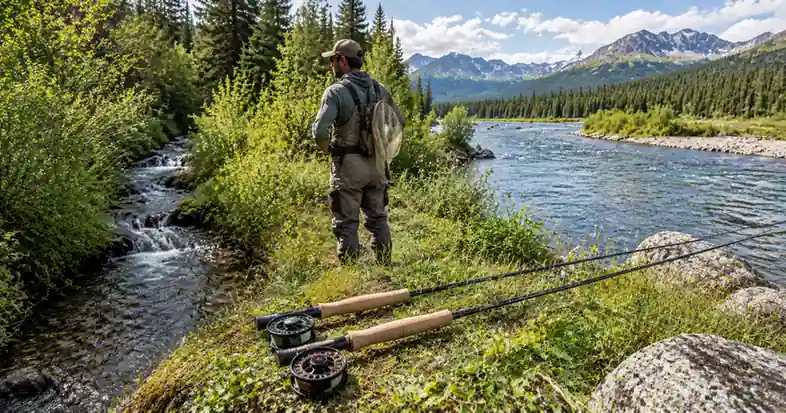
Weight tells you how much line mass the rod is designed around. Length changes reach, line control, casting room, and how easily trout fly fishing rods fit the water.
Shorter Than 9 Feet
Shorter rods are especially useful on:
- Brushy streams
- Tight mountain creeks
- Water with heavy tree cover
- Short casting lanes
A 7- to 8-foot-something rod can be easier to maneuver around branches than a 9-footer. Shorter rods can also feel more natural when most casts are short and there is little need for long mends.
The trade-off is reach. You give up some ability to hold line off conflicting currents or reach across wider seams.
Around 8 Feet 6 Inches to 9 Feet
This is the most versatile length range for many trout fly fishing rods.
A 9-foot rod provides useful reach for:
- Mending
- Roll casting
- Managing line across currents
- Indicator nymphing
- General dry-fly fishing
An 8-foot-6-inch rod can give up a little reach while feeling more compact on smaller rivers.
If you are unsure what length to buy for a first general-purpose trout rod, 9 feet is the easiest reference point.
Longer Than 9 Feet
Longer rods can add reach and improve some forms of line control.
They may make sense for:
- Specialized nymphing
- Reaching across complex currents
- Managing longer leaders
- Some larger-river applications
However, extra length is not automatically better. A longer rod can feel cumbersome on tight water and is not necessary simply because you want longer casts.
Long Euro-nymph rods are a specialized example. Their extra reach and design are intended for a particular technique, not to replace a general-purpose 9-foot trout rod.
Trout Fly Fishing Rods by Water Type
Your most common water is one of the fastest ways to narrow trout fly fishing rods.
Small Mountain Creeks
A 3- or 4-weight in a shorter length often makes sense when:
- Casting room is limited
- Most casts are short
- Flies are small
- Delicate presentation matters
A short 5-weight can still work, but it may provide more power than you need.
Medium Trout Rivers
This is where 4- and 5-weight rods become especially useful.
A 4-weight suits anglers who lean toward dries and light rigs. A 9-foot 5-weight gives more room for nymph rigs, small streamers, changing wind, and mixed techniques.
If you want one rod for several types of trout fishing, this is the strongest argument for the 5-weight.
Large Rivers and Tailwaters
Large water does not automatically require a heavy rod, but it often adds:
- Wind
- Longer line management
- Bigger indicators
- Heavier nymph rigs
- Streamer fishing
A 5-weight remains useful for much of this fishing. Move toward a 6-weight when the flies and rigs consistently demand more power.
Lakes and Open Water
On lakes, reservoirs, and open shoreline water, consider:
- Wind exposure
- Fly size
- Casting distance
- Sinking or specialty lines
- Streamer use
A general 5-weight works for many light applications, while a 6-weight gives more capability when wind or larger flies become routine.
Trout Fly Fishing Rods by Technique
The flies and rigs you cast often determine the most sensible rod faster than the fish species itself.
Dry Fly Fishing
For dedicated dry-fly fishing, 4- and 5-weight rods cover most general trout situations.
A 4-weight can be attractive when:
- Flies are relatively small
- Presentation is the priority
- Water is smaller or moderate
- Wind is manageable
A 5-weight provides more versatility when the same day might include terrestrials, larger dries, or a switch to nymphs.
Nymph Fishing
A 9-foot 5-weight is a practical general-purpose nymph rod for common indicator rigs.
As rigs become heavier, larger, or more wind-resistant, a 6-weight can become easier to manage.
Specialized Euro nymphing is different. Those rods are often longer and lighter by line-weight designation because their job centers on reach, leader control, and close-contact presentation rather than conventional fly-line casting.
Streamer Fishing
Small Woolly Buggers and modest streamers can be fished comfortably on many 5-weights.
Move toward a 6-weight when you regularly use:
- Larger streamers
- Weighted patterns
- Sink tips
- More aggressive lines
- Wind-resistant flies
Again, fly size and rig demand are more useful selection clues than trout size alone.
How Rod Action Affects the Choice
After weight and length, action helps refine how trout fly fishing rods feel and respond.
Moderate or Medium Action
A medium-action rod flexes farther into the blank than a fast rod.
For many trout anglers, that can provide:
- More noticeable loading feedback
- A more deliberate casting rhythm
- Good dry-fly presentation
- Broad general-purpose use
It can be a sensible choice when you value feel and presentation over maximum line speed.
Medium-Fast Action
Medium-fast is a common compromise in modern trout rods.
It can provide enough flex to feel the rod load while still offering the recovery and power needed for mixed techniques.
For someone who fishes dries, nymphs, and occasional streamers, medium-fast is often a practical place to start.
Fast Action
Fast-action rods flex more toward the tip and can generate higher line speed.
That can help with:
- Wind
- Larger flies
- Longer casts
- Anglers with a quicker casting stroke
The trade-off is that some beginners find a very fast rod less forgiving at short distances because it may be harder to feel the rod load.
Action labels are not perfectly standardized across manufacturers. One company’s medium-fast rod may feel noticeably different from another’s.
If possible, cast several rods before buying. And remember that rod action cannot replace sound technique. If you are still developing your stroke, learn how to cast a fly rod before assuming a different rod will solve every casting problem.
Matching Rod, Reel, and Fly Line
The rod is only one part of the system. Even well-chosen trout fly fishing rods can feel wrong when paired with unsuitable line or an awkwardly matched reel.
A simple starting principle is:
5-weight rod → 5-weight fly line
unless the rod or line manufacturer gives you a specific reason to do something different.
Modern fly lines complicate that slightly because some are intentionally built heavier than the nominal line class or use aggressive tapers designed to load particular rods and turn over larger flies.
That is why it helps to read the actual line specifications instead of relying only on the number printed on the box.
Our guide to choosing the right fly fishing line explains line weight, taper, floating vs. sinking options, and intentional overweight designs in more detail.
The reel should then have:
- Appropriate line-weight compatibility
- Enough capacity for the fly line and backing
- A physical weight that balances reasonably with the rod
- Drag appropriate for the fishing
If you are building a rod-only setup, see our guide to choosing the right fly fishing reel.
A complete outfit can simplify these choices because the manufacturer has already matched the basic rod, reel, and line components.
Common Trout Rod Buying Mistakes
The most common mistakes happen when anglers choose trout fly fishing rods from one specification instead of the entire fishing job.
Choosing by Trout Size Alone
The flies and rigs you cast often matter more.
A small trout does not make a bulky streamer easy to cast on a light rod.
Automatically Buying the Lightest Rod
A 3-weight sounds delicate and appealing, but it can become frustrating if your everyday setup includes wind, indicators, split shot, or larger flies.
Automatically Buying a 5-Weight
The 5-weight is versatile, not mandatory.
If nearly all of your fishing is on tiny creeks with small dries, a shorter 3- or 4-weight may be more enjoyable.
Buying Too Heavy for Small Water
A 6-weight can handle demanding rigs well, but it may feel excessive on a narrow creek where casts are short and flies are tiny.
Ignoring Rod Length
Weight does not tell you whether the rod will fit under tree cover or provide enough reach for the water you fish.
Choose length separately.
Treating Fast Action as a Quality Grade
“Fast” does not mean better made.
Action describes how the rod flexes and feels. A slower or medium rod may be more appropriate for the fishing you do.
Ignoring Fly-Line Compatibility
A good rod can feel poor with a badly matched fly line.
Start with the manufacturer’s rod and line recommendations.
Buying a Specialized Rod as Your Only Rod
A long Euro-nymph rod can be excellent at its intended job but awkward as a general dry-fly and streamer rod.
Buy specialty equipment when you already know you need the specialty.
FAQs About Trout Fly Fishing Rods
What Weight Fly Rod Is Best for Trout?
For general trout fishing, a 5-weight is the most versatile starting point. Choose a 3- or 4-weight for smaller water and lighter presentations, or a 6-weight when larger flies, heavier rigs, bigger water, or strong wind are common.
Is a 3-Weight Fly Rod Good for Trout?
Yes. A 3-weight is well suited to small streams, short casts, small dries, and light rigs. It becomes less convenient when wind, bulky flies, large indicators, or heavy nymph setups are common.
Is a 4-Weight or 5-Weight Better for Trout?
A 4-weight is often better for lighter dry-fly work and smaller water. A 5-weight provides more versatility for nymphs, small streamers, wind, and larger rivers. Choose based on your usual flies and water rather than trout size.
Is a 6-Weight Too Heavy for Trout?
Not necessarily. A 6-weight can be useful for larger streamers, heavier nymph rigs, strong wind, and big water. It may feel excessive for small-creek dry-fly fishing.
What Length Fly Rod Is Best for Trout?
Around 9 feet is the most versatile general-purpose length. Shorter rods are useful in tight cover, while rods longer than 9 feet can add reach for specialized nymphing or line-control situations.
Is a 9-Foot 5-Weight the Best All-Around Trout Rod?
For many anglers, yes. It offers a practical balance for dries, common nymph rigs, smaller streamers, medium rivers, and changing conditions. It is a baseline, not a rule; specialized fishing can justify a different weight or length.
Final Trout Fly Fishing Rods Takeaway
The best way to choose trout fly fishing rods is to start with the job:
Flies → Water → Wind → Technique → Weight → Length
If you need one versatile trout rod and do not yet have a specialized reason to choose differently, begin your comparison with a 9-foot 5-weight.
Move lighter and shorter for small streams and delicate presentations. Move heavier when larger flies, heavier rigs, wind, or bigger water make the casting job more demanding.
Then match the rod with an appropriate fly line and reel. The right setup is not the rod with the biggest number or highest price. It is the one that fits the fishing you actually plan to do.
Sources Used :
- Trout Unlimited — What Line Weight Fly Rod Is Really Best for Trout? — consulted for the distinction between physical rod weight and line-weight rating, choosing rods around the flies being cast, and current 2026 trout line-weight guidance.
- Trout Unlimited — Finding the Right Fly Rod for You — consulted for current rod-weight, fly-line, fly-size, and general 9-foot 5-weight selection guidance.
- Trout Unlimited — How to Choose a Fly Rod for Trout — consulted for trout-specific rod length, small-stream, dry-fly, streamer, and general-purpose 5-weight guidance.
- Orvis Learning Center — Best Beginner Trout Rod — consulted for the current beginner recommendation of a 9-foot 5-weight and its broad trout applications.
- Orvis — Choosing the Right Action in a Fly Rod — consulted for fast-, medium-, and slow-action characteristics and the recommendation to compare rod feel through actual casting when possible.