
Beginner Fly Fishing Setup: Rod, Reel, Line, Leader, and Flies
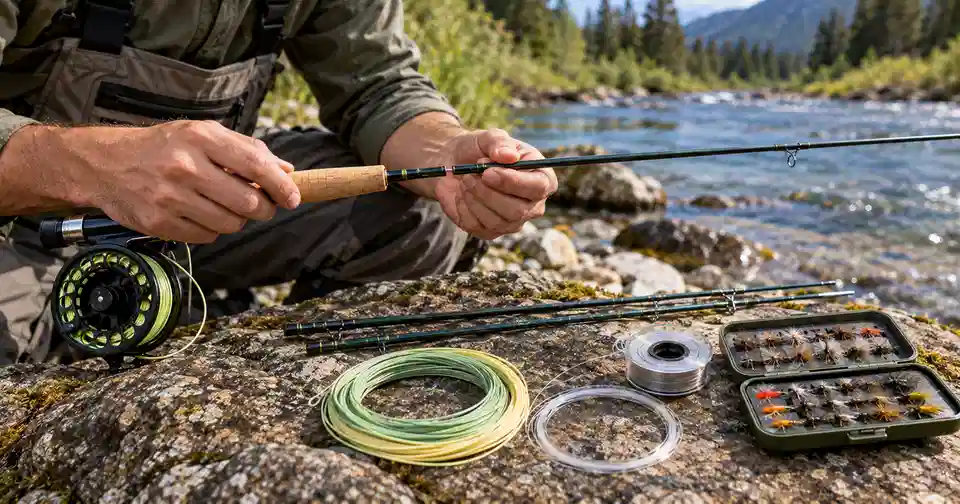
A beginner fly fishing setup is easier to understand when you treat it as one connected system rather than a shopping list.
The basic order is:
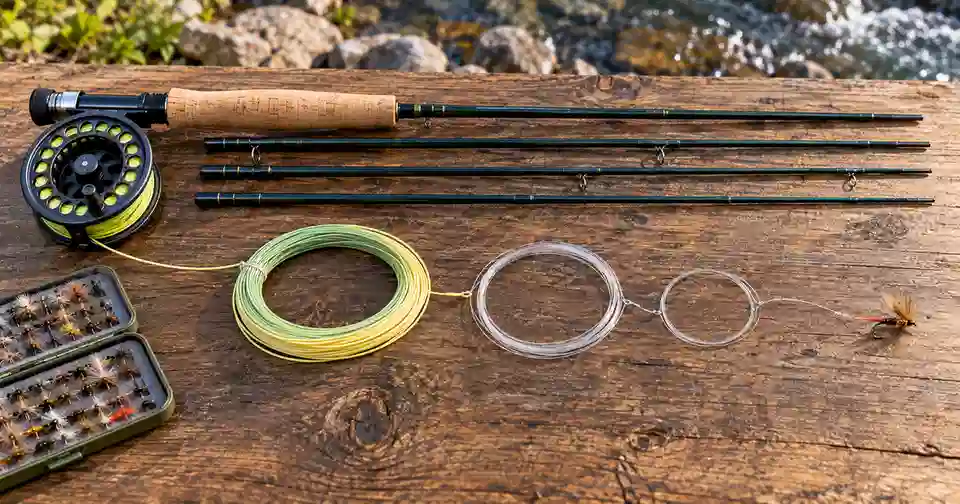
Rod → Reel → Backing → Fly line → Leader → Tippet → Fly
Each part has a different job, and each one needs to work with the parts around it. A premium reel cannot fix fly line that is wrong for the rod, and a huge fly box will not help if your leader and tippet do not suit the flies you are trying to cast.
For general freshwater fishing, a 9-foot 5-weight rod with a matching reel and weight-forward floating line is a practical starting reference. It is not the correct beginner fly fishing setup for everyone, though. Small streams, heavy bass flies, saltwater, large fish, strong wind, and specialized techniques can all require something different.
The best approach is to build from the fishing backward.
Table of Contents
Beginner Fly Fishing Setup: Quick Answer
A simple beginner fly fishing setup needs these core components:
| Component | Main Job | Beginner Priority |
|---|---|---|
| Rod | Cast and control the fly line | Essential |
| Reel | Store line and backing | Essential |
| Backing | Reserve line behind the fly line | Essential setup component |
| Fly line | Provides much of the mass used to cast | Essential |
| Leader | Tapers from thick fly line toward the fly | Essential |
| Tippet | Fine replaceable terminal material | Essential |
| Fly | Imitates or suggests fish food | Essential |
For many beginners targeting trout and other general freshwater species, a useful reference setup is:
9-foot 5-weight rod → compatible reel → suitable backing → 5-weight weight-forward floating line → tapered leader → appropriate tippet → small local fly selection
Do not copy that setup automatically if your intended fishing is very different.
Start with the species, water, flies, and techniques you expect to use.
Beginner Fly Fishing Setup: Start With the Fish and Water
Before choosing a rod weight, think about what your beginner fly fishing setup actually needs to do.
Target Species
A setup for modest trout or panfish is different from one built for salmon, pike, large bass flies, bonefish, or other powerful saltwater species.
Fish size matters, but it is not the only factor.
The flies and rigs you need to cast can influence rod weight just as much as the fish.
Water Size
A small brushy creek may favor a lighter or shorter rod that is easier to manage in tight spaces.
A large river or lake may make additional casting distance, wind resistance, and line control more important.
Do not buy for the biggest river you may someday visit if most of your fishing will happen on smaller local water.
Fly and Rig Size
A tiny dry fly creates very different casting demands from:
- a weighted nymph rig;
- an indicator;
- split shot where legal;
- a bulky bass bug;
- a large streamer.
Heavier or more wind-resistant flies generally require more power from the rod and line system.
Wind and Casting Distance
Wind can make very light tackle difficult to control.
If you regularly fish open lakes, coastal areas, or large windy rivers, a heavier line class may be more comfortable than a delicate small-stream setup.
Technique
Specialized techniques can justify specialized rods and lines.
A beginner does not need to solve every future fishing situation with the first purchase.
Build your first beginner fly fishing setup for the water and techniques you are actually likely to use.
Beginner Fly Fishing Setup: Choosing the Rod
The rod gives the beginner fly fishing setup its basic size and line class.
Fly rods are commonly described with a length and weight designation, such as:
9-foot 5-weight
The “5-weight” does not mean the rod physically weighs five units or is designed specifically for five-pound fish. It refers to the fly-line class the rod is designed around.
What Rod Weight Means
A useful general guide looks like this:
| Rod Weight | Common Starting Uses | Main Trade-Off |
|---|---|---|
| 2–3 weight | Small streams, small flies, panfish | Limited with larger rigs and wind |
| 4 weight | Lighter trout fishing, smaller water | Less power for bulky setups |
| 5 weight | General trout and versatile freshwater | Excellent baseline, not universal |
| 6 weight | Larger flies, heavier rigs, stronger wind | More power, less delicacy |
| 7–8 weight | Bass, larger streamers, stronger fish | More rod than ordinary light trout fishing requires |
Use this as a starting framework, not a strict species chart.
Why 9 Feet Is a Common General Length
A 9-foot fly rod provides useful reach for:
- line control;
- mending;
- nymph rigs;
- dry-fly fishing;
- moderate-distance casting.
It is long enough for many river situations without becoming highly specialized.
Shorter rods may be more convenient on tight streams with trees and limited casting room.
Why a 5-Weight Is a Useful Baseline
A 5-weight is popular for general freshwater fishing because it can handle many:
- trout dry flies;
- common nymph rigs;
- modest streamers;
- panfish situations;
- some lighter bass fishing.
That versatility makes it a logical reference point for a first setup.
It does not mean every beginner needs a 5-weight.
When a 3- or 4-Weight Makes More Sense
Consider a lighter setup when you mainly fish:
- small creeks;
- modest fish;
- small dry flies;
- short casting distances;
- situations where delicate presentation matters more than power.
When a 6-Weight or Heavier Makes More Sense
Move heavier when you regularly need to cast:
- larger streamers;
- bulky bass bugs;
- heavier nymph rigs;
- flies in strong wind;
- larger freshwater or saltwater setups.
If trout will be your primary target, FlyFishingScout’s fly fishing setup for trout can take you deeper into trout-specific rod, reel, line, and rig choices.
Beginner Fly Fishing Setup: Reel and Backing
The reel in a beginner fly fishing setup stores the backing and fly line.
Its job is important, but a beginner should not choose it by appearance or model number alone.
Match the Reel to the Line Class
Manufacturers may label reels with ranges such as:
- 3/4;
- 4/5;
- 5/6;
- 7/8.
Other brands use different sizing systems.
The safest approach is to read the manufacturer’s specifications and confirm that the reel is designed for your intended fly-line weight.
Do not assume a reel marked “5” means exactly the same thing across every brand.
Reel Capacity
The spool needs enough room for:
- appropriate backing;
- the entire fly line;
- enough clearance to operate without the line constantly rubbing the frame.
A reel that is too small may not hold the required system.
A reel that is unnecessarily large can add bulk without solving a problem.
What Backing Does
Backing sits between the reel arbor and the rear of the fly line.
The basic order is:
Reel → backing → fly line
It provides reserve line if a fish takes more line than the normal fly line itself provides.
Backing also helps fill the reel to an appropriate level.
Beginners do not need to guess a universal backing amount. Capacity varies with reel model, backing diameter, and fly-line design.
Follow the reel manufacturer’s guidance.
Why Beginners Usually Don’t Need an Extreme Drag System
A good drag can be useful, particularly for larger or stronger fish.
But an ordinary freshwater beginner fly fishing setup does not automatically need the most expensive sealed drag system available.
Prioritize:
- compatibility;
- capacity;
- dependable function;
- sensible balance with the rod.
For a deeper reel guide, see FlyFishingScout’s article on choosing the right fly reel.
Beginner Fly Fishing Setup: Choosing Fly Line
Fly line is one of the most important pieces of a beginner fly fishing setup because the line itself provides much of the mass used to load the rod and make the cast.
Match Line Weight to the Rod
The easiest beginner rule is:
Start by matching the fly-line number to the rod’s rated line weight.
A 5-weight rod normally starts with a 5-weight fly line.
A 6-weight rod normally starts with a 6-weight line.
Some modern tapers are intentionally heavier than their nominal rating, so always check the exact line specifications rather than automatically buying a heavier line.
Weight-Forward vs. Other Tapers
For general beginner use, a weight-forward line is usually the simplest starting point.
Weight-forward lines concentrate more mass toward the front portion of the line.
They are available for many different techniques, including:
- trout;
- bass;
- nymphing;
- streamers;
- saltwater;
- stillwater.
That does not mean all weight-forward lines are identical.
Head length, taper, mass distribution, and intended fly sizes can vary significantly.
Why Floating Line Is the General Starting Point
For many freshwater beginners, a weight-forward floating line handles a broad range of situations.
It can work with:
- dry flies;
- many nymph rigs;
- dry-dropper setups;
- smaller streamers.
A useful general trout reference is:
5-weight rod → 5-weight WF floating line
When a Specialty Line Can Wait
You may eventually need:
- sink-tip line;
- full-sinking line;
- intermediate line;
- streamer-specific taper;
- nymphing line;
- technical dry-fly line.
Do not buy several specialty lines before you understand what problem each one solves.
For a complete explanation of weights, tapers, floating versus sinking designs, and specialty lines, read FlyFishingScout’s guide to choosing the right fly fishing line.
Beginner Fly Fishing Setup: Leader and Tippet
The fine end of the beginner fly fishing setup follows this sequence:
Fly line → leader → tippet → fly
Leader and tippet are related, but they are not exactly the same thing.
What the Leader Does
A tapered leader starts relatively thick near the fly line and becomes thinner toward the fly.
The taper helps transfer energy from the fly line while allowing a lighter final section near the fly.
Leaders are available in different:
- lengths;
- terminal diameters;
- materials;
- designs.
Do not assume one leader is correct for every fly and technique.
What Tippet Does
Tippet is level-diameter material used at the terminal end of the system.
It can be used to:
- rebuild a shortened leader;
- extend its terminal section;
- change terminal diameter;
- attach certain multi-fly rigs where appropriate.
As you repeatedly change flies, you cut away some leader material. Tippet lets you restore that fine terminal section without replacing the whole leader immediately.
A New Tapered Leader Already Has a Terminal Section
A common beginner misunderstanding is that every new tapered leader needs an additional section of tippet before it can be used.
Not necessarily.
A fresh tapered leader already narrows to its terminal diameter.
You can often attach the fly directly when that diameter and length suit the presentation.
Add tippet when you need to rebuild, extend, or alter the terminal section.
Match the Terminal Section to the Fly
Do not choose tippet from fish size alone.
Consider:
- fly size;
- fly weight;
- water clarity;
- structure;
- abrasion;
- presentation;
- target fish.
A tiny dry fly may need a different terminal setup from a bulky streamer.
Beginner Fly Fishing Setup: Choosing Your First Flies
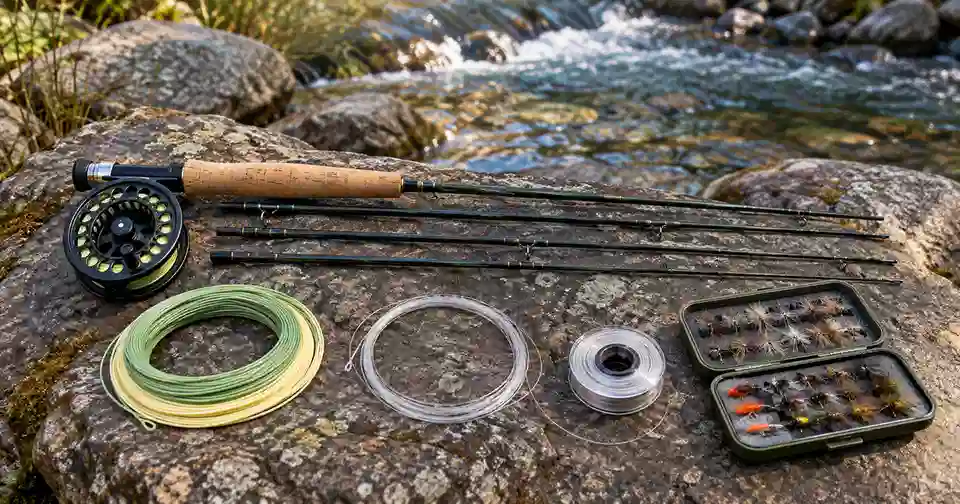
The fly completes the beginner fly fishing setup.
You do not need hundreds of patterns.
Start with a small selection that matches your local water and target species.
Dry Flies
Dry flies are generally fished at or on the surface.
They can imitate:
- adult aquatic insects;
- terrestrials;
- other surface food.
They are particularly useful when fish are visibly feeding near the surface.
Nymphs
Nymphs generally imitate subsurface stages of aquatic insects.
They are widely used because fish often feed beneath the surface even when there is little obvious activity on top.
Streamers
Streamers can imitate larger moving food such as:
- baitfish;
- leeches;
- crayfish;
- other prey.
They can require a different leader, line, or rod approach as fly size and weight increase.
Ask What Works on Your Local Water
The best first fly assortment is not necessarily the largest assortment sold online.
Ask:
- a local fly shop;
- a guide;
- an experienced local angler;
- a reputable fishing report.
Find out which patterns and sizes are actually useful for the water you plan to fish.
Start Small
A small functional box is better than fifty random patterns you do not understand.
Learn:
- what each fly represents;
- where it fishes;
- how it should be presented.
Then add patterns as your fishing gives you a reason.
How to Assemble a Beginner Fly Fishing Setup
Once the components are compatible, assembling a beginner fly fishing setup follows a logical order.
1. Assemble the Rod
Connect the rod sections carefully.
Align the guides without forcing the ferrules.
2. Install the Reel
Place the reel securely in the reel seat.
Confirm the retrieve direction works for you.
3. Load the Backing
Backing goes onto the reel before the fly line.
The correct amount depends on reel capacity and the fly line being installed.
4. Connect Backing to Fly Line
Modern fly lines may use a rear welded loop or a direct knot connection.
Follow the fly-line manufacturer’s instructions.
5. Connect the Leader
Many modern lines and leaders use compatible loops.
A direct connection such as a Nail Knot may be used when the setup does not have suitable loops.
6. Add Tippet When Needed
Use tippet when you need to rebuild or modify the leader’s terminal section.
Do not add material automatically when the existing leader already suits the fly.
7. Tie On the Fly
Choose the connection appropriate for the fly, tippet material, and presentation.
8. String the Rod
An easy method is to pull several feet of leader and fly line from the reel, fold the line loosely, and pass that larger doubled section through the guides rather than trying to feed only a thin leader through every guide.
9. Inspect the System
Before casting, check:
- reel attachment;
- rod ferrules;
- backing connection;
- fly-line connection;
- leader;
- tippet;
- final fly knot.
FlyFishingScout’s fly fishing knots guide explains the main connections from reel to fly when you are ready to practice each one individually.
Beginner Fly Fishing Setup: Matched Outfit vs. Buying Separately
A beginner can build a beginner fly fishing setup in two main ways.
You can buy a matched outfit or select each component separately.
Why a Matched Outfit Is Easier
A properly matched outfit can include compatible:
- rod;
- reel;
- fly line;
- sometimes backing and leader.
The main advantage is reduced decision-making.
You do not need to independently determine whether three major components work together before you have learned what the sizing system means.
That can let you focus on casting and fishing instead.
Why Separate Components Give More Control
Buying separately lets you choose:
- the exact rod action you prefer;
- a specific reel;
- a particular fly-line taper;
- different price levels for each component.
That flexibility becomes more valuable once you understand your fishing style.
Who Should Choose Each Route?
A matched outfit makes sense when:
- this is your first setup;
- you want the simplest path to compatible equipment;
- you do not yet know your equipment preferences.
Building separately makes sense when:
- you already understand line weights;
- you know your preferred rod characteristics;
- you want a specific reel or fly line;
- you are upgrading part of an existing system.
This article deliberately does not rank specific combos because product comparison is a different buying decision from understanding how the setup itself works.
Beginner Fly Fishing Setup Mistakes to Avoid
Most problems with a beginner fly fishing setup come from compatibility or buying too much too soon.
Mismatching Rod and Fly Line
Start with the rod manufacturer’s recommended line weight.
Do not automatically put a heavier line on the rod because someone says it is easier to cast.
Some modern lines are already intentionally heavier than their stated rating.
Buying by Reel Size Name Alone
Reel naming differs among manufacturers.
Check actual line compatibility and capacity.
Assuming a 5-Weight Is Universal
A 5-weight is a versatile reference for general freshwater and trout fishing.
It is not a universal fly-fishing rod.
Choose lighter or heavier equipment when your water, flies, target species, or conditions justify it.
Buying Specialty Fly Line Too Early
A specialty line is useful when it solves a specific problem.
A beginner who does not yet know whether they need a streamer, sinking, nymph, or technical dry-fly line probably should not buy all of them.
Confusing Leader and Tippet
A tapered leader already has a fine terminal section.
Tippet is used to maintain or modify that terminal end.
They work together rather than serving exactly the same purpose.
Buying Too Many Flies
Start with patterns appropriate for your local water.
A smaller box you understand is more useful than a giant assortment selected without a plan.
Buying Every Accessory Immediately
The beginner fly fishing setup in this article is the technical system from rod to fly.
Waders, boots, polarized sunglasses, packs, forceps, nippers, nets, clothing, safety equipment, and other first-trip items depend on how and where you fish.
FlyFishingScout’s fly fishing gear for beginners guide covers that broader first-trip checklist.
Building for Every Possible Fishery
Do not try to make your first outfit ideal for:
- tiny creeks;
- large trout rivers;
- bass ponds;
- steelhead;
- saltwater flats;
- heavy streamers;
- technical dry flies.
No single setup does everything equally well.
Build for your first real use case.
Beginner Fly Fishing Setup FAQs
What Is a Good Beginner Fly Fishing Setup?
For general freshwater and trout fishing, a 9-foot 5-weight rod with a compatible reel, appropriate backing, matching weight-forward floating line, tapered leader, tippet, and a small selection of useful flies is a practical starting point.
Different fishing situations may require lighter or heavier equipment.
Is a 5-Weight Fly Rod Good for Beginners?
Yes, for many freshwater and trout situations.
A 5-weight provides enough versatility for common dry flies, nymph rigs, and modest streamers.
It may not be the best choice for tiny creeks, large bass flies, saltwater fishing, or other specialized applications.
Does Fly-Line Weight Need to Match Rod Weight?
As a beginner rule, start with the line weight recommended by the rod manufacturer.
A 5-weight rod normally starts with a 5-weight line.
Check the exact line specifications because some tapers are intentionally designed heavier than the nominal rating.
What Is the Difference Between Leader and Tippet?
The leader is the tapered connection between the thick fly line and the fine terminal section near the fly.
Tippet is level-diameter material used to maintain, extend, or change that terminal section.
A new tapered leader normally already includes a usable terminal portion.
Do Beginners Need Backing?
Backing is part of the normal reel system.
It sits behind the fly line and provides reserve line if a fish runs beyond the fly line.
The amount depends on the reel, fly line, and fishing application.
Should a Beginner Buy a Combo or Separate Components?
A matched outfit is often easier for a first purchase because the major components are selected to work together.
Buying separately gives you more control but requires more knowledge of rod, reel, and fly-line compatibility.
For many beginners, compatibility is more valuable than customization on the first setup.
Beginner Fly Fishing Setup: Final Takeaway
A good beginner fly fishing setup is not the setup with the most equipment. It is the setup in which every component works together.
Start with the fish, water, flies, and techniques you realistically expect to use. Choose the rod weight from that job, match the reel and fly line, then complete the system with backing, leader, tippet, and a small useful fly selection.
For general freshwater and trout fishing, a 9-foot 5-weight with a matching weight-forward floating line is a strong reference point—not a universal rule.
Build one compatible beginner fly fishing setup first. Add specialized rods, lines, flies, and accessories only when your actual fishing gives you a reason.
Sources Used
Orvis — Beginner Fly Fishing Gear
Used to recheck the current beginner recommendation for a 9-foot 5-weight, the role of a matched outfit, and the core rod/reel/line/leader/tippet setup.
Orvis Beginner Fly Fishing Gear
Orvis Learning Center — What Do You Really Need to Get Started?
Used to verify the basic beginner system of rod, reel, line, leader, flies, tippet, and a simple cutting tool, and to distinguish core equipment from optional first-trip gear.
Orvis Learning Center — Getting Started
Orvis Learning Center — Best Beginner Trout Rod
Used to cross-check the current 9-foot 5-weight recommendation as a versatile trout reference setup while keeping it framed as a use-case recommendation rather than a universal rule.
Orvis — Best Beginner Trout Rod
FlyFishingScout — Fly Fishing Line: How to Choose the Right Type and Weight
Used to maintain consistency with the site’s existing guidance on matching line weight to the rod, WF floating line as a general beginner baseline, specialty lines, and the reel-to-fly system.
FlyFishingScout — Fly Fishing Line
FlyFishingScout — Fly Fishing Reels: How to Choose the Right Reel
Used to verify existing site guidance on reel line-weight ranges, manufacturer-specific sizing, capacity, and the distinction between reel size and physical reel weight.
FlyFishingScout — Fly Fishing Reels
FlyFishingScout — Fly Fishing Gear for Beginners: First Trip Essentials
Used to preserve the scope boundary between the rod-to-fly setup in this article and the site’s broader first-trip gear checklist.
FlyFishingScout — Fly Fishing Gear for Beginners
FlyFishingScout — Fly Fishing Knots: 7 Beginner Knots From Reel to Fly
Used to verify the existing reel → backing → fly line → leader → tippet → fly framework and avoid duplicating the site’s full knot instructions.
FlyFishingScout — Fly Fishing Knots