
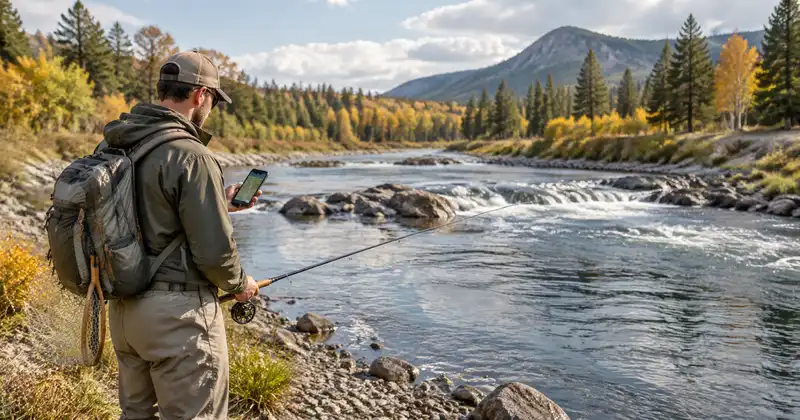
Fly Fishing Near Me: How to Find the Best Local Spots
If you are searching for fly fishing near me, do not start by looking for the most famous river in your area. Start by finding water you can legally access, confirming that it holds fish you can target with a fly rod, checking current conditions and regulations, and deciding whether the spot matches your skill level.
Use this process:
Discover → Access → Species → Conditions → Rules → Skill Match
A small local pond with open casting room can be a better first destination than a famous trout river with difficult access and strong current. The best local fly fishing spot is the one that fits the trip you actually want to make.
Table of Contents
How to Find Fly Fishing Near Me
You can build a useful shortlist of local spots before leaving home.
Start with these steps:
- Check your state fish-and-wildlife agency.
- Look for fishing maps and public-access information.
- Identify nearby rivers, streams, lakes, ponds, and reservoirs.
- Confirm which species are present.
- Verify legal access.
- Read the current fishing regulations.
- Check weather and water conditions.
- Compare each spot with your skill level.
- Keep at least one backup location.
Do not rely on a single map pin or social media post.
A location can look perfect on satellite imagery while having no legal public access, special fishing regulations, difficult parking, or conditions that make it unsuitable on the day you visit.
Start With Your State Wildlife Agency
Your state fish-and-wildlife agency should be one of the first places you check.
Depending on the state, its website may offer resources such as:
- Fishing regulations
- License information
- Public fishing areas
- Access maps
- Trout-stream maps
- Stocking information
- Species information
- Special-regulation waters
- Seasonal restrictions
State agencies are particularly important when you need to answer legal questions.
A fishing forum may help you discover the name of a river, but it should not replace the responsible agency when you need to know whether the season is open or what rules apply.
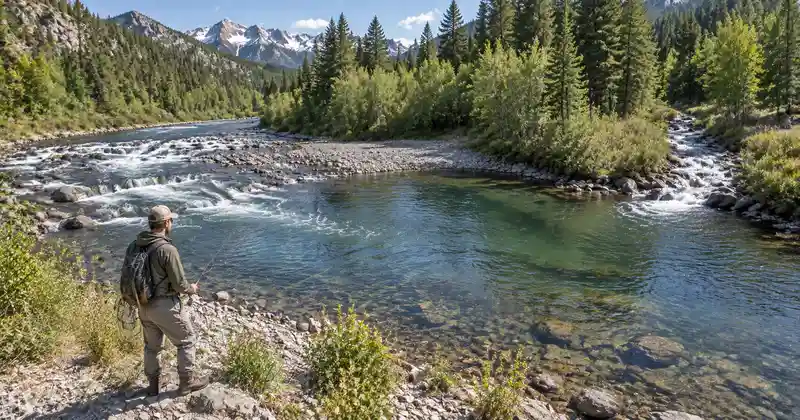
Use Fishing Maps
Fishing-location maps can help you move from “there must be water around here” to a shortlist of actual places to investigate.
Search around:
- Your ZIP code
- Your city
- Nearby towns
- State parks
- National wildlife refuges
- Public reservoirs
- Rivers crossing public land
- Lakes and ponds
Some fishing maps can also help identify nearby:
- Boat ramps
- Fishing shops
- License vendors
- Marinas
- Other fishing-related services
Treat these tools as discovery tools, not proof that every shoreline or access route is legally open.
Use Maps and Satellite Imagery
Regular maps and satellite imagery are useful for studying the shape of the water and surrounding land.
Look for:
- Rivers
- Creeks
- Tributaries
- Lakes
- Ponds
- Reservoirs
- Roads
- Bridges
- Trails
- Public parks
- Large open banks
Satellite imagery can also help you estimate whether a place has enough casting room.
But remember:
Water visible on a map does not automatically equal legal fishing access.
Always verify access separately.
What Makes a Good Local Fly Fishing Spot?
The “best” spot should be judged by practical factors, not reputation.
| Factor | What to Check |
|---|---|
| Access | Can you legally reach the water? |
| Species | Does the water hold fish you want to target? |
| Conditions | Are current water and weather conditions reasonable? |
| Regulations | Is your intended fishing method allowed? |
| Skill | Can you comfortably cast and fish there? |
| Distance | Is the drive practical for the trip you want? |
You can use this simple priority:
Legal Access → Fish → Conditions → Skill → Distance
For a beginner, easy access and open casting space may matter more than catching a particular species.
For a more experienced angler, difficult wading or technical casting may be acceptable if the water offers the kind of fishing they want.
Match the Spot to the Fish You Want to Catch
Before deciding where to go, decide what you want to fish for.
Trout Water
If your main search is trout fishing near me, start by checking state trout resources.
Potential trout water may include:
- Small streams
- Larger rivers
- Tailwaters
- Lakes
- Reservoirs
- Stocked waters
Do not assume every clear mountain stream contains trout.
Likewise, do not assume that stocked water currently holds the same number of fish simply because it was stocked at some point. Use current official information when stocking is central to your trip.
Warmwater Fly Fishing
You do not need a trout stream to use a fly rod.
Depending on your region, local ponds, rivers, and reservoirs may offer opportunities for:
- Largemouth bass
- Smallmouth bass
- Bluegill
- Other sunfish
- Carp
- Other locally appropriate warmwater species
Warmwater fly fishing can be particularly useful for beginners who live far from classic trout country.
A nearby pond with bass and panfish can provide more practice time than a trout stream that requires a long drive.
Saltwater Fly Fishing
If you live near the coast, your local options may also include:
- Bays
- Estuaries
- Flats
- Beaches
- Tidal creeks
- Shorelines
Saltwater access, species, tackle, tides, and regulations can differ greatly by location, so verify the specific area before fishing.
Once you know what species and water you plan to fish, our guide to choosing the right fly fishing flies can help you narrow down dry flies, nymphs, streamers, and other patterns.
Rivers, Creeks, Lakes, or Ponds?
Different water types create different fishing experiences.
| Water Type | Main Advantage | Main Challenge |
|---|---|---|
| Small creek | Short-range, intimate fishing | Brush and limited casting room |
| River | Varied habitat and techniques | Current, wading, and access |
| Lake or pond | Often easier bank access | Fish location may be less obvious |
| Reservoir | Multiple species and large areas | Large water can be harder to break down |
Small Creeks
Small streams can provide convenient local fishing, but trees and brush may limit your backcast.
You may need:
- Shorter casts
- Roll casts
- Careful approaches
- Smaller flies
- More accurate presentations
A small creek is not automatically beginner-friendly just because the water itself is small.
Rivers
Rivers can offer riffles, runs, pools, banks, seams, and many different fishing situations.
Their main challenge is that conditions can change quickly.
Water that was comfortable to wade during one visit may be very different after rain, snowmelt, or a dam release.
Lakes and Ponds
A pond can be an excellent first place to practice.
Advantages can include:
- Open casting room
- Bank fishing
- No need to stand in current
- Warmwater species
- Easy short sessions after work
The challenge is finding fish when there are fewer obvious current seams and feeding lanes.
Reservoirs
Reservoirs can provide varied opportunities but may feel intimidating because of their size.
Instead of trying to cover the entire water body, beginners can focus on accessible shorelines, coves, points, inflows, or other fishable areas where access is legal.
Verify Public Access Before You Go
Finding water is only the first step.
You must also determine whether you can legally reach it.
Check:
- State fishing-access maps
- Public land maps
- Official park pages
- Wildlife management areas
- Public fishing areas
- Documented access easements
- Parking rules
- Private-property boundaries
- Boat-access rules
- Wade-access rules
Access law varies significantly between states.
Do not assume:
- Every riverbank is public
- Every bridge provides fishing access
- Every trail reaches public fishing water
- Public water means the surrounding land is public
- A parking pullout gives permission to cross nearby property
When access is unclear, look for official information or choose another location rather than guessing.
Check Fishing Regulations and Licensing
Before fishing a new spot, verify the rules for that specific water.
Depending on the location, you may need to check:
- Fishing-license requirements
- Season dates
- Catch limits
- Size limits
- Catch-and-release areas
- Fly or lure restrictions
- Hook restrictions
- Special-regulation sections
- Species-specific rules
- Area permits
Do not rely on what you remember from another river or a previous year.
A single watershed can sometimes include sections governed by different rules.
Keep the relevant regulations available on your phone or offline if you will be somewhere without reliable service.
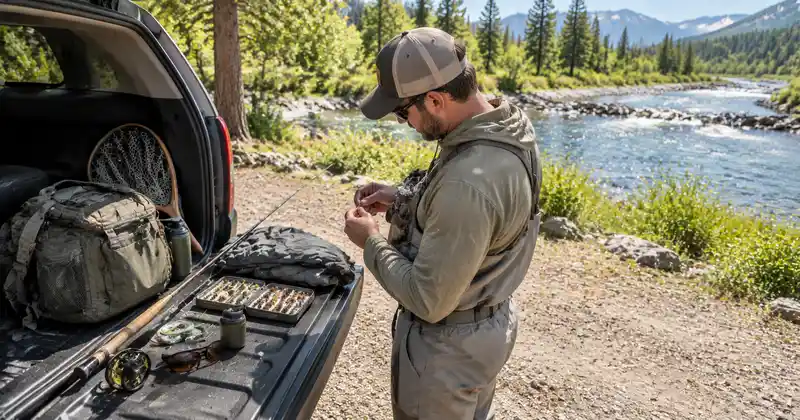
Check River Conditions Before Driving
A river being legally open does not necessarily mean it is in good condition for your planned trip.
Check Streamflow
For rivers and larger streams, stream-gauge information can help you understand current flow and recent trends.
Useful things to examine include:
- Current streamflow
- Whether the flow is rising or falling
- Recent precipitation
- Historical context where available
However, there is no universal CFS number that tells you a river is safe to wade.
A flow that is moderate on a large river could be extremely high on a small stream.
River width, depth, gradient, bottom structure, releases, and your own experience all matter.
If conditions look unfamiliar or stronger than expected, fish from the bank, move to another location, or wait for better conditions.
Check Weather and Alerts
Also check:
- Heavy rain
- Thunderstorms
- Flood warnings
- Extreme heat
- Cold weather
- Strong wind
- Road closures
- Fire or land-use restrictions where relevant
Weather affects more than comfort. It can change water conditions and access.
Match the Spot to Your Skill Level
A spot can be legal and full of fish but still be a poor match for you.
For beginners, useful characteristics can include:
- Open casting room
- Clear access
- Bank-fishing options
- Slower water
- Limited need for deep wading
- Nearby roads or services
- Enough room to practice
More challenging water can involve:
- Dense brush
- Strong current
- Deep wading
- Steep banks
- Long hikes
- Remote terrain
- Tight casting lanes
- Specialized casts
If a creek is surrounded by trees, for example, being able to cast 60 feet on an open lawn may not help much. A roll cast or short accurate presentation may be far more useful.
If you are still building those fundamentals, review how to cast a fly rod before choosing highly technical local water.
Ask a Local Fly Shop
Searching fly fishing shops near me can be one of the most useful ways to add local knowledge to your research.
A good local shop may help with:
- General fishing areas
- Current water conditions
- Useful fly types
- Local equipment needs
- Regulation resources
- Guide referrals
- Seasonal patterns
Good etiquette matters.
Do not walk into a shop expecting an employee to give you exact GPS coordinates to someone’s favorite small stream.
Instead, ask questions such as:
- “What kinds of local water are fishing well right now?”
- “Is this river suitable for a beginner?”
- “Are there public-access areas I should research?”
- “What flies would you start with this week?”
Support the shop when practical, especially if its staff spends time helping you.
Check Local Fishing Organizations
Local fishing and conservation organizations can also help you learn about your regional fishery.
For trout-focused anglers, a nearby Trout Unlimited chapter may offer:
- Conservation activities
- Educational events
- Community connections
- Meetings
- Local fisheries information
Local fishing clubs can offer similar opportunities for other species.
Do not assume a chapter or club exists to distribute fishing spots. The value is often in meeting anglers, learning about the fishery, and becoming more involved locally.
When a Local Fly Fishing Guide Is Worth It
Searching fly fishing guides near me can make sense when you want more than a place to stand and cast.
A guide may be useful when:
- You are completely new
- Public access is complicated
- You have limited fishing time
- You are visiting unfamiliar water
- You want instruction
- You need a boat for the type of fishing you want
- You want help understanding local techniques
Before booking, confirm:
- Where the trip takes place
- Whether the trip is wade or boat based
- What equipment is provided
- What you must bring
- License requirements
- Trip duration
- Cancellation policy
- Current pricing
A guide can improve your learning and help you understand a new fishery, but no legitimate guide can guarantee that fish will cooperate.
How to Evaluate a Spot Before You Drive
A quick desktop check can prevent a wasted trip.
Spend about ten minutes verifying:
- Water name: Make sure you are researching the correct river, lake, or section.
- Species: Confirm the water supports the fish you want to target.
- Legal access: Identify where you can legally enter.
- Regulations: Read rules for that specific water.
- License: Make sure you have the required license.
- Conditions: Check current flow or water conditions where relevant.
- Weather: Check the forecast and alerts.
- Parking/access: Make sure your intended access point is currently usable.
- Drive time: Decide whether the trip is realistic.
- Backup spot: Have an alternative if the first location does not work.
This process is far more reliable than driving toward an attractive map pin and hoping everything works out.
Common Mistakes When Finding Local Fly Fishing Spots
Assuming a Map Pin Means Public Access
A map can tell you where water exists.
It cannot always tell you whether crossing nearby land is legal.
Ignoring Regulations
Special rules can apply to individual rivers, lakes, species, or sections.
Check before fishing.
Looking Only for Trout
If trout water is limited near you, bass, panfish, carp, and other species can provide excellent fly fishing much closer to home.
Ignoring Current Flow
A favorite river can fish very differently after rain or high-water events.
Check conditions before driving.
Choosing Water Beyond Your Experience
Do not feel that you need to wade deep or fish technically difficult water because experienced anglers do.
Choose a location where you can concentrate on learning.
Expecting a Fly Shop to Reveal Secret Spots
Ask for general help rather than demanding someone’s private locations.
Having No Backup Plan
Crowded parking, high water, closures, wind, or access problems can ruin the first option.
A second location can save the day.
Before You Leave Home
Use this quick checklist:
- Fishing license
- Current regulations
- Legal access confirmed
- Weather checked
- Streamflow checked where relevant
- Rod
- Reel
- Fly line
- Leader
- Tippet
- Flies
- Forceps or basic tools
- Eye protection
- Weather-appropriate clothing
- Water
- Landing net where appropriate
- Phone or offline directions
- Backup fishing spot
You should also be able to rebuild basic connections if your leader or tippet breaks. Our guide to fly fishing knots for beginners covers the key knots from reel to fly.
FAQs
How Do I Find Fly Fishing Spots Near Me?
Start with your state fish-and-wildlife agency and fishing maps. Identify nearby water, confirm the species present, verify legal public access, read the regulations, and check current conditions. Local fly shops and fishing organizations can provide additional regional context.
Where Can I Find Trout Fishing Near Me?
Check your state’s trout maps, stocking resources, public fishing areas, and regulations. Local fly shops and trout organizations can also help you identify general trout-fishing opportunities. Always verify access and current rules before visiting a specific stream.
Can I Fly Fish in Local Ponds and Lakes?
Yes, if fishing is legal and suitable fish are present. Ponds and lakes can offer fly fishing for trout, bass, panfish, carp, and other species depending on your region. They can also provide more casting room than brushy streams.
How Do I Know If a River Is Publicly Accessible?
Check official state, county, park, or land-management access information. Do not assume that seeing a river from a road, bridge, trail, or map means you can legally cross the surrounding property to reach it.
Should I Ask a Fly Shop Where to Fish?
Yes. Local fly shops can be useful for general areas, current conditions, fly selection, regulations resources, and guide referrals. Ask respectful questions and do not expect staff to reveal private or sensitive fishing locations.
Should a Beginner Hire a Fly Fishing Guide?
A guide can help if you want instruction, have limited time, are fishing unfamiliar water, or need help understanding access and local techniques. Hiring a guide is useful in some situations but is not required to begin fly fishing.
Final Takeaway
Finding fly fishing near me is less about locating the closest river and more about choosing water you can legally and realistically fish.
Use the same process every time:
Discover → Access → Species → Conditions → Rules → Skill Match
Verify access and regulations, check current conditions, and choose water that fits your experience. A simple local pond, creek, or river that you can fish regularly may ultimately be more useful than a famous destination you rarely visit.
Sources Used
- Take Me Fishing / Recreational Boating & Fishing Foundation — How to Use the Places to Fish & Boat Map — current instructions confirm the map can search by U.S. address, city/state, ZIP code, or body of water; display bodies of water and points of interest; and filter for fish species and resources including fly fishing shops, ramps, and license vendors.
Take Me Fishing — How to Use the Places to Fish & Boat Map - U.S. Fish & Wildlife Service — Purchase a Fishing License — current federal resource updated June 17, 2026, directing anglers to state-specific license information and noting that requirements differ by state.
U.S. Fish & Wildlife Service — Purchase a Fishing License - U.S. Fish & Wildlife Service — Fishing — current fishing page updated August 4, 2026, emphasizing that programs and regulations can change and anglers should check individual locations for current rules.
U.S. Fish & Wildlife Service — Fishing - U.S. Geological Survey — National Water Dashboard — provides provisional real-time water information from USGS monitoring locations, including streamflow and time-series data.
USGS — National Water Dashboard - Trout Unlimited — FAQ / Chapter & Council Search information — confirms anglers can locate nearby chapters by ZIP code and view chapter contact information and events.
Trout Unlimited — Find Your Local Chapter