
How to Cast a Fly Rod: Simple Steps for Beginners
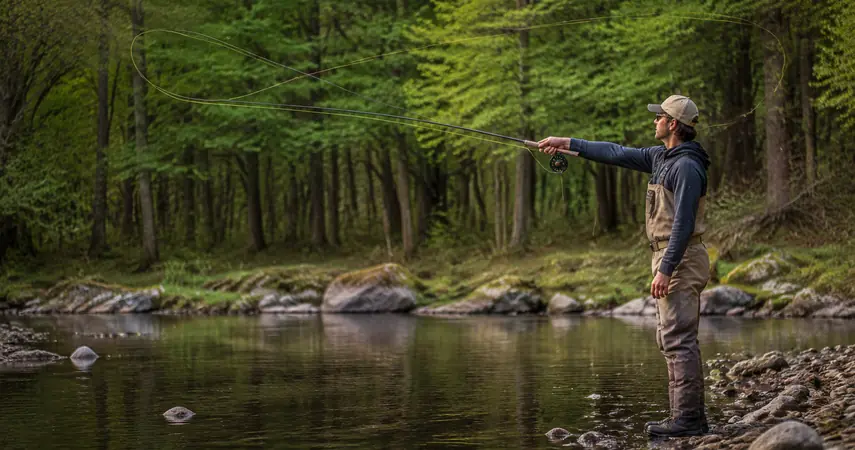
To cast a fly rod, begin with the line straight in front of you and the rod tip low. Lift smoothly, accelerate into the back cast, stop the rod clearly, and pause while the line straightens behind you. Then accelerate forward, stop again, and lower the rod tip only after the line unrolls toward your target.
That sequence is called a pick-up-and-lay-down cast. It is one of the best starting points for learning how to cast a fly rod because you can practice each attempt separately instead of trying to keep the line in the air.
The goal is not to throw the line as far as possible. Start by producing a controlled loop and placing the line near your target. Distance becomes easier after your timing and line control improve.
Table of Contents
What Makes Fly Casting Different?
Understanding how to cast a fly rod starts with recognizing what makes fly casting different from conventional fishing.
With conventional fishing gear, the weight of a lure or sinker pulls the fishing line through the air. Most artificial flies are too light to do that.
When you cast with a fly rod, the fly line provides the casting weight. The bending rod transfers energy into the line, and the moving line carries the leader and fly toward the target.
This is why fly casting depends more on timing than strength. Pulling harder does not automatically create a better cast. If the line contains slack, the rod cannot transfer energy efficiently. If you change direction too early, the line has not had time to straighten. If you apply power abruptly, the loop may cross itself or collapse.
A good beginner cast comes from three basic actions:
- Start without unnecessary slack.
- Accelerate the rod smoothly.
- Stop clearly and allow the line to unroll.
Set Up a Safe Practice Area
When learning how to cast a fly rod, choose an open practice area where the line can move safely in front of and behind you.
You can learn the basic overhead cast on an open lawn, beside calm water, or in another unobstructed area. Before starting, check for people, pets, trees, fences, power lines, and other obstacles in front of and behind you.
Do not practice with a hooked fly. Tie on a small piece of bright yarn instead. It gives you a visible practice target without an exposed hook. Wear glasses or sunglasses to protect your eyes, even when using yarn.
Use a fly rod and line designed to work together. Their weight ratings should normally match—for example, a 5-weight line with a 5-weight rod. A severely mismatched setup can make it harder for a beginner to feel the rod load and control the line.
Pull out a short, manageable amount of fly line. You need enough line beyond the rod tip to bend the rod, but starting with too much creates unnecessary timing and line-control problems.
Lay the line straight on the grass or water. Remove coils, tangles, and loose curves before your first cast.
How to Hold the Fly Rod and Line
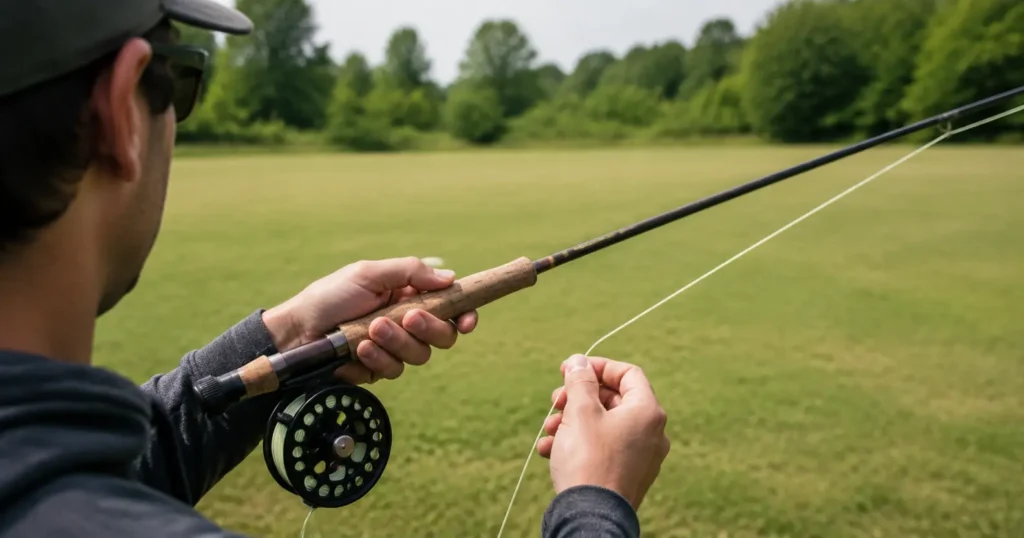
Place your thumb on top of the cork grip, pointing generally in the same direction as the rod. A relaxed handshake-style grip also works if it feels more natural.
Hold the rod firmly enough to control it, but do not squeeze it. A tight grip creates fatigue and often encourages a stiff, forceful casting stroke.
If you cast with your right hand, pinch the fly line lightly between your right index finger and the rod grip. Your left hand can hold and manage the loose line. Reverse the arrangement if you cast with your left hand.
Stand comfortably with your feet about shoulder-width apart. You can face the target or place your casting-side foot slightly behind the other. Keep your body balanced and leave enough space to move your forearm naturally.
You do not need to lock every joint in place. The objective is a controlled rod-tip path, not a rigid pose.
How to Cast a Fly Rod: Three Cues to Remember
Remove the Slack
Start with the rod tip low and the fly line straight in front of you.
If the rod tip begins high or the line lies in loose coils, part of your casting motion will be spent removing slack instead of bending the rod. That usually produces a weak or inconsistent cast.
Accelerate Smoothly
The rod should gain speed progressively during each casting stroke. Think of moving smoothly and finishing decisively rather than jerking the rod at the beginning or trying to overpower it at the end.
The length of the casting stroke can change with the amount of line outside the rod tip. A short line generally needs a shorter stroke, while more line may require a longer stroke and pause.
Stop Clearly and Wait
The stop helps the rod straighten and creates the loop that carries the line. After the back-cast stop, pause long enough for the line to extend behind you before beginning the forward cast.
Clock positions such as “10 and 2” can provide useful starting references, but they are not permanent boundaries. Rod action, line length, casting angle, and conditions can all change the appropriate casting arc.
Focus on what the line does rather than forcing the rod into exact clock positions.
How to Cast a Fly Rod Step by Step
1. Point the Rod Low at the Target
Stand with the fly line straight in front of you. Point the rod toward the line with the tip close to the grass or water.
Check behind you before every practice session. The back cast needs enough clear space for the line and leader to unroll safely.
2. Lift the Line Smoothly
Begin raising the rod tip. The first part of the motion should peel the line smoothly from the grass or water.
Avoid snapping the rod backward immediately. A rough pickup can create slack, disturb the water, or send the line in an uncontrolled direction.
3. Accelerate Into the Back Cast
Continue moving the rod upward and backward while increasing its speed smoothly. Guide the rod tip along a controlled path rather than swinging it around the side of your body.
Use your forearm and allow your shoulder to support the movement. Excessive wrist movement can widen the casting arc and make the rod tip difficult to control.
4. Make a Crisp Back-Cast Stop
Stop the rod with your hand near the side of your face or slightly above shoulder level. The exact position will vary, but the rod tip should remain high enough to send the line backward rather than down toward the ground.
The stop should be distinct, not violent. The rod will continue bending and straightening after your hand slows down, forming the back-cast loop.
5. Pause Until the Line Nearly Straightens
Wait while the line unrolls behind you. If you start the forward stroke too early, the line may crack like a whip because it has not finished traveling backward.
A longer line usually requires a longer pause. During early practice, you can turn your head and watch the back cast when it is safe to do so. This helps you connect the length of the pause with the movement of the line.
Do not wait so long that the line falls to the ground behind you.
6. Accelerate Into the Forward Cast
Move the rod toward the target with another smooth acceleration. Try to guide the rod tip back along the same general plane used for the back cast.
Keep your grip relaxed. The cast should feel controlled rather than forced.
Look toward the place where you want the line to land. Accuracy begins with a clear target, even if that target is simply a patch of grass or a floating leaf.
7. Stop High, Then Lower the Rod Tip
Finish the forward stroke with another clear stop. Hold the rod tip up briefly while the loop travels forward.
If you lower the rod immediately, the line may follow the tip downward and pile up before it fully extends. Wait until the loop has nearly unrolled, then lower the rod tip smoothly toward the grass or water.
Let the line settle before beginning another practice cast.
What a Good Beginner Cast Should Look Like
A useful beginner cast does not need to be long or extremely tight. Look for these signs instead:
- The fly line travels generally toward the target.
- The loop unrolls without crossing itself.
- The leader extends without making a sharp cracking sound.
- The line lands with reasonable control instead of collapsing in a pile.
- Your grip and casting arm remain relaxed.
- You can repeat the motion without using excessive force.
Loop size can vary with the situation. A relatively narrow, controlled loop is efficient, but beginners should focus first on producing a stable loop that travels in the intended direction.
Judge the cast by its result, not by whether your hand stopped at an exact clock position.
How to Cast a Fly Rod Without Common Beginner Mistakes
Casting problems are easier to correct when you watch the line. The symptom often provides a clue about which part of the motion needs attention.
| What You See or Hear | Likely Cause | What to Adjust |
|---|---|---|
| The leader cracks like a whip | You changed direction before the line finished straightening | Pause slightly longer and use less force |
| The line falls behind you | The pause was too long, the back-cast stop was too low, or the line was sent downward | Stop higher and begin the forward stroke sooner |
| The line piles up in front | The forward loop did not fully unroll, the rod tip dropped early, or the cast began with slack | Stop higher, hold the tip up longer, and straighten the starting line |
| The loop crosses itself | A sudden power spike or dip in the rod-tip path may have created a tailing loop | Apply power more smoothly and widen the casting stroke slightly if needed |
| The cast curves to one side | The rod tip traveled around your body instead of toward and away from the target | Improve tracking by moving the rod along one consistent plane |
| Your hand or forearm tires quickly | You are gripping too tightly or trying to muscle the cast | Relax your grip and reduce unnecessary force |
| The line will not lift cleanly | There is too much slack, too much line outside the rod tip, or the pickup begins too abruptly | Start low, straighten the line, shorten it, and lift smoothly |
These are likely causes, not universal diagnoses. More than one fault can produce a similar result. Change one part of the cast at a time so you can see what actually improves it.
A Simple Beginner Practice Routine
The best way to learn how to cast a fly rod is to practice one controlled cast at a time and reset the line after every attempt.
Repeated false casting may look impressive, but it can make learning harder because every extra stroke introduces another opportunity for a timing error.
Practice one complete cast at a time:
- Lay the line straight in front of you.
- Choose a visible target.
- Make one pickup, back cast, and forward delivery.
- Let the line land.
- Check where it landed and how the loop behaved.
- Straighten the line and reset.
- Repeat while concentrating on one cue.
For the first group of casts, focus only on starting without slack. Next, focus on smooth acceleration. Then concentrate on the back-cast pause and forward stop.
Place a hoop, towel, or other safe target on the grass if you want to develop accuracy. Begin with a comfortable target and move it gradually rather than trying to double your casting distance at once.
Stop practicing when your grip tightens or your motion becomes careless. Several short, focused sessions are more useful than continuing to repeat a tired casting stroke.
How to Roll Cast When Space Is Limited
Once you understand how to cast a fly rod with a basic overhead motion, the roll cast is a practical second technique to learn.
A roll cast is useful when trees, brush, or a steep bank prevent a normal aerial back cast. It can also help reposition line or remove slack from the surface.
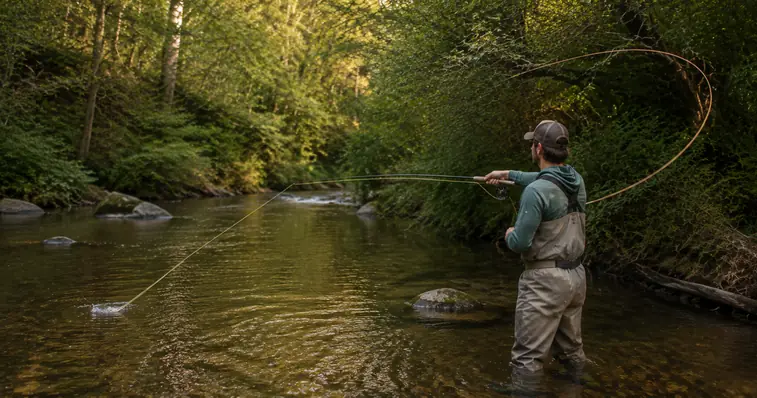
Unlike the overhead cast, the roll cast uses line touching the water or grass as an anchor.
To make a basic roll cast:
- Begin with the rod tip low and the line on the surface in front of you.
- Tilt the rod slightly away from your body for clearance.
- Move the rod upward and back slowly, allowing a curved D-loop to form behind your casting shoulder.
- Keep part of the line or leader anchored on the surface.
- Accelerate the rod forward toward the target.
- Make a clear stop with the rod tip above the horizon.
- Lower the tip as the loop unrolls.
Do not pull the line backward so aggressively that the anchor leaves the surface before the forward cast. Without that anchor and the D-loop behind the rod, the roll cast loses much of its ability to load the rod.
The roll cast deserves separate practice, but learning its basic purpose gives you an option when a standard back cast is unsafe or impossible.
Skills That Can Wait Until Later
After you learn how to cast a fly rod with consistent timing and control, you can begin adding more advanced techniques.
You do not need every casting technique before your first fishing day. Build a consistent basic cast before adding more moving parts.
Skills that can wait include:
- Repeated false casting: Useful for changing direction, adjusting distance, or drying certain flies, but unnecessary before every delivery.
- Shooting line: Adds distance by allowing line to travel through the guides after the stop.
- Double hauling: Uses the line hand to increase line speed during consecutive casting strokes.
- Long-distance casting: Requires stronger control of loop shape, timing, trajectory, and line management.
- Specialized presentation casts: Reach casts, curve casts, slack-line casts, and other techniques solve specific fishing situations.
A controlled short cast that presents the fly effectively is more useful than a long cast that lands with tangled line and an uncontrolled leader.
Frequently Asked Questions
Is fly casting difficult to learn?
The basic casting motion is not complicated, but coordinating the pickup, stop, pause, and forward stroke takes practice. Beginners usually improve faster when they use a short line, make one cast at a time, and correct one problem rather than trying to develop distance immediately.
How long does it take to learn how to cast a fly rod?
Most beginners can understand the basic casting sequence in one practice session, but developing consistent timing and accuracy takes repeated practice. Short, focused sessions are usually more helpful than practicing until your casting arm becomes tired.
How much fly line should a beginner cast?
Start with a manageable amount that allows the rod to bend without making the timing difficult. The ideal length depends on the rod, line, and caster, so there is no single required distance. Keep most extra line on the reel at first and add more only after you can form repeatable loops.
Should I practice fly casting on grass or water?
You can practice a basic overhead cast on an open grassy area. Use a yarn practice fly and wear eye protection. Water provides a more realistic pickup and is especially helpful for learning the roll cast because the surface helps anchor the line.
Why does my leader crack like a whip?
The most common reason is beginning the next casting stroke before the line has finished unrolling. Pause slightly longer after the back cast and avoid overpowering the forward stroke. The sound is a useful signal that your timing needs adjustment.
Do I need to false cast repeatedly?
No. A beginner can learn with a single pickup, back cast, and forward delivery. Excessive false casting can create more opportunities for tangles and timing errors. Add false casts later when they serve a clear purpose.
Should a Beginner Learn the Overhead Cast or Roll Cast First?
Both are valuable. The basic pickup-and-lay-down cast teaches the timing and loop control used throughout fly casting. The roll cast is particularly practical where there is little room behind you. Learn the basic motion of each, then practice the one that best matches where you expect to fish.
Conclusion
Learning how to cast a fly rod begins with three habits: remove slack, accelerate smoothly, and stop clearly. Practice with a short line, make one pickup-and-lay-down cast at a time, and let accuracy develop before chasing distance.
Once you can produce a controlled overhead cast consistently, the roll cast is a practical next skill to develop for streams and other places with limited back-cast space.