
youth waders: Choose the Right Fit as Your Child Grows
Buying youth waders for a growing child is a measurement problem, not an age-label problem. Start with height, chest or largest girth, inseam, and foot size. Then check all four against the chart for the exact model. The best fit has room for normal fishing layers and a comfortable knee bend without loose boots, fabric dragging at the ankles, or tension across the crotch and shoulders.
Parents often want a pair that lasts another season. Some growing room is sensible; buying several sizes too large is not. This guide explains how to recognize a workable fit today, when separate boots make sense, and when it’s time to replace an outgrown pair. It also shows why youth and small-adult size charts cannot be compared by the size letters alone.
Table of Contents
Youth Waders: What Proper Fit Looks Like
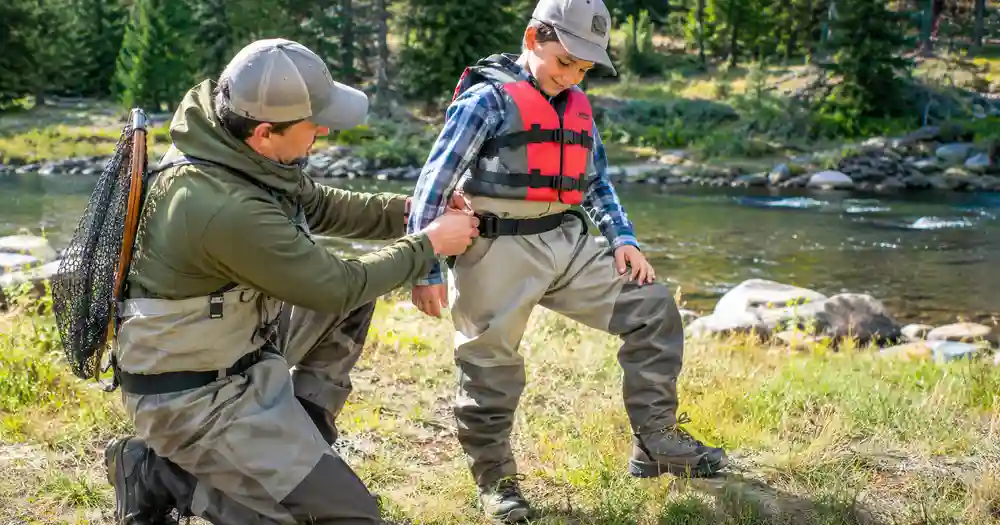
Properly fitted youth waders let a child stand, step, sit, and bend with fishing layers on. The suspenders should adjust without pulling the chest panel uncomfortably upward. The waist belt should fit as intended without being used to gather excessive material, and the legs should not bunch so heavily that the child trips while walking on dry ground.
A slightly relaxed leg is normal because waders need extra length for crouching. Tightness at the crotch when stepping onto a low bench or kneeling signals a poor fit. A boot that lets the heel lift excessively, or a stockingfoot that compresses the toes, is another reason to try a different configuration.
A quick fitting test: Ask the child to walk ten steps on dry ground, bend both knees, squat gently, and step onto a low stable platform with adult help. Look for pulling at seams, slipping footwear, and difficult movement. No fit test makes moving water safe for a child; this is a clothing check, not a water-safety test.
Before buying, ask whether the child will use the waders on a few supervised trips or regularly through different seasons. More expensive materials do not fix the wrong proportions. Prioritize usable sizing, secure footwear, mobility, and a suitable return policy over a promise that the child will “grow into” oversized gear.
How to Measure for Youth Waders
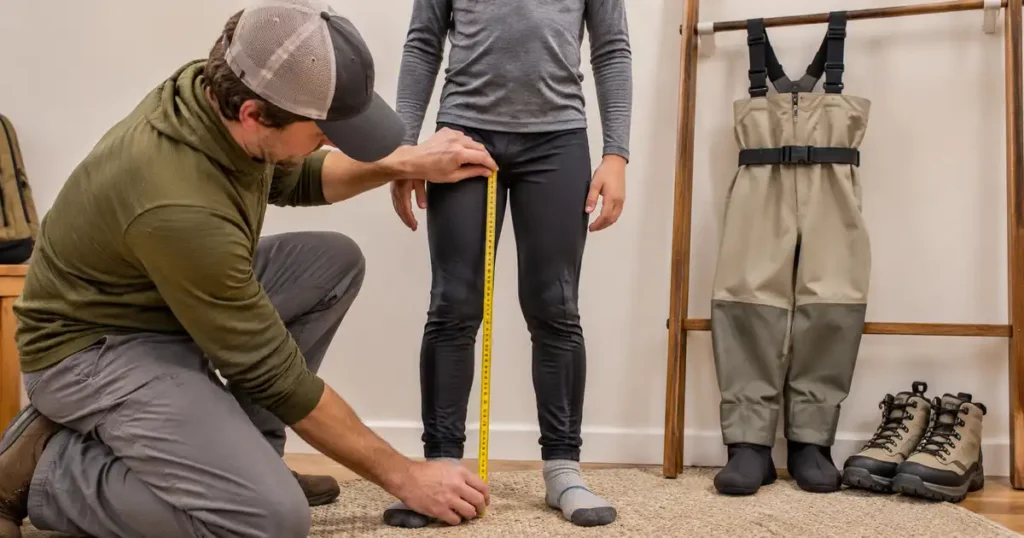
Measure the child while standing straight in comfortable clothing. Use a flexible tape and record inches; round only as directed by the manufacturer. Recheck measurements before purchasing, even if last season’s waders still look close to the right size.
Height and Chest
Measure height without shoes. For the chest, circle the tape around the fullest part without squeezing. Some adult wader charts instead use the largest body girth, which might be around the hips. Follow the chart’s actual definition rather than substituting the child’s T-shirt size.
If the child wears thick insulating layers, try the waders with those layers rather than selecting by a hypothetical amount of future growth. You want unrestricted breathing and arm movement, not an inflated size chosen from age alone.
Inseam and Leg Length
The usual body inseam runs from the crotch to the floor. Simms specifically defines its kids’ wader inseam this way. Have the child stand naturally and avoid measuring the length of favorite pants as a substitute.
A child near the top of the chart’s inseam range may need a fitting check when crouching. A child far below the garment’s available leg length may have fabric folds at the knees and ankles. Both scenarios matter because fabric that looks acceptable standing straight may behave differently while walking.
Foot Size
Check the child’s current street-shoe size, then the wader’s stockingfoot or integrated boot range. Shoe-size conventions vary. Simms, for example, publishes a separate children’s wading-boot conversion chart; its boot-size numbers do not simply duplicate the children’s street-shoe numbers.
With stockingfoot youth waders, try the neoprene feet inside properly sized wading boots and the socks the child will actually wear. The toes need space to move, while the heel should remain controlled. For further footwear guidance, see our guide to how fly fishing wading boots should fit.
Youth Waders Size Charts: Why Brand Measurements Differ
Size labels do not travel reliably between brands. Simms and Orvis publish child body measurements for their youth waders, whereas the frogg toggs youth wader tables explicitly describe dimensions of the garment itself. A 30-inch listed inseam in one system therefore does not automatically mean the same thing as a 30-inch body inseam in another.
Simms kids’ stockingfoot example
| Size | Child’s height | Chest | Body inseam | Big kid’s shoe range |
|---|---|---|---|---|
| Small | 47–52 in | 25–27 in | 21–23 in | 5–6 |
| Medium | 53–58 in | 28–30 in | 24–26 in | 5–6 |
| Large | 59–64 in | 31–32 in | 27–29 in | 7–8 |
These figures come from Simms’ published kids’ stockingfoot sizing chart. Confirm them on the product’s current chart before ordering. Orvis’ youth bootfoot table has similar height and inseam bands but its own chest and boot-size ranges; it is not a guarantee that the actual boots or cut feel the same.
For a concrete example, imagine a child who is 61 inches tall, has a 31½-inch chest, a 28-inch inseam, and wears a big-kid size 7 shoe. All four measurements fall within Simms’ published Large bands. That makes Large a size to try, not proof that every brand’s Large will fit or that there is enough room for every winter layer.
Read the chart heading before comparing
The frogg toggs youth stockingfoot garment chart lists Small with a 28-inch inseam, Medium with 30 inches, and Large with 32 inches. These describe the product’s dimensions rather than the child’s required inseam. Its bootfoot chart also uses numbered boot sizes. Do not add these numbers to a Simms body-measurement table and label them equivalent.
If none of a chart’s rows accommodates the child’s foot and body at once, do not assume going up one letter fixes the problem. Compare another product cut or ask the manufacturer for fitting advice. The right answer may be a different design instead of larger youth waders.
🎣 Smart Fit for Growing Young Anglers
Simms Kid’s Tributary Stockingfoot Waders
Looking for youth waders with a size chart built around growing kids? These breathable stockingfoot waders come in Small, Medium, and Large, with adjustable suspenders and a secure waist belt.
Check your child’s height, chest, inseam, and foot size before ordering. Separate wading boots are required.
👀 Check Price on AmazonAs an Amazon Associate, we earn from qualifying purchases.

How to Choose Youth Waders That Allow Reasonable Growth
A child should have room for a base layer and normal movement, but there’s no reliable universal rule such as buying two inches long or two full sizes larger. Wader patterns vary. Check what happens at the crotch, knees, feet, chest, and shoulders with the layers the child will wear this season.
When a child falls between two sizes, compare both sets of dimensions and the manufacturer’s fitting instructions. Orvis emphasizes having enough length to step and crouch and recommends considering layering when selecting waders. If one size pulls uncomfortably and the next size leaves loose boots or excessive folds, try a different model rather than treating either problem as acceptable.
For youth waders, the growth allowance should never come from oversized integrated boots. A boot that slips while the child walks on dry ground is unsuitable for slippery streambanks. The same applies to a loose neoprene stockingfoot that bunches inside an otherwise secure boot.
Parents also should not rely solely on the child’s age. Two children of the same age can have different chest, inseam, and foot measurements. Save a copy of the measurements and recheck before the next season; it makes future replacement easier to judge.
⭐ Stockingfoot Alternative: CADDIS Youth Promo Breathable Stocking Foot Waders
CADDIS Youth Promo Breathable Stocking Foot Waders, Taupe are a budget-conscious style to investigate if you prefer separate boots over an attached boot. Caddis’ youth breathable stockingfoot range uses waterproof/breathable construction and integrated gravel guards, although the exact model and contents should be checked before purchase. Limitation: separate boots still add cost, and Caddis’ current brand-site listing shows the Promo version sold out; the Amazon offer also needs verification.
👀 View on Amazon & Check Current Offers
Bootfoot vs Stockingfoot Youth Waders
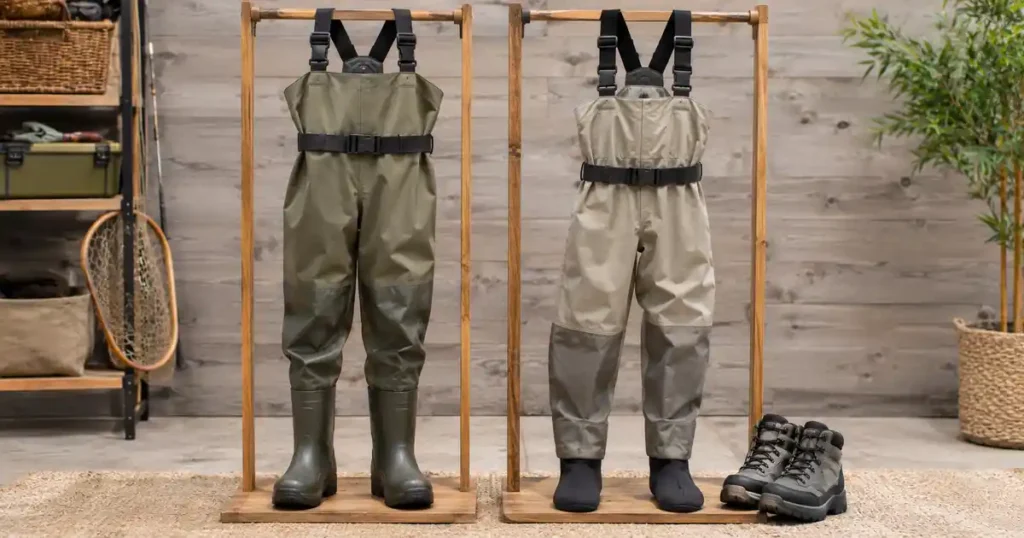
The choice between bootfoot and stockingfoot youth waders determines which parts can be sized or replaced independently. Neither system is universally safer or more economical; fit and the actual water conditions are more important.
Bootfoot Waders
Bootfoot models have attached boots, so there is one less piece to purchase. That can simplify getting ready for a short family fishing outing. The drawback for growing children is that a boot can become tight while the wader body still fits. You generally cannot replace only the integrated boot with a bigger separate pair.
🎣 Simple One-Piece Option: TIDEWE Chest Kids Waders
TIDEWE Chest Kids Waders, Waterproof Lightweight Bootfoot Waders combine a nylon/PVC wader with attached boots and adjustable suspenders. They are a practical design to compare for occasional supervised fishing when an integrated boot fits well right now. Limitation: boot sizing and traction must be checked on the actual child, and a boot that becomes too small usually means replacing the whole pair; the specific Amazon offer is not currently confirmed.
👀 View on Amazon & Check Current Offers
Stockingfoot Waders
Stockingfoot models end in neoprene socks and require separate wading boots. That allows the boots and waders to be evaluated separately; sometimes the boots can be replaced when the child outgrows them while the wader body still fits. But if the neoprene stockingfoot itself becomes too tight, buying larger boots will not solve the underlying problem.
Plan for the total cost of waders plus boots. Check the boot model’s fit guidance and any local footwear restrictions, including limits on felt soles where applicable. If a child has a notably large foot for their height, stockingfoot sizing should be checked before any recommendation is made.
Which Design Makes More Sense for a Growing Child?
| Your main concern | Design worth evaluating | Trade-off to check |
|---|---|---|
| Occasional short outings | Correctly fitted bootfoot | Attached boots cannot be upsized separately |
| Footwear likely to change first | Correctly fitted stockingfoot | Wader bootie may also become too tight |
| Long walks to fishing spots | Stockingfoot with supportive boots | Greater total cost and more parts |
| Difficult chest/inseam/foot combination | Compare multiple models and sizes | Neither design fixes incompatible proportions |
The best choice is the one your child can actually move in, not the one with the most theoretical seasons of use.
Youth Waders vs Small Adult Waders
Some children eventually need to move beyond youth sizing. But the smallest adult label is not automatically the next step after Large youth waders. Adult charts may have more space around the torso, a longer leg, and different neoprene bootie sizing even where one measurement appears to overlap.
Consider the 28-inch inseam of the sample child above. Simms’ youth Large covers 27–29 inches. Its women’s Short adult options include a 28–29-inch inseam, but their body-girth and stockingfoot measurements are defined differently. A matching leg length is only one part of the decision. The child still needs secure shoulders, appropriate girth, and a comfortable foot.
Start by asking: Does the child exceed a youth height, chest, inseam, or foot range? Does an adult short/petite configuration match all important dimensions? Can the child crouch and step without excess fabric or pressure? If the adult model fails those checks, don’t buy it simply for future growth.
For a broader explanation of material and construction differences once adult sizing becomes relevant, see our guide to choosing fly fishing waders. That buying guide does not replace the youth fitting steps here.
Signs Your Child Has Outgrown Youth Waders
Youth waders should be reassessed after a growth spurt, before a new fishing season, and whenever the child reports discomfort. A pair can look intact but no longer allow comfortable movement. The opposite is also true: a leak doesn’t always mean the size is wrong.
Use this replacement check on dry ground:
- Crotch or inseam tension: the fabric pulls sharply when stepping up, sitting, or squatting.
- Stockingfoot pressure: the child’s toes are compressed even before the wading boot is tightened.
- Bootfoot tightness: the integrated boot presses the toes, even if the chest panel still fits.
- Shoulder or chest pull: adjusted suspenders cannot provide comfortable coverage without tension.
- Poor movement: the child shortens their stride or struggles to bend despite suitable layers.
- Excessive bunching: going up in size creates too much loose fabric, slipping footwear, or an unstable fit.
If the current youth waders fit but have a small leak, inspect them according to the manufacturer’s repair instructions. A patch or professional repair may be appropriate for some damage, while a torn seam, damaged boot, or severely worn material could make replacement sensible. Don’t assume a repaired pair is suitable until its integrity has been checked.
If the child has grown out of the foot or inseam range, stop using the pair for wading while you reassess sizing. A repair cannot lengthen the leg or make an integrated boot properly larger.
Safety and Mobility Checks Before Fishing
Proper fit is one safety consideration, not a guarantee that wading is safe. Children should be closely supervised by an adult around rivers, lakes, and streams. The National Park Service recommends an appropriately sized, U.S. Coast Guard-approved life jacket for children around open water and a designated adult water watcher. A wader is not flotation equipment.
Before any fishing trip, inspect the condition of the youth waders, try the actual clothing layers, adjust the suspenders and belt according to the maker’s instructions, and verify that the boots have suitable traction. Watch the child walk and bend on dry, level ground. Keep the first fishing locations conservative; a shallow bank may be more appropriate than entering moving water at all.
Don’t wade into fast current, unexpected holes, or slippery crossings simply because the child has waterproof gear. Cold water and changes in flow make even familiar locations dangerous. If conditions are uncertain, fish from a safe bank or postpone the outing. A snug wading belt does not replace a life jacket or adult supervision.
Youth Waders FAQs and Final Buying Checklist
Should I buy youth waders one size larger?
Only if the larger size fits securely with today’s intended clothing and permits controlled movement. One letter larger is not automatically appropriate, especially with attached boots or an oversized neoprene foot.
How much extra inseam room is acceptable?
Enough for stepping, bending, and sitting without tension, but not so much that fabric bunches heavily around the ankles. There is no universal extra-inch rule across manufacturers. Use the product’s actual fit instructions and a dry-ground try-on.
Can a child use women’s or men’s small waders?
Sometimes, if the adult chest or largest-girth measurement, leg length, bootie, and suspenders all fit properly. Do not assume an adult XS or Short equals a youth Large. Check all dimensions and model availability.
What if the child’s foot is too big for youth stockingfeet?
Check whether another youth model has a different stockingfoot range. If not, compare shorter adult configurations against every body measurement. A larger external boot does not fix a neoprene stockingfoot that is too tight.
When should outgrown waders be replaced?
Replace or stop using them for wading when the bootie or boot compresses the foot, the inseam restricts movement, or the torso cannot be adjusted comfortably. Inspect leaks separately: repairable damage and outgrown sizing are different problems.
Are stockingfoot waders better for growing children?
They can offer more footwear flexibility because boots are separate. However, the child’s neoprene stockingfoot must still fit, and separate boots increase total cost. The better choice depends on the child’s measurements and intended use.
Final buying checklist: Measure height, chest or girth, inseam, and feet; compare the exact model’s chart; try it with layers; test walking and crouching; inspect the boot fit; and confirm suitable safety equipment. Choose youth waders that function properly now, then measure again as your child grows. A secure current fit matters more than buying extra seasons on paper.
References
- Simms Fishing — Kid’s Size Charts
- Simms Fishing — Kid’s Tributary Waders – Stockingfoot
- Simms Fishing — Women’s Wader Size Guide
- Orvis — Wader Sizing Information
- frogg toggs — Size Charts
- Caddis Sports — Waders and Shoes
- Caddis Waders — Caddis Youth Breathable Stockingfoot Wader
- Lowe’s — Tidewe Chest Wader, Model B0834VJKJQ
- National Park Service — Reel It In: Be Prepared for a Successful Fishing Day
- U.S. Coast Guard — Life Jacket Wear and Fit
- FlyFishingScout — Fly Fishing Wading Boots: How to Choose the Right Pair
- FlyFishingScout — Best Fly Fishing Waders: Top Picks for Every Budget