
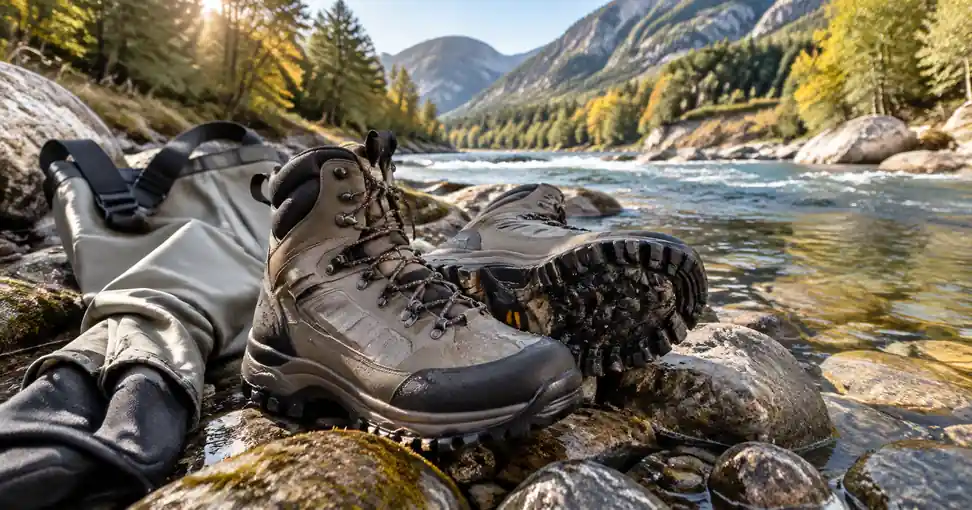
Fly Fishing Wading Boots: How to Choose the Right Pair
Fly fishing wading boots should match the water, terrain, and waders you actually use. The right pair gives your feet room inside stockingfoot waders, provides support on uneven ground, and uses an outsole that makes sense for the surfaces you cross.
There is no single best pair of fly fishing wading boots for every angler. Rubber, felt, and studded soles each have strengths and limitations, and local rules can remove some options entirely. Fit also varies by brand, so the common advice to “always buy one size larger” is too simple.
Use this order when choosing: water and regulations first, then sole type, fit, support, traction, and hiking needs.
Table of Contents
How Fly Fishing Wading Boots Should Fit
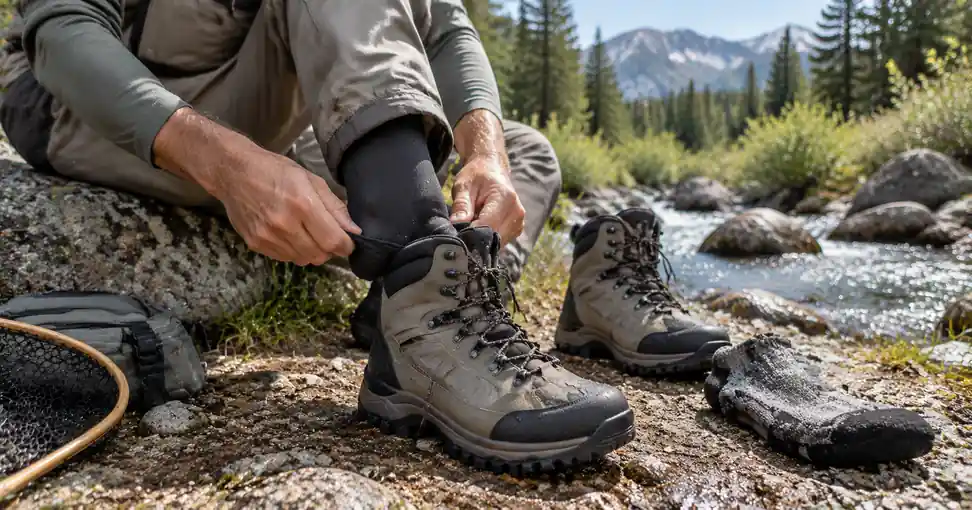
Fly fishing wading boots should feel secure without crushing the neoprene stockingfoot of your waders. You need enough room for the bootie, your fishing sock, and normal toe movement, but not so much extra space that your heel slides around.
A tight boot can restrict circulation and make cold-weather fishing uncomfortable. A loose boot can reduce stability and allow your foot to move inside the boot on uneven rocks.
The best way to check fit is to try the boots with the same stockingfoot waders and socks you expect to wear while fishing. Lace the boots fully, walk around, flex your ankles, crouch, and step up onto something low. Your heel should stay reasonably controlled, your toes should not hit the front, and the boot should not pinch across the midfoot.
Do You Need to Size Up?
Do not assume that every pair of fly fishing wading boots needs to be one full size larger than your street shoes.
Sizing systems differ by manufacturer. Orvis says its wading boots are sized to accommodate stockingfoot waders. Simms currently says most men successfully wear its boots somewhere between their street-shoe size and one full size larger, with half sizes moving to the next full size.
That difference is exactly why a generic size-up rule can fail. Check the current size chart for the brand and model you are buying, then test the boot with your actual wader bootie if possible.
Check Heel, Toe, and Midfoot Fit
Your toes need room to move, especially in cold conditions when thicker socks may be involved. At the same time, your heel should not lift dramatically with every step.
Pay attention to the midfoot too. The lacing system should hold your foot securely without forcing you to overtighten the boot. If the boot only feels stable when the laces are painfully tight, the shape may not suit your foot.
Leave enough space for the stockingfoot without creating a sloppy fit. A boot that is merely “big enough to fit the wader” is not automatically the right size.
Fly Fishing Wading Boots: Rubber vs Felt Soles
One of the biggest decisions with fly fishing wading boots is outsole material. Rubber and felt behave differently in the river and on land, so neither should be treated as universally better.
Rubber-Sole Wading Boots
Rubber sole wading boots are the more versatile option for many anglers who move between trails, banks, mud, gravel, and water. Rubber is also easier to clean and usually dries faster than absorbent felt.
Rubber can be especially useful when a fishing day includes a long hike or frequent transitions between land and water. It is also the obvious choice where felt is prohibited.
The trade-off is that plain rubber may not provide enough grip on every slick submerged surface. Algae-coated rock, smooth bedrock, and certain steep river bottoms can still be difficult. That is where compatible studs or another traction system may become useful.
Felt-Sole Wading Boots
Felt sole wading boots remain popular with some anglers because felt can provide useful grip on certain slick underwater rocks. However, felt absorbs water and can remain damp longer than rubber.
That matters for travel and aquatic invasive species prevention. Some jurisdictions prohibit felt or other absorbent fibrous soles, so you should never buy felt first and check the rules later.
Felt also performs differently once you leave the river. Mud, snow, and long trail approaches can make it less convenient than rubber, and wet felt requires careful cleaning and drying before moving to another body of water.
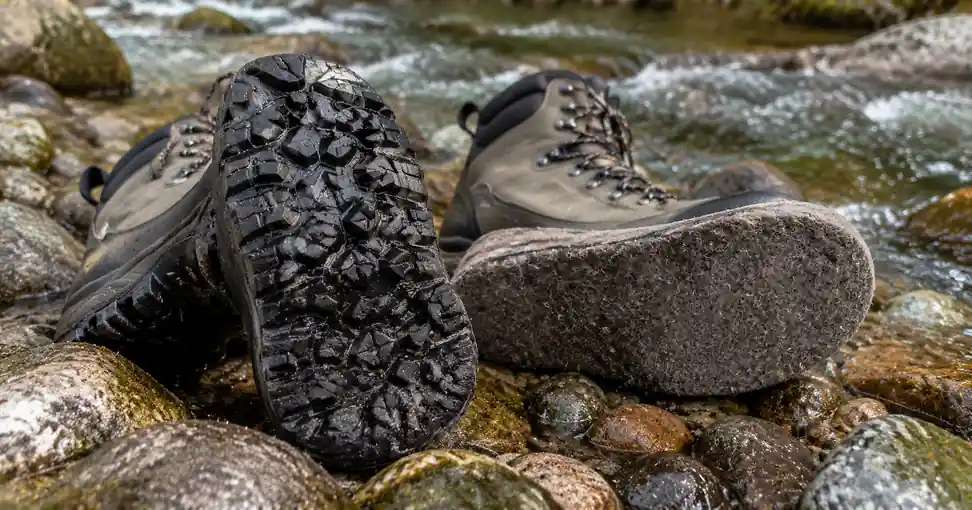
Check Felt Rules Before Buying
Rules for fly fishing wading boots are not uniform across the United States.
Yellowstone National Park currently prohibits footgear with absorbent felt or other fibrous material on the soles while fishing. Alaska prohibits footwear with felt or other fibrous material on the soles while sport fishing in fresh water.
Those are examples, not a complete national list. Regulations can be specific to a state, park, watershed, or other management area and can change. Check the responsible fish-and-wildlife agency or land manager before buying felt for a particular destination.
Fly Fishing Wading Boots: When Studs Improve Traction
Studs can make fly fishing wading boots more secure on some slippery surfaces, especially when a compatible rubber or felt outsole needs additional bite.
They are most useful when the boot manufacturer specifically supports studs and the river bottom calls for them. Carbide or metal traction can help on slick rock, but that does not mean studs improve every situation.
Studs can be noisy on rock. They can damage or mark some boat decks and other surfaces, and they may feel awkward on paved or hard indoor surfaces. They also wear over time and may need replacement.
Use only studs or cleats that are compatible with the boot. Check the manufacturer’s installation instructions and make sure the sole has designated mounting points or sufficient material. Do not assume a traction component made for one boot can safely be installed in another.
Most importantly, extra traction does not make difficult current safe. A studded boot can still slip, and no outsole can compensate for water that is too deep, too fast, or beyond your experience.
How to Choose Fly Fishing Wading Boots for Your Water
The easiest way to choose fly fishing wading boots is to work backward from the places you actually fish.
Before looking at brands, identify the river bottom, bank terrain, hike length, water temperature, local rules, and whether you fish from a boat as well as on foot. If you are still deciding where to fish, our guide to find suitable local fly fishing water explains how to verify access, current conditions, regulations, and skill fit before a trip.
Rocky Rivers
On rocky rivers, look for a supportive boot with good lateral stability, a protective toe area, and an outsole suited to the specific rock you encounter.
Slick submerged stone may call for more aggressive traction than a shallow gravel-bottom stream. If studs are permitted and compatible with the boot, they may help. A wading staff can also add another point of contact when conditions justify one.
Mud, Gravel, and Mixed Banks
Rubber is often a practical choice when you move across mud, loose gravel, grass, trail surfaces, and water during the same day.
An outsole with useful tread can provide better walking versatility than felt in these situations. However, the exact tread pattern and rubber compound matter, so do not judge a boot only by whether the outsole is labeled “rubber.”
Long Hikes to the River
If reaching the water requires several miles of walking, treat your fly fishing wading boots partly like hiking footwear.
Look for secure heel hold, adequate cushioning, manageable weight, ankle support, and an outsole that works on dry ground as well as in the river. A very stiff or heavy boot may feel stable in current but become tiring on a long approach.
Also consider drying time if you travel frequently or fish multiple waters during one trip.
Cold Weather and Snow
Cold-weather fishing adds another fit problem: thicker socks and cold feet.
Do not solve that by stuffing extra socks into a boot that is already tight. Compression can reduce comfort and circulation. Start with enough room for the stockingfoot and appropriate insulation without creating excessive movement inside the boot.
On snow and ice, the traction that works in a river may not be the traction you want on the trail. Check the whole route, not only the riverbed.
Fly Fishing Wading Boots and Stockingfoot Waders
Most dedicated fly fishing wading boots are designed to work with stockingfoot waders. These waders end in a waterproof neoprene bootie rather than an attached boot.
If you’re building the rest of your setup too, our guide to the best fly fishing gear covers rods, reels, fly line, waders, packs, nets, and essential tools.
The boot goes over that stockingfoot. This gives you more freedom to choose the footwear, sole type, support, and fit you prefer. Orvis likewise distinguishes stockingfoot waders, which require separate boots, from bootfoot models with attached footwear.
Bootfoot waders are different. They have boots permanently attached, so you do not normally pair them with separate wading boots.
When fitting a stockingfoot system, evaluate the waders, socks, and boots together. The neoprene bootie adds volume compared with an ordinary sock, and different manufacturers account for that volume differently in their sizing systems.
Do not buy fly fishing wading boots based only on your street-shoe number. Use the actual manufacturer’s chart and, when practical, try the complete system before committing.
If you wet-wade without waterproof waders, use an appropriate neoprene or wet-wading sock to take up the space normally occupied by the stockingfoot and to reduce rubbing.
Features That Matter in Fly Fishing Wading Boots
Beyond the outsole, several construction details determine whether fly fishing wading boots suit your style of fishing.
Ankle and Lateral Support
Wading often puts your feet on angled, irregular surfaces. A supportive upper can help control side-to-side movement and make the boot feel more stable around rocks.
Support should not be confused with a guarantee against injury. Even a rigid boot cannot prevent every twist, slip, or fall.
Midsole Structure
A supportive midsole helps spread pressure when you stand on uneven rocks and can make long periods of wading more comfortable.
Very soft footwear may feel comfortable on a flat trail but allow too much flex when your foot is positioned between stones. On the other hand, an extremely stiff boot may feel cumbersome for anglers who walk long distances.
Choose the balance that matches your water and walking.
Toe and Heel Protection
A reinforced toe area is useful when you regularly bump submerged rocks. Heel structure also helps keep the rear of the foot stable.
These features matter most when fishing rough, rocky water. They may be less important for an angler who mainly fishes gentle banks or from a boat.
Drainage and Drying
Wading boots are designed to get wet. Good drainage lets excess water leave the boot as you step onto shore, while materials that dry efficiently are useful for comfort, travel, and gear care.
Fast-drying construction does not replace cleaning. Mud, plant fragments, and aquatic organisms can remain on boots, laces, seams, studs, and other equipment.
Interchangeable Soles
Interchangeable-sole systems can make sense for anglers who fish very different terrain.
Korkers currently uses its OmniTrax 3.0 interchangeable sole system on its wading boots. Compatible sole options include rubber, felt, studded rubber, and other traction designs, and Korkers says the soles can be changed without tools. Replacement soles must match the boot size and work only with compatible Korkers OmniTrax boots.
That flexibility can reduce the need for multiple pairs of boots, but it only helps if you genuinely need different outsole types. An angler who fishes one local river on similar terrain may prefer the simplicity of a fixed outsole.
Clean, Drain, and Dry Your Gear
All fly fishing wading boots need proper care when you move between waters.
Yellowstone’s current invasive-species guidance tells recreational users to clean, drain, and dry equipment. Its April 2026 guidance specifically includes boots and equipment, while the park’s current fishing regulations prohibit absorbent felt or fibrous fishing footwear.
After fishing, remove visible mud, plants, and debris. Drain water from equipment and let it dry thoroughly before using it in another water body. Follow local decontamination guidance where additional steps are required.
Do not assume rubber eliminates invasive-species risk. Alaska’s fisheries guidance also notes that wading boots are not the only equipment capable of transporting invasive organisms.
Common Wading Boot Buying Mistakes
Even good fly fishing wading boots can be a poor purchase when they are chosen for the wrong reason.
Automatically Buying One Size Larger
This is one of the easiest mistakes to avoid.
Some manufacturers account for stockingfoot volume in their sizing system. Others provide guidance that may place you at your street size or up to one size larger. Half sizes create another variable.
Use the current brand and model chart instead of relying on a universal rule.
Choosing Sole Type Before Checking Regulations
A felt boot is a poor purchase for water where felt is prohibited.
Check the rules for the places you expect to fish before comparing felt models. If you travel frequently, a rubber or interchangeable system may simplify planning, depending on your destinations.
Buying for the River but Ignoring the Hike
The boot has to reach the water before it can perform in the water.
If your normal day includes long approaches, steep banks, loose gravel, or muddy trails, include those surfaces in the buying decision. River traction is only part of the job.
Assuming More Traction Makes Wading Safe
Traction can help footing, but it cannot eliminate the force of moving water.
Water depth, current speed, bottom shape, cold, visibility, and your experience all affect whether a crossing is reasonable. If you are new to moving water and unsure how to judge wading conditions, qualified fly fishing instruction can be more useful than simply buying a more aggressive outsole.
Fish from shore or choose easier water when conditions exceed your ability.
Ignoring Cleaning and Drying
A boot can look clean while remaining damp or holding debris around laces, seams, studs, or the outsole.
Build cleaning, draining, and drying into your routine, especially when moving between different rivers, lakes, or watersheds.
FAQs About Fly Fishing Wading Boots
Should Wading Boots Be One Size Larger Than Normal Shoes?
Not always. Wading boot sizing is brand specific. Some manufacturers design their sizing around stockingfoot waders, while others may recommend a size close to or above your street-shoe size.
Use the current manufacturer’s chart and try the boot with your stockingfoot wader and fishing socks when possible.
Are Rubber or Felt Wading Boots Better?
Neither is universally better. Rubber sole wading boots are versatile for trails, banks, travel, and places where felt is prohibited. Felt can provide useful grip on some slick underwater rock but absorbs water and is banned in certain locations.
Choose according to your terrain and current regulations.
Can You Wear Regular Hiking Boots With Stockingfoot Waders?
Dedicated wading boots are usually the more practical choice. They are built to accommodate a neoprene stockingfoot, drain water, and provide support and traction in wet environments.
Ordinary hiking boots may fit poorly over the stockingfoot and may not drain or tolerate repeated immersion as well.
Do You Need Studs on Wading Boots?
Not necessarily. Studs can improve traction on some slick surfaces, but they add noise, may be unsuitable for certain boat decks or hard surfaces, and must be compatible with the boot.
Choose them for a specific traction need rather than automatically.
Are Felt Wading Boots Illegal?
They are prohibited in some places, but there is no single nationwide rule that applies everywhere.
Yellowstone National Park prohibits absorbent felt or other fibrous-soled footwear while fishing, and Alaska prohibits felt or fibrous soles while sport fishing in fresh water. Check the exact location’s current regulations before fishing.
Can You Use Wading Boots Without Waders?
Yes. Anglers sometimes use wading boots for wet wading with neoprene wet-wading socks instead of waterproof stockingfoot waders.
The sock helps with fit and reduces rubbing while filling some of the volume normally taken up by the stockingfoot.
Final Thoughts on Fly Fishing Wading Boots
The right fly fishing wading boots come from a simple decision process:
Water → Regulations → Sole → Fit → Support → Traction
Start with where you fish. Check whether felt is legal, identify the surfaces you walk on, and decide how much hiking is involved. Then use the manufacturer’s current sizing guidance and test the boots with your stockingfoot waders and socks.
Do not buy more traction than you need, and do not treat traction as a substitute for sound wading judgment. The best pair is the one that fits your feet, works with your waders, suits your water, and makes sense for the places you actually fish.
Sources Use :
Orvis — How Do I Pick a Pair of Wading Boots?
Used to verify stockingfoot fit and Orvis sizing guidance.
Orvis wading boot fit guide
Orvis — Wader Sizing Information
Used to verify the current Orvis wading-boot size chart.
Orvis sizing guide
Simms — Wading Boot Size Chart
Used to verify that Simms says many men successfully size between street-shoe size and one full size larger.
Simms wading boot size chart
National Park Service — Yellowstone Fishing Regulations
Used to verify the current prohibition on absorbent felt or other fibrous-soled fishing footwear.
National Park Service — Yellowstone Aquatic Invasive Species Management / 2026 AIS Guidance
Used to verify current clean, drain, and dry guidance.
Alaska Department of Fish and Game — Alaska’s Ban on Felt-Soled Wading Footwear
Used to verify the prohibition on felt or other fibrous-soled footwear while sport fishing in Alaska fresh water.
Korkers — OmniTrax Fishing / Fishing Soles
Used to verify the current OmniTrax 3.0 interchangeable-sole system, compatibility, and available sole types.