
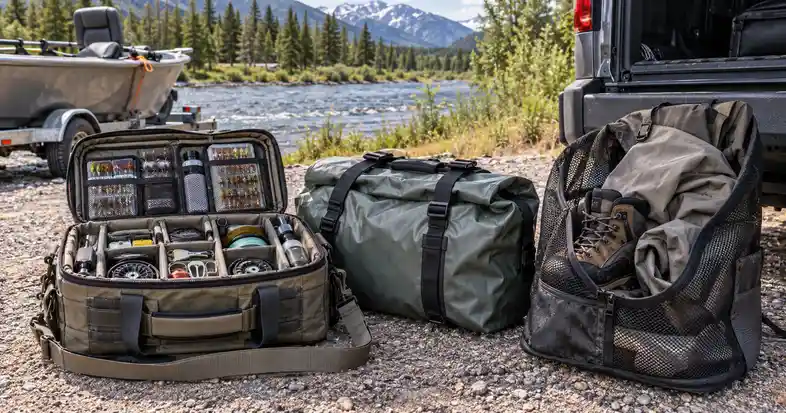
Fly Fishing Gear Bag: How to Choose the Right Bag for Your Gear
A fly fishing gear bag should make it easier to protect, organize, and move your equipment without forcing you to carry more than you need. The right bag depends less on brand and more on where the bag will spend most of its time: on a boat, in a vehicle, in airline luggage, or carrying wet waders and boots.
The easiest way to choose a fly fishing gear bag is to start with its job, then compare water protection, capacity, internal organization, and carry method. A structured boat bag, a waterproof duffel, and a ventilated wader bag may all be useful, but they solve different problems.
Use this order:
Home base → Water exposure → Load → Organization → Carry method
Table of Contents
What Should a Fly Fishing Gear Bag Actually Do?
A fly fishing gear bag has three basic jobs: protect equipment, keep it organized, and make it easy to move from home to the water.
For many anglers, that means carrying fly boxes, spare reels or spools, leaders, tippet, tools, rain gear, extra clothing, food, and small accessories. Some bags also protect rods, while others are designed specifically for wet waders and boots.
The first decision is whether you need bulk storage or an on-body fishing pack. A sling, chest pack, or vest is designed to stay on you while casting and wading. A gear bag usually carries more equipment and is often left in a vehicle, boat, lodge room, or base camp.
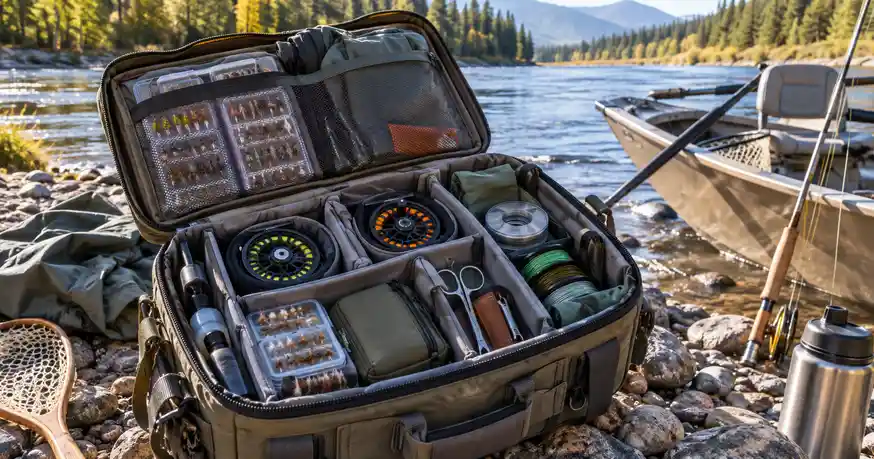
A good fly fishing gear bag should also keep fragile or expensive items away from loose tools, wet footwear, and sharp objects. Internal dividers, padded sections, and small zippered pockets can make that much easier.
Fly Fishing Gear Bag Types: Which One Fits Your Fishing?
The best fly fishing gear bag for you depends on where it will be used most often. Start with that environment before comparing features.
General Gear and Vehicle Bag
A general storage bag works well when most of your equipment moves by truck or car and you mainly need organization.
For this use, full submersible construction is often unnecessary. Look for a durable shell, reinforced bottom, useful handles, enough internal structure to prevent everything from becoming one pile, and pockets that let you separate small tackle from clothing.
A vehicle bag should also be easy to lift when fully loaded. Oversized bags often encourage anglers to carry more gear than they actually use.
Fly Fishing Boat Bag
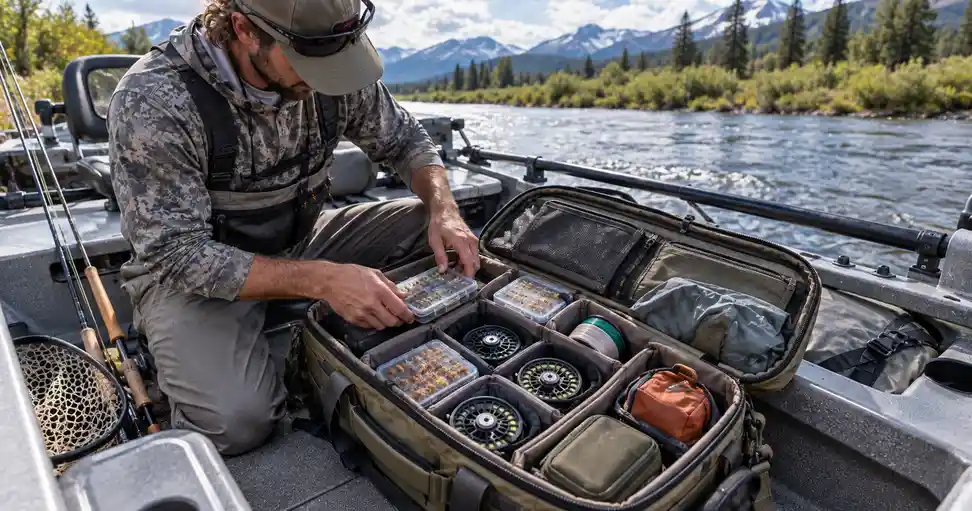
A fly fishing boat bag should prioritize structure, water resistance, fast access, and secure attachment.
Fishpond’s current Cutbank Gear Bag has a 22L capacity, 900D TPU-coated NewStream fabric, molded top and bottom, adjustable dividers, two removable interior pouches, and four heavy-duty boat lash points. Fishpond uses water-resistant YKK zippers rather than describing the bag as fully submersible.
That combination makes sense for a raft, drift boat, or flats boat where spray and wet decks are common but quick access matters.
The trade-off is weight and structure. A molded 22L boat bag can be excellent on deck but less convenient for airline travel or long walks.
Waterproof or Submersible Duffel
A waterproof fly fishing bag becomes more useful when immersion, heavy spray, or repeated exposure to wet environments is a realistic possibility.
Fishpond’s current Thunderhead Submersible Duffel uses 900D TPU-coated fabric, a fully waterproof TRU Zip closure on the main compartment, a 39L capacity, a shoulder strap, and external daisy-chain attachment points for rod tubes. Fishpond lists it as carry-on-size compatible, although individual airline rules should still be checked before travel.
This type of bag is useful for clothing, electronics stored appropriately, and other equipment that needs a higher level of water protection.
The trade-off is that fully waterproof construction can cost more and may provide less quick-access organization than a structured tackle bag. Do not pay for submersible construction if the bag will spend almost all of its life in a dry vehicle.
Fly Fishing Travel Bag
A fly fishing travel bag should protect equipment while making packing efficient.
The current Orvis Carry-It-All is built around that job. Orvis uses 100% recycled CORDURA re/cor fabric for the shell, a separate internal zippered rod compartment, adjustable internal dividers, reinforced outer corners, and a lockable main zipper. The medium version holds up to a 9-foot four-piece rod, while the large version holds up to an 11-foot four-piece rod.
That design is useful when rods, reels, fly boxes, and clothing need to travel together in one organized system.
The trade-off is bulk. A rod-capable travel bag is not necessarily the bag you want beside you while actively fishing.
Fly Fishing Wader Bag
Wet waders and muddy boots deserve their own storage strategy.
The Simms Taco Wader Bag is a current example of a purpose-built wet-gear bag. Simms lists a 35L capacity, PU-coated 600-denier nylon shell, mesh vents, and enough room for up to two stockingfoot waders and two pairs of wading boots. It also opens flat to function as a changing mat.
If you are still choosing the footwear that will go into this part of your setup, our guide to fly fishing wading boots explains sole type, fit, traction, and stockingfoot compatibility.
A ventilated wader bag is for transport, not long-term damp storage. Simms advises letting waders dry thoroughly once you get home.
Fly Fishing Gear Bag Waterproofing Explained
Water resistance is one of the most confusing parts of choosing a fly fishing gear bag because manufacturers may use similar-looking materials with very different closure systems.
Water-Resistant
A water-resistant bag is designed to handle splashes, light rain, damp boat decks, and normal outdoor use better than an ordinary fabric bag.
That does not mean it can be submerged.
The Fishpond Cutbank is a good example: the body uses welded, TPU-coated material, but the manufacturer specifies water-resistant YKK zippers.
For anglers who mostly fish from a boat or keep the bag in a vehicle, water resistance may be enough.
Waterproof and Submersible
A waterproof or submersible design needs more than coated fabric. The closure is critical.
On the Thunderhead Submersible Duffel, Fishpond pairs TPU-coated fabric with a fully waterproof TRU Zip main closure. The exterior quick-access pocket, however, uses a water-resistant YKK Aquaguard zipper rather than the same waterproof closure.
That is a useful reminder to check each compartment rather than assuming every pocket has the same protection level.
When Full Waterproofing Is Worth Paying For
Consider full waterproofing when the bag regularly sits on wet boat floors, rides in exposed rafts, encounters heavy rain, or carries items that need more protection from water.
For ordinary truck storage, lodge-to-river transport, or equipment kept under a boat cover, a less expensive water-resistant bag may be the more practical choice.
The goal is not to buy the highest waterproof rating available. It is to match protection to realistic exposure.
How Big Should a Fly Fishing Gear Bag Be?
The right capacity depends on what you actually carry.
Before buying a fly fishing gear bag, lay out the equipment you take on a normal trip. Separate what must stay dry from what can get wet, and decide what needs its own protective case.
Lay Out Your Gear Before Choosing Capacity
A general packing list may include:
- fly boxes
- spare reel or spool
- leaders and tippet
- nippers and forceps
- floatant or sink treatment
- rain shell
- extra layer
- hat and gloves
- food and water
- small first-aid items
- sunglasses case
- wading accessories
- camera or electronics in suitable protection
If you are still building the equipment that will go inside the bag, our guide to the best fly fishing gear covers the main rod, reel, line, wading, carrying, and landing components.
Once everything is laid out, choose a bag that fits that normal load with a little extra room. Do not automatically jump to the largest size.
Avoid the Oversized-Bag Trap
A bigger fly fishing gear bag is not automatically better.
Extra capacity often turns into extra weight. Large empty spaces also allow gear to shift around unless the bag has useful dividers.
For a boat angler carrying several fly boxes, extra reels, rain gear, and lunch, 20 to 25 liters may be practical. For travel, you may want more capacity. For a simple local trip from the vehicle, you may need much less.
Buy around your typical day, not the rare trip where you carry everything you own.
Fly Fishing Gear Bag Organization Features That Matter
Capacity tells you how much fits. Organization determines whether you can find it.
A good fly fishing gear bag should let you reach frequently used items without unpacking the entire bag.
Adjustable Dividers
Dividers are useful for separating reels, fly boxes, tools, and accessories.
They are especially helpful in structured boat bags and travel bags because they prevent heavier equipment from shifting into fragile items.
The Cutbank uses an adjustable divider system, while the Orvis Carry-It-All uses adjustable internal compartments for customizable storage.
Molded or Reinforced Bottom
A reinforced base helps a bag keep its shape and provides a barrier between the contents and a wet or dirty surface.
This matters most in boats, truck beds, and river-access areas where the bag may repeatedly be set down on rough or damp ground.
A molded base can add weight, so it is less important if your priority is airline travel or minimalist packing.
Quick-Access Pockets
Keep small items you use frequently in places you can reach without opening the main compartment.
Good candidates include leaders, tippet, nippers, forceps, sunglasses, licenses, and sunscreen.
Do not use an exterior quick-access pocket for something that needs full waterproof protection unless the manufacturer specifically rates that pocket for it.
Wet/Dry Separation
Do not mix wet waders, muddy boots, dry clothing, and delicate tackle without a plan.
A dedicated wader bag is the cleanest solution when wet gear is a regular part of your trips. If you use one larger travel bag, keep wet equipment inside a separate washable compartment or suitable secondary bag.
Once home, remove wet gear and dry it fully rather than leaving it sealed in the fly fishing gear bag.
Rod and Reel Protection
Reels can be damaged by loose tools, heavy boots, or metal objects moving around inside a bag.
Use padded dividers, reel cases, or separate compartments where appropriate.
If you are still deciding what reel belongs in your kit, our guide to choosing the right fly fishing reel explains reel sizing, drag, backing capacity, and compatibility.
Rod storage is more specialized. If you want the bag to carry rod sections or tubes, verify the maximum rod configuration rather than assuming every travel bag is long enough.
Line and Spare-Spool Storage
Spare fly lines and reel spools should be kept organized so you know what each one is for.
Before filling the bag with extra spools, make sure each line solves a real need; our guide to choosing the right fly fishing line explains weight, taper, depth, and conditions.
You do not need several spare lines simply because the bag has room for them.
Fly Fishing Gear Bag for Boat vs Travel vs Vehicle Storage
The easiest final comparison is to choose from your main use.
Boat: prioritize structure, water resistance, a secure base, lash points, and fast access. A bag similar to the Fishpond Cutbank fits this job well because the organization stays accessible while the bag remains on deck.
Vehicle: prioritize organization, easy loading, reinforced construction, and enough separation between wet and dry items. Full submersion protection is usually less important unless the bag also goes onto a boat.
Travel: prioritize equipment protection, efficient shape, comfortable handles or shoulder straps, rod compatibility if needed, and dimensions that work with your transport plans.
Wet gear: prioritize ventilation, easy cleaning, and enough space for waders and boots. A wader bag should make it easier to get dirty gear home without turning the rest of your luggage into wet storage.
You may eventually use more than one bag. That is not unnecessary duplication if each one solves a clearly different problem.
Fly Fishing Gear Bag Buying Mistakes
Buying by Size Alone
Capacity is only useful when the bag still carries comfortably and keeps equipment organized.
A huge bag with no internal structure can be less useful than a smaller bag with good dividers.
Assuming Water-Resistant Means Submersible
These terms are not interchangeable.
Check the closure, seams, fabric, and manufacturer’s actual description. A coated fabric with a water-resistant zipper does not automatically make the entire bag waterproof under immersion.
Failing to Separate Wet Waders
Wet waders and boots can carry mud and water into the rest of your equipment.
Use a ventilated wader bag or a dedicated wet compartment, then remove the gear and dry it once you return home.
Ignoring Loaded Weight
A bag may feel light when empty but become difficult to move after you fill it with reels, fly boxes, water, clothing, boots, and tools.
Think about how far you actually carry it.
Buying Too Many Compartments
Organization is helpful, but highly specialized compartments can reduce flexibility.
Adjustable dividers are often more useful than dozens of fixed pockets because your equipment may change over time.
Forgetting How the Bag Will Be Carried
Shoulder straps, grab handles, backpack straps, and boat lash points solve different problems.
Choose around the route from your house to the water. If the bag is awkward during that route, the internal features will not make up for it.
Fly Fishing Gear Bag FAQs
What Size Fly Fishing Gear Bag Do I Need?
Choose capacity from your normal load. Lay out what you usually carry, then buy enough room for that equipment plus a small amount of extra space.
A boat angler with several boxes and layers may need a structured 20-plus-liter bag, while a local vehicle-based angler may need much less.
Do I Need a Waterproof Fly Fishing Gear Bag?
Not always.
A waterproof or submersible bag is useful when immersion, heavy rain, or repeated exposure to wet boat environments is realistic. For vehicle storage and ordinary transport, a water-resistant bag may provide enough protection at lower cost and complexity.
What Is the Difference Between a Boat Bag and a Regular Gear Bag?
A boat bag is usually designed around wet decks and fast access. It may include a reinforced or molded base, water-resistant construction, internal dividers, and lash points.
A general gear bag may prioritize lighter weight, simple storage, or travel instead.
Can I Put Wet Waders in My Fly Fishing Gear Bag?
You can transport them in a suitable wet-gear compartment or wader bag, but do not leave damp waders sealed in the bag for long-term storage.
Remove them after the trip and let them dry thoroughly according to the manufacturer’s care guidance.
Should a Fly Fishing Travel Bag Hold Rod Tubes?
Only if that is part of your travel system.
Some dedicated travel bags, such as the current Orvis Carry-It-All, include internal rod storage. Other duffels use external attachment points for rod tubes. Decide whether you want the rods inside the bag, attached outside, or carried separately before choosing the bag.
Final Thoughts on Choosing a Fly Fishing Gear Bag
Choose a fly fishing gear bag by starting with where it will live.
A boat bag needs structure, water protection, and fast access. A travel bag needs organization and equipment protection. A submersible duffel makes sense when water exposure is serious. A wader bag solves the very different problem of transporting wet, muddy gear.
Use this sequence:
Home base → Water exposure → Load → Organization → Carry
Once those five decisions are clear, the right bag becomes much easier to identify. Buy enough capacity for the gear you actually use, protect wet and fragile equipment appropriately, and avoid paying for features that do not solve a real problem in the way you fish.
Sources Used
Fishpond — Cutbank Gear Bag
Used to verify the current 22L capacity, 900D TPU-coated NewStream fabric, molded top and bottom, adjustable dividers, removable pouches, boat lash points, and water-resistant YKK zippers.
Fishpond — Thunderhead Submersible Duffel
Used to verify the current 39L capacity, 900D TPU-coated fabric, waterproof TRU Zip main closure, exterior water-resistant pocket, shoulder strap, rod-tube attachment points, and Fishpond’s carry-on compatibility positioning.
Orvis — Carry-It-All Bag
Used to verify recycled CORDURA re/cor construction, separate internal rod storage, adjustable dividers, reinforced corners, available dimensions, and supported rod configurations.
Simms — Taco Wader Bag
Used to verify the current 35L capacity, PU-coated 600-denier nylon construction, mesh ventilation, changing-mat design, and stated wader and boot capacity.
Simms — Wader Care and Fit Guidance
Used to verify care guidance for removing wet equipment from transport storage and allowing waders to dry thoroughly after use.