
Fly Fishing Chest Pack: How to Choose Capacity, Fit and Access
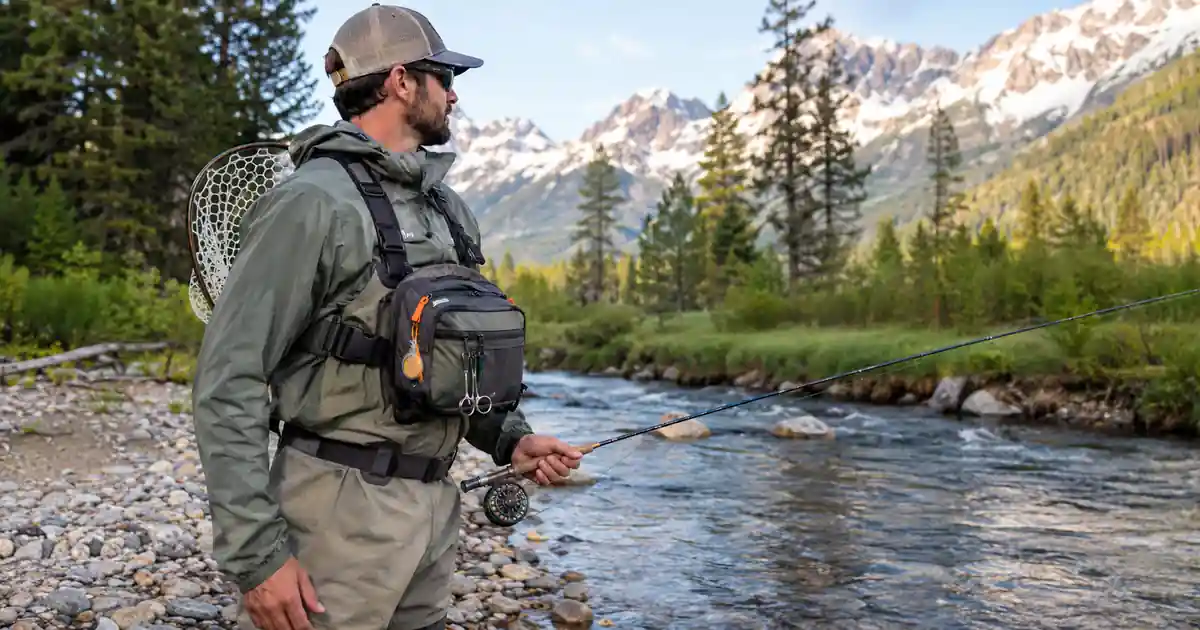
A fly fishing chest pack should make changing flies and reaching essential tools easier, not leave you fighting straps or searching through crowded pockets. The right choice depends less on its advertised capacity than on the fly boxes you carry, how the harness fits over your clothing, and whether you can use the pockets without interrupting a cast or losing your footing.
Quick answer: Measure your largest fly box first, list the equipment you truly use, and compare those dimensions with the pack’s compartments. Then try the pack loaded, over the waders or jacket you actually wear. Choose its pocket layout, net attachment, and water protection for your normal fishing—not for the most extreme trip imaginable.
This guide explains how to compare the fit and practical access of a fly fishing chest pack, with manufacturer-documented examples from Fishpond, Orvis, and Simms and smaller alternatives for different needs.
Table of Contents
Fly Fishing Chest Pack: Quick Buying Decision
A chest pack puts flies, tippet, and small tools in front of your body. It can be convenient when you often change rigs while standing beside or in a river, but front-mounted storage is not automatically the best answer for every angler.
| Your priority | What to look for | What to check before buying |
|---|---|---|
| A few essentials | Compact main compartment | Your largest fly box fits through the opening |
| Frequent fly changes | Drop-down work surface or wide opening | The opened lid doesn’t spill supplies |
| Long walks | Stable, adjustable harness | Loaded pack doesn’t bounce or pull on your neck |
| Fishing with waders | Layer-compatible straps | Pack doesn’t obstruct belt or foot visibility |
| Carrying a landing net | Holster, D-ring, or compatible release | Your actual net and tether work together |
| Heavy spray or immersion risk | Manufacturer-rated waterproof compartment | Closure is fully sealed and used as directed |
A useful five-part test for any fly fishing chest pack is measure → load → adjust → move → decide. If you cannot complete that test before ordering, check the return policy and keep all tags attached until you have tried the pack indoors.
Fly Fishing Chest Pack Capacity: Match Boxes to Compartments
Build an Essential Carrying List
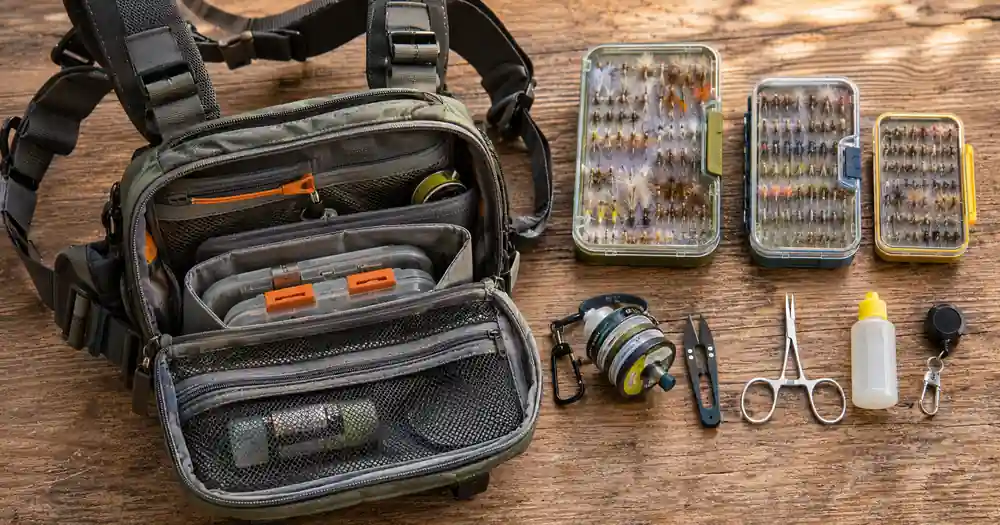
Start with the items you reach for during an ordinary outing: one or two fly boxes, tippet, nippers, forceps, leaders, and any technique-specific accessories. Add drinking water, a rain layer, and other personal essentials to the overall trip plan, but do not assume all of them need to fit in the chest pack.
For help deciding which tools are essential, see our guide to essential fly fishing accessories. Separating everyday tools from optional extras can prevent you from buying a larger pack than you need.
| Item | Your actual dimensions | Must be in front pocket? | Optional? |
|---|---|---|---|
| Largest fly box | ___ × ___ × ___ in | Yes / No | No |
| Second fly box | ___ × ___ × ___ in | Yes / No | Yes / No |
| Tippet and leaders | Measure holder or bundle | Yes / No | No |
| Nippers and forceps | Check attachment length | Yes / No | No |
| Floatant or indicators | Measure containers | Yes / No | Yes / No |
| Phone or keys | Check protected pocket | Yes / No | Depends |
Measure the Box, Not Just the Pack
Record the length, width, and thickness of your largest fly box, including any hinges or raised latches. Then check the compartment opening, internal depth, and the space taken by dividers. A box might fit inside a compartment on paper but still be difficult to pass through a narrow zipper opening.
Manufacturers commonly publish exterior pack dimensions and total volume rather than each pocket’s usable internal dimensions. Treat exterior measurements as a helpful reference, not proof of fit. If dimensions are missing, ask the seller for internal measurements or test the pack with your own gear.
Liters Versus Practical Space
When comparing fly fishing chest pack capacity, a 4L pack is not necessarily half as useful as an 8L pack. Two 8L designs can divide their space very differently between front and rear compartments. Bulky streamers may need a thick box, whereas slim nymph boxes can stack more efficiently. Pockets, curved panels, and padded inserts all change usable space.
For instance, Orvis lists its Chest Pack at 4L, while Fishpond lists the Cross-Current at 8L. Those numbers explain approximate total volume, not how many particular fly boxes either pack will hold.
When a Compact Option Makes Sense
If your everyday setup fits in a small box and a few tool pockets, a compact fly fishing chest pack may be more comfortable to manage than a larger bag. But the smaller option should be chosen because it fits your kit—not merely because its volume number looks minimalist.
Affiliate disclosure: As an Amazon Associate, we earn from qualifying purchases. FlyFishingScout may earn a commission from qualifying purchases at no additional cost to you.
🎣 Compact Essentials Pick — AC ALLEN Fall River Fishing Chest Pack, Gray/Lime. The maker describes a 2.5L pack with an adjustable neck and waist strap, a fold-down workstation, and a main pocket designed for up to two fly boxes. It’s a sensible candidate when you carry a modest kit, but the claimed box count won’t guarantee your particular boxes fit. 👀 View the Fall River & Check Amazon Options.
Fly Fishing Chest Pack Fit Over Waders and Layers
Adjust It Fully Loaded
An empty fly fishing chest pack may seem comfortable even if it shifts once you add boxes and tools. Place your normal gear inside, put on the jacket or waders you use most often, and tighten the straps until the bag feels stable without restricting breathing or shoulder movement.
Reach across your body, look down at your feet, and imitate retrieving fly line. If the pack swings toward your casting arm or bounces when you step, re-adjust it before deciding the design fits you.
Waders, Rain Jackets, and a Backpack
Thicker layers change the harness adjustment you need. Check that you can loosen the straps for a rain shell and shorten them again when wearing lighter clothing. The pack should not cover or prevent proper adjustment of your wading belt.
If you also use a backpack, verify the exact compatibility system. Fishpond Cross-Current attaches to specified Fishpond backpacks, Orvis states its Chest Pack is compatible with the Bug-Out Backpack, and Simms lists compatibility between its Headwaters pack, Headwaters backpack, and Simms waders. These are brand- and model-specific connections, not universal interchangeability.
Movement and Foot Visibility
Try a short indoor movement test: bend forward, squat, step onto a low stable platform, extend both arms, and look down toward where your feet would enter water. You should still be able to see and judge your footing. Do not test an unfamiliar or overloaded pack by stepping directly into moving water.
A chest pack does not function as flotation equipment. Maintain appropriate wading precautions and do not assume keeping gear high on your chest makes deep water safe. For a broader checklist of first-trip essentials, see our guide to fly fishing gear for beginners.
Is Weight Evenly Supported?
If a thin neck strap carries most of the load, the pack may become uncomfortable during longer outings. A harness that distributes weight across shoulders and back can be useful for heavier gear, but fit varies from person to person. Evaluate actual loaded comfort; no manufacturer specification proves that one model fits every body.
Fly Fishing Chest Pack Access and Pocket Layout
Workstations and Main Pockets
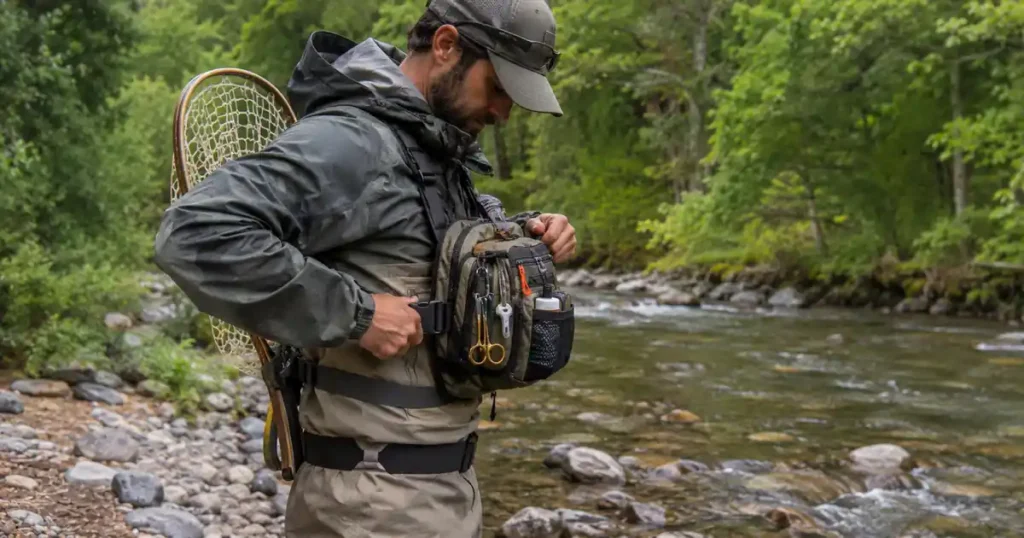
A fly fishing chest pack with a drop-down pocket may provide a convenient small work surface when changing flies. Check whether it opens fully, stays supported, and lets you find items without loose hooks dropping out. A broad top-opening main compartment can suit anglers who prefer pulling out one large fly box.
Position your most frequently used fly box where it can be reached with one hand while the other controls the rod. Reserve deep or rear compartments for supplies you use less often.
Organize Tippet and Tools
Nippers and forceps should sit on secure retractors or attachment points that allow their normal movement without hanging over the casting line. A tippet holder is useful only when it fits the spool sizes you carry. Test every tool’s range of movement with the pack loaded.
A magnetic quick-access pocket can help secure small items, but it is not a replacement for checking closures and warnings. Fishpond explicitly warns that the Cross-Current contains magnets and should not be used with a pacemaker or similar medical device.
A Low-Profile Alternative
If quick access is more important than carrying several large boxes, compare vertical chest packs with wider-front designs. Fishpond’s Canyon Creek is a useful example: the manufacturer specifies 2.5L, a fold-down fly bench, attachment points, and an integrated rear net slot. You still need to test the actual fly-box dimensions and decide whether its harness suits your clothing.
⭐ Streamlined Access Option — Fishpond Canyon Creek Chest Pack. Its vertical layout, zip-down fly bench, and tool attachment points can suit anglers who value organized access without a bulky front compartment. The manufacturer’s stated capacity is 2.5L, so measure your boxes; the Amazon listing may not always have a featured seller offer. 👀 View Canyon Creek & Check Seller Options.
Net Attachment: Slot, D-Ring, and Release
A fly fishing chest pack can advertise a net attachment point without including a complete carrying system. That distinction matters when your landing net has a particular handle length, frame weight, or tether arrangement.
Integrated Net Sleeves
Some packs include a rear slot or holster intended to accept a net handle. For example, Fishpond lists net slots on the Cross-Current and Canyon Creek, while Simms identifies an integrated net slot on the Headwaters.
A slot needs to accommodate your actual handle without allowing the net to fall out or hit your legs. Check whether you can reach the handle safely and put it back without twisting awkwardly.
D-Rings and Magnetic Releases
A D-ring provides an attachment location; it does not mean a magnetic release, clip, or tether comes with the pack. Confirm which items are included and which must be purchased separately.
A net release should support the net securely without leaving excess dangling line. Practice retrieving the net on land before fishing.
Avoid Swinging or Snagging Gear
Long tethers and loosely hanging accessories can snag branches, interfere with line handling, or strike you while walking. Clip tools close to the body. If the net rides behind your shoulder, make sure you can still remove it when wearing a rain jacket or backpack.
Fly Fishing Chest Pack Weather Protection
Water-Resistant Does Not Mean Submersible
A water-resistant fly fishing chest pack may help protect gear from ordinary spray or light rain, but water can enter through zippers, seams, or openings if the pack is soaked or submerged. Do not infer waterproof performance from a fabric name alone.
Simms describes its Headwaters model using water-resistant zippers and fabric features; that is different from a waterproof, sealed main compartment. Fishpond’s Cross-Current also should not be treated as a dry bag simply because it is an outdoor fishing pack.
Specialized Waterproof Storage
When protection from immersion is a genuine requirement, examine packs whose manufacturers explicitly describe a waterproof closure and compartment. Fishpond’s current Thunderhead Submersible Chest Pack uses a waterproof main-compartment closure and publishes an interior measurement of 9 × 7 × 3.75 inches. The manufacturer’s current version must not be confused with older Amazon listings that may have different fabric or zipper details.
💧 Water-Protection Alternative — Fishpond Thunderhead Fly Fishing Chest Pack (2022 Amazon listing). Consider this product family only if you truly need a waterproof main compartment rather than ordinary splash resistance. The linked listing is labeled as a 2022-era version; confirm its closure, condition, exact variant, and seller availability instead of assuming it matches today’s manufacturer model. 👀 Inspect the Thunderhead Listing & Seller Options.
Protecting Electronics and Valuables
Even with a sealed compartment, follow the maker’s zipper maintenance and closing instructions. If losing access to a phone or other essential equipment would create a problem, use additional appropriate protection and avoid relying on one closure alone.
Neither a waterproof pack nor a chest-mounted carrying position makes aggressive wading safe. Choose your route based on current, depth, footing, and your experience.
Chest Pack vs. Vest vs. Waist Pack
A fly fishing chest pack is not automatically better than the alternatives. Each carries weight and equipment differently.
| Carry system | Main advantage | Main trade-off |
|---|---|---|
| Chest pack | Frequent-use gear close to hand | Can obstruct front of body and sight of footing |
| Vest | Numerous pockets spread around torso | Can feel bulky or hot and encourages overpacking |
| Waist pack | Keeps upper chest and shoulders clearer | Contents may sit lower and require rotation to access |
| Sling pack | Useful volume that can rotate into reach | Access often requires moving the pack |
Choose a vest if you prefer many small pockets, a waist pack if you want your chest clear, or a chest pack when rapid front access matters most. There is no need to buy more than one carrying format until you understand its limitations in your own fishing.
Fly Fishing Chest Pack Models Compared
These fly fishing chest pack examples show why capacities and harness layouts must be considered together. They are not a ranking based on hands-on testing.
| Manufacturer model | Published volume | Published exterior dimensions | Notable layout |
|---|---|---|---|
| Fishpond Cross-Current | 8L | Front 11 × 8.5 × 5.5 in; back 11.5 × 10.5 × 1 in | Front magnetic pocket, separate rear storage, net slot |
| Orvis Chest Pack (25FS) | 4L | 11 × 7.5 × 3.75 in | Drop-down pocket, recessed tippet bar, net D-ring |
| Simms Headwaters Chest Pack | 8L | Front 11 × 5.5 × 8.5 in; back 9 × 3 × 12.5 in | Removable rear unit, molded workstation, net slot |
All dimensions and capacities above are reported by the manufacturers. Exterior measurements are not a promise of usable internal clearance, and listed weight refers to the unloaded product.
Fishpond Cross-Current: Two-Sided Organization
The 8L Cross-Current combines front storage with a separate rear panel. Fishpond lists a magnetic front pocket, a main zippered compartment intended for larger fly boxes, a rear net slot, and a D-ring for a net release. Its published unloaded weight is 1.7 lb.
It is worth comparing if you want to distribute some supplies behind your body or connect the pack to a compatible Fishpond backpack. The trade-offs are additional size and the magnet warning. Confirm both your own medical-device compatibility and the compartments needed for your kit.
Orvis Chest Pack: More Compact 4L Storage
Orvis’s 4L Chest Pack features a recessed Tippet Whippet docking station with a tippet bar, a fold-down main opening, smaller pockets, and a net D-ring. Orvis lists the 25FS design at about 0.88 lb unloaded.
The smaller stated capacity may suit a carefully edited collection of tools. But its shape must still accept your largest fly box. The Bug-Out Backpack compatibility is specific to Orvis’s system, not proof that it attaches to other brands.
Simms Headwaters: Modular 8L Configuration
Simms lists its Headwaters at 8L and 1.7 lb unloaded, with a removable rear storage compartment, a compression-molded workstation, net slot, and attachment options for compatible Simms waders and the Headwaters backpack.
These features are useful if you already use those systems or need to configure the harness for different outings. They do not guarantee that the pack will feel lighter or remain more stable once loaded; try the full configuration.
Smaller and More Protective Alternatives
The Allen Fall River and Fishpond Canyon Creek provide compact 2.5L alternatives for anglers who carry less. The Thunderhead family emphasizes water protection, with additional attention required for closure design and exact model generation. These are different use cases, not a single ranking of best to worst.
Fly Fishing Chest Pack Loaded-Fit Checklist and FAQs
Try-On Checklist Before Buying
Use this fly fishing chest pack loaded-fit test before you remove the tags or commit to a pack:
- Put your largest fly box in the compartment and make sure it passes easily through the opening.
- Add the tippet, nippers, forceps, leaders, and other items you normally carry.
- Wear the waders, jacket, or layers you use on the water.
- Adjust shoulder, neck, and body straps according to the manufacturer.
- Reach for your main fly box and return it without dropping loose equipment.
- Reach toward your net and check any separate release or tether.
- Bend, squat, turn your torso, and make a safe practice casting motion with an unrigged rod or without a hook.
- Look down to verify that you can still see your feet and potential hazards.
- Check whether the pack strikes your arms, interferes with the wading belt, or bounces.
- Repeat with your rain shell and any backpack you plan to use.
If the fit fails, consider a different harness or carrying format rather than assuming extra strap tightening will fix an unsuitable pack. If you are considering a secondhand pack, our used fly fishing gear guide explains what to inspect before buying.
How Many Fly Boxes Fit in a Chest Pack?
There is no universal number. For any fly fishing chest pack, two boxes with the same nominal size can have different thicknesses, and a pack’s zipper opening may be narrower than the compartment itself. Measure and test your own boxes rather than treating advertised liters as a box count.
Can a Chest Pack Interfere With Casting?
Yes. A fly fishing chest pack can catch line or restrict your casting-arm movement when poorly positioned or overloaded. Test its loaded placement, tool attachments, and strap stability before fishing.
Can You Wear a Chest Pack Over Waders?
Usually, yes, if the harness adjusts properly and leaves the wading belt accessible. Layer thickness and pack height matter. Do not let the pack interfere with safe movement or visibility of your footing.
Are Fly Fishing Chest Packs Waterproof?
Not all of them. Some are water-resistant, while selected submersible models feature waterproof main compartments when the closure is used correctly. Check the specific manufacturer’s claim, zipper design, and instructions.
Can You Attach a Landing Net to a Chest Pack?
Many models have a rear slot or D-ring, but the net may require a separate release, tether, or compatible handle. A mounting point is not necessarily a complete net-carrying system.
Conclusion
The right fly fishing chest pack is the one that holds your real equipment, stays stable over your fishing clothes, and makes important tools easy to reach. Start with the size of your largest fly box, then evaluate compartment access, harness comfort, net mounting, and weather protection.
Do not buy more capacity or waterproofing than your fishing requires. Before ordering, measure, load, adjust, move, and decide. That simple process can tell you more about a pack’s suitability than its pocket count or marketing description.
References
- Fishpond — Cross-Current Chest Pack
- Orvis — Chest Pack (25FS)
- Simms Fishing — Headwaters Chest Pack
- Allen Company — Fall River Fly Fishing Chest Pack
- Fishpond — Canyon Creek Chest Pack
- Fishpond — Thunderhead Submersible Chest Pack
- Fishpond — Warranty & Repair
- Amazon — AC ALLEN Fall River Fishing Chest Pack
- Amazon — Fishpond Canyon Creek Chest Pack
- Amazon — Fishpond Thunderhead Fly Fishing Chest Pack, 2022 Listing