
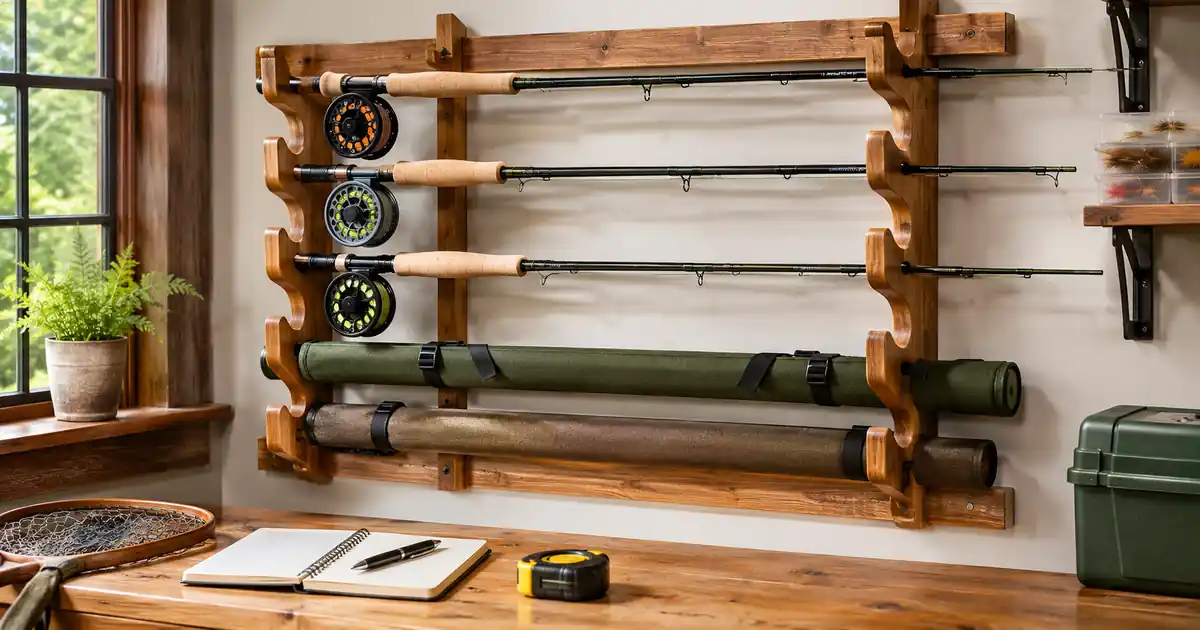
Fishing Rod Wall Rack: Measure, Plan, and Mount Rod Storage Safely
Before installing a fishing rod wall rack, identify the wall material, confirm you may drill there, and read the exact rack manufacturer’s mounting instructions. Then measure the rods, reels, available wall space, and the route needed to retrieve each rod. If a required support or clearance check cannot be verified, use a protective tube or freestanding storage instead.
A fishing rod wall rack is home storage equipment, not a boat holder, shore rod rest, or car-roof carrier. This guide supplies an original measurement worksheet and a decision process, not a universal drilling recipe. FlyFishingScout has not installed or independently load-tested the products described. Manufacturer and rod-care information checked November 23, 2026.
Table of Contents
Fishing Rod Wall Rack: Is Your Wall Suitable?
Begin with the surface. Is it ordinary wood-stud drywall, old plaster, brick, concrete, or another type of construction? Do you have permission to make holes? Can you identify the required supporting structure without risking concealed electrical wiring or plumbing? If you cannot answer those questions, stop before selecting anchors or marking holes.
The safe load depends on the complete installed system: wall condition, fastener arrangement, bracket geometry, actual rods, and foreseeable impacts. The advertised weight or rod-count capacity of a fishing rod wall rack is not a certification for a particular home. A picture of a rack on painted drywall does not tell you what is supporting it.
| Pre-install question | Proceed only when | Otherwise |
|---|---|---|
| Property permission | Necessary approval is granted | Use no-drill storage |
| Construction identified | Exact wall material is known | Investigate or consult a qualified installer |
| Support verified | Required backing and hidden-service hazards checked | Do not drill |
| Correct manual | Instructions match the exact model/version | Obtain current instructions |
| Room clearance | People, doors, vehicles and rods can move freely | Reposition or choose another method |
A no-purchase option comes first: Clean and dry your fly rod, place the sections in an appropriately sized sock and protective tube, and store it in a safe dry location. Orvis recommends full drying before rod storage and warns against heat or bending. A stable existing cabinet may be better than installing an exposed rack you cannot verify.
A fishing rod wall rack should not depend on generic adhesive-only hooks or improvised nails unless the exact attachment system is specifically approved for that wall and load. A renter also needs to check alteration rules independently of whether the hardware seems easy to fit.
Measure Your Fishing Rod Wall Rack Space and Rods
Measure usable space rather than the entire wall
Record wall width and height after subtracting obstructions: doors, cabinets, garage-door tracks, shelves, electrical access, pipes, moving vehicles, bicycles, and habitual walking routes. Open doors and cabinet fronts fully while assessing the space. A wall can look clear until a garage door rises or a hatch opens nearby.
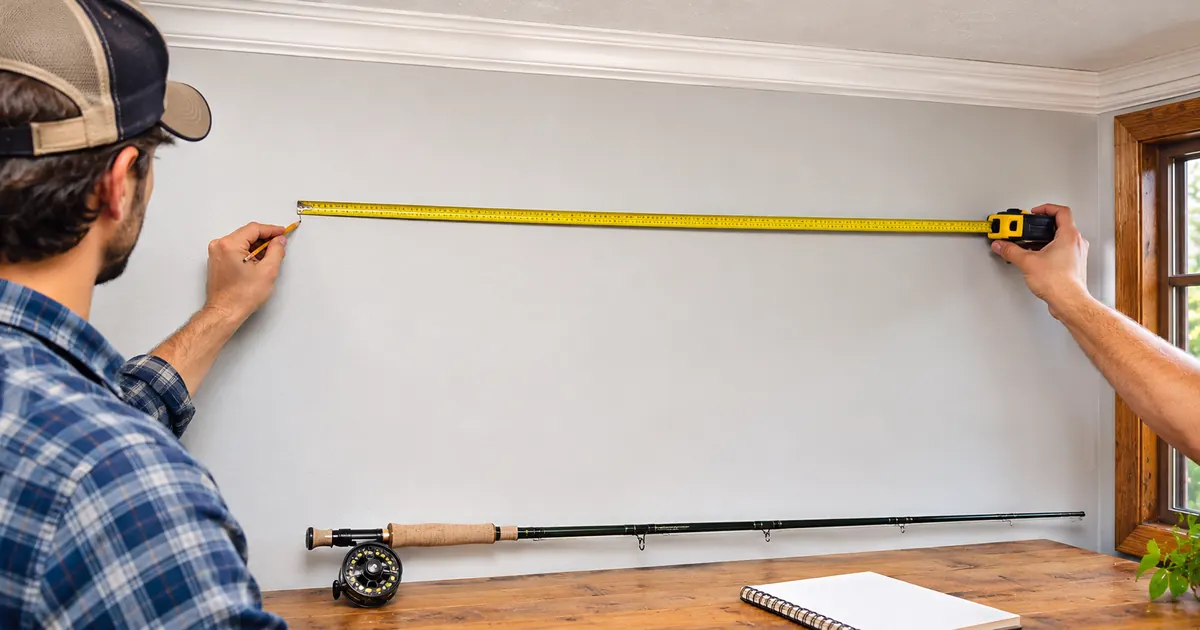
A fishing rod wall rack needs space not only when the rods are parked but also while a person lifts, slides, or turns one to remove it. The longest rod’s complete retrieval path may require more room than its resting outline. Do not plan around the rod merely fitting between two fixed objects.
Measure actual fly rods and reels
A nine-foot four-piece rod has a full assembled length and much shorter packed sections; measure the form you intend to store. Record the longest assembled rod, shortest rod that must engage both supports, largest reel body, protruding reel handle, cork grip and rod tube. Do not assume generic spinning-rod clip diameters suit a thin fly-rod blank.
If several rods share a fishing rod wall rack, check the space between their reels and whether line guides, ferrules, loops and tips could touch the adjacent outfit. A claim such as “holds eight rods” usually describes the manufacturer’s intended arrangement, not a guarantee that eight fully rigged fly rods with bulky reels will fit.
Printable fishing rod wall rack worksheet
| Write this down before buying or mounting | Your measurement / answer |
|---|---|
| Wall construction and permission | ________________________ |
| Usable wall width and height | ________________________ |
| Longest assembled rod | ________________________ |
| Longest packed section or protective tube | ________________________ |
| Shortest rod that must engage supports | ________________________ |
| Largest reel and handle projection | ________________________ |
| Exact rack model and manual revision | ________________________ |
| Required mounting support points verified | ________________________ |
| Tip and guide clearances | ________________________ |
| Garage door, vehicle, cabinet and walkway path | ________________________ |
| Complete removal motion possible? | ________________________ |
| Decision: suitable / unsuitable / unverified | ________________________ |
Use removable paper or a safe cardboard outline to model the rods and rack on a workbench before you touch the wall. The completed worksheet is a planning record, not a structural calculation or installation authorization. Keep a copy with the actual rack manual.
Text-only rod-clearance layout
| Position | What must fit | Potential contact |
|---|---|---|
| Butt end | Grip, reel seat and hand access | Wall and nearby objects |
| First support | Approved rod-contact area | Guide, reel or thin blank |
| Middle span | Unbent rod between supports | Pressure or accidental line loop |
| Second support | Approved support location | Fragile tip and ferrule |
| Far end | Clear rod tip and removal path | Ceiling, door, shelf or vehicle |
This layout is deliberately not a support-spacing formula. The required span comes from the specific product manual and the actual rod. Never transfer a surfboard-mount measurement or one rack manufacturer’s support heights to a different fishing rod wall rack.
Fishing Rod Wall Rack Layouts: Horizontal vs. Vertical
Horizontal storage usually needs greater clear wall length and can make each rod visible; vertical storage may save width but demands sufficient height and safe overhead retrieval space. Either orientation can damage a rod if it presses on a delicate tip or forces a reel against the wall.
| Issue | Horizontal layout | Vertical layout |
|---|---|---|
| Main space | Long wall span | Usable height |
| Removal | Sideways or lifting motion | Lifting before withdrawal |
| Reel placement | Adjacent reel handles can collide | Reels may conflict with floor or neighboring grips |
| Tip safety | Support near tip must be suitable | Ceiling and top clearance matter |
| Low ceiling | Sometimes suitable with enough wall length | Often difficult for assembled rods |
| Access route | Watch cabinets, doors and tools | Watch doors, ceiling and people |
Some rack designs allow multiple orientations. StoreYourBoard states that its Stillwater model permits horizontal or vertical wall use and certain ceiling configurations, but that statement applies to Stillwater only. A fishing rod wall rack sold with a vertical mounting system is not automatically certified for horizontal or overhead use.
Test the longest and shortest rod. A short rod should not fall between support points; the longest should be removable without bending or striking the ceiling. Check reels and line loops while simulating the movement. If this cannot be achieved, rethink the orientation or use cases instead.
Low-ceiling garage example
An assembled fly rod placed vertically near a low ceiling may appear to fit while stored, yet the tip can hit the ceiling the moment you lift the butt to remove it. A horizontal fishing rod wall rack avoids that particular motion but may cross the travel path of the overhead door. These are layout questions, not one-size-fits-all measurements.
Fishing Rod Wall Rack Mounting: Follow the Exact Manual
There is no universal drilling depth, screw size, anchor capacity or mounting height for a fishing rod wall rack. The correct procedure depends on the exact rack, its current manual, and the supporting wall. If the instructions are missing, unclear or incompatible with the substrate, contact the manufacturer or a qualified installer rather than improvising.
Different manufacturer systems require different procedures
The Stillwater Fishing Rack installation guide from StoreYourBoard gives product-specific assembly and safety warnings. The separate RODLOK manual describes upper and lower expandable bars, an alignment process, and checking the wall for hidden wires or pipes. Its lower-bar height is related to the longest handle and upper-bar height to the shortest rod. Those measurements are RODLOK-specific, not generic wall-rack rules.
An anchor supplied with a kit may be intended for a particular wall assembly, while ceiling installation may require specific structural members. Old plaster, masonry, wood studs and hollow walls are not interchangeable. A manufacturer’s general “easy installation” marketing claim does not remove the need for the exact fastening instructions.
Pre-install verification checklist
- Read the full current manual for the exact rack model and check supported orientations.
- Confirm property permission, actual wall material and suitable structural support.
- Assess electrical wiring, pipes and any other concealed services; an uncertain cavity is a stop condition.
- Verify which fasteners and locations the manufacturer actually authorizes for the situation.
- Prepare measuring tape, pencil, level, suitable detection tools, protective equipment and any tools the manual specifies.
- Review the manufacturer’s limits concerning load, rod contact, hardware condition and inspection.
- Stop if any critical step cannot be verified; a professional or a no-drill alternative is better than a guess.
A fishing rod wall rack installed over a walkway, near an exit, above a frequently occupied area, or where a vehicle or ladder may strike it needs special scrutiny. Do not hide the risks of an unsuitable location behind an attractive installation photograph.
Reel Clearance, Rod Tips, and Garage Door Hazards
A rack that is structurally secure can still be a poor storage choice. Fly reels project away from rod blanks, guides protrude from the shaft, and fine rod tips can be vulnerable to accidental pressure. A fishing rod wall rack must let each rod rest and be removed without unwanted bending.
- Check that the reel handle cannot catch the neighboring rod or rack support.
- Ensure the contact area suits the actual fly-rod diameter and does not pinch guides or ferrules.
- Keep rod tips away from vehicle movement, garage doors, tools, children and pets.
- Remove exposed hooked flies and control line loops before storing the rod.
- Check that the entire retrieval path is free, not merely the final resting position.
- Protect emergency exits, utility panels and work areas from stored equipment.
Stand where you would retrieve the rod while considering your longest rod and largest reel. A fishing rod wall rack is unsuitable if the user must pull by a delicate tip, force a reel past a bracket, or bend the blank around a cabinet. Measure the space with the garage and nearby shelves in their ordinary in-use state.
Avoid treating a manufacturer’s capacity as a promise that every slot will accommodate a fully rigged outfit. Two large fly reels may demand much greater spacing than empty conventional rod handles. If a support designed for a thick butt slips around a slender blank, seek model-specific compatibility evidence before loading it.
No-Drill Alternatives to a Fishing Rod Wall Rack
If a fishing rod wall rack cannot be installed with verified support and permission, do not force the decision. A protective rod tube, existing secure storage cabinet, or freestanding floor organizer is a legitimate solution. Renters and anglers in older properties may benefit most from avoiding wall modifications entirely.
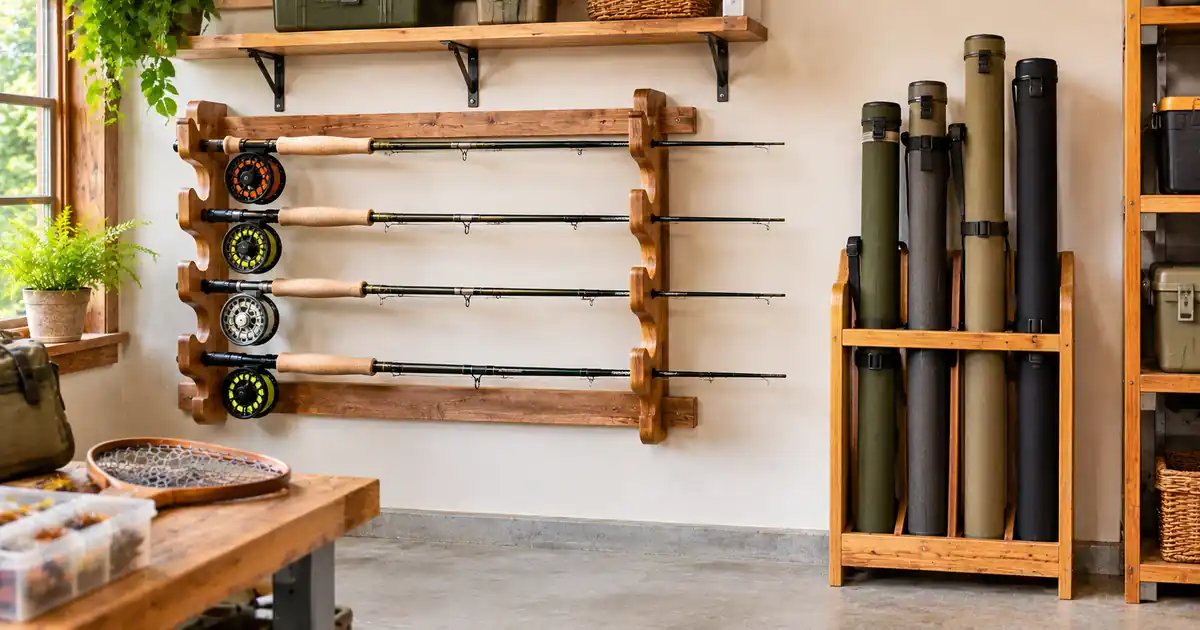
| Method | Why consider it | What still requires care |
|---|---|---|
| Rod sock and protective tube | Compact storage for disassembled fly rods | Correct length, dry rod, avoid heat or crushing |
| Freestanding round floor rack | No wall penetrations and access to several rods | Stable floor, reel clearance, safe location |
| Existing closet or cabinet | Enclosed storage and fewer accidental knocks | Humidity, sharp edges, space and easy retrieval |
| Purpose-built floor organizer | Regular access to assembled outfits | Compatible clips, stable base and traffic clearance |
Orvis advises that rods should be completely dry before returning them to their socks or tubes. A sealed, wet tube is not the same as protected storage. Rods also should not be left bent under pressure or in excessive heat. Follow instructions for the actual rod material and its storage case.
A no-drill alternative needs its own checks. A floor rack in a narrow hall can tip or be struck by pets and children, and a rod tube left behind a closing door can still damage equipment. A fishing rod wall rack is only one possible organization method; correct placement matters in every format.
Mounting Inspection and Ongoing Storage Care
Once a fishing rod wall rack is installed according to the product’s manual, use its official inspection and loading procedure. Do not perform an improvised overload test or assume the wall cannot change. Stop using the rack if a support starts to move, the wall surface deteriorates, or any clip damages a rod.
- Check each bracket and fastening point for visible damage or movement, according to the manual.
- Inspect contact surfaces for sharp edges, worn padding and unwanted pressure on rod sections.
- Ensure reels, line loops and rod tips do not collide during ordinary removal.
- Recheck after adding a longer rod, moving furniture, or changing the garage layout.
- Clean and thoroughly dry rods before extended storage, following manufacturer care advice.
- Stop and investigate loose hardware, new cracks, rust, moisture or an unstable support.
Dust, dampness and heat are additional considerations in sheds and garages. A fishing rod wall rack can provide quick access but leaves equipment exposed. In a damp location, a suitable protective case stored indoors may be preferable. No generic rack maintenance schedule replaces the exact manufacturer’s recommendations.
Fishing Rod Wall Rack Buying Checklist and FAQs
Five relevant design examples
| Model | Manufacturer-described role | Key verification |
|---|---|---|
| StoreYourBoard Stillwater, SYB-STILLWATER | Two-piece wood wall/ceiling rack; maker lists up to eight rods | Manual 06741, support spacing, wall suitability; manufacturer page was marked unavailable |
| RODLOK expandable system | Upper/lower bar system with wall-specific installation guidance | Exact bar geometry, mounting instructions and rod lengths |
| PLUSINNO V9 | Vertical wall holder with maker-described soft roller-style supports | Fly-rod diameter, mounting requirements and reel clearance |
| PLUSINNO H5W wood holder | Horizontal wall/ceiling storage; packages differ | Exact selected bundle, mounting instructions and support geometry |
| Rush Creek Creations 16-Rod Round Rack | Freestanding rod organization with individual slots | Floor stability, rod/reel fit, room placement |
A fishing rod wall rack marketed for several rods is not necessarily compatible with every fly rod, guide and reel. Use the maker’s documentation and your own worksheet before treating any example as a purchase recommendation.
Optional, disclosed Amazon alternatives
Affiliate disclosure: As an Amazon Associate, FlyFishingScout earns from qualifying purchases. These links may earn a commission at no additional cost to you. ASINs were matched to US Amazon product identifiers using third-party catalog records, but current Amazon checkout, seller, stock and package variants could not be independently confirmed. Verify the exact item and safety instructions before buying.
PLUSINNO V9 Vertical Fishing Rod Holder — Blue 1-Pack — 🧰 Compact vertical storage: the maker describes grip supports intended for multiple rods. Check the actual fly-rod diameter and whether the rack can be mounted properly on your wall. Check this specific option on Amazon.
PLUSINNO H5W Wooden Horizontal Rod Holder — Two-Pack — 📐 Horizontal layout candidate: this catalog-matched wood option may work when you have adequate wall length and compatible supporting structure. Check the exact two-pack and current manual. Check this specific option on Amazon.
Rush Creek Creations 16-Rod Round Freestanding Holder — 🏠 No-drill alternative: a floor organizer may suit renters or uncertain walls. Confirm its exact finish and design, assembled stability, and reel/tip fit. Check this specific option on Amazon.
These are different possible answers to a storage problem—not safety-certified winners or personally tested equipment. An Amazon listing may change its bundle or model; do not transfer installation or capacity claims to a mismatched product.
Can I mount a fishing rod rack in drywall?
Only where the exact manufacturer instructions authorize the required fixing method for the real drywall and support structure. Included anchors are not universal approval. If the substrate is uncertain, use a qualified installer or choose protected no-drill storage.
How high should a wall fishing rod rack be?
There is no universal figure. Your rods, reel positions, ceiling, reach and rack design decide the placement. RODLOK gives a method for its own product, which should not be copied onto other holders.
Is horizontal or vertical better for fly rods?
Either can work with the right supports and clearances. Horizontal uses wall length; vertical requires safe height and a good removal path. Avoid any arrangement that bends the tip or pressures a guide.
What if I rent and cannot drill?
Use an approved freestanding rack, a rod tube or an existing cabinet. Do not assume adhesive hooks can safely support multiple valuable rods based on generic marketing.
Will an eight-rod holder fit eight fly rods?
Not necessarily. Rod counts depend on the maker’s intended configuration; fly reels, guide positions and mixed lengths can reduce the number that fits without contact.
Can ceiling mounting use ordinary wall anchors?
Do not assume that. Overhead systems have specific mounting and falling-object hazards. Follow the exact ceiling instructions and obtain competent installation help when needed.
When to Skip a Fishing Rod Wall Rack and Use a Rod Tube
Skip the proposed installation if permission, wall material, manual, compatible supports or safe removal clearances cannot be confirmed. Protecting a fly rod in a dry, correctly sized sock and tube may be the better solution. A fishing rod wall rack should never become necessary merely because you have already bought one.
Our published fly fishing gear bag guide offers related storage and transport context. The fly fishing rod comparison illustrates why rod length and configuration differ. The site’s rod-case article is still a draft, so this article does not link to it publicly.
Measure first, verify your exact rack and wall, and stop if the final support or access check remains uncertain. Keep the worksheet and manual for reassessment after equipment or room changes. Editorial release gate: this draft is not an installation certification and should not be published until its original diagrams and model-specific safety review are approved.
References
- StoreYourBoard — Stillwater Fishing Rack — manufacturer specifications.
- StoreYourBoard — Stillwater Installation Guide — official installation warnings.
- RODLOK — User Guide — wall-mounted storage.
- RODLOK — Installation Instructions — model-specific installation process.
- StoreYourBoard — Mounting and Installation Guide — wall and ceiling conditions.
- PLUSINNO — V9 Vertical Fishing Rod Holder — maker description.
- PLUSINNO — Rod Holders — H5W identity.
- Rush Creek Creations — 16-Rod Round Rack — freestanding alternative.
- Orvis — How To: Fly Rod Care — cleaning and drying.
- Orvis — Off-Season Gear Maintenance — storage environment.
- ASINSIGHT — US Fishing Rod Holder Catalog — V9 ASIN.
- FirstCastFishing — H5W Two-Pack — catalog ASIN.
- Desertcart — Rush Creek Round Rack — catalog identifier.