
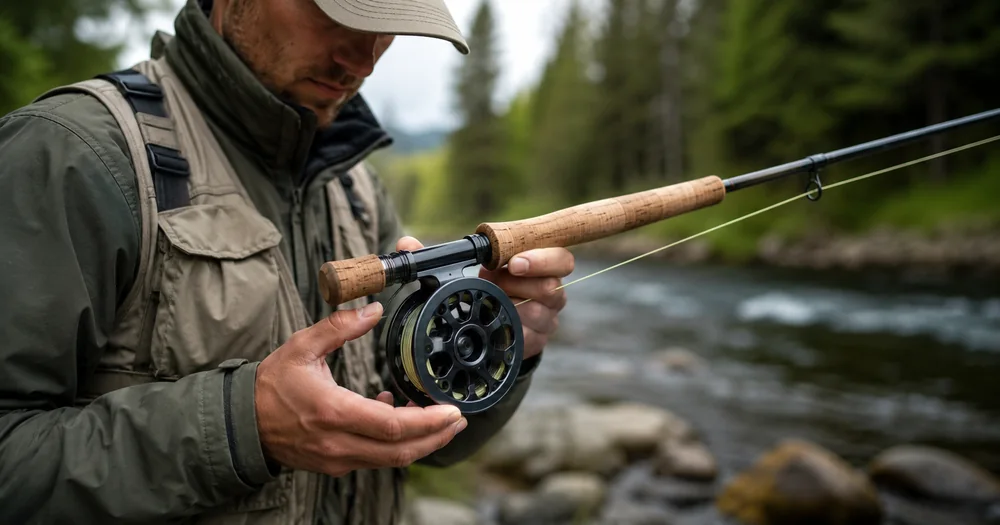
Fly Fishing Reels: How to Choose the Right Reel
Choosing between fly fishing reels becomes much easier when you start with compatibility instead of brands or price. First, match the reel to your rod and fly line. Then consider the fish you target, the water you fish, how much drag and backing you need, and which reel design fits your setup.
For many trout anglers, a simple reel with the correct size and enough capacity may be all that is necessary. If you target larger freshwater fish or fish in saltwater, drag performance, backing capacity, construction, and environmental protection become more important.
The goal is not to buy the most expensive reel. It is to choose a reel that fits your rod, line, target fish, and actual fishing conditions.
Table of Contents
How to Choose Fly Fishing Reels
When comparing fly fishing reels, use this five-step process:
- Match the reel to your rod and fly-line weight.
- Consider the fish you plan to target.
- Decide how much drag and line capacity you need.
- Choose an arbor and construction suited to your fishing.
- Check physical weight, balance, retrieve direction, and budget.
Following this order prevents you from paying extra for features that may not improve your fishing.
A premium reel can still be the wrong reel if it does not match your rod or fly line.
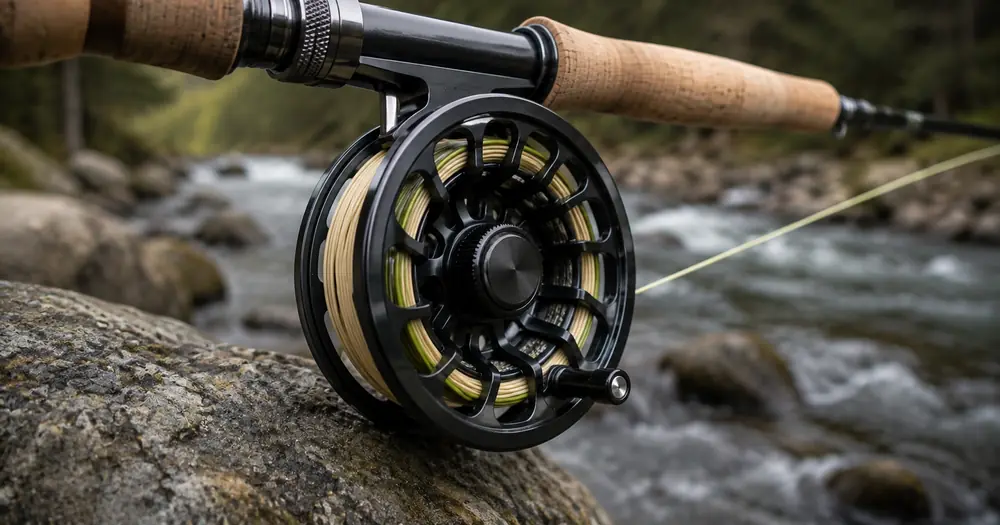
Start by Matching the Reel to Your Rod and Fly Line
Reel sizing usually relates to the fly-line weights the reel is designed to hold.
A reel intended for lightweight trout fishing will normally be smaller than one built for heavier salmon, steelhead, or saltwater setups.
Manufacturers do not all label fly fishing reels in exactly the same way. Some reels use ranges such as 3/4, 5/6, or 7/8, while others use manufacturer-specific numbers or Roman numerals.
The safest approach is to check the manufacturer’s stated fly-line compatibility instead of assuming a reel number means the same thing across every brand.
What Do Fly Reel Size Numbers Mean?
A reel marked 5/6 generally indicates that it is designed to work with 5- and 6-weight fly lines.
Similarly, a 7/8 reel is typically intended for 7- and 8-weight lines.
Some manufacturers design one reel size to cover three or more nearby line weights. That is normal and gives anglers flexibility.
Always check the specifications for the individual reel rather than relying only on the model name.
Fly Reel Size vs. Fly Reel Weight
The word “weight” can become confusing for beginners because it describes different things in fly fishing.
A 5-weight rod refers to the line-weight system the rod is designed around. A reel might be rated for 4- through 6-weight lines.
Neither number tells you how much the reel physically weighs.
The actual weight of a fly reel is normally listed in ounces.
Keep these three measurements separate:
- Rod and line weight: The fly-fishing sizing system.
- Reel size rating: The line weights the reel is designed to support.
- Physical reel weight: How much the reel itself weighs.
Understanding this difference makes comparing fly fishing reels much easier.
Match the Reel to the Fish You Target
Once you know which reels fit your rod and fly line, consider the fish you expect to catch.
Small trout and panfish usually place relatively modest demands on a reel. In many situations, an angler controls much of the fight by managing the fly line with the line hand.
Larger and stronger fish can make the reel more important.
Bass, large trout, steelhead, salmon, and many saltwater species may take longer or more powerful runs. That can increase the importance of drag performance, line retrieval, and backing capacity.
You do not need the strongest drag available simply because it sounds better.
Choose the reel for the fish you actually target.
Understand Fly Reel Drag Systems
The drag system creates resistance when a fish pulls line from the reel.
For small trout fishing, the drag may play only a limited role. When targeting stronger fish capable of pulling significant amounts of line from the spool, the drag becomes much more important.
When evaluating fly fishing reels, you will commonly encounter two broad drag styles.
Click-and-Pawl Reels
A click-and-pawl reel uses a relatively simple mechanical system to provide resistance as the spool turns.
These reels remain popular for lightweight freshwater fishing, especially trout.
They can appeal to anglers who prefer:
- Simple construction
- Traditional styling
- A lightweight setup
- Direct control during the fight
The trade-off is that click-and-pawl systems generally provide less adjustable resistance than modern disc-drag reels.
For small and moderate trout, that may not be a problem.
For larger, stronger fish, a more capable drag system may be more useful.
Disc-Drag Reels
A disc-drag system uses friction surfaces to provide adjustable resistance.
The angler can increase or reduce that resistance depending on the fish and situation.
Disc drag becomes especially useful when a fish takes enough line that the fight moves onto the reel.
Steelhead, salmon, powerful freshwater species, and many saltwater fish can make a dependable adjustable drag much more valuable.
That does not mean every beginner needs an expensive disc-drag system. Your fishing situation should determine how much drag capability you actually need.
Do You Need a Sealed Drag?
A sealed drag is designed to reduce the amount of water, sand, grit, salt, and other contaminants reaching important drag components.
This can be particularly useful in saltwater environments.
For ordinary freshwater trout fishing, a sealed system may be less important than:
- Correct reel size
- Appropriate capacity
- Reliable construction
- Comfortable balance
- Reasonable price
Do not assume that “sealed” means “maintenance-free.”
Saltwater equipment should still be cleaned and cared for according to the manufacturer’s instructions.
Choose the Right Arbor Size
The arbor is the central part of the reel spool around which the backing and fly line are wound.
Arbor diameter affects how the line sits on the reel and how much line you retrieve with each turn of the handle.
Large Arbor Fly Reels
A large arbor fly reel uses a larger-diameter center section.
One of the main advantages is faster line pickup.
Because the line is wound around a larger diameter, each rotation of the spool can retrieve more line than a comparable smaller-arbor design.
This can help when a fish suddenly changes direction and swims toward you, leaving loose line that needs to be recovered quickly.
Larger coils can also help reduce the tight coiling that may occur when fly line remains stored around a smaller diameter.
Large-arbor designs are common among modern fly fishing reels, but that does not mean they are automatically the best choice for everyone.
You still need to consider:
- Overall reel diameter
- Spool width
- Physical reel weight
- Capacity
- Rod balance
- Intended use
Mid- and Standard-Arbor Reels
Mid- and standard-arbor reels use a smaller center diameter.
They retrieve less line per spool revolution than a comparable large-arbor design, but they can still work very well.
A traditional or compact arbor may be perfectly suitable for lightweight trout fishing where rapid line pickup is not especially important.
The choice should therefore be based on your fishing rather than the assumption that a larger arbor is automatically superior.
One important point: arbor size alone does not determine backing capacity.
Total capacity depends on the complete spool design, including its diameter, width, fly-line size, backing diameter, and other dimensions.
Check the manufacturer’s capacity specifications for the exact reel.
Check Fly Line and Backing Capacity
A fly reel needs enough room for both your fly line and the appropriate amount of backing.
Backing is the thinner line stored underneath your fly line.
If a strong fish pulls the full fly line away from the reel, the backing provides additional line.
How important that is depends heavily on the species you target.
A small-stream trout angler generally has very different capacity needs from someone targeting:
- Steelhead
- Salmon
- Bonefish
- Tarpon
- Other strong-running fish
Fly-line design also affects how much space is required.
Some specialty lines are thicker than traditional fly lines and may occupy more of the spool.
For that reason, avoid relying on one universal backing recommendation.
When comparing fly fishing reels, check the manufacturer’s capacity information for your intended line and backing combination.
Consider Reel Weight and Rod Balance
Lighter is not automatically better.
The reel sits behind your casting hand and affects how the entire outfit feels.
A reel that is extremely heavy can make a light rod feel awkward. But an unusually light reel can also change the balance of a longer rod.
Rod length, reel-seat position, casting style, and personal preference can all affect what feels comfortable.
There is no single perfect balance point that applies to every angler.
If you can try the setup in person, mount the reel on the rod and hold the rod as you normally would while fishing.
If you are buying online, compare:
- Manufacturer line-weight recommendations
- Actual reel weight
- Reel diameter
- Similar reels designed for the same class of rod
Physical reel weight should be one part of the decision, not the entire decision.
Fly Reel Construction: What Are You Paying For?
Construction affects price, weight, durability, appearance, and how a reel handles demanding environments.
Die-Cast Aluminum
Die casting forms metal components using a mold.
This process can produce functional reels at a lower cost than extensive precision machining.
For many freshwater anglers, a properly designed die-cast reel can provide everything they need.
Do not assume that a cast reel is automatically poor quality.
The quality of the finished product depends on the complete design and manufacturing process.
Machined Aluminum
Many premium fly fishing reels are machined from aluminum.
Machining allows manufacturers to create precise reel frames, spools, and other components.
Machined construction is common on higher-priced freshwater and saltwater reels, but the manufacturing method alone does not make one reel better for your fishing.
You should still evaluate:
- Drag design
- Capacity
- Weight
- Finish
- Intended environment
- Spool dimensions
- Overall construction
For demanding use, paying more for higher-end construction may make sense.
For simple freshwater trout fishing, it may not be necessary.
Composite and Other Materials
Some affordable fly reels use composite materials or combinations of different materials.
These can help reduce cost and, depending on the design, may also reduce weight.
Do not dismiss a reel simply because it is not made entirely from machined aluminum.
Judge the specific reel according to your actual use.
Freshwater vs. Saltwater Fly Reels
Freshwater and saltwater environments can place very different demands on fly fishing reels.
| Consideration | Typical Freshwater Priority | Stronger Saltwater Priority |
|---|---|---|
| Drag | Depends on target fish | Strong, dependable drag often matters more |
| Drag protection | Often less critical | Sealing can help around salt and sand |
| Backing | Species dependent | Greater capacity may become more important |
| Construction | Many designs can work | Corrosion protection becomes more important |
| Reel size | Match rod, line, and fish | Heavier line systems often require larger reels |
Do not assume a freshwater reel is automatically suitable for saltwater just because its line rating matches your rod.
If you intend to fish in saltwater, verify that the manufacturer considers the reel suitable for that environment.
Saltwater use can make features such as corrosion-resistant construction, protected drag systems, and adequate backing capacity more important.
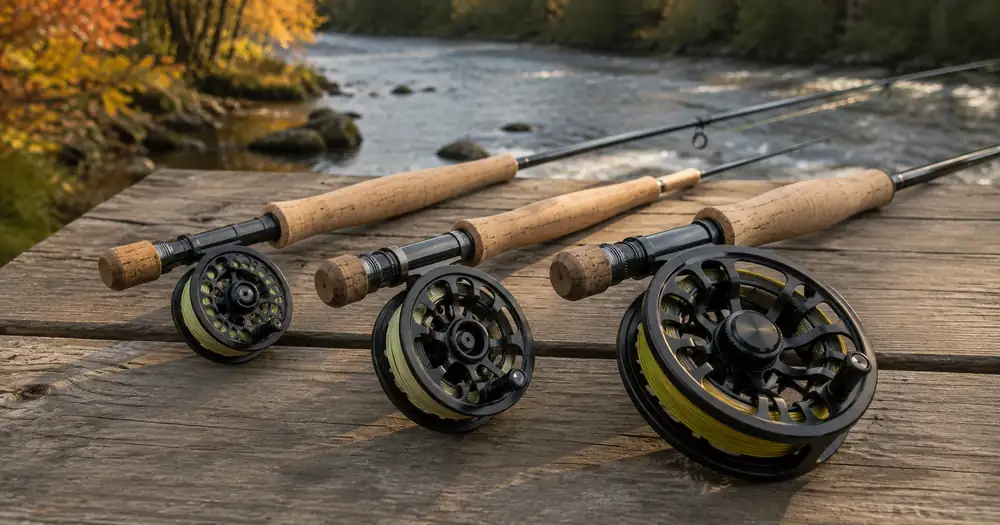
Left-Hand vs. Right-Hand Retrieve
Retrieve direction determines which hand turns the reel handle.
Many right-handed anglers cast with their right hand and retrieve with their left. This allows them to keep the rod in the casting hand throughout the fight.
Other anglers prefer the opposite arrangement.
Neither method is universally correct.
Many modern fly reels can be converted between left- and right-hand retrieve, but the procedure differs between models.
If retrieve direction matters to you, check whether the reel supports conversion before buying it.
What Should a Beginner Look for in a Fly Reel?
A fly reel for beginners does not need every premium feature available.
The priority is getting the fundamentals right.
Get These Features Right First
Look for:
- Correct rod and fly-line compatibility
- Enough spool capacity
- Drag appropriate for your target fish
- Suitable construction for your fishing environment
- Reasonable physical weight
- Preferred retrieve direction
- Dependable operation
These factors matter more than cosmetic details.
Features You May Not Need to Pay Extra For
Depending on where and how you fish, you may not need:
- Extremely powerful drag for small trout
- Huge backing capacity
- Advanced saltwater sealing
- Premium decorative machining
- Specialty finishes
- Multiple spare spools
- Extremely lightweight construction
Spend more when the feature solves a real problem.
For example, environmental protection matters more if you frequently fish saltwater. Greater backing capacity makes more sense when targeting fish capable of long runs.
A beginner fishing small local trout streams should not feel required to buy the same reel as an angler targeting powerful saltwater species.
Quick Fly Reel Guide by Fishing Situation
| Fishing Situation | Reel Priorities |
|---|---|
| Small-stream trout | Correct light-line rating, compact size, simple design |
| General trout | Proper capacity, comfortable balance, appropriate drag |
| Bass and larger freshwater fish | Suitable drag and capacity |
| Steelhead and salmon | Reliable drag, enough backing, appropriate reel size |
| Saltwater | Verified saltwater suitability, capable drag, capacity, corrosion protection |
| First fly reel | Compatibility before premium features |
These are starting points rather than fixed specifications.
Two anglers targeting the same species may still prefer different fly fishing reels because they use different rods, fly lines, water types, and techniques.
Common Fly Reel Buying Mistakes
Buying by Brand Before Checking Compatibility
Start with your rod, line, and fishing situation.
Even a high-quality reel is a poor choice if it does not fit the rest of your setup.
Confusing Reel Size With Physical Weight
A 5-weight fly-fishing setup does not mean the reel physically weighs 5 ounces.
Always separate the line-weight rating from the reel’s actual weight.
Buying the Wrong Reel Rating
Do not assume all manufacturers use identical sizing systems.
Check the stated fly-line compatibility.
Ignoring Backing Capacity
Backing becomes increasingly important when targeting fish capable of long runs.
Make sure your reel has enough capacity for the line and backing combination you plan to use.
Assuming More Drag Is Always Better
Powerful drag can be valuable for strong fish.
It may add little practical value when your fishing involves small trout that rarely require heavy drag pressure.
Assuming Large Arbor Means More Capacity
A large arbor can improve line pickup, but total capacity depends on the entire spool design.
Ignoring Rod-and-Reel Balance
Do not choose a reel solely because it is the lightest available.
Think about how the complete outfit will feel.
Forgetting Retrieve Direction
Check how the reel is configured and whether it can be switched.
Paying for Saltwater Features You Do Not Need
Features built for harsh saltwater environments can be valuable when you actually need them.
They may provide little benefit for occasional freshwater trout fishing.
Choosing Only by Price
The cheapest reel is not automatically the best value, and the most expensive reel is not automatically the best performer for your situation.
Buy according to your fishing requirements.
Fly Reel Buying Checklist
Before comparing individual fly fishing reels, write down:
- Your rod weight
- Your fly-line weight
- Compatible reel size
- Main target species
- Freshwater or saltwater use
- Required drag capability
- Preferred arbor style
- Fly-line and backing capacity
- Acceptable physical reel weight
- Preferred construction
- Left- or right-hand retrieve
- Your budget
- Whether spare spools matter
- Whether warranty and manufacturer support matter
Once you know these details, you can compare individual reels without getting distracted by features you do not need.
FAQs
What Size Fly Reel Do I Need?
Start with your rod and fly-line weight, then choose a reel whose manufacturer lists that line within its supported range. A 5-weight setup, for example, might work with a reel rated 4/5, 5/6, or another manufacturer-specific size that explicitly supports a 5-weight line.
Does a Fly Reel Need to Match the Rod Weight?
The reel should be compatible with the fly line and rod system, but the numbers do not always match one-to-one. Many reels support a range of nearby line weights. Check the manufacturer’s stated compatibility rather than relying only on the reel name.
Is a Large Arbor Fly Reel Better?
Not always. A large arbor can retrieve line faster and wind line in larger coils, but overall reel weight, capacity, spool dimensions, balance, and intended use still matter. Smaller-arbor reels remain practical for some lightweight trout setups.
How Important Is Drag on a Fly Reel?
Drag becomes more important as fish become larger, stronger, or more capable of long runs. For small trout fishing, extreme drag capability is often unnecessary. For salmon, steelhead, and many saltwater species, dependable adjustable drag can become a major consideration.
How Much Should a Beginner Spend on a Fly Reel?
There is no single price that fits every beginner. Prioritize correct compatibility, enough capacity, suitable drag, and dependable construction. Spend more when additional features solve a real problem in the type of fishing you plan to do.
Can You Put a 5-Weight Reel on a 6-Weight Rod?
Possibly. What matters is the reel’s stated line-weight range. If the reel supports a 6-weight fly line and has enough capacity for the intended setup, it may work. If it is designed only for lighter lines, choose a different size.
Final Takeaway
Choosing fly fishing reels should begin with compatibility rather than price, brand, or premium features.
Match the reel to your rod and fly line first. Then consider the fish you target and the environment you normally fish. After that, compare drag, backing capacity, arbor design, physical weight, construction, and retrieve direction.
For your first reel, getting those fundamentals right matters far more than buying the most technically impressive option.
Before comparing individual products, write down your rod weight, fly-line weight, target species, and typical fishing environment. That short list will eliminate many unsuitable reels immediately and make the final buying decision much easier.
Sources Used — Not Part of the Article:
- Orvis — How Do I Choose a Fly Reel? Orvis reel-selection guide
- Orvis — Fly Fishing Reels — current reel-sizing and selection guidance. Orvis fly reel guide
- Orvis — Do I Need a Large-Arbor Fly Fishing Reel? Orvis large-arbor guide
- Orvis — C.F.O. III Click-and-Pawl Fly Reel — current specifications and retrieve-conversion information. Orvis CFO reel specifications
- Wild Water Fly Fishing — Fly Fishing Reel Size Chart: How to Match Your Reel to Your Rod Weight, published March 13, 2026. Wild Water reel-size guide
- Sage / Far Bank — THERMO Fly Fishing Reel — current manufacturer specifications for large arbor, machined construction, sealed drag, and retrieve conversion. Sage THERMO specifications
- Redington / Far Bank — GRANDE Fly Fishing Reel — current manufacturer specifications for capacity, physical reel weight, machined construction, and sealed drag. Redington GRANDE specifications