
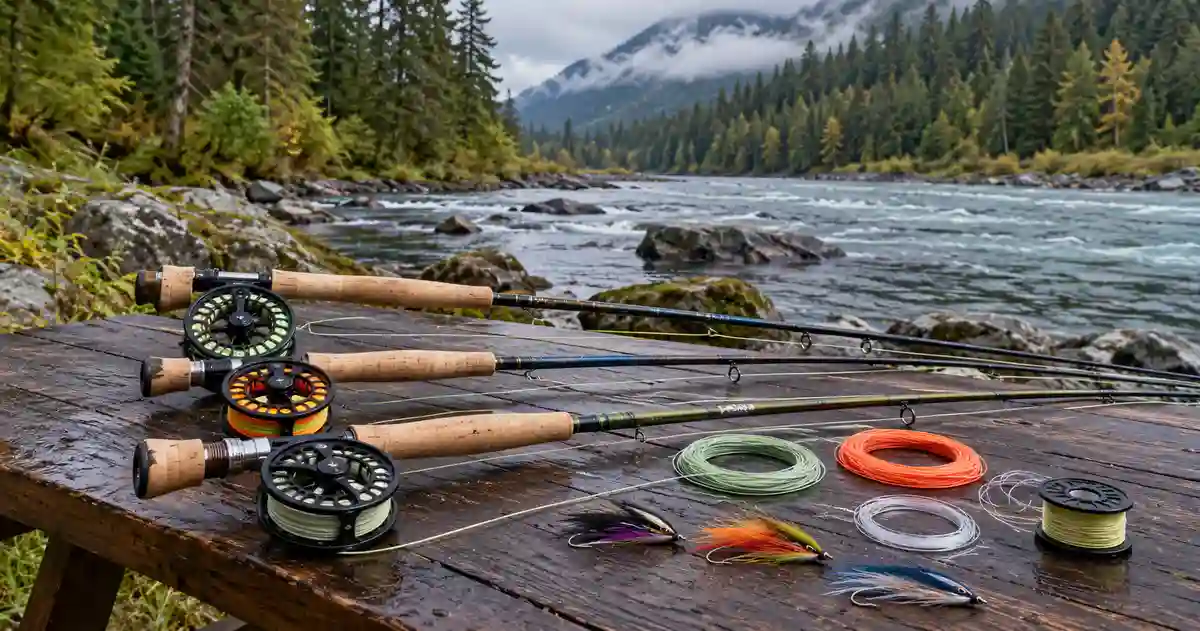
Fly Fishing Gear for Salmon: Rods, Reels, and Lines by Species
Choosing fly fishing gear for salmon starts with three questions: which salmon are you targeting, where will you fish, and what will your rod have to cast? An 8-weight single-hand outfit can make sense for coho in an open estuary, while a large Chinook in fast current may call for more rod power, reel capacity, and a different line. A long Spey rod is not automatically better just because salmon are big.
This guide compares rod weights, reel sizes, backing, fly lines, and leaders for the major salmon species. It also checks real manufacturer specifications so you can compare complete outfits without accidentally combining incompatible components. Product details and availability were reviewed October 17, 2026; check the exact model and configuration before purchasing.
Table of Contents
Fly Fishing Gear for Salmon: Quick Buyer’s Answer
For a versatile first single-hand outfit, a 9-foot 8-weight rod, a reel genuinely rated for an 8-weight line with useful backing capacity, and a weight-forward floating line make a sensible starting system for many coho, pink, and sockeye situations. This is not an endorsement of using an 8-weight everywhere: strong chum, large Chinook, bulky flies, heavy current, and long Spey casts can require different equipment.
| Fishing situation | Rod starting point | Reel priority | Line starting point |
|---|---|---|---|
| Pink salmon in accessible shoreline water | 9–10 ft, 6–8 wt single-hand | Smooth drag; sufficient backing | WF floating |
| Sockeye in river margins | 9–10 ft, 7–8 wt single-hand | Good drag and line pickup | Floating line that mends well; lawful terminal rig |
| Coho in rivers and estuaries | 9 ft, often 8 wt single-hand | Large arbor, reliable drag, capacity | Floating or appropriate intermediate/sink-tip |
| Powerful chum near current | 9 ft, roughly 8–10 wt | Strong drag and ample backing | Floating or sink-tip according to depth |
| Large Chinook in a big river | Stout 9–10 wt single-hand or suitable two-hand rod | Robust drag and high-capacity spool | Heavy sink-tip or matched Spey system as conditions require |
| Atlantic salmon where fishing is legal | Single-hand or double-hand selected for river size | Balanced reel with adequate capacity | Floating, Scandi, or other matched head and tip |
When comparing fly fishing gear for salmon across species, use the table as a starting point rather than a substitute for matching the components. The right fly fishing gear for salmon is the complete system, not a rod number. Check whether your chosen reel holds the actual line plus backing, and whether the line’s grain weight matches your rod’s casting design. A reel marked 7/8 does not automatically fit every 8-weight Spey system.
Fly Fishing Gear for Salmon by Species
Species-based recommendations are starting points, not minimum legal standards or promises about fish size. The water, flies, and casting method matter as much as the salmon itself. Here is how to narrow the fly fishing gear for salmon you need.
Pink Salmon
Pink salmon generally allow lighter tackle when you are fishing accessible water with modest flies. A 9- or 10-foot 6–8-weight single-hand rod is a practical range; a floating line handles many shallow river and estuary presentations. An existing 7- or 8-weight with a sound drag may already be appropriate. This is where fly fishing gear for salmon can be built economically by reusing a suitable trout or light streamer outfit. If you fish saltwater, inspect reel materials and clean your gear afterward. Do not upgrade solely because a dedicated salmon product exists.
Sockeye Salmon
A 9- to 10-foot 7- or 8-weight helps with the close-range line management often needed when sockeye travel near river margins. A floating line with manageable head length can be useful for mending. Sockeye can make hard runs, so don’t treat the reel as a simple line holder. For sockeye, fly fishing gear for salmon should prioritize line control and dependable backing rather than oversized streamer-casting power. Regulations around sockeye methods are particularly important: the gear and terminal presentation permitted on one river may not be lawful on another.
Coho / Silver Salmon
A fast-action 9-foot 8-weight is an established all-around coho reference. It can deliver a broad range of flies without automatically committing you to king-salmon equipment. A large-arbor reel with a smooth drag and sufficient backing is important, especially around tidewater. Floating lines work in many freshwater presentations; an intermediate line or sink-tip may be more useful when you must hold the fly deeper. Coho fly fishing gear for salmon should be chosen around water depth and fly size rather than one fixed line recipe.
Chum Salmon
Chum can require more control than their average size initially suggests. A stout 8- or 9-weight single-hand rod is a useful baseline; larger specimens and strong current can justify a 10-weight. A floating line reaches shallow fish, while a sink-tip helps in deeper runs. Select a reel you can operate smoothly under pressure. If fly fishing gear for salmon will be used primarily for chum, prioritize reliable drag and fish-control over ultralight components.
Chinook / King Salmon
Large Chinook deserve a different equipment decision. A strong 9- or 10-weight single-hand rod is common for some applications, but a 13-foot-plus two-handed rod with a properly matched head and tip can be better suited to sweeping big river runs. Alaska Fly Fishing Goods recommends capacity for at least 150 yards of 30-pound backing in its king-salmon discussion. That is a specialist benchmark, not a universal rule or a guarantee that a reel of a given label meets it. Be conservative about tackle strength when heavy fish and fast current meet.
Atlantic Salmon
Atlantic salmon tackle depends on the fishery and river. A lighter single-hand outfit may be appropriate for smaller rivers; larger water may favor a 12- to 15-foot double-hand rod and suitable Scandi or Skagit system. Do not assume an American state has an open Atlantic salmon fishery: Maine prohibits intentionally fishing for sea-run Atlantic salmon because of their endangered status. Research legal options and exact rules for the river and country where you will fish. Selecting fly fishing gear for salmon never overrides a closed or protected fishery.
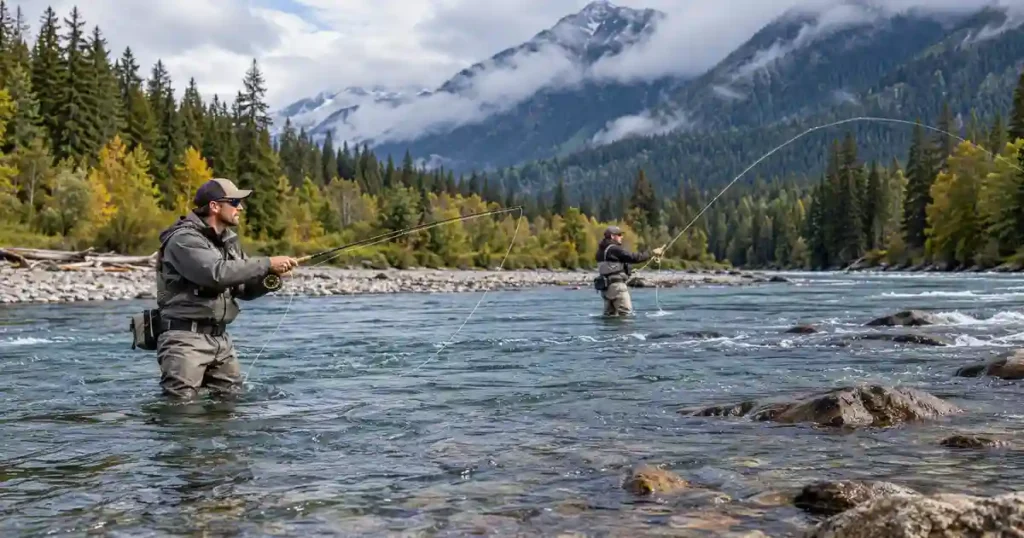
Single-Hand vs Switch vs Spey for Salmon
A single-hand fly rod is the least complicated starting choice when you can make overhead or roll casts, fish shorter lines, and need to retrieve streamers or mend nearshore drifts. Nine feet is versatile; some anglers prefer a 10-foot rod for extra line control. That does not mean longer is always better around trees or cramped riverbanks.
A switch rod sits between single-hand and full Spey designs. It can offer two-handed casting options on medium water, but ratings, rod length, and ideal head weights differ by manufacturer. The label switch does not tell you which line to order. This makes fly fishing gear for salmon with a switch rod a compatibility decision first and a casting-style preference second.
A double-hand Spey rod becomes attractive on broad rivers, especially with little room for a traditional overhead back cast. Scandi-style heads can suit lighter presentations; compact Skagit heads can carry heavier sink tips and flies. Both need a casting stroke and anchor suited to the head, tip, and river. A Spey rod is a casting system rather than a shortcut to fighting large fish.
For fly fishing gear for salmon with two hands, follow the manufacturer’s grain-window recommendation. For example, Guideline’s 15-foot Elevation DH #10/11 specifies a 630–680-grain recommended head weight, while smaller Elevation DH variants differ. Guideline’s Classic Scandi system also lists the weight of the body separately from the weight of the attached tip. Don’t compare those head weights directly with ordinary single-hand 8-weight labels.
Fly Fishing Gear for Salmon: Choosing Rod Length and Weight
First ask whether you need to cast small flies quietly, turn over heavy streamers, manage a long drift, or throw a sink tip. Those jobs can demand different rod actions even within the same numbered weight. A 7-weight is pleasant for modest presentations; an 8-weight offers a useful coho compromise; a 9- or 10-weight gives more power for large flies and demanding salmon water. None is automatically sufficient for every fish.
Check the rod’s intended line system. A 9-foot single-hand 8-weight usually starts with a matched single-hand 8-weight line, subject to deliberately overweight specialty tapers. A 13-foot Spey #8/9 must be matched through its actual grain rating and the head-maker’s guidance, not by grabbing an ordinary WF8 line off the shelf. For a broader primer, see our beginner fly fishing setup before choosing a specialized salmon rod.
When selecting fly fishing gear for salmon to use with an existing trout outfit, consider what can safely be reused. A 6-weight may work for pinks in suitable open water, but a delicate 5-weight trout rod is not a sensible default for large Chinook or a heavily weighted salmon rig. If only one purchase is possible, upgrade the component limiting casting control or safe fish handling, rather than replacing everything indiscriminately.
Fly Fishing Gear for Salmon: Reels, Drag, and Backing
A reel must carry the line and backing without overfilling, recover line efficiently, and apply consistent pressure on a fish making a hard run. A large arbor helps retrieve line rapidly. Smooth drag behavior matters more than an unverified maximum-drag number, because salmon can change direction quickly and slack can develop.
Use published spool capacity for a specified line-and-backing combination. The Sage Spectrum C 7/8 is listed at WF8 plus 200 yards of 20-pound backing; the 9/10 at WF10 plus 200 yards of 30-pound backing. Those are not blanket promises for extra-thick integrated lines, alternative backing materials, or a bulky Spey system. Check the finished spool fill and leave room so the line never rubs the frame.
Saltwater deserves additional attention. Corrosion-resistant construction and appropriately protected drag systems are helpful, but even reels sold for saltwater need cleaning and manufacturer-specified maintenance. Sage describes the Spectrum C as a die-cast aluminum reel with a sealed carbon drag and surface-protective finish. That is a design description, not evidence that FlyFishingScout tested its longevity. Machined alternatives may be desirable for intensive coastal work, but their higher cost must serve a real use case.
When comparing fly fishing gear for salmon reels, also confirm the retrieve hand, spare-spool availability, reel balance on the rod, and how much room remains for backing after your preferred fly line is installed. FlyFishingScout’s guide to choosing a fly fishing reel covers the general size and drag criteria.
Fly Fishing Gear for Salmon: Floating, Sink-Tip, and Spey Lines
Your fly line provides the casting mass and strongly influences where the fly fishes. Among fly fishing gear for salmon, it is often the most overlooked part of an otherwise capable outfit. Begin by identifying the depth you actually need, then select density, head shape, and line weight. The line is not just an accessory to the rod; it can determine whether the outfit works at all.
Weight-forward floating: A versatile starting line for pinks, many sockeye approaches, shallow coho, and indicator or floating-line presentations where permitted. It allows easy line control, though a weighted fly may still reach below the surface.
Intermediate: Sinks gradually and can help keep a fly beneath waves or surface disturbance in estuaries and some coastal conditions. It is not a substitute for heavy sinking tips in fast deep runs.
Sink-tip and full-sinking: Useful where the fly must stay deeper, but more difficult to manage in shallow snag-filled water. Choose depth and current first; faster sinking is not automatically better.
Scandi shooting heads: Typically favor controlled two-handed presentations and compatible tips. Guideline’s Classic Scandi system uses bodies and tips with separate published weights. Skagit heads are compact tools often used to cast heavier flies and sink tips; their exact tip and head combinations must match the rod’s recommended grain window and the line manufacturer’s instructions.
In fly fishing gear for salmon, a multi-tip system can be efficient if river depth changes during a trip. But it also adds cost and complexity. Do not buy a complete range of tips until you know which heads, tip weights, and running lines are compatible. Our general article on choosing the right fly fishing line explains why lines with the same number can cast differently.
A concrete example: RIO’s Premier OutBound Short 8-weight lists a 30-foot, 330-grain head, with floating, intermediate, and sinking variants. That powerful short head is intended for large flies and quick loading of relevant single-hand rods. It should not be mistaken for a 330-grain Spey recommendation merely because both are measured in grains.
Fly Fishing Gear for Salmon: Leaders and Tippet
Leader choices need to fit the presentation and applicable local rules. For many floating-line presentations, a tapered leader gives an understandable starting point; with large flies and strong current, a shorter, stronger leader may turn over and control the fly better. For deep sink tips, a shorter leader helps keep the fly closer to the tip’s intended depth instead of drifting high above it.
Do not select leader strength by species name alone. The useful breaking strength depends on fish size, abrasion, current, fly construction, and the rod’s ability to cushion sudden pressure. Check line-to-leader connections, tippet knots, and backing junctions before fishing. The ordered connection is reel → backing → fly line → leader → optional tippet → fly; FlyFishingScout’s fly fishing line setup walks through that assembly.
For fly fishing gear for salmon used with two-handed heads, also verify whether the front tip is looped, whether a separate leader or polyleader is expected, and what length the casting manufacturer recommends. Randomly adding a long trout leader to a heavy sinking tip can undo the presentation the line was designed to achieve. Keep a few suitable terminal options rather than buying every diameter available.
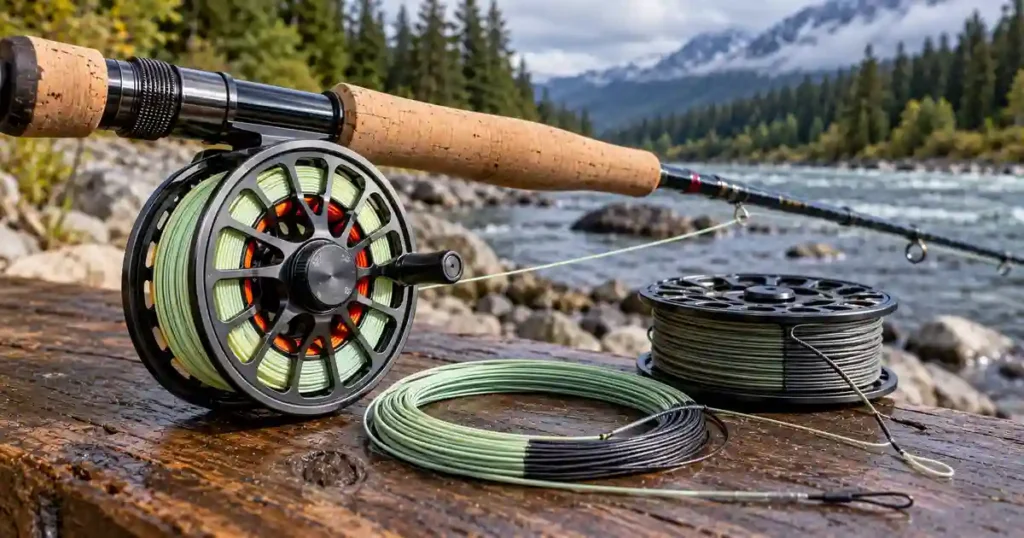
Current Salmon Rod, Reel, and Line Models Compared
These fly fishing gear for salmon examples were selected using the criteria above. The following products are manufacturer-verified examples, selected for clear specifications, relevance to the preceding species-based criteria, and identifiable limitations. They have not been personally tested by FlyFishingScout. Prices and availability shown on October 17, 2026 can change, and the links go to the manufacturers’ product pages rather than invented affiliate destinations.
Sage Foundation 890-4 — Single-Hand 8-Weight Rod
Verified specifications: 9 feet, 8-weight, four pieces, fast action, fighting butt, Graphite IIIe blank. Sage lists the rod at $550. It is a concrete example of the 8-weight category discussed for many coho outings.
Best fit: An angler wanting a current single-hand 8-weight rod for appropriately sized salmon flies and other heavy freshwater or coastal applications. Trade-off: It is not a two-handed Spey rod, and a fast action may not suit every caster. The manufacturer’s page does not claim this specific rod was developed around Alaskan coho; suitability here is an editorial application of its specifications.
Sage Spectrum C 7/8 — Reel for a General 8-Weight
Verified specifications: Large-arbor design, sealed carbon drag, die-cast aluminum frame, 4-inch diameter, 6¼-ounce listed weight, and WF8 plus 200 yards of 20-pound backing capacity. The inspected black variant was marked sold out at the time of research; other colors or dealers may differ. The page displayed $225.
Best fit: Someone evaluating reel capacity for an 8-weight coho outfit. Trade-off: Its stated capacity assumes a particular WF line and backing; saltwater suitability does not eliminate cleaning. It is not worth ordering this exact unavailable color without checking current stock.
Sage Spectrum C 9/10 — Reel With More Capacity
Verified specifications: 4 5/16-inch diameter, 7½-ounce weight, sealed carbon drag, die-cast frame, and WF10 plus 200 yards of 30-pound backing. Listed manufacturer price: $225 at review.
Best fit: A heavier single-hand system where backing strength and spool volume are important. Trade-off: Larger and heavier than the 7/8. Do not presume its standard WF10 capacity remains unchanged with an oversized Spey line or very thick backing.
Guideline Elevation DH — Double-Hand Salmon Rod
Verified specifications: Four-piece double-hand family with 12-foot #7/8, 13-foot #8/9, 14-foot #9/10, and 15-foot #10/11 versions. Guideline lists the 14- and 15-foot versions for larger rivers, heavier heads, and larger flies; a displayed price was $699. The inspected #10/11 variant was shown as unavailable, so check the precise version before buying.
Best fit: Salmon anglers who specifically plan to learn or use two-handed casting on suitable rivers. Trade-off: Higher system complexity, longer rod, and a separate grain-matched line system. It is unnecessary for many nearshore coho or pink-salmon situations.
RIO Premier OutBound Short — Single-Hand Specialty Fly Line
Verified specifications: The 8-weight is listed with a 330-grain 30-foot head; the series includes floating, intermediate, and sinking configurations. Manufacturer price shown: $99.99, depending on chosen configuration.
Best fit: Anglers needing a front-loaded single-hand line to turn over large flies or manage a relevant coastal presentation. Trade-off: More concentrated head mass than many conventional lines. Confirm compatibility with the specific rod before assuming an 8-weight label tells the whole story.
Guideline Classic Scandi Multi-Tip Body — For a Matched Spey System
Verified specifications: Body weights include 26 g/400 grains through 39 g/600 grains, depending on variant. A 29 g/450-grain floating body is listed with a roughly 21.3-foot length; compatible tips add weight and length. The inspected body page displayed $99.99.
Best fit: A two-handed angler building an interchangeable-tip system for changing water depth. Trade-off: This is a body, not automatically a complete ready-to-fish head. You must account for tip weight and potentially running line, and match the completed system to the rod.
Buying takeaway: The most useful fly fishing gear for salmon is what fits the water and the rest of your tackle. A verified manufacturer specification is more informative than an unsubstantiated “best salmon reel” badge. If you already own a suitable rod, spend first on the missing compatible component rather than buying an entire outfit again.
Fly Fishing Gear for Salmon: Three Practical Outfits
These are illustrative configurations, not fixed packages or guaranteed matches across every line taper. Check the exact components before spooling.
Outfit A: Lighter Salmon in Manageable Water
Target: Pink salmon or other relatively modest fish where allowed. Rod: 9-foot 6–7-weight single-hand, assuming fly size and fish strength suit it. Reel: Correctly matched drag and backing. Line: WF floating. Leader: Appropriate strength and length for current and regulations. Reuse first: A sound 7-weight trout/streamer setup may already meet the need. Skip for now: A big-river Spey outfit.
Outfit B: Versatile Coho Single-Hand System
Target: Coho in smaller rivers, estuaries, or open coastal conditions. Rod: 9-foot 8-weight. Reel: Verified 7/8 or compatible size with useful backing; the Spectrum C 7/8’s WF8 plus 200-yard/20-pound published capacity is an example, subject to real line volume. Line: WF floating for many river uses, with intermediate or sink-tip only when depth demands it. Upgrade priority: A suitable reel and line before unnecessary rod duplication. Limit: A large weighted fly in strong wind may stretch a moderate 8-weight’s comfort zone.
Outfit C: Large Chinook or Broad-River Spey
Target: Big Chinook in legal open fisheries, or appropriately regulated Atlantic salmon on a substantial river. Rod: A strong 9–10-weight single-hand for a suitable single-hand method, or a 13–15-foot two-handed rod selected for the river and cast. Reel: Smooth drag and capacity verified for the exact system; specialist Chinook advice commonly begins at 150 yards of 30-pound backing. Line: A rod-matched Skagit or Scandi body/head and the correct tip, or an appropriate heavy single-hand system. Limit: This equipment can be excessive for pink salmon and short shoreline casts.
The fly fishing gear for salmon you already own should be judged against these jobs, not against a shopping list. If your outfit already casts the fly, protects your knots, carries adequate backing, and controls fish in the expected current, replacing it may deliver little benefit.
Rules, Handling, FAQs, and Final Buying Checklist
Fishing rules change with location, salmon runs, protected populations, and emergency orders. Alaska’s Department of Fish and Game says emergency orders can open or close fisheries, modify limits, and change legal methods at any time. Check the exact water, species, and current order before purchasing a specialized rig for that fishery. Maine’s prohibition on targeting sea-run Atlantic salmon is a different, species-specific restriction that should not be confused with lawful fisheries in other regions.
Handle fish with wet hands and keep them in the water where practical. Use gear strong enough to avoid deliberately prolonged fights, support fish appropriately when lifting is allowed, and follow current retention, release, hook, and seasonal rules. Saltwater equipment should be cleaned following the manufacturer’s directions after exposure.
Is an 8-Weight Enough for Salmon?
Often for coho and some pink or sockeye settings, yes. A fast 9-foot 8-weight is an established coho reference. It is not the default for every heavy Chinook or large fly in strong current.
Do I Need a Spey Rod?
Not if a single-hand outfit handles your casts and presentation. Spey equipment becomes useful on broad rivers with limited back-cast space or particular swing-and-sink-tip methods. Plan for the required matched head, tips, and casting practice.
How Much Backing Should a Salmon Reel Hold?
There is no universal amount. For example, Sage specifies WF8 plus 200 yards of 20-pound backing on the Spectrum C 7/8 and WF10 plus 200 yards of 30-pound on the 9/10. Check actual line volume and your fishery rather than assuming capacity from the reel’s size label.
Floating Line or Sinking Line for Salmon?
Start with what keeps the fly at the needed depth. Floating works in many shallow, nearshore, and mending-intensive presentations. Intermediate and sinking systems solve different depth and current problems; they are not automatically superior.
Can I Use a Single-Hand 8-Weight Line on a #8/9 Spey Rod?
Not automatically. Two-handed rods are matched using their recommended casting-head grain windows and sometimes additional tip weights. A common single-hand WF8 designation does not provide enough information by itself.
Final Compatibility Checklist
- Identify the species and verify the fishery is open.
- Match rod length, weight, and casting design to fly size and water.
- Check reel capacity for the actual fly line plus intended backing.
- Choose line density for presentation depth, not popularity.
- For Spey, confirm head grain weight and tip compatibility.
- Select leader, tippet, knots, and hooks for conditions and local law.
- Verify exact model variant, stock, current price, and warranty terms.
- Check balance, corrosion care, and safe fish-handling needs.
The right fly fishing gear for salmon is a matched rod, reel, line, backing, and leader that suit your species and water. For many coho anglers, that can start with a straightforward 8-weight single-hand outfit. For powerful Chinook or long Spey casts, build the system around real line weights, reel capacity, and river demands. Buy the component that solves an identified problem—not a heavier outfit simply because the fish is called salmon.
References
1. Alaska Fly Fishing Goods — Fly Fishing 101: Silver Salmon
2. Alaska Fly Fishing Goods — Meet the Fish: Pink Salmon
3. Alaska Fly Fishing Goods — Meet the Fish: Sockeye Salmon
4. Alaska Fly Fishing Goods — Meet the Fish: Chum Salmon
5. Alaska Fly Fishing Goods — Meet the Fish: King Salmon
6. Guideline — Elevation DH Double-Hand Salmon Rods
7. Guideline — Classic Scandi Multi-Tip Setup
8. Guideline — Classic Scandi Multi-Tip Body Specifications
9. Guideline — Fly Fishing Equipment FAQ
10. Sage — Foundation 890-4 Fly Rod
11. Sage — Spectrum C 7/8 Fly Reel
12. Sage — Spectrum C 9/10 Fly Reel
13. RIO — Premier OutBound Short Fly Line
14. Maine Department of Marine Resources — Atlantic Salmon
15. Alaska Department of Fish and Game — Sport Fishing Emergency Orders