
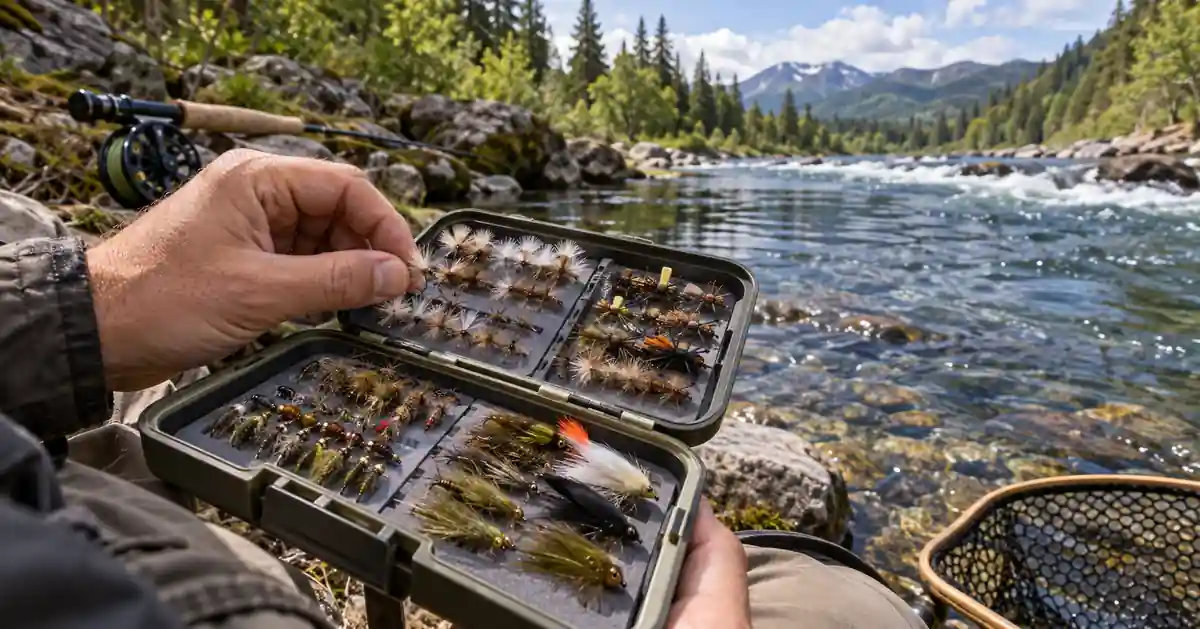
Fly Fishing Flies for Trout: Types, Patterns, and How to Choose
Choosing fly fishing flies for trout becomes much easier when you stop asking, “What is the best fly?” and start asking, “Where are the trout feeding?”
Begin with:
Feeding Layer → Food Clue → Size → Water Conditions → Pattern
If trout are rising, start with surface or emerging insects. If they are feeding deeper, nymphs may make more sense. If they are chasing larger prey, a streamer can become the better tool.
Pattern names come last.
If you are still learning the basic differences among fly categories, our guide to the main types of fly fishing flies provides the broader foundation.
Table of Contents
The Main Types of Trout Flies
| Fly Type | Main Fishing Zone | Typical Role |
|---|---|---|
| Dry fly | Surface | Adult aquatic insects and terrestrials |
| Nymph | Below surface | Immature aquatic insects |
| Wet fly/soft hackle | Film to subsurface | Emerging or swimming insects |
| Streamer | Subsurface | Baitfish, leeches, larger prey |
| Terrestrial | Surface | Ants, beetles, hoppers and other land insects |
You do not need every pattern in every category.
You need enough variety to change depth, size, and food type when the situation changes.
Dry Flies for Trout
Dry flies float on or in the surface.
They are useful when:
- Trout are visibly rising
- Adult insects are on the water
- Terrestrials are falling from bankside vegetation
- You want to prospect suitable shallow water
Common trout patterns include:
- Parachute Adams
- Elk Hair Caddis
- Stimulator
- Griffith’s Gnat
- Royal Wulff
- Comparadun-style flies
Parachute Adams
The Parachute Adams is useful because it provides a general mayfly-like profile and good visibility.
It is not a perfect imitation of every mayfly.
Think of it as a versatile pattern rather than a guaranteed answer.
Elk Hair Caddis
This is a useful caddis-style surface fly and can work especially well when adult caddis are active.
Stimulator
A Stimulator can function as an attractor and can also suggest larger insects depending on size and color.
Its buoyancy can make it useful as the top fly in some dry-dropper rigs.
Nymphs for Trout
Trout often feed below the surface even when no obvious activity is visible.
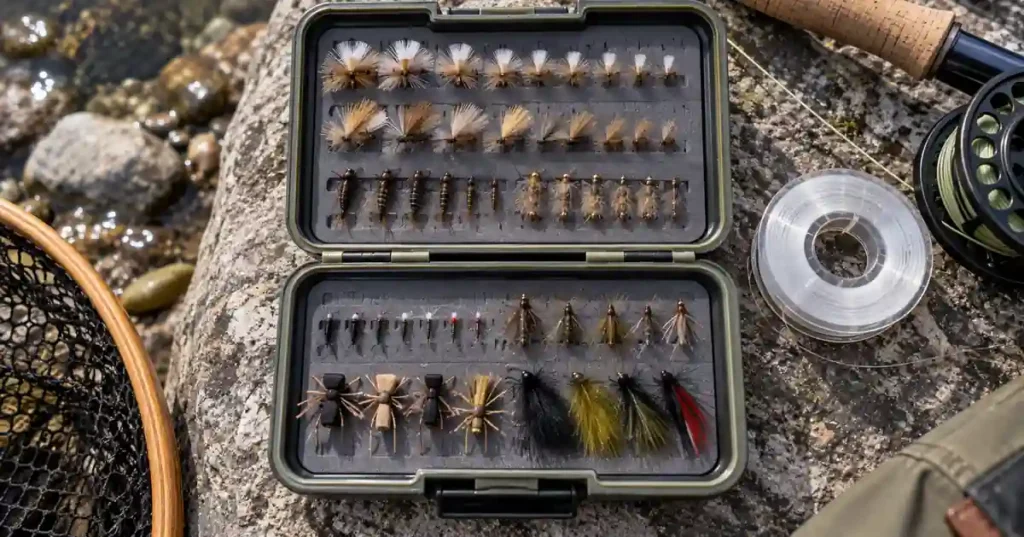
Nymphs represent immature aquatic insects and are among the most useful patterns to carry.
Common examples include:
- Pheasant Tail
- Hare’s Ear
- Prince Nymph
- Zebra Midge
- Copper John
- Perdigon-style nymphs
Pheasant Tail
A Pheasant Tail gives you a slim mayfly-nymph profile.
Carrying it in several sizes is often more useful than buying one example each of many unrelated nymphs.
Hare’s Ear
The Hare’s Ear has a rougher, more general insect profile.
It is useful when you need a buggy impression rather than a highly exact imitation.
Zebra Midge
Small midge patterns can become important when trout are feeding on small aquatic insects, especially in waters where midges are a major food source.
Weighted vs. Unweighted Nymphs
A weighted nymph reaches depth more quickly.
An unweighted version can be useful when:
- Water is shallow
- Fish are feeding higher
- You want the weight elsewhere in the rig
- A slower sink is useful
Do not assume heavier is always better.
Wet Flies and Soft Hackles
Wet flies and soft hackles occupy an important space between traditional nymphs and surface flies.
They can suggest:
- Emerging insects
- Swimming insects
- Caddis pupae
- Other vulnerable food moving in the current
They can be:
- Dead-drifted
- Swung
- Lifted toward the surface
- Fished through riffles and runs
A soft hackle is particularly useful when you see signs of emerging insects but trout are not taking fully formed dries consistently.
Streamers for Trout
Streamers represent larger prey such as:
- Baitfish
- Leeches
- Crayfish-like forms
- Other substantial food
Common trout streamers include:
- Woolly Bugger
- Muddler-type flies
- Small baitfish imitations
- Sculpin-style patterns
A Woolly Bugger is especially useful for beginners because it can be fished in many ways.
You can:
- Strip it
- Swing it
- Drift it
- Pulse it through deeper water
Streamers are not only for unusually large trout.
They are simply another way to represent a different food source.
Terrestrials
Not everything trout eat begins underwater.
During the appropriate seasons, streamside land insects can become important.
Useful terrestrial groups include:
- Ants
- Beetles
- Hoppers
- Crickets
A terrestrial may become especially useful:
- Near grassy banks
- Beneath overhanging vegetation
- During warm months
- When aquatic insect activity is limited
Do not automatically choose a giant hopper because it is summer.
Match the fly to what the water and surrounding habitat suggest.
How to Choose Fly Fishing Flies for Trout
The following process is more useful than memorizing a “top 20” list.
Step 1 — Find the Feeding Layer
Look at what trout are doing.
Surface
You see:
- Rising fish
- Splashy takes
- Insects on the water
Try a dry fly or terrestrial.
Just Below the Surface
You see:
- Bulges
- Subtle rises
- Fish moving without fully breaking the surface
Consider:
- Emerger
- Soft hackle
- Unweighted nymph
Deeper Water
You see no surface activity and trout are likely holding near the bottom.
Try nymphing at the correct depth.
Active Chasing
Fish are pursuing minnows or reacting aggressively.
A streamer may be appropriate.
Step 2 — Look for Food Clues
Look at:
- Insects on the surface
- Insects flying near the water
- Nymphs under stream rocks where legal and appropriate to inspect
- Terrestrials in nearby vegetation
- Small baitfish
You do not need to identify every insect to species.
Start with general categories.
Step 3 — Match Approximate Size
Size can matter before exact color.
If trout are feeding on very small insects, a large attractor may not match what is happening.
Likewise, a tiny midge is not an efficient answer to every situation.
Carry several sizes of your most useful patterns.
Step 4 — Adjust for Water Conditions
Consider:
- Depth
- Current speed
- Water clarity
- Light
- Wind
- Structure
For example, getting a nymph to the correct depth may matter more than changing it from one shade of brown to another.
Step 5 — Pick the Pattern
Now select the pattern that best matches the first four steps.
This order keeps you from changing flies randomly.
Fly Size Matters More Than Beginners Expect
Buying ten pattern names in only one size each can leave major gaps.
A better approach is often:
- Fewer pattern families
- More useful sizes within those families
For example, several sizes of:
- Parachute Adams
- Elk Hair Caddis
- Pheasant Tail
- Hare’s Ear
- Zebra Midge
- Woolly Bugger
can cover more situations than a box filled with one-off novelty patterns.
Fly size also affects your terminal setup. If you are unsure how tippet diameter and fly size work together, see our guide to choosing the right fly fishing tippet.
A Simple Beginner Trout Fly Box
You do not need a huge assortment.
A practical starter framework could include:
Dry Flies
- Parachute Adams in several sizes
- Elk Hair Caddis in several sizes
- One buoyant attractor such as a Stimulator
Nymphs
- Pheasant Tail
- Hare’s Ear
- Zebra Midge
- One heavier nymph option
Wet/Soft Hackle
- One general soft-hackle pattern in a couple of useful sizes
Streamers
- Woolly Bugger in a few colors/sizes
- One small baitfish-style streamer
Terrestrials
Seasonally:
- Ant
- Beetle
- Hopper
This is a framework, not a universal shopping list.
Local insects and fish behavior still matter.
Should You Buy a Trout Fly Assortment?
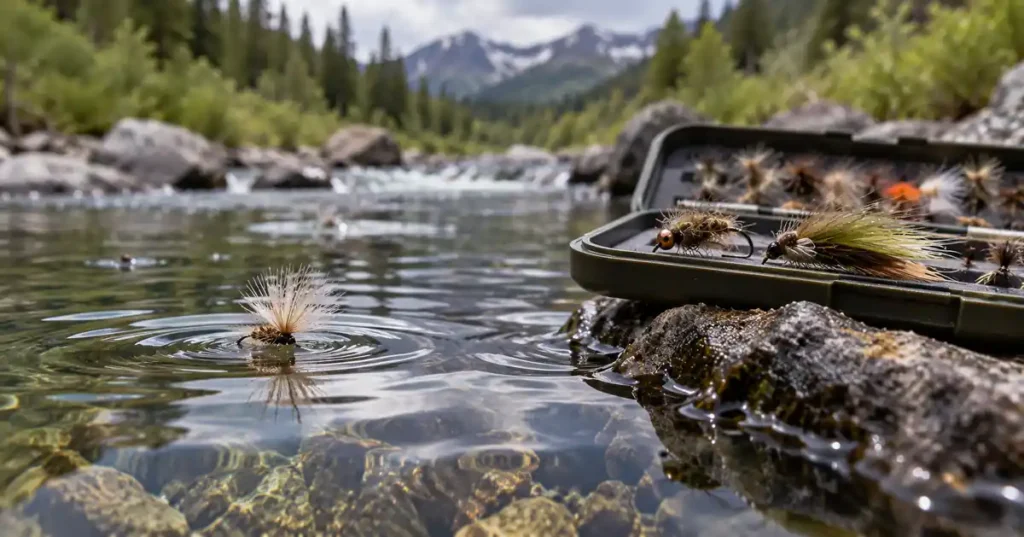
A prebuilt assortment can be useful for a beginner who does not yet know what to buy individually.
But do not judge an assortment by fly count alone.
Check:
Category Coverage
Does it include useful:
- Dry flies
- Nymphs
- Streamers
- Other relevant categories
Sizes
Are several useful sizes represented?
Duplication
Are you getting useful duplicates—or simply the same mediocre choice repeated many times?
Pattern Identification
Can you identify the flies later so you can replace successful patterns?
Regional Relevance
A box built specifically around one region may not be ideal for another.
Replacement Availability
Can you buy individual replacements, or do you need to purchase the entire assortment again?
Current Trout Fly Assortment Examples
These are current manufacturer examples, not universal rankings.
Orvis All-Around Trout Fly Selection
The current Orvis All-Around Trout Fly Selection is listed at $30 at the time of research.
It provides a compact option for someone who wants a small starting selection rather than a huge box.
Orvis Essential Trout Fly Selection
The current Orvis Essential Trout Fly Selection is listed at $70.
This is the broader current assortment option.
Before buying, compare its current contents with the actual water you fish.
Essential Trout Nymph Assortment
Orvis also currently offers an Essential Trout Nymph Assortment at $70.
That makes more sense for someone who already knows they want a nymph-focused selection rather than a balanced first box.
Buying Individual Core Patterns
You can also build a box one pattern at a time.
For example, Orvis currently lists the Adams Parachute as an individual dry-fly option.
That approach makes it easier to buy multiple useful sizes of patterns you understand rather than taking whatever sizes happen to come in a kit.
Common Trout Fly Buying Mistakes
Judging Value by Fly Count
One hundred random flies are not automatically better than twenty useful ones.
Buying One Size of Everything
Several sizes of a core pattern are often more useful.
Choosing Color Before Depth
If your nymph is two feet above the fish, changing from olive to brown may not solve the problem.
Buying Only Dry Flies
Surface fishing is enjoyable, but trout spend plenty of time feeding below the surface.
Buying Only Tiny Hatch-Specific Flies
A first box should handle multiple conditions.
Ignoring Local Food
Regional differences matter.
Forgetting Tippet Compatibility
Tiny flies and large streamers create very different leader and tippet requirements.
Assuming a National Fly List Works Everywhere
A useful core box still needs local adjustment.
Quick Trout Fly Selection Checklist
Before changing flies, ask:
- Are trout feeding at the surface or below?
- What food is visible?
- What approximate size is it?
- How deep is the water?
- How fast is the current?
- Is the water clear or stained?
- Can my current fly reach the correct depth?
- Is the tippet suitable for the fly?
- Is the presentation natural?
- Am I changing patterns because of evidence—or just guessing?
When changing flies frequently, reliable knots become especially useful. Our guide to fly fishing knots for beginners covers the core connections from reel to fly.
FAQs
What Flies Should Every Trout Angler Carry?
A practical box should cover surface and subsurface fishing. Core options can include a few dry-fly families, several nymphs, a soft hackle, one or two streamer styles, and seasonal terrestrials in multiple useful sizes.
Should I Use a Dry Fly or Nymph?
Use fish behavior as your guide. Visible surface feeding supports a dry-fly choice, while little surface activity often makes a nymph a better starting point.
What Size Flies Are Best for Trout?
There is no universal size. Match the approximate natural food, local insects, water conditions, and target fish. Carrying multiple sizes of core patterns is more useful than depending on one “perfect” number.
Are Streamers Good for Trout?
Yes. Streamers can represent baitfish, leeches, and other larger prey. They are especially useful when trout are willing to chase or when you want to cover deeper or larger water.
Are Trout Fly Assortments Worth Buying?
They can be helpful for beginners if they include useful categories and sizes. Avoid choosing solely by the total number of flies.
Final Takeaway
The best way to select fly fishing flies for trout is to decide where the fish are feeding before deciding what famous pattern to tie on.
Use:
Feeding Layer → Food Clue → Size → Water Conditions → Pattern
Build a small box around useful pattern families in several sizes. Learn why you choose each fly, and your fly box will become much more useful than one filled with dozens of patterns you cannot identify.
Sources Used
- Orvis — Fishing Flies Assortments — current trout assortment lineup and current $30/$70 pricing.
Orvis — Fly Assortments - Orvis — All-Around Trout Fly Selection — current $30 product example.
Orvis — All-Around Trout Fly Selection - Orvis — Essential Trout Fly Selection — current $70 broader trout assortment.
Orvis — Essential Trout Fly Selection - Orvis — Dry Flies and Nymph Flies — current examples of dry-fly and nymph inventory, including individual pattern availability.
Orvis — Dry Flies
Orvis — Nymph Flies