
Flies for Carp Fishing: Best Patterns, Weight, and Presentation
The best flies for carp fishing are the ones that reach a carp’s feeding zone without alarming it. Start with a compact nymph, small crayfish imitation, or worm-style fly, then choose its weight and presentation for the water in front of you. A perfect-looking pattern can go untouched if it splashes beside the fish, falls too slowly, or moves above the bottom while the carp is feeding below.
This guide focuses on choosing artificial flies for common carp in US ponds, lakes, and rivers. It explains when to use different profiles and sink rates, where to place a fly, and what to change after a refusal. It does not claim any one pattern works everywhere or that the recommendations were personally field-tested.
Table of Contents
Flies for Carp Fishing: Which Type Should You Start With?
For a carp nosing through shallow sediment, begin with a small bottom-oriented pattern you can land quietly and let settle. A Hare’s Ear-style nymph, sparse crayfish imitation, or compact carp hybrid gives you a useful first choice. In current, the same silhouette may need extra weight; over very shallow mud, an unweighted or lightly weighted version may be more appropriate.
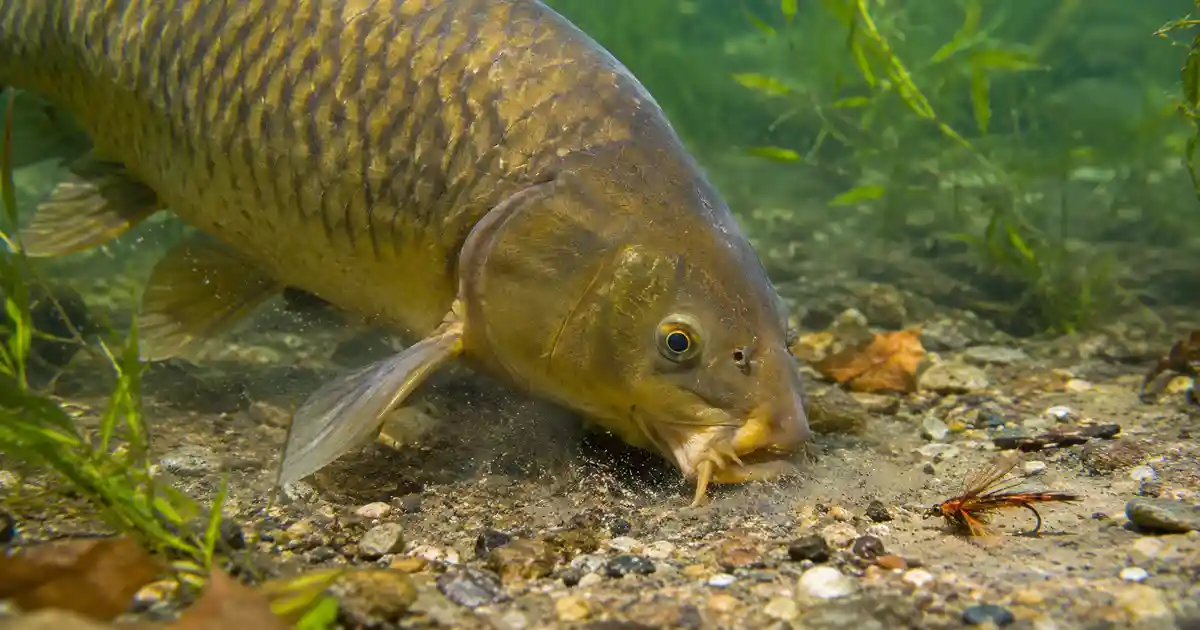
Before choosing flies for carp fishing, read the fish. A carp with its head down, tail raised, or a moving patch of disturbed sediment may be feeding near the bottom. A slowly cruising fish could be searching for food, but you cannot know its intention from movement alone. A fish holding still or traveling quickly may give you no reason to cast yet. When in doubt, observe rather than presenting flies repeatedly.
| What you notice | Starting fly choice | First presentation adjustment |
|---|---|---|
| Carp rooting along a soft bottom | Compact nymph or worm-like fly | Quiet entry; let it settle near the feeding lane |
| Fish working among rocks | Small crayfish or buggy hybrid | Control the drop and avoid dragging into gaps |
| Carp moving beside aquatic plants | Damsel/dragonfly nymph or small leech | A slow sink and brief, subtle movement |
| Fish feeding in a deeper or moving lane | Slimmer, appropriately weighted nymph | Allow enough lead and sink time |
| Clear surface feeding | Suitable terrestrial or surface imitation | Keep unnecessary subsurface flies out of the presentation |
The table is a starting framework, not a claim that every head-down carp wants a worm or that cruising carp never eat. To learn how to find and approach feeding fish, see fly fishing for carp. Here, the priority is selecting and presenting the imitation once you have a possible target.
Best Flies for Carp Fishing: Patterns and Their Trade-Offs
Comparing flies for carp fishing starts with the food they suggest and how the materials behave underwater. Common carp consume small bottom-associated invertebrates, including insect larvae and crustaceans, as well as other organic material. You are choosing an artificial offering the fish might investigate, not reproducing its entire diet.
| Fly family | Potential use | Main trade-off |
|---|---|---|
| Crayfish or craw-style | Rocky margins and bottom-feeding fish | Bulky or weighted versions can splash and snag |
| Worm-style | Soft sediment and slow bottom presentations | Overly large or bright profiles may not fit the situation |
| Aquatic nymph | Subtle prey near weed edges or sediment | Very light versions may not reach depth quickly |
| Leech or small streamer | Fish responding to a moving profile | Fast stripping can move the fly out of the feeding lane |
| Terrestrial or surface fly | Clearly visible surface feeding | Poor match for carp actively rooting on the bottom |
Crayfish Imitations
Compact crayfish flies can be useful around rocks, gravel, or other places where small crustaceans are plausible food. The Umpqua Barry’s Carp Fly, for example, is officially listed in rusty, size 6 and designed to ride hook-up. That orientation can help with bottom presentation but does not make it snag-proof.
A crayfish imitation is a poor default when its heavy eyes crash into very shallow water. Try a lighter version or place it farther ahead of the fish so the disturbance fades before it arrives. If you move the fly, think of a short crawl or modest escape movement followed by a pause, rather than nonstop stripping.
Worm Patterns
Worm-style flies for carp fishing offer a different shape, from a slim, flexible imitation to a bulkier hybrid with a contrasting tail. They may fit a carp that is slowly probing soft sediment, but a pattern’s name does not establish that worms are what a particular fish is eating.
In still shallow water, an unweighted or modestly weighted carp worm can descend gently. In deeper water, too little weight may leave it suspended above the fish’s activity. Avoid assuming a bright red or pink worm must outperform a muted one; first check whether your fly reaches the intended level.
Nymphs and Aquatic Insect Imitations
Nymphs are useful flies for carp fishing because they can imitate small aquatic larvae without excessive bulk. A Hare’s Ear-style nymph, dragonfly nymph, or damselfly imitation provides different silhouettes and potential movements. Around vegetation, a subtly moving olive nymph may suit what the fish is doing better than a large crayfish pattern.
A verified commercial example is Umpqua’s H.V.R.T. Carp Fly, listed as a Gold Ribbed Hare’s Ear-style pattern in size 8. The company describes it as a crossover from an aquatic nymph profile. That is useful design context, not proof it will catch carp in your local pond.
Barry’s Carp Bitter, listed by Umpqua in olive and rusty, size 6, is deliberately a multi-prey imitation that may suggest a small crayfish or larger aquatic insect. You can start with that versatile silhouette without pretending it perfectly matches one prey species.
Leeches and Small Streamers
Among flies for carp fishing, a small Woolly Bugger or leech provides a flexible, moving profile. In a calm pond, let it settle and make a small adjustment rather than automatically retrieving it fast. In darker or deeper water, some controlled movement may help you maintain contact and detect a take.
The Umpqua Backstabber is another verified example, offered in size 6 in black leech, olive, and rusty. Its marabou and hackle provide movement; brass dumbbell eyes add weight. Do not label every Backstabber variation unweighted or assume its advertised soft entry will be quiet at every casting distance.
Surface and Terrestrial Patterns
Carp sometimes feed at the surface. When you actually observe rises, surface sipping, or insects being taken, a suitable ant, beetle, or terrestrial imitation may be worth trying. Fly recommendations for Rocky Mountain carp include terrestrial patterns, but they are conditional alternatives, not substitutes for subsurface nymphs when fish are rooting through mud.
For a refresher on how these categories differ, the FlyFishingScout guide to types of fly fishing flies explains nymphs, streamers, and surface patterns without turning this article into a general fly-selection tutorial.
Weighted vs Unweighted Flies for Carp Fishing
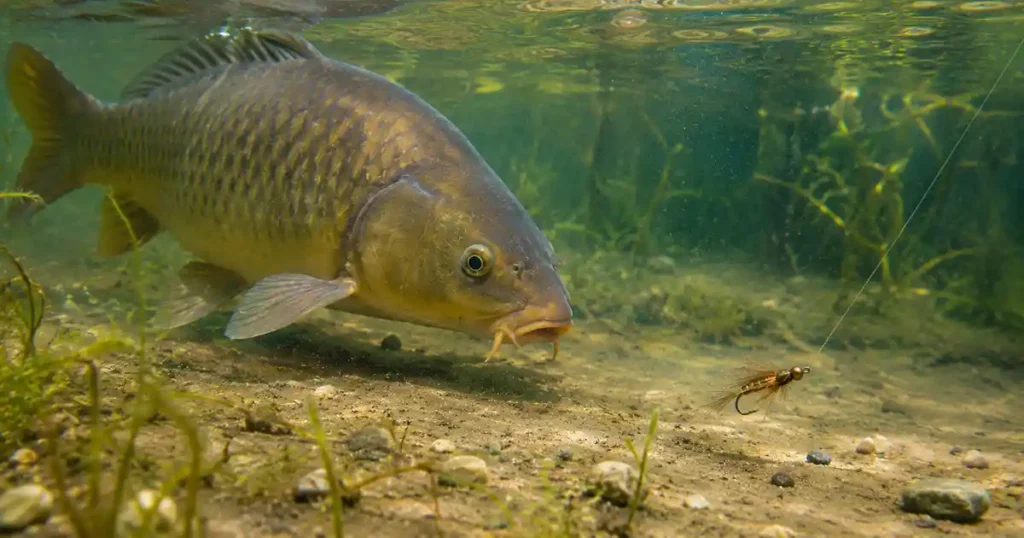
Choosing weighted versus unweighted flies for carp fishing changes both how the fly enters the water and how soon it reaches the feeding zone. There is no fixed sink rate for a hook size: materials, trapped air, water depth, leader tension, and current all matter.
When Unweighted Flies Make Sense
Unweighted patterns may land more softly and descend slowly, which can help in very shallow, calm water or when carp feed just above vegetation. The drawback is time: the fish may pass before the fly gets near the bottom. An unweighted fly is not inherently better if it never reaches the fish.
When Lightly Weighted Flies Help
A small bead-chain or modestly weighted fly is a practical middle option when you need a controllable drop without a dramatic splash. It can be easier to place near a feeding path than a fly that hovers for too long. But bead-chain eyes that work in still water may be insufficient in a river current.
When Heavier Flies Are Necessary
More heavily weighted eyes can help the fly penetrate current or reach deeper feeding levels. The trade-off is a more forceful entry and potentially more bottom snags. Weight alone does not guarantee the right presentation: a heavy fly cast too close to a carp can end the opportunity before it settles.
How to Test a Fly’s Sink Rate
Before choosing among weighted flies for carp fishing, drop or cast the fly in nearby water where you can see it safely. Watch how it lands, whether it hangs on vegetation, and how long it takes to settle. Use that observation to decide how far ahead of a moving carp to place it. Repeat if you change flies, depth, or current. This is an on-site adjustment, not a laboratory measurement.
| Water condition | Try first | Reconsider if… |
|---|---|---|
| Very shallow, calm flat | Unweighted or lightly weighted fly | The fish passes before it sinks |
| Shallow water with light current | Light to moderate weight | Current lifts it out of the lane |
| Deeper water or faster flow | More concentrated weight, suitable profile | Entry splash or bottom snagging becomes excessive |
Match Fly Size, Shape, and Color to Conditions
The hook number is only part of the story. Two size-8 carp flies can have very different body lengths, weights, leg spread, and silhouettes. A sparse nymph and a bulky crayfish pattern will not enter or move through water identically even if their hooks share a number.
Umpqua lists the Backstabber, Barry’s Carp Bitter, and Barry’s Carp Fly in size 6; the Carp-It Bomb comes in sizes 8 and 10. These are verified product options, not a universal best-size rule. Local prey, water clarity, hook wire, and how the fly rides matter as much as the label.
When selecting flies for carp fishing, start with natural olive, brown, tan, or rusty profiles when they reasonably resemble the bottom and likely food. A darker fly can provide contrast over a pale bottom; a pale fly may stand out over dark vegetation. Neither contrast nor camouflage guarantees a take. If you’re seeing refusals, consider reducing the fly’s size or bulk before purchasing many color variations.
For flies for carp fishing in snaggy water, examine hook orientation and the placement of weight. A hook-up design may reduce some contact with the bottom, but exposed legs, material, and the hook can still catch vegetation or rocks. Test the fly’s posture rather than assuming every weighted-eye pattern rides point-up.
Flies for Carp Fishing by Water Type and Feeding Depth
You can adapt flies for carp fishing to different water by changing weight and delivery rather than carrying dozens of near-identical patterns.
Shallow Still Water
In a clear pond margin, a carp may see or feel a fly landing nearby. Start with a relatively light, compact imitation that reaches the feeding zone without a hard splash. Give the fly enough time to settle before the fish reaches it; don’t place an unweighted fly inches in front of a moving fish if it needs several seconds to descend.
Deeper Ponds and Lakes
At greater depth, fly visibility and sink timing become harder to judge. A slightly heavier nymph or crayfish-like hybrid may get down more predictably, but you should still check whether the fish is feeding at the bottom, suspended, or moving elsewhere. Surface activity calls for a different choice than bottom rooting.
Moving Water
Current can carry a fly past the fish before it reaches bottom. A slim, somewhat heavier profile may help it descend, while upstream or across-stream lead gives it time to arrive naturally. Watch whether leader drag lifts the fly or accelerates it unnaturally. Avoid repeatedly sweeping a hook toward the fish’s body.
Rocky or Weedy Bottoms
On rocks, a hook-up crayfish pattern may help reduce some snagging. Among weeds, a slim nymph or lighter leech can be easier to control than a bulky, heavily weighted pattern. If the fly repeatedly catches, adjust its path or profile rather than forcing it through vegetation.
Carp-It Bomb, offered by Umpqua in sizes 8 and 10, was developed for shallow sight-fishing flats. Its creator highlights air-trapping dubbing as a design feature. That makes it a useful example of why material behavior matters; it does not imply a fixed sink rate or guaranteed suitability for every shallow flat.
How to Present Flies for Carp Fishing Without Spooking Fish
With flies for carp fishing, quiet placement, sink time, and controlled movement matter as much as selecting a plausible pattern. First identify the fish’s likely path. Then choose a place for the fly to arrive before the carp reaches it, rather than dropping a heavy fly onto its head. Keep your fly line and shadow away from the fish when possible.
A useful sequence is to observe, choose a landing lane, make one controlled cast, let the fly reach the intended level, and then use a small movement or pause if warranted. A drag-and-drop presentation can work when there is room to land beyond the fish and guide the fly into position without sweeping line across its body. It is not the correct technique for every depth or current.
Example: A tailing carp in a shallow pond. You see the fish tip down and stir a thin patch of silt. Select a compact, lightly weighted nymph and land it ahead of the moving feeding path, far enough away that its entry is less intrusive. Let it descend and wait. If the fish approaches but does not take, a tiny twitch may help; a rapid strip could pull the fly away before inspection.
Example: A feeding carp in slow river current. You can see the fish holding near the bottom, but a light fly drifts above it. Try a slimmer, slightly heavier pattern, and make the cast far enough ahead for the current to bring it into the feeding lane at depth. Mend or manage line only as needed to prevent unnatural drag. If the current accelerates the fly past the fish, adjust the lane before changing pattern color.
A fish opening its mouth, changing angle, or moving toward the fly can provide useful clues, but seeing a take is not always possible. Avoid repeated aggressive strikes at uncertain movements, especially when the fly could be near the fish’s body. Use the legal tackle and fish-handling methods required by the water you’re fishing.
For a genuine demonstration, see Orvis’s How to Sight-Fish with Nymphs for Carp in the References. The video covers fly choice, presentation, and avoiding disturbance; it is not a substitute for observing your own water.
When Carp Ignore Your Fly: What to Change First
Repeated refusals do not automatically mean you own the wrong flies for carp fishing. Use a short diagnosis before opening the fly box again:
- Check likely feeding activity. Is the fish rooting, tailing, or deliberately investigating food? If not, give it time or seek another target.
- Check the landing. Did the fly or line slap the water? Move the target point or use a lighter imitation.
- Check depth. Did the fly settle where the fish is feeding, or hang above it? Adjust weight or allow more lead time.
- Change movement. Try a pause or very short crawl rather than long repeated strips.
- Adjust size or silhouette. A more compact nymph may look less intrusive than a large crayfish imitation in clear shallow water.
- Change pattern family only when useful. If the fish is working along weeds, for example, a damsel nymph may be a more plausible option than a bottom-heavy craw.
- Stop when the opportunity has passed. Repeated casts to an alarmed or unresponsive carp can disturb other fish nearby.
Imagine using a worm-style fly in two feet of still water. The carp passes before the fly settles. Rather than immediately changing to a bright leech, try leading it farther ahead or using a more appropriately weighted version of the same silhouette. Change one variable at a time so you can learn what improved the presentation.
Build a Beginner Box of Flies for Carp Fishing
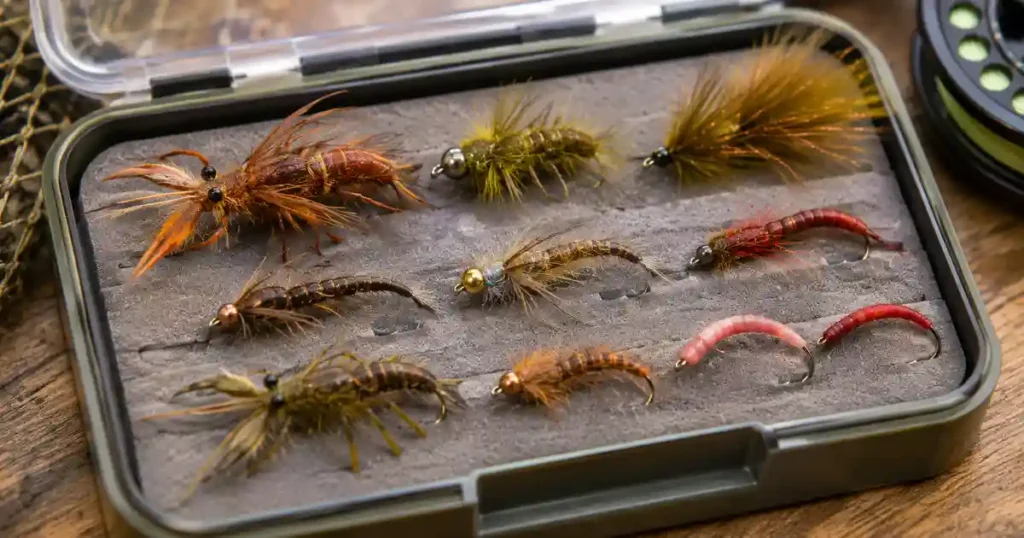
A beginner choosing flies for carp fishing does not need a large collection. Start with different jobs, not ten nearly identical colors. A compact set of around eight flies can cover several profiles and sink rates while leaving room to adapt after you learn what local carp respond to.
| Starting assortment | Suggested quantity | Why it earns space |
|---|---|---|
| Compact nymphs in two weights | 3 | Small, subtle subsurface options |
| Small crayfish or hybrid flies | 2 | Bottom-oriented profile for mixed substrates |
| Worm-style flies | 2 | Alternative shape for slow, soft-bottom presentations |
| Small leech or Woolly Bugger | 1 | Moving profile when that behavior is relevant |
This is an illustrative selection, not a packaged commercial kit or a promise that eight flies are enough for every waterbody. An optional surface pattern makes sense if you regularly see surface feeding. Likewise, a heavier variant may be useful in a river but unnecessary in a shallow pond.
Commercial patterns such as the Backstabber, Barry’s Carp Bitter, Carp-It Bomb, and H.V.R.T. Carp Fly provide real examples of available silhouettes. They are not mandatory purchases: a trout nymph you already own may do the job when its strength, size, sink behavior, and presentation are suitable. Check retailer stock and exact pattern specifications before ordering.
Organize flies for carp fishing by how each fly sinks and behaves rather than simply by color. That makes it easier to respond to a missed feeding lane without starting over with a random pattern.
Flies for Carp Fishing FAQs
What is the best fly for a beginner targeting carp?
A compact nymph or modestly weighted buggy pattern is a practical starting choice when carp are feeding near the bottom. The correct sink rate and quiet presentation matter more than a universally named best fly.
Are weighted flies always better for carp?
No. Heavier flies reach depth faster but may splash or snag. Unweighted flies can enter quietly but may not reach the feeding zone soon enough. Match weight to actual depth, flow, and fish movement.
What size flies should I use for carp?
Commercial carp patterns appear in several hook sizes, including sizes 6, 8, and 10 in verified Umpqua listings. That is not a universal recommendation; consider silhouette, hook strength, available prey, and conditions.
Can carp take unweighted flies?
Yes, when the fly reaches a feeding fish at the appropriate time and level. An unweighted nymph or other imitation can be useful in calm shallow water, but may descend too slowly elsewhere.
Why do carp ignore worm and crayfish patterns?
Even well-chosen flies for carp fishing may be refused because of an unresponsive fish, a loud landing, the wrong sink rate, or excessive retrieve movement. Observe and change one controllable part of the presentation before replacing the pattern.
Can I use ordinary trout nymphs for carp?
Often, yes. A suitable nymph can imitate food carp consume. Make sure the hook, leader, and fly weight are appropriate for the fish and water; tiny light-wire hooks may not suit larger carp or heavy cover.
Final takeaway: Choose flies for carp fishing by matching profile and weight to where a fish is likely feeding. Start with a few nymphs, craw-style and worm-style patterns, then practice quiet entry and controlled sink time. On your next outing, identify the feeding level first—and change the fly only when you have a reason.
References:
- U.S. Geological Survey — Common Carp (Cyprinus carpio): Species Profile
- American Carp Society — Fly-Fishing for Carp
- California Fly Fisher — Early Season Carp in Reservoirs
- Orvis — Top 5 Flies for Rocky Mountain Carp
- Orvis — Video: How to Sight-Fish with Nymphs for Carp
- Umpqua Feather Merchants — Backstabber
- Umpqua Feather Merchants — Barry’s Carp Bitter
- Umpqua Feather Merchants — Barry’s Carp Fly
- Umpqua Feather Merchants — Carp-It Bomb
- Umpqua Feather Merchants — H.V.R.T. Carp Fly
- FlyFishingScout — Fly Fishing for Carp: How to Find, Approach, and Catch Feeding Fish
- FlyFishingScout — Fly Fishing Lures: Types of Flies & How to Choose