
Fly Fishing for Carp: How to Find, Approach, and Catch Feeding Fish
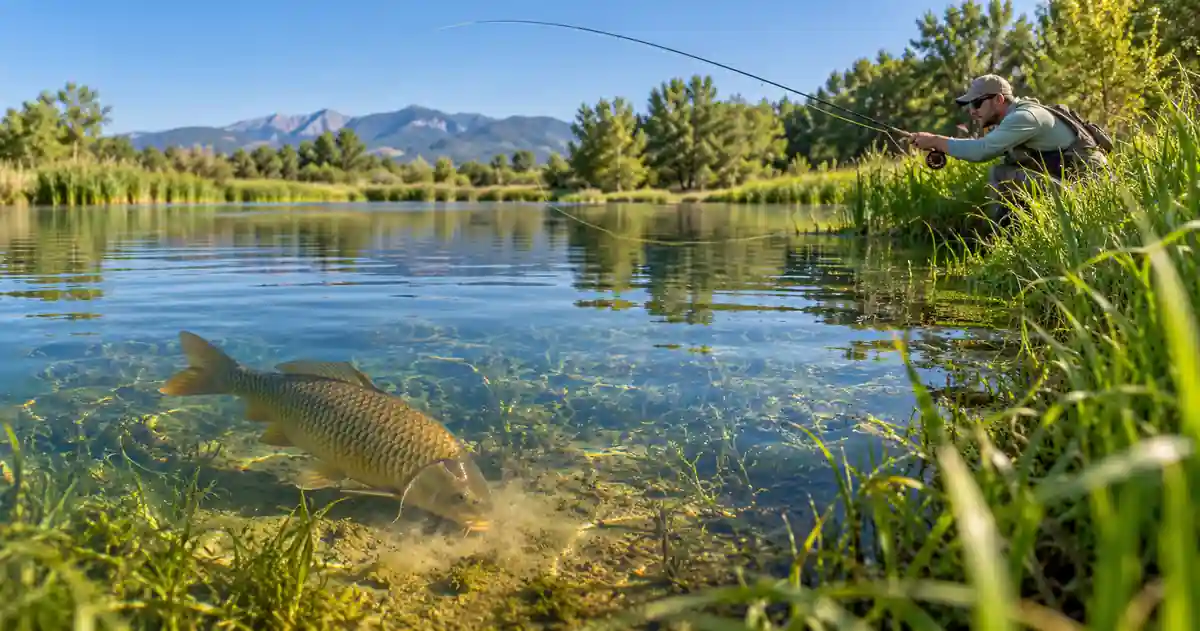
Fly fishing for carp becomes much more manageable when you stop casting at every fish you can see. A carp cruising across a pond or suspended near the surface may ignore an excellent fly. One feeding head-down in shallow water, however, gives you a clearer opportunity: watch its path, approach quietly, and let a small fly settle where it is already looking for food.
This guide focuses on common carp in American ponds, lakes, and slow rivers. You’ll learn to recognize feeding signs, make a quiet presentation, choose flies by sink rate, and handle a powerful fish on your existing fly tackle. No technique guarantees a take, and local rules can change how you may fish for or release carp.
Table of Contents
Fly Fishing for Carp: Quick Start for Beginners
The basic plan for fly fishing for carp is to find a feeding fish, approach without disturbing it, place a fly in its feeding path, watch for the take, and apply controlled pressure. That sequence matters more than owning a specialized box of carp patterns.
| What you notice | What it might mean | Your first move |
|---|---|---|
| Head down, tail raised, bottom being disturbed | Likely active feeding | Watch the direction, then make one quiet presentation |
| Fresh mud puff moving through a shallow area | Possible bottom-feeding carp | Confirm movement or see the fish before casting |
| Carp cruising steadily at mid-depth | Feeding intent is uncertain | Observe longer or search for another target |
| Fish sitting still just under the surface | No clear feeding sign | Avoid repeated blind casts |
| Several fish thrashing together in shallow vegetation | May be spawning activity | Leave them undisturbed and check local rules |
Start with a floating line, a small nymph or other bottom-oriented imitation, and a landing net suited to the fish. Fish a quiet bank where you can see the bottom or follow a moving mud cloud. You do not need to buy a new outfit before you know what size carp live in your local water.
Finding Feeding Carp in Ponds, Lakes, and Slow Rivers
When fly fishing for carp, finding a fish that is actively looking for food matters more than simply locating carp in the water. Common carp eat bottom-dwelling insects, small crustaceans, snails, detritus, and plant material. As they root around, they can disturb sediment and aquatic vegetation. Look for evidence of that behavior rather than assuming every large fish is ready to eat.
Shallow Pond Margins and Coves
For fly fishing for carp in ponds, check gradual banks, shallow corners, and protected coves. Mud or sand you can see through makes sight fishing easier. Carp sometimes enter very shallow water to feed, although temperature, disturbance, and season influence where they appear. A productive shore on one visit may be empty on the next.
Walk the bank slowly before making a cast. If you see a carp, stop and determine whether it is rooting along the bottom, moving purposefully, or merely holding in place. Resist the urge to cast immediately. A short observation can prevent several wasted presentations.
Weed Edges and Soft-Bottom Flats
The outer edge of vegetation can offer food and cover, while open patches let you lower a fly without snagging. Look for a line of freshly disturbed sediment moving beside weeds or small areas where a carp has been turning over the bottom. Avoid dragging flies through dense vegetation simply because a fish is nearby.
Slow River Sections and Backwaters
In rivers, look for slower edges, side channels, backwaters, and gentle flats adjacent to current. Fish may face into the flow while feeding on drifting or bottom-dwelling food. Read the current before making the cast: a fly that drops neatly in a pond may be swept past the fish in a river.
For fly fishing for carp in moving water, approach and presentation may be very different from a still-water stalk. A shorter, controllable shot can outperform a long cast if the current pulls the leader away from the feeding lane.
When to Observe Instead of Casting
If you see fish holding motionless or swimming without signs of feeding, give them time or move to a better opportunity. Glare, wind, and cloudy water can make feeding behavior difficult to interpret. Sometimes returning under better viewing conditions is more productive than repeatedly casting without a clear target.
Fly Fishing for Carp: Spot Tailing, Mudding, and Bubbles
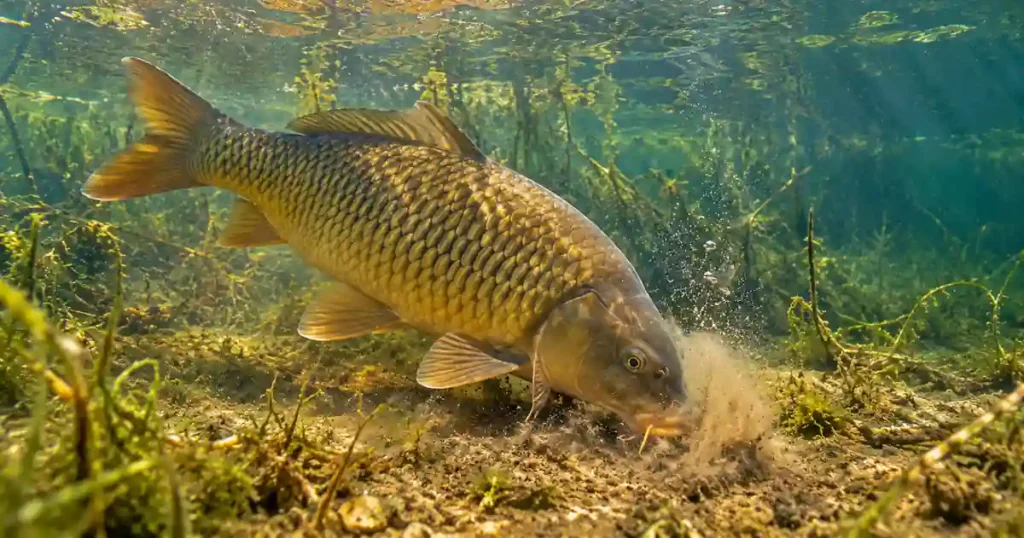
The most useful clues for fly fishing for carp are tailing and rooting. A carp with its head tipped down may show its tail near or above the surface while probing sediment. You may also see small clouds of silt that seem to advance across a shallow flat.
Tailing: The fish’s head-down posture and slow movement suggest it is searching the bottom. Watch which way it progresses before picking a landing zone.
Mudding: A fresh, localized plume can mark where a fish has disturbed the bottom. But wind, turtles, other fish, or a person wading can stir sediment too. Look for an actual carp or repeated fish-like movement before committing to a cast.
Bubbles: Small bubbles can rise after bottom disturbance. Bubbles by themselves are not reliable proof of feeding carp; gas release and other activity can produce them. Combine this clue with tailing or mud movement.
Cruising: A fish swimming in a straight line may be traveling between feeding areas. Give it time to stop or change posture before casting.
Spawning: Groups splashing and thrashing in shallow plants may be spawning rather than feeding. Do not provoke fish to react or disturb spawning activity.
Fly Fishing for Carp: Stealth and Sight-Fishing Approach
Stalking is a major part of fly fishing for carp because a poor approach can end the opportunity before the fly lands. Fish in shallow water may react to footfalls, abrupt shadows, a fly line slapping the surface, or repeated overhead movements.
Approach from the bank with small deliberate steps. Stay back from the waterline while you scan. If the shore is exposed, lower your profile rather than standing against a bright open background. Polarized sunglasses can help cut surface glare, but they will not make muddy water transparent.
Pay attention to sun angle and wind. Try to keep your shadow away from the fish, and make your cast in a direction you can control safely. A breeze can disturb the surface enough to hide fish, although it may also make the angler less conspicuous. Never step deeper or move onto unsafe ground merely to shorten a cast.
One carefully planned short cast is usually better than ten false casts over a feeding carp. If brush blocks the back cast, use a cast you can make safely instead of forcing the rod through branches. FlyFishingScout’s guide to fly fishing casting techniques explains the differences between overhead, roll, and other useful casts.
Practical example: You spot a carp tailing about a rod-length beyond a shallow weed edge. Stop walking. Watch its next two feeding movements. Then choose an open patch ahead of it, not the fish’s head itself. If it turns away before you cast, reset your position instead of chasing it down the shoreline.
Fly Fishing for Carp: How to Present the Fly
In fly fishing for carp, a good presentation places an appropriate fly at feeding depth without frightening the fish. The exact landing distance depends on water clarity, depth, fish movement, and how quickly your pattern sinks. No universal “cast three feet ahead” rule will suit every situation.
Lead the Fish Without Landing on It
Observe the direction of a feeding carp. Choose a clear landing point a little ahead or to the side of that path, where the fly can sink before the fish arrives. Avoid landing the fly line over its back or throwing a heavy nymph directly onto its head.
For fly fishing for carp on shallow flats, watch where the leader and line will land as carefully as the fly. A quiet fly is little help if several yards of line splash across the fish.
Try a Controlled Drag-and-Drop
A drag-and-drop presentation can help where you have room to land beyond the fish without lining it. Cast so the fly lands away from the carp, keep the fly line from crashing over it, move the fly carefully into the intended lane, then let it sink. Use small movements and control the drop rather than swinging the fly into the fish.
This is not mandatory. In very shallow clear water, a direct but delicate presentation into an open feeding lane may be better than pulling a fly across the surface. If repositioning the fly creates more disturbance, stop and choose another method.
Let the Fly Sink Naturally
Once the fly reaches the lane, let it settle. Carp may examine or inhale a fly near the bottom and reject it quickly. Long aggressive stripping can pull the imitation away before the fish can approach.
A lightly weighted fly makes a softer entry but sinks more slowly. A heavy bead or dumbbell eye reaches depth faster but can splash or hang in weeds. Test the sink rate close to shore before aiming at a fish. You need to know approximately when the fly will reach its feeding level.
Use Small Movements, Not Constant Stripping
Try a tiny twitch, a short crawl along the bottom, or a pause after the fly settles. When a carp is already rooting for food, making the fly flee rapidly may be less convincing than leaving it available. Some carp will chase moving food, so movement is not inherently wrong; match what you observe rather than follow a rigid rule.
Adapt the Drift in Moving Water
In current, allow enough time and upstream or across-stream lead for the fly to reach the fish’s level. A slim heavier fly may be appropriate when a slow-sinking pond nymph never reaches the bottom. Keep line drag from lifting the fly out of the feeding zone.
Best Flies for Carp and How to Choose Their Sink Rate
The most useful patterns for fly fishing for carp imitate food the fish might already be seeking, without excessive bulk. Common carp have a varied diet, so a small fly box can cover several appearances and sink rates. The right weight often matters more than the pattern’s marketing name.
| Fly family | Sensible starting use | Main limitation |
|---|---|---|
| Hare’s Ear or similar nymph | Feeding near soft bottom or insect-rich water | Very small or light versions may drift above the fish |
| Worm-style imitation | Carp probing mud or soft sediment | Some synthetic materials may be restricted by local fly-only rules |
| Compact crayfish imitation | Rocky edges or areas with crayfish | Heavy, exposed hooks may snag |
| Carp hybrid / sparse weighted pattern | Sight fishing when a defined sink rate is needed | Too much weight can splash in shallow water |
| Small Woolly Bugger or leech | Slightly deeper or stained water | Excessive movement may push a wary fish away |
A tan, olive, brown, rust, or black variation can provide useful contrast, but do not buy five colors before you know the sink rate of your chosen pattern. A compact natural-colored nymph is often a sensible first try where the carp are rooting along the bottom.
Still pond: Start relatively light if the water is shallow and calm, where a hard landing is especially noticeable.
Windy or deeper pond: Increase weight only enough to reach the feeding zone without losing control of the fly.
Slow river: Consider a slim, somewhat heavier pattern that cuts through current and reaches bottom before sweeping past the fish.
Rocky bottom: Think about hook orientation and avoid repeatedly dragging a hook through cracks. A point-up design can reduce some snags, but is not snag-proof.
FlyFishingScout’s guide to types of fly fishing lures explains nymphs, streamers, and related fly categories if you’re using patterns first bought for trout.
You do not need to buy a specialized carp fly assortment to begin fly fishing for carp. First see whether a few existing nymphs and small streamers can be presented at the correct depth. More elaborate carp-specific flies may become useful once you identify what your local fish eat and the weight you need.
Fly Fishing for Carp With a Simple Rod and Leader Setup
You can begin fly fishing for carp with ordinary freshwater fly-fishing equipment when the expected fish are modest and the water has room for them to run. A 5-weight trout rod may suit smaller carp and light flies in open water, but it is a poor choice for intentionally targeting very large fish beside dangerous snags.
Rod: A 6- to 8-weight outfit offers greater control for larger carp, heavier patterns, stronger wind, and cover. Choose based on the real fishery, not simply because carp are sometimes large. Casting a weighted nymph is different from casting a bulky streamer.
Reel and backing: Carp can make sustained runs. Check that the reel has a smooth, adjustable drag and enough correctly spooled backing for the water and expected fish. Avoid overfilling the spool, and keep fingers clear of a rapidly spinning handle.
Line: A weight-forward floating line is a versatile starting point because many productive opportunities occur in visible, relatively shallow water. A sink-tip is not an automatic upgrade; it may reduce the control you need to place a fly precisely near a feeding fish. The guide to choosing the right fly fishing line covers the general differences between floating and sinking systems.
Leader and tippet: Use enough length to keep the fly line from landing directly over the fish, but not so much that you cannot control the fly or clear knots through the guides. An approximately 9-foot tapered leader is a practical starting reference in open stillwater, subject to adjustment. Match tippet strength to fish size, cover, fly weight, and abrasion—not to a universal carp formula.
Landing net: A suitably large rubberized or fish-friendly net helps land fish without prolonged exhaustion or dropping them on gravel. If large carp are likely, bring a net sized for them rather than a tiny trout net. Bring forceps and a safe way to keep the fish close to the water.
What can wait: Premium carp-branded rods, multiple specialized lines, and an enormous fly assortment. Practice spotting and presenting to feeding fish before deciding which additional purchase would actually help.
Fly Fishing for Carp: Setting the Hook and Landing Fish
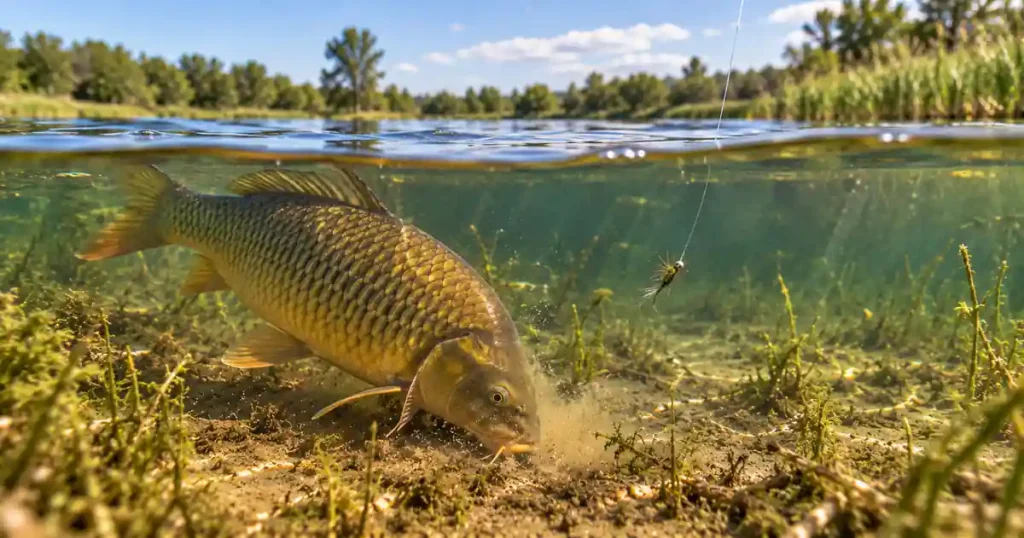
Recognizing a take is a distinctive challenge of fly fishing for carp. A fish may inhale a bottom fly and reject it quickly, so a strong tug on the line is not always your first clue. Whenever visibility allows, watch the carp’s mouth and the fly’s position closely.
Detecting the Take
Signs may include the fish tipping toward the fly, a brief mouth movement, a flash of pale lips, or the leader moving unexpectedly. None is proof on its own. If you see the fly disappear and the fish’s mouth close around it, remove slack and make a short, controlled lift or sweep to establish contact.
Avoid a huge, abrupt upward strike. It can break light tippet, pull the fly from a fish’s mouth, or send a weighted fly back toward you if the fish never took it. With little visibility, watch the end of the fly line for a purposeful movement, but don’t interpret every twitch as a bite.
Handle the First Run
Once the fish is securely hooked, keep the line free from your fingers, shoes, rocks, and the rod handle. Let the drag do its job; use smooth pressure rather than clamping down on a powerful first run. A carp may head toward weeds, wood, or a bank undercut, so maintain an angle that encourages it away from immediate hazards without high-sticking the rod.
Net and Handle the Fish
Bring the fish toward the net only when it can be guided under control. Keep it low and close to the water. Wet your hands before touching it; avoid placing a carp on dry gravel, a hot dock, or an abrasive bank. Support its body with both hands if lifting is lawful and necessary, and minimize air exposure.
In jurisdictions where common carp may legally be released, let it recover upright in the same waterbody before it swims away. Never relocate a live carp into another pond or river. If local law requires different disposition of a species, follow that law rather than applying a blanket catch-and-release rule.
Fly Fishing for Carp: Fixing Refusals and Missed Takes
When fly fishing for carp ends in refusals, diagnose the presentation before buying a new fly. An ignored fly doesn’t automatically mean the fish disliked its color.
- Recheck the fish: Was it truly feeding, or only cruising past the bottom?
- Reduce disturbance: Did the leader slap the water or your shadow cross the fish?
- Check depth: Did the fly reach the feeding zone, or pass above it?
- Change movement: Try a longer pause, smaller twitch, or less stripping.
- Adjust weight or profile: Replace an overly heavy splashy fly with a lighter one, or add weight if current prevents it from sinking.
- Move on: A fish that repeatedly ignores clean opportunities may be less useful than one feeding in another location.
Example: You see a carp moving a mud cloud along a pond margin. Your first nymph lands quietly, but the fish moves past before the fly sinks. Instead of immediately switching to a bright worm, choose a landing point slightly farther ahead and give the same fly more sink time. If it still hangs above the bottom, consider a slightly heavier version. If the fish stops feeding or bolts, leave it and find another opportunity.
For a visual example of presentation and stealth, see the Orvis lesson How to Sight-Fish with Nymphs for Carp in References. The demonstration takes place at Ontario’s Bay of Quinte and is a technique example, not a recommendation to fish a particular location or assume local access.
Regulations, Species Identification, and Responsible Release
This guide concerns common carp, not every fish with “carp” in its name. Common carp have a long dorsal-fin base and small whisker-like barbels near the mouth. Native bigmouth buffalo lack those barbels. Grass carp have a different appearance and may be subject to stocking or protection rules. Do not assume that harvest, release, or transport regulations are identical for these species.
An important part of fly fishing for carp is recognizing that common carp are nonnative and may damage shallow-water habitats by disturbing sediments and plants; states classify and manage them differently. For example, Minnesota identifies common carp as a regulated invasive species and permits an angled common carp to be returned to the same waterbody, while prohibiting introduction into new waters. Michigan also restricts moving and releasing caught fish into different waters. Those examples do not establish a nationwide catch-and-release rule.
Before fly fishing for carp, check the fishing-license requirements, state and waterbody rules, permitted tackle, and public access. Ponds in parks may have additional local rules. A pond visible from a sidewalk may still have prohibited fishing or private-bank access.
Rinse and clean gear when moving between waters to reduce the spread of aquatic organisms. Never move live carp, other fish, or aquatic plants between ponds. Keep fishing line, hooks, and litter out of the water. If a carp is to be released under local rules, handle it gently, support its body, and minimize the time out of water.
Fly Fishing for Carp FAQs and Final Checklist
Is Carp Fly Fishing Suitable for Beginners?
Yes, if you can make a controlled short cast and are willing to spend time observing. Finding feeding fish and presenting without disturbance are usually more important early skills than long-distance casting.
Can You Catch Carp With a 5-Weight Fly Rod?
Yes, particularly smaller fish in relatively open water. For large carp, strong current, or heavy cover, a 6- to 8-weight may provide better control. A reel with a suitable drag and backing matters as fish size increases.
What’s the Easiest Way to Find Feeding Carp?
Look for head-down fish, tails close to the surface, and fresh bottom disturbance in shallow water. Confirm the movement before casting; mud and bubbles alone are inconclusive.
Why Do Carp Ignore Artificial Flies?
A fish may not be feeding, or the fly may land too loudly, sink at the wrong rate, or move unnaturally. Start by observing behavior, then change the angle, depth, or movement one variable at a time.
What Fly Should I Start With?
Try a compact nymph or similarly subtle bottom-oriented fly that reaches the fish’s feeding depth. A lightly weighted pattern suits quiet shallow water; more weight may be needed in current.
Can You Catch Carp in Cloudy Water?
Yes, but sight fishing becomes harder. Watch for moving mud plumes, tails, and disturbance along shallow edges. Do not cast blindly into every cloud; confirm likely fish activity and use a fly you can control.
First-Session Checklist
- Choose a bank where you can observe shallow water safely.
- Bring a floating-line outfit, two or three different fly profiles, and a suitable net.
- Watch for a feeding fish before choosing a casting angle.
- Make one quiet presentation and let the fly reach the feeding zone.
- Watch for the take, set with controlled tension, and avoid overplaying the fish.
- Confirm local access, identification, and release rules before fishing.
The central lesson of fly fishing for carp is simple: choose the feeding opportunity before choosing the fly. Observe first, approach quietly, control the sink rate, and make one useful presentation instead of casting repeatedly at every visible fish. For your next outing, spend the first few minutes watching the shallows; that observation may teach you more than changing patterns every five casts.
References
1. U.S. Geological Survey — Common Carp (Cyprinus carpio) Species Profile
2. Minnesota Department of Natural Resources — Common Carp
3. Michigan Department of Natural Resources — Common Carp and Suckers
4. Michigan Department of Natural Resources — Fishing Regulations
5. Michigan Invasive Species Program — Invasive Species Prevention for Boaters and Anglers
6. U.S. Fish & Wildlife Service — Clean, Drain, Dry
7. Outdoor Life — The Ultimate Beginner’s Guide to Fly Fishing for Carp
8. MidCurrent — How to Catch Carp on a Fly: Stalking and Presentation Tactics
9. Orvis — How to Get Started in Carp Fishing, with Rick Mikesell
10. Orvis — Pro Tips: How to Fish for Carp in Moving Water, Part I