
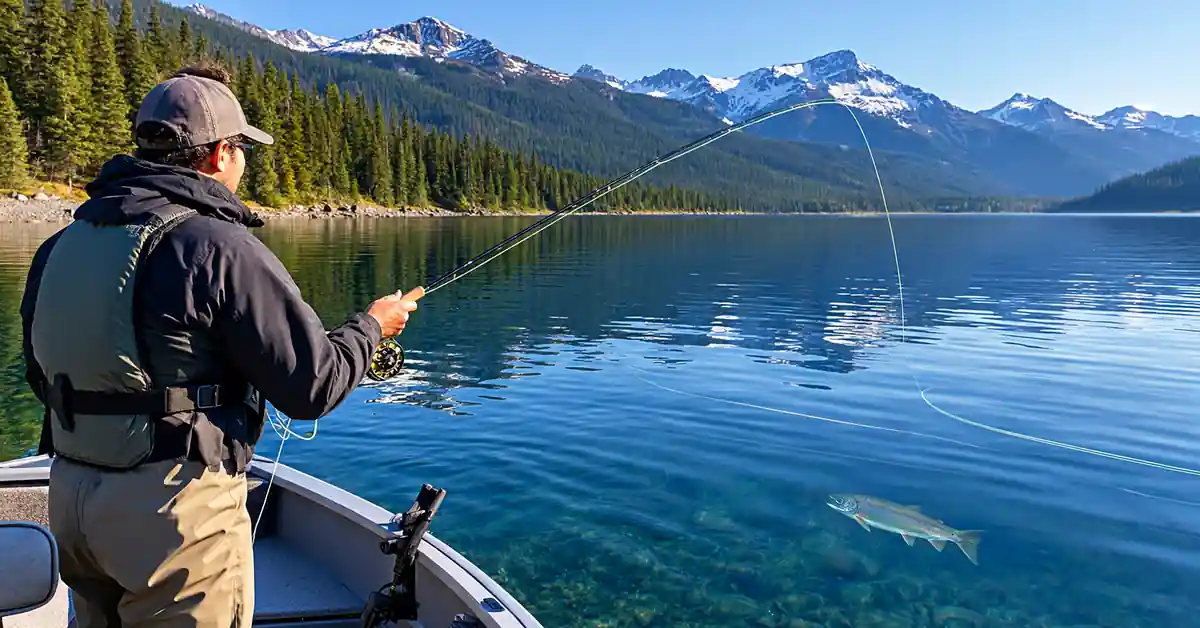
Fly Fishing for Kokanee Salmon: Flies, Depths, and Legal Methods
Fly fishing for kokanee salmon is largely a depth-finding problem. These small, landlocked sockeye often feed in open water instead of cruising the same shoreline all day. In spring, a school may be high enough in the water column to reach with a floating line and a small fly. By midsummer, the same lake may hold kokanee below the depth that an ordinary cast and retrieve can cover effectively.
This guide explains how kokanee feed, where to look during different seasons, which flies and fly lines are worth trying, and when fishing from shore is realistic. It also covers spawning periods and rules on snagging and retention. Legal examples were checked in October 2026; always use the regulations for your own state, waterbody, and fishing date.
Table of Contents
Fly Fishing for Kokanee Salmon: Quick Answer
Yes, you can catch kokanee on a fly rod. The most practical starting point for fly fishing for kokanee salmon is a lake where the fish are feeding at a reachable depth. Use a floating line with small chironomids or nymphs when fish are shallow, an intermediate line for a slightly deeper, slow-moving presentation, or a suitable sinking line when fish are deeper but still realistically accessible. Finding the school matters more than buying one supposedly perfect fly.
| What you observe | First fly approach to consider | Important limitation |
|---|---|---|
| Insects hatching and fish near the surface | Small emerging insects or a carefully suspended nymph | Surface activity may be trout rather than kokanee |
| Fish suspended a few feet down | Floating line and indicator, or a slow intermediate retrieve | Match the fly to the measured or observed depth |
| Fish holding moderately deep | Appropriate sinking line and counted retrieve | Sink rate does not guarantee a specific fishing depth |
| Schools far offshore or very deep | Reconsider location, timing, or another lawful fishing method | A fly rod may not reach them efficiently |
| Fish collecting to spawn | Check closures and avoid disturbing spawning habitat | Colorful fish are not automatically legal to target or retain |
When planning fly fishing for kokanee salmon, begin with the lake’s current rules and a realistic access plan. Decide whether you can reach the fish safely and legally before selecting a fly pattern.
Kokanee Salmon vs Ocean-Run Sockeye
Kokanee and ocean-going sockeye are both Oncorhynchus nerka. Sockeye typically migrate between freshwater and the ocean. Kokanee spend their entire lives in freshwater lakes and connected streams. That life-history difference changes the fishing. A kokanee feeding in a reservoir may take a small artificial insect, whereas an ocean-run sockeye returning to spawn is largely focused on migration.
Kokanee commonly consume tiny zooplankton, including small crustaceans suspended in the water. They can also take larger aquatic invertebrates when these become available, including chironomid pupae, mayfly nymphs, and damselfly nymphs. Small flies can therefore be meaningful food imitations rather than merely bright objects presented to a passing fish.
For fly fishing for kokanee salmon, feeding silver fish are generally a more appropriate focus than brightly colored fish gathering to spawn. Adult kokanee are usually silver before spawning. Mature fish can turn vivid red with greenish heads, and males develop changes in jaw and body shape. During the spawning phase, fish may congregate on gravel shorelines or move toward tributaries. These visible fish are vulnerable to disturbance, and their appearance tells you nothing about whether the area is open to fishing.
The difference matters when planning fly fishing for kokanee salmon: do not transplant Alaska’s Kenai Flip or sockeye flossing arrangements into a lake or tributary and assume the technique is suitable or lawful. Kokanee angling should begin with feeding fish, accessible depth, and the rules for the actual water.
Fly Fishing for Kokanee Salmon: Seasonal Depth Changes
Kokanee move within lakes as water temperature, available oxygen, light, and plankton distribution change. Their depth is not fixed by a calendar. In a stratified reservoir, the thermocline separates warmer surface water from cooler water below; fish may use a band where temperature, oxygen, and food are suitable. Deeper is not always better if very deep water has poor oxygen conditions.
For fly fishing for kokanee salmon, the most useful seasonal question is: At what depth are feeding fish today, and can my presentation spend enough time there?
| Season | Common planning pattern | Fly-line implication | Check before fishing |
|---|---|---|---|
| Spring | Fish may be near the surface or in upper layers | Floating or intermediate lines can be useful | Temperature, insect activity, distance from shore |
| Early summer | Schools may shift progressively deeper | Intermediate or sinking line may help | Where schools and plankton actually concentrate |
| Midsummer | Fish often suspend offshore in cooler water | Fast sinking lines have limits; boat access may help | Reachable depth, oxygen, wind and safe boating |
| Autumn | Mature fish move toward spawning areas | Fishing opportunities may be restricted | Retention rules, tributary closures, spawning habitat |
These are tendencies, not guaranteed depths. Idaho Fish and Game has published examples of fish near 1–10 feet in spring and deeper, around 15–40 feet in early summer. Those figures describe fishing observations and conventional presentations, not a claim that a fly cast will reach or remain at every listed depth.
Spring: Look High Before Going Deep
In a cold or recently ice-free lake, kokanee may feed in upper layers and sometimes near accessible shorelines. Watch for subtle surface movement, insects, birds working over plankton-rich water, and fish that appear repeatedly in the same band. Begin with a small suspended fly or slow subsurface retrieve rather than automatically choosing the fastest sinking line.
If you are learning fly fishing for kokanee salmon from the bank, spring gives you a more plausible starting scenario than a midsummer school suspended far offshore. Even then, bank opportunities depend on the reservoir’s shape and where fish are actually feeding.
Summer: Locate the Layer, Not Just the Bottom
As upper water warms, kokanee may move into a cooler zone and remain suspended above much deeper lake bottom. Dropping a fly all the way to the bottom can put it below the fish. Use local fishery reports, a fish finder when available, or careful experimentation to identify the productive layer.
A sinking line can help, but the fly’s actual depth depends on how much line is out, time allowed to sink, fly buoyancy, retrieve speed, wind drift, and boat movement. The line’s labeled sink rate is only a starting point. If schools are repeatedly beyond practical fly-fishing reach, change locations, fish a shallower period, or accept that another legal method may be better suited to that water.
Fall: Fishing and Spawning Are Different Decisions
Kokanee often shift toward spawning areas as maturity approaches. Some waters may be open to catching fish but closed to possession; others have tributary or shoreline closures. Do not treat fish in bright spawning colors as a convenient target. Read local rules and avoid wading through spawning gravel even when you are not fishing.
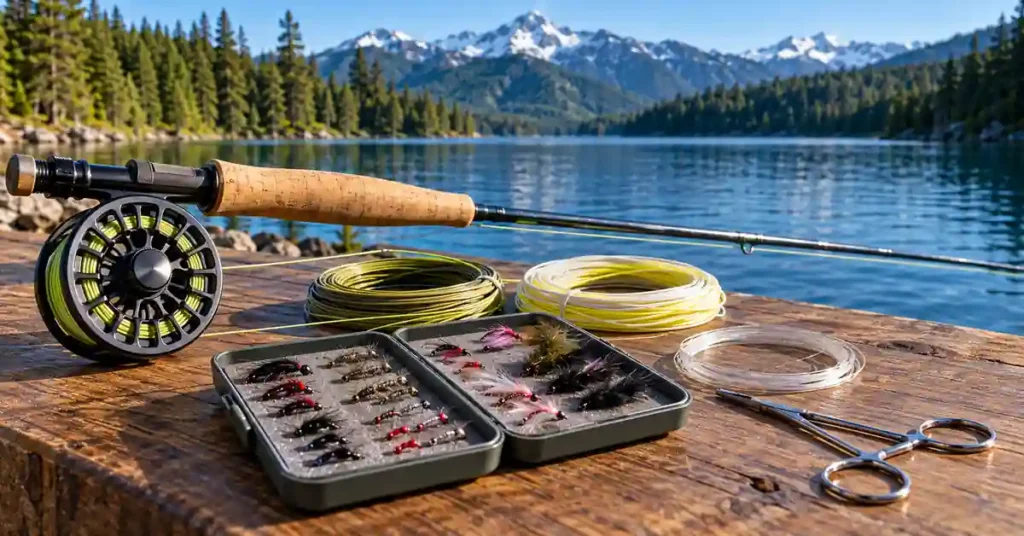
Fly Fishing for Kokanee Salmon: Finding Schools
To find kokanee, think of a three-dimensional lake rather than a shoreline trout stream. The fish may hold over deep water at a relatively shallow depth, gather near a drop-off, or move with food sources. A productive-looking bank is only useful if kokanee are within reach of your fly.
Begin With an Access and Depth Plan
Study a lake map or official fishery description. Look for legal launches or banks that reach deeper water, submerged points, and broad shelves beside drop-offs. An accessible shelf may let you work several depths without traveling far. But an appealing contour line on a map does not guarantee fish or safe access.
For fly fishing for kokanee salmon, observe the water before casting. If fish are occasionally showing near a weed-free edge or insect activity is concentrated in a bay, start there. If the only reports describe fish in deep open-water schools far from shore, adjust expectations before making a long drive with a floating line alone.
What Sonar Can and Cannot Tell You
For fly fishing for kokanee salmon, sonar can help answer a practical question: is a suspected school at a depth your line can fish? A fish finder can show marks at certain depths and reveal bait or plankton layers. It cannot reliably identify every fish species from a mark by itself. Kokanee often travel in schools, but trout and other fish may occupy similar water. Use sonar as a depth clue, then evaluate whether a legal fly presentation can reach that zone.
Without electronics, work through reachable depth bands systematically. Spend a measured interval with one presentation, change either the depth or retrieve, and watch for repeated signs. Avoid changing fly, line, depth, and location simultaneously, because you will not know what improved the result.
Watch Food and Water Conditions
Zooplankton distribution can change with light, temperature, and lake conditions. A visible insect hatch can briefly make a shallow presentation worthwhile. Wind may concentrate surface food but can also make a float tube or small kayak unsafe. Do not chase a distant feeding school into conditions beyond your boating ability.
Fly Fishing for Kokanee Salmon: Flies to Try
A fly does not need to imitate every component of kokanee’s plankton diet. Much of their everyday food is tiny. Practical fly fishing for kokanee salmon often uses the larger insects or small swimming organisms that kokanee occasionally take, or compact flies presented where feeding fish can investigate them.
| Fly type | When it may help | Presentation idea |
|---|---|---|
| Chironomid pupa or larva | Fish feeding on midge stages | Suspend near an observed feeding depth |
| Small mayfly or damselfly nymph | Accessible spring or early-summer fish | Slow, controlled retrieve |
| Scud or freshwater shrimp-style pattern | Lakes with suitable invertebrate forage | Gentle subsurface movement |
| Micro leech | Fish responding to a small moving fly | Short slow strips with pauses |
| Small Woolly Bugger | Searching reachable subsurface layers | Steady or interrupted retrieve |
| Sparse, subtly bright streamer | Situations where fish react to motion or color | Test color only after depth is reasonable |
Start With Small, Observable Patterns
Chironomids are a good first experiment when a stillwater hatch is occurring. A small black, olive, brown, or reddish pupa can be fished at a measured depth beneath a suitable indicator where allowed. Do not guess that a long indicator leader is always easy or safe to cast from a crowded boat.
Small nymphs and micro leeches give you a way to test moving presentations when fish are within reach. A slow retrieve with short pauses may hold the fly in a useful zone longer than a fast, erratic strip. If fish repeatedly respond to motion but miss the fly, try reducing speed before changing the entire setup.
Bright Colors Are Experiments, Not Guarantees
Experienced kokanee anglers sometimes try pink, orange, silver, or chartreuse accents. Such colors can be worth comparing with natural patterns, particularly in a sparse streamer or leech. However, a flashy fly at the wrong depth is still unlikely to solve the problem. Avoid promising that a particular shade is the universal best fly for kokanee salmon.
If fly fishing for kokanee salmon produces no activity, ask in order: Am I near kokanee? Can the fly reach them? Is it staying there? Only then ask whether a different pattern or color might help.
Fly Fishing for Kokanee Salmon: Rod, Lines, and Leaders
A general-purpose 4- to 6-weight freshwater fly rod can be a practical starting range for reachable kokanee, with a 5-weight especially convenient for small flies and controlled presentations. Match rod, line, leader, and expected wind rather than choosing tackle from the word salmon. In strong wind or when casting bulky sinking lines, a more suitable rod-line pairing matters more than an exact fish-size formula.
For fly fishing for kokanee salmon, the fly line is often the equipment choice with the biggest effect on presentation depth. FlyFishingScout’s guide to fly fishing line explains the main differences among floating, intermediate, sink-tip, and full-sinking designs.
Floating Line and Indicator Fishing
A floating line works for surface insects and suspending a chironomid or small nymph at a manageable depth. Set the indicator position after considering the water depth and the height of the fish, not merely the distance from your fly to the bottom. Use a leader arrangement that casts safely and complies with the lake’s terminal-tackle rules.
When fly fishing for kokanee salmon with a suspended chironomid, long fixed leaders can be awkward to lift and cast. A specialized sliding indicator or different presentation may solve some handling problems, but check the rig and local rules rather than attaching accessories without a purpose.
Intermediate Lines and Shallow Retrieves
An intermediate line sinks relatively slowly, making it useful for keeping a micro leech or small streamer just beneath the surface on some days. Allow a short countdown after the cast, then retrieve in controlled intervals. Adjust the countdown before changing the retrieve speed if you suspect fish are a little deeper.
Full-Sinking Lines and Their Limits
Sinking lines can explore deeper reachable water, but sink rate is not a depth guarantee. A line labeled at a certain inches-per-second rate sinks under test conditions; your fly may travel at a changing depth as you retrieve. A dense line may also require different casting technique and more room to lift from the water.
When fly fishing for kokanee salmon, use a countdown as a repeatable starting measurement, not an exact depth meter. If a fly sinks during the pause but rises during a fast retrieve, slow the retrieve or use a different line only when sensible. Do not assume a fly line can efficiently fish a school marked 60 feet down just because it is called fast-sinking.
Leader, Tippet, and Soft Mouths
Choose leader and tippet that allow a small fly to move naturally while still letting you land the fish promptly. Kokanee have relatively delicate mouths and may come unhooked during abrupt pressure changes. Keep rod pressure smooth, avoid violent hook sets, and use a suitable landing net if needed. The correct leader strength depends on the rig, water, and fish rather than a universal pound-test recommendation.
For the underlying reel-to-fly sequence, see our fly fishing line setup guide. That article explains connections; this guide addresses how the assembled tackle reaches kokanee in a lake.
Fly Fishing for Kokanee Salmon: Cast, Retrieve, and Slow Trolling
There are several realistic ways to present a fly to kokanee. Which one works depends on where the school is, whether fish are responding to insects or motion, and whether the presentation can remain at their depth. For fly fishing for kokanee salmon, deliberate, repeatable changes usually tell you more than constantly switching patterns.
Suspend a Chironomid at a Reachable Depth
When fish are holding relatively shallow, use a floating line and appropriately sized indicator system where lawful. Present the fly at a sensible depth, allow it to settle, and watch for subtle takes. Small movement can come from gentle surface ripples, but high wind may create too much drag or become unsafe for a small craft.
Count Down a Sinking-Line Retrieve
Cast safely, let the line settle for a consistent count, and retrieve with short controlled strips or a gentle hand-twist motion. On the next cast, change the countdown slightly if conditions allow. This comparison helps identify a productive presentation range, although it does not reveal exact depth without other measurements.
If you are new to controlled fly casts or need a roll cast near vegetation, review FlyFishingScout’s fly fishing casting techniques. Use a casting style suitable for the bank, boat, line type, and people around you.
Move a Fly Slowly Behind a Boat Only Where Lawful
Some fly anglers slowly trail or troll a suitable fly behind a rowed or powered boat, using an appropriate line and secure rod handling. This can help cover more reachable water, but it is not a conventional cast-and-retrieve presentation, and the local fishing rules or vessel restrictions still apply. Do not copy conventional kokanee trolling speeds and hardware arrangements into a fly-only fishery without checking the definitions.
Boat speed, turns, line length, and the fly’s buoyancy all affect depth. A slowly trolled fly is not automatically at the same depth as a fly suspended under an indicator. Keep the line away from the propeller, passengers, and other anglers.
When the Fish Are Too Deep
If kokanee are consistently holding deeper than a practical fly rod presentation reaches, be realistic. You may have more useful fishing by returning during cooler conditions, finding another legal lake with shallower fish, or choosing a different lawful technique. You do not have to force fly fishing for kokanee salmon into conditions better suited to specialized conventional deep-water equipment.
Shore Fishing, Float Tubes, and Boats
Fishing from the bank offers simple logistics and avoids boat costs, but kokanee often spend time in open water beyond ordinary casting distance. Spring shallows, steeply dropping banks, and reachable feeding areas can create exceptions. That is why a shore-accessible fly-fishing opportunity must be verified for the particular lake rather than assumed from a stocking report.
Shore Fishing: Find Reachable Water
Look for lawful public shorelines where depth increases within casting range and where a back cast can be made safely. A rocky point may bring deeper water close to shore, but slippery banks and steep drop-offs create hazards. Respect private-property boundaries and do not wade into areas used for spawning.
If fishing from shore is the only practical option, fly fishing for kokanee salmon is often worth prioritizing in cooler periods with shallow fish. Arriving with only a floating line during a midsummer deep-water bite may lead to frustration even when kokanee are abundant in the reservoir.
Float Tube or Kayak: More Reach, More Responsibility
A float tube or kayak can help you reach offshore feeding areas, but the freedom comes with cold-water, wind, and rescue risks. Use a properly fitting U.S. Coast Guard-approved wearable life jacket where applicable, and wear it on the water. Select a craft suitable for the conditions, understand self-rescue, carry communication and signaling gear, and stay within a safe return distance. A fish finder is useful only when your craft is safe to operate and you can present the fly at the indicated depth.
Boat Fishing: Position Instead of Chasing
For fly fishing for kokanee salmon, a boat can help you work a school without the long casting distance required from shore. Still, avoid repeatedly motoring through feeding fish or crowding other anglers. Hold an appropriate safe position in suitable weather, make short controlled presentations, and secure all loose fly line. Changing wind and boat drift can alter the depth of a sinking-line presentation even when your retrieve stays the same.
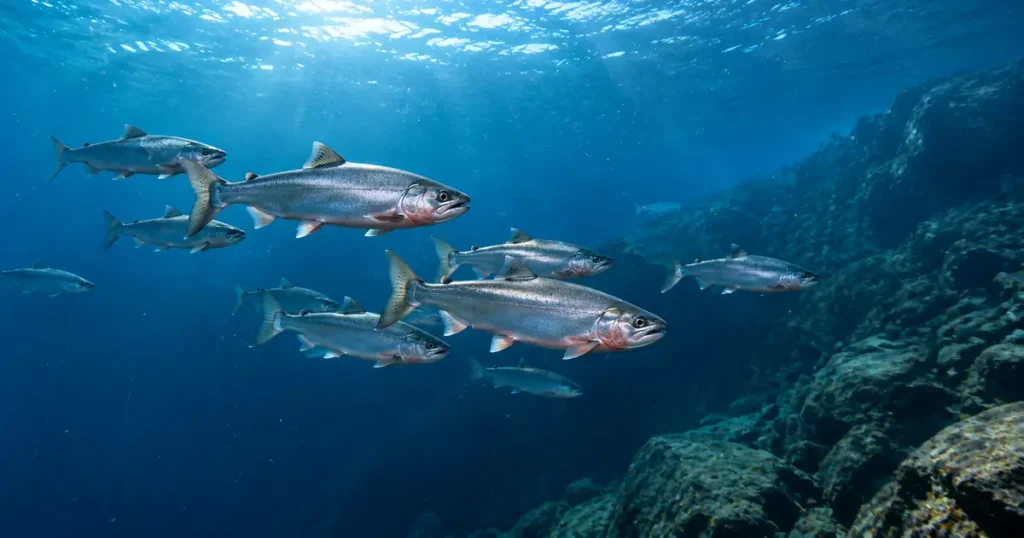
Spawning Kokanee: Behavior and Fish Care
Kokanee generally mature, change color, and move toward spawning tributaries or suitable gravel habitat during fall. Their dramatic red bodies make them easy to see and easy to disturb. In some waters spawning occurs along lake shorelines; in others fish enter streams. Local timing and access restrictions vary.
For fly fishing for kokanee salmon during spawning season, concentrate on understanding the regulations and protecting habitat. Do not walk across redds, chase fish in shallow water, handle them for photographs, or allow pets to harass spawning schools. Never infer that a river mouth or tributary full of red fish is open for fishing simply because nearby lake water remains accessible.
A responsible fly fishing for kokanee salmon plan includes a clear decision to stop or move when fishing would disturb actively spawning fish, even if the angler has not yet seen a posted closure. For a lawfully caught fish being released, minimize handling and air exposure, use wet hands, and follow the local release rules. For retained fish, follow the specific lake’s limits and fish-handling requirements.
Fly Fishing for Kokanee Salmon: Legal Rules, Flossing, and Snagging
There is no single United States regulation for fly fishing for kokanee salmon. Fishing seasons, legal tackle, hook rules, catch limits, harvest restrictions, and spawning protections are determined by the relevant state and often the individual lake or tributary. A method accepted in one state should not be assumed lawful somewhere else.
Utah: A 2026 Spawning-Season Possession Rule
Utah’s 2026 fishing guidebook states that anglers may not possess kokanee salmon anywhere in the state from September 10 through November 30. The rule is not a claim that every Utah lake is closed to all fishing throughout that period. Additional water-specific rules and tributary closures may apply. Check the current guidebook and any later emergency changes before fishing. Do not treat these 2026 dates as confirmed rules for an unspecified future year.
Washington: What the Snagging Definition Says
Washington Administrative Code WAC 220-300-160 defines snagging as an effort to take fish with a hook and line in a way that the fish does not voluntarily take the hook into its mouth. This is an important difference from assuming that every fish hooked in or near its mouth represents a voluntary strike. Washington’s applicable fishing-method prohibitions and water-specific rules must also be checked before fishing.
Why Kokanee Flossing Is Not a Default Fly Method
In salmon fishing, flossing or lining may describe getting a line or leader across a moving fish’s mouth so that the hook catches without a voluntary take. That mechanism is not equivalent to presenting a chironomid or streamer to a feeding kokanee. Do not attempt to line or deliberately foul-hook fish, especially visible spawners, as a substitute for a lawful feeding presentation. Where the legal meaning is uncertain, contact the relevant fisheries authority instead of relying on a social-media video.
Idaho, Oregon, and Named-Water Exceptions
Idaho posts an official 2025–2027 fishing-rules edition revised in September 2026. It includes regional and named-water provisions; an old internet summary may omit later updates. Oregon likewise publishes zone regulations and in-season changes. For example, a dated 2026 Oregon rule change specified a special kokanee limit for Lemolo Reservoir and Hemlock Lake—evidence that a generic statewide limit cannot safely be applied to every lake.
Five-Minute Legal Checklist
Before fly fishing for kokanee salmon, check the state fishing license requirements, locate the exact lake and any adjacent tributary in the official regulations, identify the open season and retention limits, review permitted fly or lure and hook rules, and check emergency updates. Recheck before each trip rather than treating a previous season’s regulation screenshot as permanent permission.
Fly Fishing for Kokanee Salmon: FAQs and Final Checklist
What Are the Best Flies for Kokanee Salmon?
Chironomid pupae, small nymphs, micro leeches, and compact Woolly Buggers are useful patterns to try. The best choice depends on reachable fish depth and feeding activity, not color alone.
Can You Catch Kokanee on a Fly Rod From Shore?
Yes, particularly when fish are near shore and at reachable depths. Many kokanee remain offshore, so a suitable bank and season matter more than casting distance alone.
Do You Need Sinking Fly Line for Kokanee?
Not always. Floating line works for surface feeding and shallow suspended flies. Intermediate and sinking lines can help with deeper presentations, but no line guarantees access to very deep schools.
How Deep Should You Fish for Kokanee in Summer?
There is no universal number. Fish often shift deeper as surface water warms. Official Idaho guidance describes an example of 15–40 feet in early summer, but actual depth depends on that lake and date. A fly angler must also decide whether the school is within realistic reach.
Can Kokanee Be Caught on Chironomids?
Yes, especially where kokanee are taking larger invertebrates at accessible depths. Suspending a small chironomid or retrieving it gently may be practical in suitable conditions.
Is Flossing for Kokanee Legal?
Do not assume so. Definitions and prohibitions vary, and Washington’s snagging definition specifically considers whether a fish voluntarily takes the hook into its mouth. Focus on lawful feeding presentations and consult local regulators about any uncertain method.
Can You Fish for Kokanee During Spawning Season?
It depends on the location. Utah’s 2026 rules prohibit possession statewide from September 10 through November 30, and some waters have additional closures. Do not assume the same restrictions apply elsewhere—or that a no-possession rule means all fishing is closed.
Final Checklist
- Confirm that kokanee are present and that the named lake is legally open.
- Determine whether fish are within a practical fly-fishing depth.
- Choose a floating, intermediate, or sinking line for that depth.
- Carry a few small insect patterns and compact moving flies.
- Test depth and retrieve systematically instead of switching everything at once.
- Use a safe shoreline or suitable watercraft with appropriate rescue preparation.
- Review local snagging definitions, retention rules, and spawning closures.
- Avoid disturbing spawning fish or habitat.
The most reliable way to approach fly fishing for kokanee salmon is to find reachable feeding fish, put a modest fly in their depth zone, and fish within current local rules. Start in suitable spring conditions, learn how depth changes through summer, and accept the limits of a fly rod when kokanee are far offshore or very deep. A thoughtful depth plan and lawful presentation matter more than any promised secret pattern.
References
- Oregon Department of Fish & Wildlife — Kokanee Fishing in Oregon
- Idaho Fish and Game — F&G Staff Gives Kokanee Fishing Tips
- Washington Department of Fish & Wildlife — Kokanee
- BC Fishn — Kokanee on the Fly
- Utah Division of Wildlife Resources — Where to See Red Kokanee Salmon in Utah This Fall
- Utah Division of Wildlife Resources — Fishing Guidebooks
- Washington State Legislature — WAC 220-300-160, Definitions
- Washington Department of Fish & Wildlife — Fishing Regulations
- Washington Department of Fish & Wildlife — Emergency Fishing Rules
- Idaho Fish and Game — Fishing Seasons and Rules
- Oregon Department of Fish & Wildlife — Regulation Updates
- U.S. Coast Guard — Life Jacket Wear