
Fly Fishing for Sockeye Salmon: Methods, Gear, and Fishing Rules
Fly fishing for sockeye salmon can mean two very different things. One angler may present a streamer and wait for a salmon to take it. Another may use a fly rod to drift a leader through a migration lane, hoping the hook catches at the mouth as the fish moves past. Those approaches are not mechanically identical, even when the rod, reel, and fly look similar.
That difference matters on Alaska rivers, where special fly-only areas, hook specifications, closed waters, and emergency orders can control what is allowed. This guide explains sockeye behavior, conventional fly presentations, flossing, the Kenai Flip, tackle choices, and how to check the rules before casting. Its regulatory examples are from Alaska’s 2026 season, verified in October 2026; they are not promises about a later season.
Table of Contents
Fly Fishing for Sockeye Salmon: Quick Answer
The most important fact about fly fishing for sockeye salmon is that using a fly rod does not necessarily mean a fish voluntarily bit a fly. Sockeye returning to spawn generally are not feeding as actively as they did at sea, so anglers sometimes use short drifts and methods described as lining or flossing. A genuine fly take, a lined mouth hookup, and an intentionally foul-hooked fish need different explanations.
| Method | How contact typically occurs | Does it prove the fish bit the fly? | What to check |
|---|---|---|---|
| Conventional fly presentation | A fish intercepts or reacts to an artificial fly | A genuine take may occur | Open fishery and permitted fly or lure |
| Flossing or lining | A drifting leader contacts a passing fish and a mouth hookup may result | No | Legal method, tackle, intent, and hook location |
| Kenai Flip | A short flip, controlled drift, and return, often used for lining | No | Specific Kenai reach and current rules |
| Intentional snagging | Angler tries to hook a fish somewhere other than its mouth | No | Prohibited in Alaska freshwater |
Start by identifying the exact section of river, not by copying a rig seen online. Alaska regulations expressly prohibit intentionally snagging fish in freshwater and require fish accidentally hooked outside the mouth to be released immediately. A mouth hookup does not cancel a closed season or make prohibited gear acceptable.
Understanding Sockeye Salmon Behavior and River Migration
Sockeye salmon (Oncorhynchus nerka) are anadromous: most hatch in freshwater, migrate to the ocean to grow, and return to freshwater to spawn. Their young often rear in lakes, where they feed on plankton and small crustaceans. At sea, adults feed on a mixture of small organisms. Returning adults focus on migration and reproduction, not the sustained feeding behavior anglers expect from trout.
A migrating sockeye can still contact, react to, or occasionally take an artificial fly. However, anglers should not interpret every hooked fish as evidence that it actively pursued food. The distinction explains why fly fishing for sockeye salmon can look unlike retrieving a streamer for coho, which may respond more readily to a moving fly in freshwater. FlyFishingScout’s guide to fly fishing for coho salmon explains that separate presentation problem.
Why Fish Use Shoreline Travel Lanes
As salmon move upstream, current speed, depth, structure, and channel shape affect their paths. In some Kenai Peninsula fisheries, sockeye travel surprisingly close to the bank, especially along defined edges. That can make a short controlled presentation more relevant than an extremely long cast. It does not justify stepping into a strong current or blocking an active migration lane.
For fly fishing for sockeye salmon, anglers often look for deeper water below riffles, accessible gravel margins, and visible routes through changing current. Some fish may rest before a shallow passage. Observing fish at a safe distance helps you understand where they travel without crowding others or disturbing fish that are actively spawning.
Silver Migrants and Spawning-Color Fish
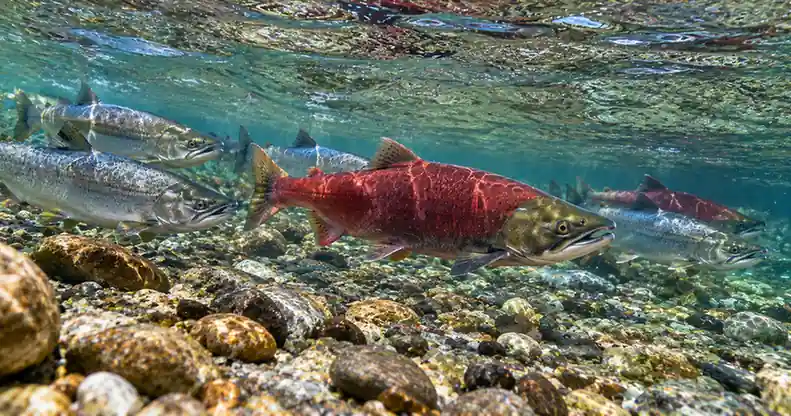
Sockeye entering freshwater are commonly silver with a blue-green back. As they approach spawning, their bodies can become bright red with green heads; males may develop pronounced hooked jaws. Changing color is part of the life cycle, not a reliable sign that a fish is legal to keep. Identification, retention limits, and open dates remain separate questions.
Kokanee are landlocked members of the same species, but fishing lakes for kokanee involves different feeding behavior, seasonal depth decisions, and local regulations. Do not transfer a Kenai River sockeye method to a reservoir simply because both fish are O. nerka.
Fly Fishing for Sockeye Salmon: Conventional Takes vs Lining
In conventional fly fishing for sockeye salmon, you cast an imitation so a fish can choose to strike or react to it. A streamer may be retrieved, swung, or drifted at an appropriate depth, and a take occurs when the fish closes its mouth on the fly. That can happen with salmon, but it should not be assumed to happen every time a sockeye becomes hooked near its mouth.
Lining, often called flossing, describes a different mechanism. A leader drifts into the path of a moving fish; as the line slides across or near the mouth, the hook can catch around the mouth without the fish deliberately eating the fly. Anglers may use artificial flies as terminal tackle, but this technique is not equivalent to a voluntary fly take.
The distinction is not simply academic. It affects how you describe your fishing, interpret a hook-up, and evaluate whether your chosen presentation raises ethical or legal concerns. The exact terms anglers use are not substitutes for the wording of state regulations.
| Question | Conventional fly take | Lined or flossed mouth hookup |
|---|---|---|
| Why did the fly enter the mouth area? | Fish took or reacted to the fly | Leader and fish crossed paths |
| Is the fish actively feeding? | Not necessarily, but it reacted | Not required |
| Can the hook end up in the mouth? | Yes | Yes |
| Does mouth-hooking alone establish full legality? | No | No |
| Does this describe intentional body snagging? | No | Not by definition; actual conduct matters |
For fly fishing for sockeye salmon, use this comparison to avoid two common mistakes: claiming every mouth-hooked sockeye bit a fly, and claiming every use of the term flossing automatically describes the same illegal act as deliberate body snagging. A fisheries officer, not a blog, is the right source for applying the actual rules to a questionable setup.
Fly Fishing for Sockeye Salmon: Flossing and the Kenai Flip
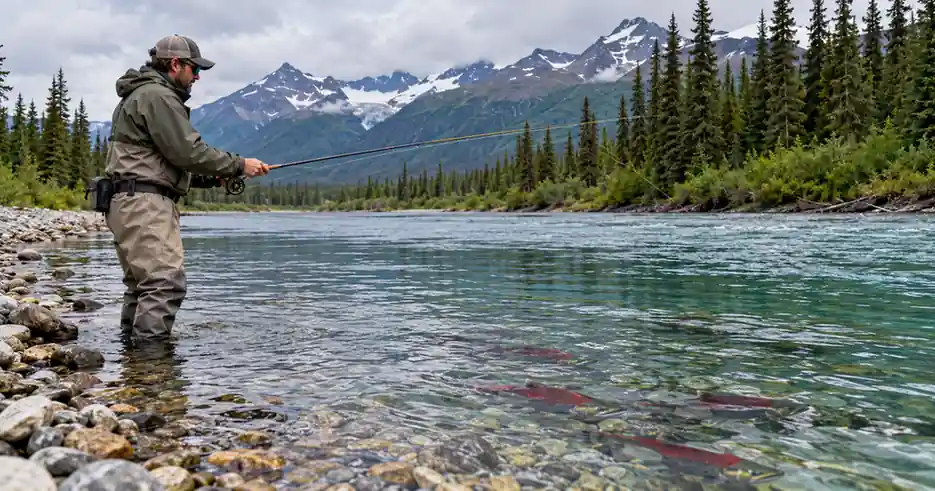
In fly fishing for sockeye salmon, the Kenai Flip is a regional name for a short-line presentation often associated with sockeye fishing near the Kenai River’s bank. Instead of carrying a long aerial cast, an angler places a short length of line and leader into moving water, lets the current take the terminal tackle through a controlled drift, and prepares for the next presentation. Many anglers use this motion while attempting to line sockeye.
That description explains a familiar riverbank technique; it is not an instruction to sweep a bare hook through fish. Repeated hard jerks aimed at a fish’s flank are not ordinary fly presentation and risk prohibited snagging. Anglers should avoid techniques designed to foul-hook fish, respect surrounding anglers, and follow the specific gear and method regulations in their fishing reach.
What the Drift Is Supposed to Do
For fly fishing for sockeye salmon in a moving migration lane, the current rather than the fly fisher’s retrieve often determines how the leader and artificial fly travel. The goal of a responsible legal setup is controlled contact with the water, not repeated forceful striking at visible bodies. Exact leader length, weight placement, fly specifications, and allowable equipment cannot be copied from one river to another.
A short presentation is especially practical when other people share a narrow bank and fish are traveling close to shore. However, short does not automatically mean safe: keep hooks behind clear casting lanes, avoid crossing other anglers’ lines, and never stand where a hooked salmon could pull you off balance.
Learn the Motion Without Copying Old Regulations
The Alaska Department of Fish and Game’s Sockeye Salmon Fishing 101 educational video discusses rod and reel choices, flies, weights, and techniques. It is listed in References for readers who want visual examples. Because that video dates from 2020, any tackle or area-rule examples in it must be checked against the current season’s regulations.
This is also why articles about fly fishing for sockeye salmon should not label a single leader-and-weight recipe as legal across Alaska. Use the applicable official booklet and emergency orders, and ask ADF&G for clarification if you are unsure whether a particular presentation complies.
Snagging vs Flossing: What Makes a Sockeye Hookup Legal?
For fly fishing for sockeye salmon, Alaska’s 2026 Southcentral sport-fishing rules say that intentionally snagging or attempting to snag fish in freshwater is unlawful. They define snagging in terms of hooking a fish somewhere other than its mouth, and require an accidentally foul-hooked fish to be released immediately. That establishes a clear rule against deliberate body-hooking; it does not give anglers a blanket endorsement of every mouth-hooking strategy.
Four questions need separate answers:
- Is the fishery open? A salmon may be present while targeted fishing is closed. Some sanctuary and upstream areas have distinct opening dates or year-round salmon closures.
- Is your tackle allowed? Fly-only water may restrict hook type and size, whether a fly may be weighted, and where added weight can be placed.
- How are you fishing? A method intended to foul-hook fish is not made acceptable by calling it a Kenai Flip or attaching an artificial fly.
- Where is the fish hooked? Fish unintentionally hooked outside the mouth must be released immediately in Alaska freshwater, without counting them as legal harvest.
Why the Ethical Debate Continues
Some anglers accept legal lining methods as a practical harvest approach when migrating sockeye are not readily taking streamers. Others prefer to fish only for voluntary takes and argue that flossing falls outside their idea of fly fishing. Both viewpoints exist, but personal preference and enforcement rules are different questions. A respectful article can explain the distinction without making unsupported claims that all lining is illegal or that all flossing is authorized.
If you accidentally foul-hook a fish, stop trying to retain it, avoid lifting it onto gravel, and release it promptly while following applicable handling rules. In a crowded river, consider moving or changing your lawful presentation if repeated unintended foul-hookups occur. When rules are ambiguous, contact the responsible ADF&G office before continuing.
Fly Fishing for Sockeye Salmon: Rods, Reels, and Lines
The right outfit for fly fishing for sockeye salmon depends on water flow, expected fish size, the permitted terminal rig, and whether you intend a conventional fly presentation or a specialized short drift. A powerful salmon in moving water can put far more pressure on your tackle than a smaller trout in a still pond.
Rod Weight and Casting Style
For fly fishing for sockeye salmon, an 8- or 9-weight single-hand rod is a useful starting reference for many sockeye river conditions. Some anglers select lighter or heavier rods based on the current, fish size, and tackle; a specialized two-handed setup may be appropriate for other methods and waters. These are practical ranges, not legal tackle classifications or universal minimums. A rod powerful enough to land fish efficiently should still cast the legally allowed fly or lure safely.
Reel Drag, Backing, and Control
Choose a reel matched to your rod and line, with a dependable drag and adequate backing for the actual setup. A smooth drag can help handle an unexpected run, while excessive pressure can break tippet or destabilize a wading angler. Inspect the backing connection and leader knots before a trip. FlyFishingScout’s guide to choosing a fly fishing reel covers capacity and drag choices in greater depth.
Floating vs Sinking Lines
A floating fly line is practical for many controlled near-bank presentations and makes line pickup and mending straightforward. A sink-tip or sinking line may be useful when presenting a streamer conventionally to fish deeper in open, legally fishable water. But line density does not override hook and added-weight restrictions. Do not assume an integrated sinking system or a special leader is automatically allowed in a fly-fishing-only reach.
If you need help assembling the basic outfit, FlyFishingScout’s fly fishing line setup explains how backing, fly line, leader, and fly connect. Use it for general rigging principles, then check the actual legal tackle definition for sockeye where you will fish.
Wading and Fish-Handling Gear
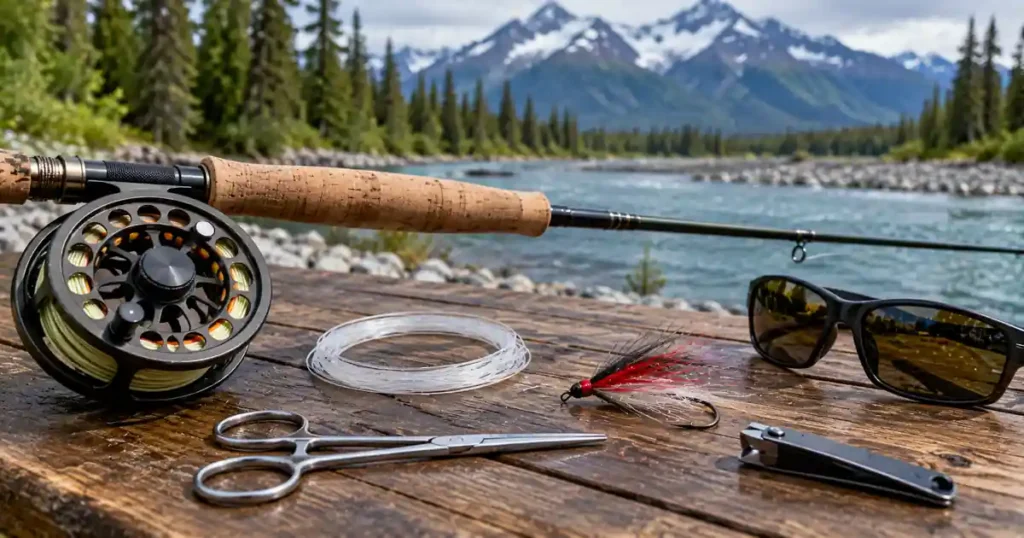
Polarized glasses help protect your eyes from hooks and can aid observation in clear water. Wear suitable non-felt wading footwear in Alaska freshwater, a wading belt, and weather-appropriate layers. Carry forceps, a legal measuring tool where needed, and a means to store any retained fish according to local fish-cleaning and bear rules. Equipment does not make deep or fast water safe to enter.
Fly Fishing for Sockeye Salmon: Flies and Leader Choices
In fly fishing for sockeye salmon, a Russian River Coho Fly, a sparse bucktail-style pattern, or another locally permitted imitation may be suitable terminal tackle in a fly-only fishery. The phrase best fly for sockeye can be misleading if a technique depends mainly on fish movement and leader position rather than a feeding response. For conventional presentations, a properly sized streamer or small shrimp-like imitation may be worth evaluating, but there is no verified universal color or fly that guarantees sockeye takes.
In fly fishing for sockeye salmon, the rules can matter more than the pattern name. Check hook gap, barb rules where applicable, number of hooks, whether a fly must be unweighted and unbaited, and whether added weight is permitted at a specified distance. If you tie your own flies, the style of construction should meet the jurisdiction’s definition of an artificial fly—not merely resemble a common commercial pattern.
Russian River Fly-Only Example
The 2026 Kenai/Russian River booklet describes gear in its designated fly-fishing-only waters as one unweighted, single-hook, unbaited fly, with a hook gap of 3/8 inch or less. It specifies a fly weighing less than 1/4 ounce, and any additional weights at least 18 inches ahead of the fly. The rules apply to the mapped regulated waters, not every stream in Alaska. The description also does not mean you must add weight; the actual presentation and conditions may differ.
In other areas, artificial lures, single-hook rules, and bait allowances may be defined differently. Never take an online gear diagram into another drainage and assume the same terminal tackle is lawful. Change your setup only after checking that reach’s current provisions and emergency orders.
Fly Fishing for Sockeye Salmon: Where and When It Works
Timing for fly fishing for sockeye salmon varies by Alaska drainage. The species commonly returns to Alaska freshwater in summer, but even within the Kenai system the early Russian River run and later groups of sockeye do not arrive in the same places at the same time. An older run-timing chart can help choose a general travel window; it cannot establish a legal opening or guarantee fish on a particular day.
ADF&G’s Northern Kenai guidance describes second-run sockeye heading into the upper Kenai and Russian River area around late July and early August. In some reaches, fish travel near the bank and hold below shallower riffles. Conditions, river clarity, streamflow, and the movement of fish can all change which water is useful. Avoid walking through spawning redds or crowding a narrow travel lane simply to stand closer to visible salmon.
A Three-Part Water Check
Before fly fishing for sockeye salmon, look for a lawful, safe place to stand; water where the fly or permitted tackle can move under control; and clear space to cast or drift without crossing other anglers. If the water is too fast to wade safely, fish from appropriate lawful bank access or choose another opportunity. Do not enter a restricted sanctuary or closed reach because you can see fish there.
For fly fishing for sockeye salmon outside Alaska, the same principles of fish behavior and tackle fit may help, but the Alaska-specific provisions in this article do not apply. Every state, province, or fishery can define legal methods and seasons differently.
Alaska Sockeye Fishing Regulations: Kenai vs Russian River
For fly fishing for sockeye salmon, the 2026 Alaska Southcentral regulations are a useful example of why there is no single statewide sockeye limit or universal fly-only rule. The lower Kenai mainstem, middle Kenai confluence Areas A and B, and Russian River have different boundaries and seasons. Emergency orders can change the printed booklet during the same summer.
| Example from 2026 | Printed or dated provision | Why it matters |
|---|---|---|
| Lower Kenai mainstem, sockeye 16 inches or longer | June 20–August 15: 6 per day, 12 in possession; outside that period, different limits | Not a statewide limit; read exact reach rules |
| Russian River designated sockeye reach | June 11–August 20: 3 per day, 6 in possession in printed booklet | Local opening and fly-only gear differ from lower Kenai |
| Kenai–Russian confluence Sanctuary Area B | Printed July 15–August 20 opening; a 2026 order opened it June 18 | Emergency orders can change open dates |
| Russian/upper Kenai area temporary limit | June 25–July 14, 2026: increased to 6 per day, 12 in possession for designated waters | Temporary order can change limits, then expire |
| Russian River upstream of a specified marker below the falls | Closed year-round to all salmon fishing | Fish presence is not permission to target them |
These are dated 2026 examples, not current legal advice for 2027. ADF&G markers and maps determine the actual boundary. Do not use a broad map pin, a town name, or the phrase Kenai River as a substitute for reading the water-specific rule.
Five Checks Before Every Fishing Session
For fly fishing for sockeye salmon, the safest legal habit is to verify five things before you set up:
- Exact waterbody and markers: Identify the river section and whether you are inside a fly-only or sanctuary area.
- Open species and dates: Check the appropriate 2026 regional regulation booklet or the later current booklet for your trip year.
- Emergency orders: Review ADF&G’s order list for the management area and any species-specific change.
- Gear and retention: Check permitted flies or lures, hook-gap limits, weights, daily limits, possession limits, and size categories.
- License and special conditions: Verify the applicable sport-fishing license, any area closures, and handling requirements.
For example, a 2026 order opened the Russian River Sanctuary earlier than its printed July 15 opening, and another temporarily increased sockeye limits in designated Russian/upper Kenai waters. A screenshot of the booklet alone would have missed those changes. Conversely, an expired order must not be treated as permission in a later season.
If regulations or marker boundaries remain unclear, contact ADF&G before fishing. This is especially important where an angler is combining fly-fishing gear with methods commonly described as flossing.
Fly Fishing for Sockeye Salmon: Safety and Ethical Release
Safety is especially important when fly fishing for sockeye salmon in rivers shared by anglers, fish, and bears. Standing in a crowded line of waders can create hazards from swinging rods, sharp hooks, tangled leaders, and slippery submerged rocks. Keep a safe casting lane and do not step into deeper water simply because fish are passing farther out.
Fast, cold river water can knock a person down quickly. Wear a wading belt and secure footwear; Alaska’s 2026 Southcentral rules prohibit absorbent felt or similar fibrous soles while sport or personal-use fishing in freshwater. Carry weather layers and consider a wading staff where it is appropriate. If you cannot remain stable with both feet planted, the spot is not suitable for that presentation.
Fish Handling and Bear Awareness
Know whether a fish must be released before bringing it to shore. A fish accidentally hooked outside the mouth must be released immediately in Alaska freshwater. For a lawful release, use wet hands, avoid contact with the gills, minimize air exposure, and keep the fish in water where feasible. Use sufficiently strong tackle to avoid unnecessarily long fights.
Follow local fish-cleaning rules; never leave unattended fish, food, or waste where it may attract bears. On the Russian River, ADF&G has issued specific reminders about handling fish carcasses, protecting trails and habitat, and keeping belongings attended. Check current U.S. Forest Service and ADF&G instructions rather than improvising disposal methods.
Responsible fly fishing for sockeye salmon also means giving other anglers room, staying off sensitive spawning beds, and changing a presentation that repeatedly produces accidental foul-hookups. A crowded river is not a reason to use more forceful sweeps or ignore restrictions.
Fly Fishing for Sockeye Salmon: FAQs and Legal Gear Checklist
Do Sockeye Salmon Actually Bite Flies?
Some may react to or take artificial flies, but freshwater spawning migrants generally are not feeding like trout. Many fly-rod hookups come from lining methods rather than voluntary feeding takes. Do not assume every mouth-hooked fish actively bit the fly.
Is Flossing Considered Fly Fishing?
It may use a fly rod and artificial fly, but the hooking mechanism can differ from conventional fly fishing. Whether a specific setup and method are lawful depends on the jurisdiction, water, tackle rules, intent, and hookup. The term itself does not settle the question.
Is the Kenai Flip Legal?
There is no blanket permission just because anglers use that name. Any fishing must comply with the applicable reach’s method, fly, hook, weight, season, and retention rules. Intentional freshwater snagging is prohibited in Alaska, and foul-hooked fish must be released immediately.
What Is the Difference Between Flossing and Snagging?
Flossing generally refers to line contact that can produce a mouth hookup without a voluntary take. Snagging means hooking a fish outside its mouth; deliberately attempting to snag fish in Alaska freshwater is prohibited. An angler’s actual actions and the applicable rules matter more than labels.
Can I Use a Weighted Fly on the Russian River?
Not in designated fly-fishing-only water under the 2026 rules described here: the fly must be unweighted, with a hook gap of 3/8 inch or less and a fly weight below 1/4 ounce. Any separately added weights must be at least 18 inches ahead of the fly. Check the exact reach and current emergency orders before fishing.
What Size Fly Rod Works for Sockeye?
An 8- or 9-weight is a reasonable starting reference for many situations, but current strength, method, fly, and anticipated fish can change the choice. Use a compatible reel with adequate backing and avoid tackle so light that fish are exhausted unnecessarily.
What If I Hook a Sockeye Outside the Mouth?
Release it immediately as required in Alaska freshwater, with careful handling. Do not retain it as a legal catch or repeatedly repeat a presentation that is producing accidental foul-hookups.
Final Legal Gear Checklist
- Identify the precise river reach, markers, and open salmon season.
- Check the current ADF&G booklet and any active emergency orders.
- Confirm whether the water is fly-fishing-only.
- Check allowable fly or lure type, hook gap, hook number, fly weight, and added-weight placement.
- Review daily and possession limits for the specific water and dates.
- Avoid deliberate snagging and immediately release unintentionally foul-hooked fish.
- Choose safe bank access, appropriate wading gear, and a fish-handling plan.
The key to fly fishing for sockeye salmon is knowing what the fish is doing, what the tackle is doing, and what the regulation permits. Begin with sockeye migration behavior, distinguish a genuine fly take from a lined hookup, and check the exact river’s legal methods before making your first presentation. That knowledge is more valuable than copying an unverified rig from a video or fishing forum.
References
- Alaska Department of Fish and Game — Sockeye Salmon Species Profile
- Alaska Department of Fish and Game — Sport Fish Statewide Regulations
- Alaska Department of Fish and Game — 2026 Southcentral Alaska Regional Regulations (PDF)
- Alaska Department of Fish and Game — 2026 Kenai River and Russian River Regulations (PDF)
- Alaska Department of Fish and Game — Sockeye on the (Shrimp) Fly
- Alaska Department of Fish and Game — Northern Kenai June Fishing Guidance
- Alaska Department of Fish and Game — Northern Kenai July Fishing Guidance
- Alaska Department of Fish and Game — Russian River Sanctuary Opens Early for Sport Fishing (2026)
- Alaska Department of Fish and Game — Russian River & Upper Kenai River Sockeye Limits Increased (2026)
- Alaska Department of Fish and Game — Southcentral Emergency Orders
- Alaska Department of Fish and Game — Sport Fishing Licenses, King Salmon Stamps, IDs and Harvest Cards
- Alaska Department of Fish and Game — Sockeye Salmon Fishing 101 (Official Educational Forum)
- Alaska Department of Fish and Game — Reel Times Newsletter: Sockeye Salmon Fishing 101