
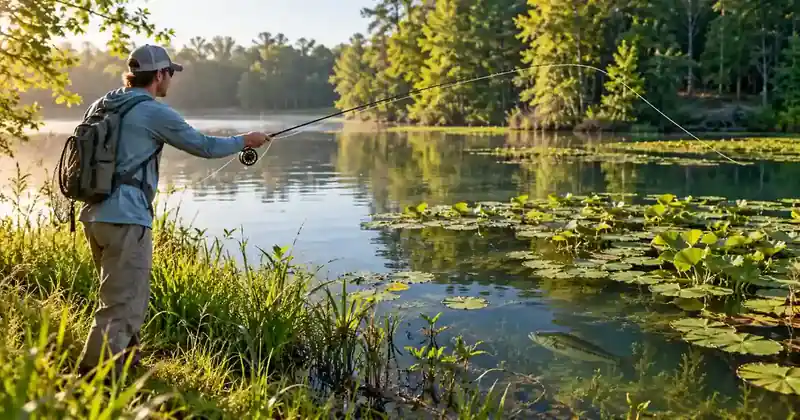
Fly Fishing for Largemouth Bass: Where to Find Them and What Works
Fly fishing for largemouth bass gets easier when you stop casting at every patch of water and start looking for places a bass can ambush food. Weed edges, fallen trees, dock shade, and changes in depth all deserve attention. But finding a fish is only half the problem: a largemouth you can see may be resting, cruising, or guarding a nest rather than feeding.
You do not need a specialized bass outfit to begin. Small streamers and modest surface flies may work with the trout rod you already own. This guide explains where to look in ponds and lakes, which flies and retrieves fit each situation, and what to try when visible bass follow your fly without taking it. No one pattern or adjustment guarantees a strike.
Table of Contents
Fly Fishing for Largemouth Bass: Quick Answer
Start fly fishing for largemouth bass by looking for an edge where cover meets open water: a weed line, the shaded side of a dock, or a submerged branch beside deeper water. In calm, low-light conditions, try a manageable surface popper and pause between movements. If nothing responds, swim a small streamer along the same edge at different depths before moving to the next spot.
| What you see | Where to cast | Sensible first presentation |
|---|---|---|
| Lily pads with open lanes | Into the gap or along the outside edge | Small frog-style fly or popper with pauses |
| Submerged wood | Beside the branches, not into the thickest tangle | Small streamer with short strips |
| A shady dock | Along the shade line without hitting the structure | Soft-landing streamer or surface fly |
| Open water beside a drop-off | Across the depth transition | Slowly retrieved subsurface fly |
| Fish ignoring a surface fly | Same cover at a lower level | Woolly Bugger or baitfish streamer |
These are starting points, not rules. Watch for baitfish moving, surface disturbances, and fish that actively chase food. A lively feeding area deserves more attention than a visible bass that has ignored several careful presentations.
Where Largemouth Bass Hold in Ponds and Lakes
For fly fishing for largemouth bass in ponds and lakes, first identify the vegetation and structural edges. Largemouth bass also occupy backwaters and slow-moving rivers. Adults use cover to approach prey with less exposure, and smaller fish may shelter in vegetation and woody debris. That makes the relationship between cover and open water more useful than a random cast toward the middle of the pond.
Weed Beds and Lily Pads
Look for the outside boundary of submerged weeds, gaps between lily pads, and a lane where vegetation ends near deeper water. Bass can wait inside cover and move into a clear opening to feed. A popper moving down an open lane is easier to retrieve cleanly than one dragged through a dense mat.
Dense weeds are not automatically productive. If you cannot present the fly without collecting vegetation, fish the adjacent edge instead. A weed guard may reduce some snags, but it can also interfere with clean hooking if poorly designed or mismatched to the fly.
Fallen Trees, Submerged Logs, and Stumps
Wood creates shade, hiding places, and travel edges. Pay attention to the tip of a fallen tree, the side of a trunk, or an opening between branches. Begin with a cast that stays clear of the thickest snags, and move closer only if you can keep the line and hook under control.
A streamer passing just outside a stump may be more practical than a fly cast into its center. Short, accurate presentations also reduce time spent retrieving flies from branches.
Docks, Shade, and Shoreline Cover
Dock pilings, overhanging bushes, and shaded banks can offer ambush positions, especially when bright light makes open shallows less appealing. Start with the shadow boundary, then test a deeper position if you see no response. Consider how the sun moves: a useful shaded bank in the morning may be fully exposed by afternoon.
Respect private property and do not cast beneath occupied docks or toward people. Shoreline access is not implied by a dock being visible from the water.
Drop-Offs and Deeper Water
The edge where a shallow shelf falls away gives bass access to different depths. In summer heat or colder months, the outside edge of vegetation, an underwater point, or a gradual drop may be more useful than the shallowest shoreline cover.
In a small pond without a depth map, look for darker water near a steep bank, the outside of a weed bed, or a dam face where access is legal and safe. Depth is only part of the picture: temperature and dissolved oxygen also influence where fish can comfortably hold.
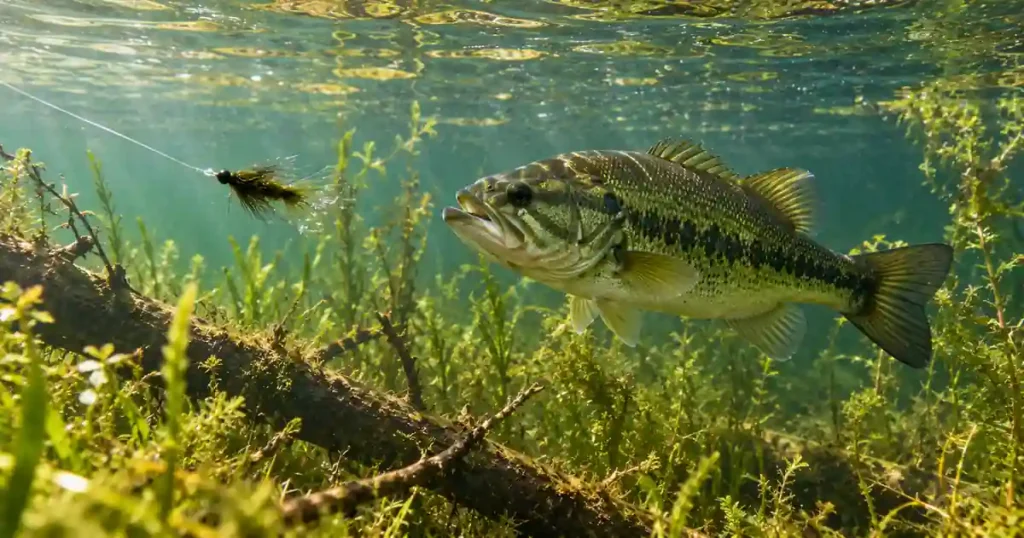
Fly Fishing for Largemouth Bass Around Cover
Accuracy matters more than maximum distance when fly fishing for largemouth bass around cover. Land the fly beside the target, not on the fish or in a branch pile. A quiet presentation can give a nearby fish time to notice the fly without being alarmed by a hard splash or an overhead shadow.
Walk slowly along the bank and stay back from clear, shallow water. If possible, make your first cast before stepping to the water’s edge. Check your back-cast space: brush and trees can be as troublesome behind you as submerged wood is in front.
Fish an edge in sections. For example, make one cast parallel to a ten-foot stretch of weed line, one through an opening, and one across the outside edge at a deeper angle. If you see a chase or a boil, repeat a similar angle with a deliberate change in pause or retrieve speed. If nothing suggests feeding activity, move down the shoreline.
A short overhead cast works where you have room. A roll cast can help when the bank restricts your back cast, though it still needs a suitable anchor and some room behind the rod. The guide to fly fishing casting techniques explains how to choose between those casts without turning this species article into a casting lesson.
Avoid forcing the fish from heavy cover with an underpowered setup. If you cannot turn a hooked bass safely away from snags, fish more open edges or use equipment better suited to that situation.
Fly Fishing for Largemouth Bass: Poppers, Frogs, and Streamers
Choosing a fly for largemouth bass is mostly a decision about depth, size, and movement. The most useful patterns suggest something bass may encounter in the water: small fish, frogs, crayfish, insects, or other vulnerable prey. Start with a few different fly types instead of dozens of near-identical colors.
Surface Poppers and Sliders
When fly fishing for largemouth bass on the surface, poppers are a practical option: their cupped faces move water when stripped. A small pop, followed by a complete pause, can keep the fly near cover longer than a continuous noisy retrieve. Sliders tend to move with a softer surface disturbance. In still water, both are worth trying, especially around visible surface feeding or along a quiet weed edge.
A frequent mistake is popping too rapidly. Try one or two short movements, then let the fly sit. If you see a swirl without a firm take, resist immediately ripping the bug out of the area. With a clear strike, remove slack and raise or sweep the rod under control; avoid striking simply because water splashed nearby.
Frog-Style Flies
Frog imitations are particularly relevant around lily pads, emergent vegetation, and shallow margins. Their legs and outline may suggest a frog moving through an opening. Fish them across safe open lanes with short movements, and allow pauses. Bulky or weed-resistant constructions require an outfit that can cast them reliably.
Baitfish Streamers and Woolly Buggers
A Woolly Bugger is a practical first subsurface fly because it can suggest several forms of swimming prey. A slim baitfish streamer gives a more fish-like silhouette. Cast along cover, allow the fly to sink to the intended level, and retrieve with short strips interrupted by pauses.
For fly fishing for largemouth bass in small ponds, a modest olive, black, or white streamer is often a simpler starting choice than a large articulated fly. If fish follow but do not take, test a slower retrieve or a different depth before changing color.
Crayfish and Other Subsurface Patterns
Crayfish-style flies can be useful near rock, wood, and firm-bottomed areas where that prey is present. Let the fly reach the appropriate level and move it in controlled short pulls. Avoid dragging an exposed hook continuously through branches or vegetation.
| Fly type | Best first situation | Main trade-off |
|---|---|---|
| Popper | Surface activity, open pockets, low light | Bulky versions are hard to cast with light rods |
| Frog-style fly | Pad edges and shallow vegetation | Can snag or fail to hook cleanly in thick cover |
| Woolly Bugger | Open lanes, pond edges, uncertain feeding depth | May run above or below the fish if not counted down |
| Baitfish streamer | Baitfish activity and shaded cover | Large profiles require more casting power |
| Crayfish imitation | Rocky or woody bottom habitat | Bottom contact increases snag risk |
For a broader explanation of flies versus conventional lures, see FlyFishingScout’s guide to types of fly fishing lures. Orvis also provides a bass-bug selection demonstration; the verified lesson is listed in References.
Fly Fishing for Largemouth Bass With Trout Gear
You can try fly fishing for largemouth bass with a 5-weight trout rod if you use reasonably small flies, fish water with manageable cover, and do not expect the rod to turn over an oversized air-resistant popper. A suitable 5-weight floating line, a straightforward leader, and small streamers may be enough for an introductory pond session.
A 6- or 7-weight can make somewhat larger patterns easier to deliver. A 7- or 8-weight often becomes more practical with broad-faced bass bugs, substantial streamers, windy conditions, or cover that demands more control. Rod choice is strongly influenced by the fly’s size and air resistance—not only the bass’s weight. Orvis uses an 8-weight as a broad general bass reference, not an absolute minimum.
For fly fishing for largemouth bass with poppers and shallow streamers, a weight-forward floating line is a straightforward starting point. If you consistently need to reach deeper fish, an appropriate sink-tip or sinking option may help, but it is not an essential first purchase. Read the guide to choosing the right fly fishing line for a fuller discussion of tapers and sinking behavior.
Choose leader strength for cover, fish size, fly turnover, and local rules rather than copying a delicate trout leader automatically. Heavy, short leaders may turn over large bass bugs better, while small streamers in open water need less brute force. Check knots for abrasion after working around branches or dock pilings.
What can wait: a premium bass reel, a dedicated sinking-line collection, and giant fly assortments. If your existing equipment casts your chosen fly cleanly and can land fish promptly, learn the water before upgrading.

Why Visible Largemouth Bass Ignore Flies
One frustration with fly fishing for largemouth bass is seeing a fish in clear water and watching it ignore multiple good-looking presentations. Visibility does not prove hunger. A bass may be resting, cruising between areas, reacting to your movement, or protecting a spawning nest.
Look for behavior, not just a silhouette. A fish accelerating at small prey, turning toward surface disturbances, or actively hunting around a weed edge may offer a better opportunity than one holding motionless in the shallows. Even then, there is no way to diagnose every refusal by sight alone.
A bass that follows a Woolly Bugger and turns away might have been curious, startled, uninterested in the movement, or unable to reach the fly comfortably at that depth. These are possibilities, not proven explanations. Changing the fly immediately may hide the more useful clue: the retrieve or approach was wrong for that particular fish.
Repeated overhead casts can expose an angler’s presence and cause additional disturbance. Give a fish room. If you suspect spawning or nest guarding, leave it alone rather than repeatedly provoking a defensive strike. That response should not be confused with normal feeding.
Fishing pressure is another consideration when fly fishing for largemouth bass at popular public ponds; it may affect how cautiously fish respond. When a highly visible fish keeps ignoring carefully placed flies, move to another piece of structure and look for actual feeding activity.
Fly Fishing for Largemouth Bass: Five Presentation Fixes
Use this sequence when fly fishing for largemouth bass produces follows, swirls, or no visible response. Adjust one major variable at a time so you can learn from what happens.
1. Observe Before Another Cast
Stop casting briefly. Watch whether fish are chasing small prey, moving along a weed edge, or simply remaining in place. A motionless fish that appears to be guarding a nest is a reason to move, not a challenge to provoke a reaction.
2. Change Your Angle and Distance
Back away from the bank if possible and cast across the fish’s likely travel path instead of directly over it. Try swimming the fly parallel to the weed edge. Keep the fly in a clear lane so the fish can see and approach it.
3. Change Retrieve Speed and Pauses
For a popper, replace constant noise with one controlled pop and a longer pause. For a streamer, try shorter strips followed by a stop, or a steady slow swim. Watch the fly close to shore to understand how each movement changes its behavior underwater.
4. Change Depth and Profile
If the surface fly gets no interest, try a subsurface pattern. If a streamer passes over fish without response, let it sink longer where that can be done without snagging. A smaller fly can sometimes offer a less intrusive silhouette; a more visible one can help in stained water. Change profile before endlessly rotating through similar colors.
5. Leave an Inactive Fish
Do not spend an hour making increasingly aggressive casts at one bass. Search for moving baitfish, a newly shaded stretch of bank, or vegetation connected to deeper water. Your time may be better spent locating a feeding opportunity than making another retrieve past a fish that is not responding.
Example: A bass follows an olive Woolly Bugger beside a dock, then veers away. Rather than immediately tying on a brighter version, let the area settle. Cast from a different angle, count the fly down slightly, and use two short strips followed by a pause. If it still ignores the fly, move to the next shaded edge. This is a troubleshooting exercise, not a promised strike sequence.
For a visual lesson, Orvis’s Fly Retrieves demonstrates bass presentations and is linked in References. Watch the fly’s movement and pauses, then practice those mechanics with your own setup.
Fly Fishing for Largemouth Bass by Season and Conditions
The best place to start fly fishing for largemouth bass changes with temperature, daylight, and access to comfortable water. Seasonal timing differs between northern and southern states, so treat these as movement patterns rather than fixed calendar dates.
Spring: Moving Toward Shallows
As water warms, bass may use areas near shallow spawning habitat. Edges, woody cover, and nearby depth transitions can offer feeding opportunities. In areas with nest-guarding fish, avoid deliberately targeting bass that are clearly protecting eggs or fry. Check local spawning-season protections.
Summer: Shade, Cover, and Usable Depth
For fly fishing for largemouth bass during hot weather, test shaded banks, outer weed lines, and places with nearby deeper water. Early morning and evening often provide useful windows for shallow-water feeding. However, deep water is not automatically better: some lakes develop poorly oxygenated lower layers. Read temperature and fish activity rather than assuming the deepest water holds the bass.
Fall: Follow Available Food
Cooling conditions can change where small fish gather and where bass feed. Look for baitfish near coves, vegetation edges, and depth changes. A baitfish streamer becomes a sensible pattern to try, but the specific retrieve still depends on fish activity and water temperature.
Winter: Slower, More Deliberate Presentations
In colder water, bass may feed less often or respond to slower movement. Try controlled subsurface presentations near suitable holding water and allow more time between strips. Avoid assuming all fish will be in one fixed depth range.
Clear vs. Stained Water and Changing Light
In clear water, approach quietly and start with a less conspicuous fly where appropriate. In stained water, a dark silhouette or more noticeable profile may be easier for bass to locate. Low light can favor shallow opportunities; bright light may make shade and cover more important. These are starting hypotheses that should be tested, not guarantees.
Regulations, Access, and Responsible Release
The rules for fly fishing for largemouth bass depend on your state and the specific waterbody. Check the current fishing-license requirement, seasons, size and bag limits, tackle restrictions, and any protected spawning areas before fishing. A public pond may have special management rules. A visible shoreline does not give you permission to cross private property or use a privately owned dock.
Handle bass with wet hands and minimize time out of the water. If you plan to release one, keep a suitable hook-removal tool ready, avoid exhausting the fish, and support its body horizontally if you need to lift a larger fish. Do not hold a heavy bass by the lower jaw alone while allowing its body to hang at an awkward angle. Avoid touching the gills.
Single barbless hooks can make release easier where appropriate. If a fish is deeply hooked, use suitable tools and follow local agency guidance rather than causing unnecessary injury. Release the fish upright in the water and let it regain its balance before it swims away.
Watch for slippery banks, strong drop-offs, heat, thunderstorms, and people behind your casting shoulder. Even an ordinary pond demands safe casting and awareness of changing conditions.
FAQs About Fly Fishing for Largemouth Bass
Can I Catch Largemouth Bass on a 5-Weight Fly Rod?
Yes, in suitable conditions. Fly fishing for largemouth bass with a 5-weight can work for small Woolly Buggers and modest surface flies in relatively open water. Large, wind-resistant bass bugs and heavy cover are better reasons to move to a stronger outfit than the species name alone.
What Fly Should I Try First in a Small Pond?
Start with a small popper when bass appear active near the surface, especially in low light. If that does not produce interest, try a modest Woolly Bugger along the weed edge or shaded cover at a slightly deeper level.
Why Does a Bass Follow a Streamer but Not Bite?
The fish might not be actively feeding, or the speed, depth, or profile may not invite a take. Back off, change your angle, adjust movement or sink time, and move if the fish continues to ignore the fly.
Are Poppers Better Than Streamers for Largemouth Bass?
Neither is always better. A popper can be useful for surface-oriented fish and open pockets around vegetation. A streamer is more versatile when prey or bass are feeding beneath the surface.
Where Do Largemouth Bass Go During Hot Weather?
They may use shade, vegetation edges, or suitable deeper water, but temperature and oxygen both matter. Start near cover connected to different depths and watch for active feeding periods rather than assuming the deepest water is always best.
Final Thoughts on Fly Fishing for Largemouth Bass
The simplest approach to fly fishing for largemouth bass is to locate cover, watch for feeding behavior, and choose a fly you can present at the right depth. Work weed lines, shaded docks, wood, and depth changes with controlled casts. If a fish refuses the fly, adjust the angle, retrieve, and depth before buying more patterns.
For your next pond session, bring one manageable popper and one small streamer. Fish three promising edges deliberately, note where you see active prey or follows, and build your next decision from those observations. You will learn more than by casting randomly at every bass you can see.
References
1. U.S. Fish & Wildlife Service — Largemouth Bass
2. North Carolina Wildlife Resources Commission — Largemouth Bass
3. Iowa Department of Natural Resources — Largemouth Bass
4. Minnesota Department of Natural Resources — How to Catch a Largemouth Bass
5. Indiana Department of Natural Resources — Best Practices for Fishing
6. Orvis — Fly Rod & Tackle for Fishing Bass
7. Orvis — Fly Patterns for Largemouth and Smallmouth Bass