
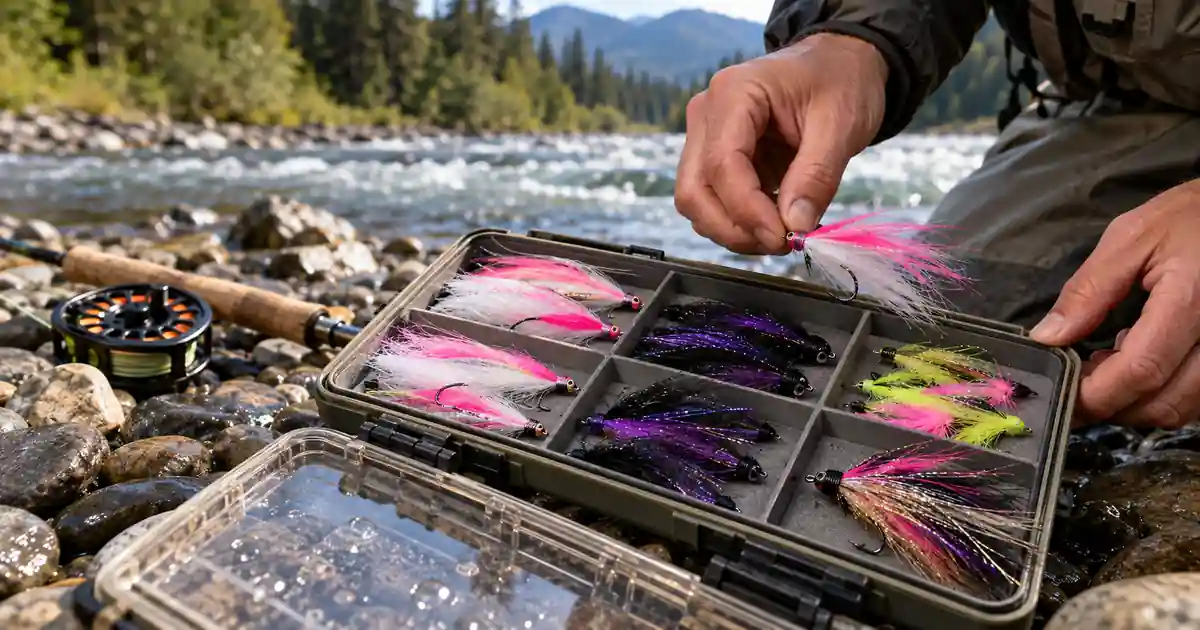
Fishing Flies for Salmon: Best Patterns by Species and Conditions
Buying fishing flies for salmon should start with one question: which salmon are you targeting, and where? A shrimp-style Atlantic salmon fly, a large Chinook Intruder, and a small pink-salmon beach fly can all be good purchases—but they solve different problems. A fly that makes sense on a Canadian Atlantic salmon river might be unsuitable or even illegal in an Alaska fly-fishing-only area.
For a practical first box of fishing flies for salmon, choose a few patterns for your actual species and method, then vary size, silhouette, color, and depth. This guide compares Atlantic, King, Coho, Pink, Sockeye, and Chum options so you can buy deliberately instead of ordering every salmon fly that catches your eye.
Table of Contents
Fishing Flies for Salmon: Quick Species Comparison
The best fishing flies for salmon are those suited to the species, water, and permitted presentation. Atlantic salmon anglers often carry traditional wet flies, shrimp patterns, tubes, and sometimes surface Bombers. Pacific salmon choices commonly include leeches, Clouser-style baitfish imitations, Comets, Intruders, and other streamers. Sockeye needs special care because local tackle rules and the difference between a voluntary take and snagging matter.
| Target salmon | Useful fly categories to investigate | Starting selection principle |
|---|---|---|
| Atlantic | Shrimp-style wet flies, hair-wing wets, tube flies, Bombers | Match river height and whether the presentation is subsurface or on top |
| King / Chinook | Intruders, articulated streamers, large leeches | Choose a fishable profile for the river’s depth and current |
| Coho / Silver | Comets, leeches, Clouser-style flies, flashy streamers | Bring contrasting profiles and retrieve options |
| Pink / Humpy | Compact pink or contrasting streamers, shrimp-like flies | Start relatively small, especially for beach opportunities |
| Sockeye / Red | Local legal fly patterns, including sparse shrimp-style flies | Confirm permitted tackle and avoid intentional snagging |
| Chum / Dog | Leeches and contrasting streamers | Let the specific river, fish condition, and rules determine the choice |
Atlantic vs Pacific Salmon: Why Fly Choice Changes
Atlantic salmon (Salmo salar) and the Pacific salmon species commonly encountered in North America belong to different groups. Their fishing traditions also differ. On many Atlantic salmon rivers, anglers swing relatively small traditional flies, fish tubes at various depths, or skate a surface fly. For Pacific salmon, a stripping retrieve, a swung Intruder, or a sparse shrimp imitation may be more appropriate depending on species and location.
Coho may chase moving flies near saltwater beaches yet become less responsive in a freshwater pool. The fishing situation is as important as the fish’s name when selecting fishing flies for salmon.
Adult salmon typically feed far less after entering freshwater to spawn, although behavior varies by species and fishery. A take can involve different responses, not simply hunger. For this reason, explanations such as “this fly perfectly matches their food” should not be assumed for every returning salmon.
Important U.S. distinction: Wild Atlantic salmon in the Gulf of Maine distinct population segment are endangered, and recreational fishing for Atlantic salmon is prohibited in the United States. This guide’s Atlantic salmon buying advice concerns fisheries where angling is legally permitted, including relevant Canadian and international waters—not a recommendation to target protected U.S. fish.
Best Fishing Flies for Salmon by Species
The following fishing flies for salmon represent pattern families and verified examples, rather than a universal ranking. Evaluate fly size, hook or tube configuration, materials, presentation, and downsides before buying.
Atlantic Salmon: Shrimp Patterns, Traditional Wets, Tubes, and Bombers
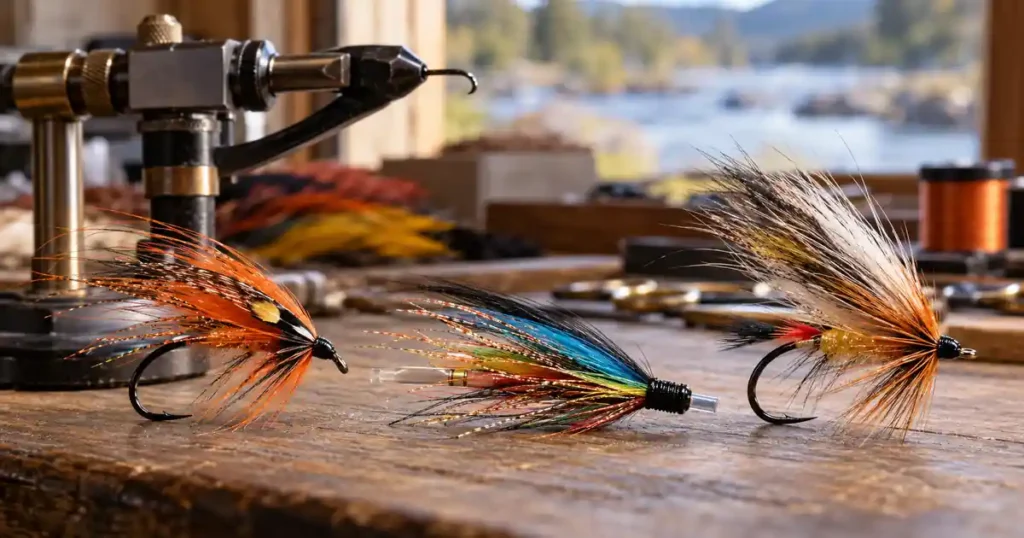
Ally’s Shrimp is a recognizable starting point. It offers a shrimp-inspired shape with lively materials and is sold in more than one configuration. Fulling Mill lists versions tied on double hooks, including sizes 8, 12, and 14, as well as a 25 mm tube version. These are different constructions; a 25 mm tube is not a “size 25 hook.”
A Cascade-style fly adds a contrasting wing and color accent. Fulling Mill’s Cascade Hot, for example, is listed as a 25 mm conehead tube fly. Its conehead changes its construction and how it may be fished; it is not simply a lighter wet fly with another color.
Traditional hair-wing wets such as Black Bear Green Butt-style patterns offer a different silhouette from shrimp-style designs. Bombers and hitched surface flies offer a separate option when a surface presentation is appropriate.
Buying priority: Start with one restrained wet fly, one shrimp-style or contrasting fly, and—if the water and method justify it—either a tube or a surface option. Choose size variants for the actual river conditions.
Trade-off: Double hooks, tubes, and added weight may face local restrictions. Some tube flies require separately purchased compatible hooks. A retailer’s “salmon fly” label is not proof that its hook configuration is legal where you intend to fish.
King / Chinook Salmon: Intruders and Larger Streamers
King salmon often call for a more substantial presentation than a small salmon-beach fly, especially in large rivers where reaching the holding depth is difficult. Intruder-style flies, articulated patterns, substantial leeches, and large Clouser-style flies are common categories worth evaluating.
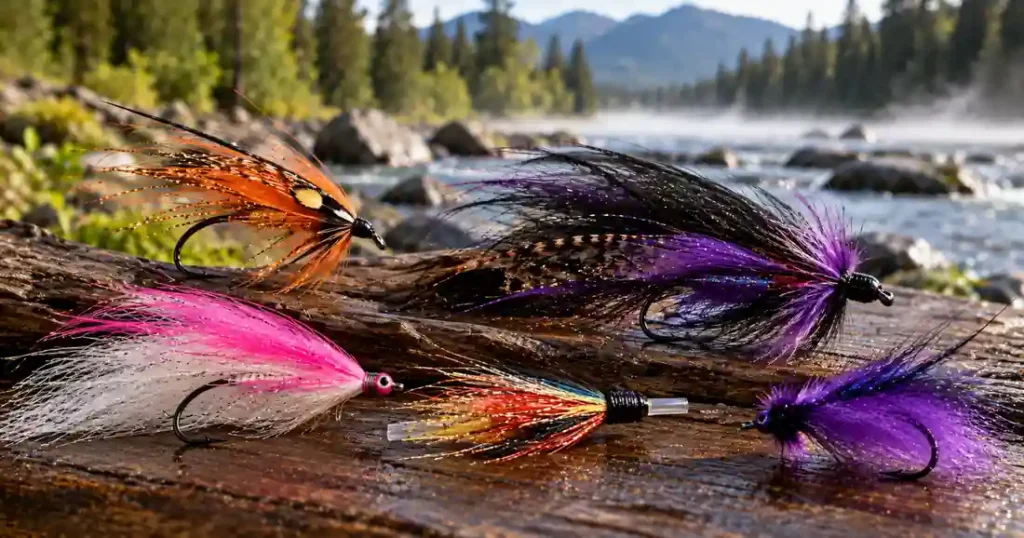
An Intruder-style pattern uses a noticeable profile and mobile materials; some versions have trailing hooks. A darker black-and-blue choice gives a strong silhouette, while pink, purple, or other contrasting combinations offer a visibly different alternative. When purchasing fishing flies for salmon such as Chinook, check how the fly achieves its profile. A bulky articulated fly can be difficult to cast, and a heavily weighted version may be unnecessary when the fishing line already controls depth. Hook configuration and maximum hook-gap rules may also limit your options.
Buying priority: Choose one fishable larger silhouette in a dark tone and one contrasting color or slightly different size, then confirm the local fishing method. Do not buy a box of giant flies before discovering what your guide or river regulations allow.
Coho / Silver Salmon: Comets, Leeches, and Clouser-Style Flies
Coho anglers frequently use marabou leeches, Hot Shot Comets, and flashy streamers. Pacific Fly Fishers, for example, lists Hot Shot Comets in chartreuse, pink, and purple, together with Starlight Leeches and larger contrasting patterns in its Coho selection. Its Purple Hot Shot Comet product listing specifies size 2 and weighted eyes; those specifications belong to that exact product, not every Comet.
These patterns create meaningfully different movement. A leech’s mobile fibers pulse in the water; a Clouser-style fly offers a baitfish-like profile; a Comet provides a contrasting attractor presentation. Select between them based on whether the fish respond to a swing, slow retrieve, or quicker strip.
For saltwater beaches, smaller baitfish and shrimp-like patterns deserve consideration. The BC Federation of Fly Fishers describes Coho beach flies commonly tied on size 6 or 8 hooks. These are examples from a particular fishery, not a universal Coho hook-size rule.
Buying priority: A dark leech, a bright Comet or similar attractor, and a restrained baitfish-style fly give a beginner distinct choices without excessive overlap.
Pink / Humpy Salmon: Smaller Streamers and Color Contrast
Among fishing flies for salmon, sensible Pink salmon starting options include compact pink or pink-and-white baitfish-style flies, small Clouser variations, and shrimp-like patterns. The BC Federation of Fly Fishers specifically discusses pink, silver, and blue-green options for its Vancouver Island beach fishery.
Buying priority: Two modestly sized pink or pink-and-white flies and a contrasting blue-green, silver, or darker option. Confirm whether you will be fishing saltwater, tidewater, or a river; the best presentation may differ.
Trade-off: A pattern intended for a slow-moving beach school may not reach an appropriate depth in a fast river. Also, the common phrase “pink for pinks” is a useful starting convention—not a law of fish behavior.
Sockeye / Red Salmon: Legal Flies and Voluntary Takes
Sockeye demand more caution than a simple “best flies” ranking. Alaska Department of Fish and Game educational material discusses the Russian River fly, Comet, Krystal Shrimp, and other sparse patterns. One agency feature documents Sockeye taking a shrimp-style fly in the mouth, demonstrating that a voluntary take is possible; that does not establish that every hooked Sockeye voluntarily took the fly.
Sockeye in freshwater are often not aggressive feeders. Some commonly discussed methods involve drifting a fly through migrating fish; anglers must distinguish a legitimate take from intentional snagging or flossing. Mouth-hooking alone does not prove that a fish chose to bite. Alaska prohibits intentional snagging in freshwater and requires fish unintentionally hooked outside the mouth to be released immediately.
When buying fishing flies for salmon in designated Alaska fly-fishing-only waters, remember that statewide rules specify one unweighted single-hook fly, a hook gap of 3/8 inch or less, and any separate weight at least 18 inches ahead of the fly. Area restrictions can add other requirements or closures. Do not purchase weighted streamers for such an area assuming they are automatically permitted.
Buying priority: Contact the managing agency or a reputable local fly shop about legal fly construction before ordering. Consider only the few patterns appropriate to that specific fishery.
Trade-off: A generic “Sockeye assortment” cannot tell you whether a technique is ethical or a particular rig is lawful. Follow both the regulations and the principles of fair angling.
Chum / Dog Salmon: Contrasting Leeches and Streamers
For Chum salmon, leeches and other contrasting streamers are practical starting categories among fishing flies for salmon. Pink, black, and chartreuse variations appear in specialist Pacific-salmon fly catalogs; Alaska Fly Fishing Goods also documents dark and brightly colored options used across several Pacific salmon fisheries.
Buying priority: If Chum is your actual target, start with a dark leech and one contrasting pattern in a locally accepted size. Avoid buying the same expensive assortment recommended for Chinook unless the fishing circumstances genuinely overlap.
Fishing Flies for Salmon by Water Conditions
Water conditions can change which fishing flies for salmon are practical even when you stay with the same species. Depth, current speed, and visibility help determine the fly’s size, apparent bulk, and presentation.
Low, Clear Water
Start by considering a smaller or more restrained profile, particularly for Atlantic salmon in low summer conditions or visible fish that appear easily disturbed. A lighter fly may allow a more controlled, less intrusive presentation.
On a Coho beach, clear water can favor a sparse baitfish-like fly rather than an enormous attractor. But smaller is not automatically correct: check what local fish actually respond to.
High or Stained Water
With fishing flies for salmon in colored water, a more visible or larger profile can be easier for fish to encounter. Bright accents, a defined dark silhouette, or a fly fished deeper may be useful. On an Atlantic salmon river, a heavier tube or larger contrasting pattern may be appropriate where legal.
Deep Pools and Strong Currents
Getting to the fish may matter more than buying another color. Some patterns achieve depth through a weighted head; others are fished with suitable sinking lines or tips. These approaches are not interchangeable under every regulation.
Choose a fly and presentation you can control, and check whether weight is permitted on the fly, on the line, or elsewhere on the rig. If the fly repeatedly snags, changing the depth strategy may matter more than changing the pattern name.
Estuaries and Saltwater Beaches
When selecting fishing flies for salmon in saltwater, Coho and Pink salmon may respond to small baitfish-like or shrimp-like flies presented on an active retrieve. Watch the direction of traveling fish, where doing so is safe and lawful, and adjust retrieve speed rather than automatically selecting a larger hook.
Fishing Flies for Salmon by Size, Color, and Presentation
When comparing fishing flies for salmon, separate what the fly looks like from how it moves. A small pink Clouser, a size 2 weighted Comet, and a 25 mm salmon tube each use different measurements and produce different presentations.
Size: Hook sizes are numbered differently from tube lengths. A size 8 hook is generally smaller than a size 2 in comparable styles, but physical proportions differ between manufacturers. Tube flies are often specified in millimeters or inches; the hook fitted to the tube must be evaluated separately.
Color: Carry a small amount of useful contrast rather than every available shade. A dark silhouette, a bright attractor, and a restrained baitfish or shrimp appearance may cover more meaningful situations than five very similar purple flies.
Presentation: Swinging allows current to move the fly across a run. Stripping adds movement through deliberate line retrieval. Surface patterns may be skated or hitched where appropriate. A fly selected for one technique does not automatically behave the same way under another.
If you are new to the difference between streamers and wet flies, FlyFishingScout’s guide to types of fly fishing lures explains the main categories before you make a species-specific purchase.
The Orvis lesson Salmon and Steelhead Flies is a useful demonstration of presenting impressionistic patterns with the current, particularly for readers evaluating swung flies. It is listed in References below rather than embedded in the article body.
How to Build a Compact Box of Fishing Flies for Salmon
A sensible box of fishing flies for salmon should be species-specific, not an arbitrary 30-fly set advertised for all salmon. Start with one destination and method, then purchase variations that genuinely change what you can present.
Here’s an illustrative 12-fly Coho river box, not a universal buying prescription:
| Pattern group | Example | Quantity |
|---|---|---|
| Dark leech | Black, or black with a contrasting accent | 3 |
| Bright Comet-style fly | Pink or chartreuse | 3 |
| Contrasting leech | Purple or pink variation | 2 |
| Baitfish-style streamer | Sparse silver or white variation | 2 |
| Different-depth option | A legally suitable lighter or heavier version of a proven style | 2 |
| Total | Four functional groups, with spares | 12 |
Check exact fly dimensions and legal hook configuration before treating this as a shopping list. For a King river trip, replace most of those smaller options with a few suitable larger streamers; for Atlantic salmon, use appropriately sized wets, shrimp patterns, or tubes instead. For Sockeye, do not use this box at all without confirming the particular river’s rules.
Why Copies Matter
Carry duplicates of your most useful flies in case of snags or damaged hooks. One reliable backup is usually more useful than another nearly identical color.
Buy for the Trip, Not for the Catalog
Write down the target species, river or shoreline, season, presentation, and expected depth. Then choose one or two primary patterns and a contrasting alternative. Leave room to add a locally recommended fly after learning what you actually need.
How to Buy Fishing Flies for Salmon Without Overspending
Commercial listings for fishing flies for salmon are most helpful when they give you the exact configuration—not just a dramatic name and bright photograph.
Before buying, check:
- Species and water: Is this fly intended for your target and actual river, estuary, or beach?
- Dimensions: Is “size” a hook number, a tube length, or the complete dressed fly?
- Hook arrangement: Single, double, or trailing hook? Barbed or barbless? Legal where you fish?
- Weight: Weighted eyes, conehead, tube, or unweighted body? Does the planned method permit it?
- Materials: Sparse bucktail, marabou, synthetic flash, or a bulky articulated profile?
- Duplicates: Are repeated flies useful backups or just redundant colors?
- Retail conditions: Is the model actually available, and does the assortment permit substitutions?
For a concrete comparison, Fulling Mill lists a Cascade Hot 25 mm conehead tube and multiple Ally’s Shrimp constructions. Meanwhile, Pacific Fly Fishers lists a size 2 Purple Hot Shot Comet with weighted eyes. Those verified specifications show why the pattern name alone is insufficient to make a fair comparison.
A preassembled selection may be convenient, but inspect the contents. A Coho box full of brightly weighted river streamers is not necessarily appropriate for a shallow beach. Some sellers also reserve the right to substitute patterns if stock changes.
For presentations that depend on depth, your fly line can matter as much as the fly. FlyFishingScout’s guide to choosing the right fly fishing line explains the general difference between floating, sink-tip, and sinking options without turning this article into an equipment setup guide.
Salmon Fly Rules, Hook Restrictions, and Ethical Fishing
Even the best fishing flies for salmon are poor purchases if they are not legal for the water you plan to fish. Regulations can vary between states, provinces, rivers, and particular river sections, and can change with an emergency order.
Before a trip, verify that your fishing flies for salmon and intended technique meet the following conditions:
- Targeting that salmon species is currently permitted.
- The fishery allows artificial flies, and how it defines an artificial fly.
- Single, double, trailing, or barbless hooks are required or restricted.
- There is a maximum hook gap, allowed fly weight, or minimum distance between added weight and the fly.
- Catch-and-release or retention limits apply, and whether a seasonal closure or emergency order has changed them.
The Alaska Department of Fish and Game’s statewide regulation summary specifically prohibits intentional snagging in freshwater and requires fish accidentally hooked outside the mouth to be released immediately. Alaska’s designated fly-fishing-only waters have additional fly and weight rules; other areas may differ, so check the exact region and drainage.
Do not confuse an artificial fly with a legal method. A bright fly dragged or swept through a school to hook fish involuntarily is not equivalent to a fish choosing to take it. The legal definition of snagging and any local restrictions must govern the technique.
Atlantic salmon also require a separate conservation check: NOAA identifies the Gulf of Maine population as endangered, with U.S. recreational Atlantic salmon fishing prohibited. Choose only legally open Atlantic salmon fisheries elsewhere.
Handle fish with wet hands when practical, keep fish intended for release in the water as much as possible, avoid unnecessary handling, and do not disturb fish actively spawning. Check current weather and flows before wading or fishing around strong currents.
FAQs About Fishing Flies for Salmon
Do Atlantic and Pacific Salmon Use the Same Flies?
Sometimes a similar wet fly or streamer can be used for different species, but no single selection works for every fishery. Atlantic traditions often include wet flies and tubes; Pacific methods may favor leeches, streamers, or different retrieves. Choose by species and water.
What Color Salmon Fly Should a Beginner Buy First?
Buy a locally recommended primary color plus one useful contrast. For example, a Coho river angler might carry dark and pink or chartreuse variations, while a Pink salmon beach angler might start with small pink and silver or blue-green options. Color is only one factor.
Are Bigger Flies Always Better for King Salmon?
No. Larger Intruder-style patterns can be useful for Chinook in certain rivers, but an oversized fly can be hard to cast or present at the right depth. Consider the available holding water, chosen method, and local rules before selecting size.
Do Sockeye Salmon Voluntarily Take Artificial Flies?
They sometimes do. Alaska Department of Fish and Game has documented voluntary takes on shrimp-style flies. However, mouth-hooking by itself is not proof of a voluntary bite, and deliberate snagging is prohibited in Alaska freshwater. Follow the specific fishery’s regulations and ethical methods.
Can One Salmon Fly Assortment Work for Multiple Species?
It may contain some useful overlap, especially among Coho, Chum, and Pink salmon streamers. But a generic assortment can miss key sizes, hook restrictions, or presentation needs. A species-specific box of fishing flies for salmon is usually a clearer first purchase.
Final Thoughts on Fishing Flies for Salmon
The most useful fishing flies for salmon are chosen after you identify the fish, water, and legal method—not before. Build a short list of complementary patterns, buy a few appropriate size and color variations, and carry spares of the flies that actually fit your trip.
Before purchasing, confirm the current local regulations and ask a reputable shop or guide about the exact presentation. That will help you spend less on unnecessary flies and arrive with a box that makes sense for the salmon you’re pursuing.
References
1. Orvis — Chapter Ten: Steelhead & Salmon Fly Fishing
2. Orvis — Salmon and Steelhead Flies
3. BC Federation of Fly Fishers — Fly-fishing the Beaches for Salmon
4. Fulling Mill — Ally’s Shrimp, Salmon Double Size 8
5. Fulling Mill — Ally’s Shrimp, Salmon Double Size 12
6. Fulling Mill — Ally’s Shrimp, Micro Double Size 14
7. Fulling Mill — Ally’s Shrimp, 25 mm Tube
8. Fulling Mill — Cascade Hot, 25 mm Tube
9. Fulling Mill — Top 5 Salmon Fishing Tactics
10. Pacific Fly Fishers — 10 Great Flies for Coho Salmon
11. Pacific Fly Fishers — Hot Shot Comet, Purple
12. Pacific Fly Fishers — Fly Selection: Silver Salmon
13. Alaska Fly Fishing Goods — Meet the Fish: King Salmon
14. Alaska Fly Fishing Goods — Fly Patterns of AFFG: Wild Thing
15. Alaska Department of Fish and Game — Sockeye on the (Shrimp) Fly
16. Alaska Department of Fish and Game — Sport Fish Statewide Regulations
17. Alaska Department of Fish and Game — Sport Fishing Regulations
18. NOAA Fisheries — Atlantic Salmon: Science
19. NOAA Fisheries — Atlantic Salmon Conservation Management