

Fly Fishing Starter Kit: What Beginners Need to Get Started
A fly fishing starter kit should solve one problem before anything else: it should give you a compatible rod, reel, backing, fly line, and leader that work together. That is the casting system. After that, you still need to check whether the kit includes tippet, flies, basic tools, eye protection, and the personal gear required for your first trip.
For many beginners who plan to fish freshwater for trout, a 9-foot 5-weight outfit is a practical starting point. It is versatile enough for dry flies, many nymph rigs, and smaller streamers without being excessively heavy. It is not universal, though. Small creeks, bass water, salmon, or saltwater can call for different weights.
The simplest way to judge a fly fishing starter kit is to ask whether it is casting-ready, fishing-ready, or trip-ready. That distinction prevents a common beginner mistake: assuming the word “complete” means nothing else is needed.
Table of Contents
Fly Fishing Starter Kit: Quick Answer
A useful fly fishing starter kit should first include a matched rod, reel, backing, fly line, and leader. A case is also valuable. Some kits stop there, while others add flies or tools. Before buying, check exactly what is included and what you still need for your first fishing day.
Think of starter kits in three levels:
Casting-ready: Rod, reel, backing, fly line, and leader are matched and assembled or ready to assemble.
Fishing-ready: The casting system plus tippet, appropriate flies, and basic tools such as nippers and forceps.
Trip-ready: Fishing-ready gear plus polarized glasses, licence or permit, weather-appropriate clothing, water, and any wading equipment your location requires.
A matched outfit can be an excellent first purchase even if it is only casting-ready. The problem starts when a beginner believes that a rod-and-reel outfit automatically includes every fishing and trip essential.
What Comes in a Fly Fishing Starter Kit?
The contents of a fly fishing starter kit vary by manufacturer, so never rely on the words “kit,” “combo,” “outfit,” or “complete” by themselves. Read the contents list.
Fly Rod
The rod determines the line-weight class around which the rest of the outfit is built.
For general trout fishing, many starter outfits use a 9-foot 5-weight rod. That configuration is popular because it can handle a broad range of freshwater trout techniques while remaining manageable for a beginner.
A starter rod should also fit the water you actually expect to fish. A short 3- or 4-weight can be more enjoyable on tiny creeks, while a 6-weight or heavier setup can make more sense for larger flies, bass, wind, or stronger fish.
Fly Reel
The reel stores the fly line and backing.
For ordinary trout fishing, the most important beginner question is compatibility. The reel must have enough capacity for the included line and backing and should be sized appropriately for the rod.
Premium drag is less important on a basic trout starter outfit than buying a reel that actually fits the line class.
Backing
Backing sits underneath the fly line on the reel.
It provides extra line capacity if a fish takes the entire fly line away from you, but it also fills space on the spool so the fly line sits at an appropriate diameter.
Many matched outfits include backing already installed. Confirm this rather than assuming.
Fly Line
Fly line is one of the most important components in the outfit because its mass loads the rod during the cast.
For a general 5-weight beginner setup, a 5-weight floating line is a logical starting point. Many starter outfits include a weight-forward floating line because it works across common freshwater situations and is straightforward to learn with.
The line should not be treated as an afterthought. A well-matched rod and reel can still feel poor if the line does not suit the rod or intended fishing.
Leader
The leader connects the thick fly line to the much finer tippet and fly.
Many starter outfits include one tapered leader, which is enough to assemble the outfit and begin practicing. It is not a lifetime supply. Leaders wear, shorten, and sometimes become damaged, so eventually you will need replacements.
Carrying Case
A rod or rod-and-reel case protects the outfit in a vehicle, closet, or during travel.
It is not essential to making a cast, but it is genuinely useful. Several established starter outfits include a case, which reduces the number of immediate extra purchases.
Fly Fishing Starter Kit: What Is Usually Missing?
A fly fishing starter kit may contain the complete casting system without containing everything you need to fish.
That is normal. The important thing is knowing what remains.
Tippet
Tippet is the final fine-diameter section between the leader and fly.
Even when a kit includes one tapered leader, it may not include a spool of tippet. You will eventually need tippet to rebuild or extend the end of the leader after changing flies.
Choose tippet based on the flies, fish, and presentation rather than buying a giant assortment immediately.
Flies
Many branded rod-and-reel outfits do not include flies.
That can actually be useful because local fly choice depends on species, season, water, and current conditions. A small locally appropriate selection is usually more useful than dozens of random patterns added only to make a kit look bigger.
Nippers
Nippers are small cutting tools used to trim leader and tippet material cleanly.
They are inexpensive and one of the simplest additions to a starter outfit.
Forceps
Forceps or hemostats are useful for removing hooks and handling some rigging tasks.
Choose a simple fishing model rather than assuming the most feature-heavy tool is necessary.
Polarized Sunglasses
Polarized glasses reduce glare and can make it easier to see into the water, but their safety role is just as important for beginners. They provide a physical barrier between your eyes and a moving hook.
Licence and Personal Gear
No tackle kit replaces the need to check fishing licences, permits, local regulations, weather, hydration, and clothing.
Waders are also not automatically required. Some fisheries can be reached from the bank or fished from a boat, while others make wading gear useful.
For the broader first-trip checklist, see FlyFishingScout’s fly fishing gear for beginners guide.
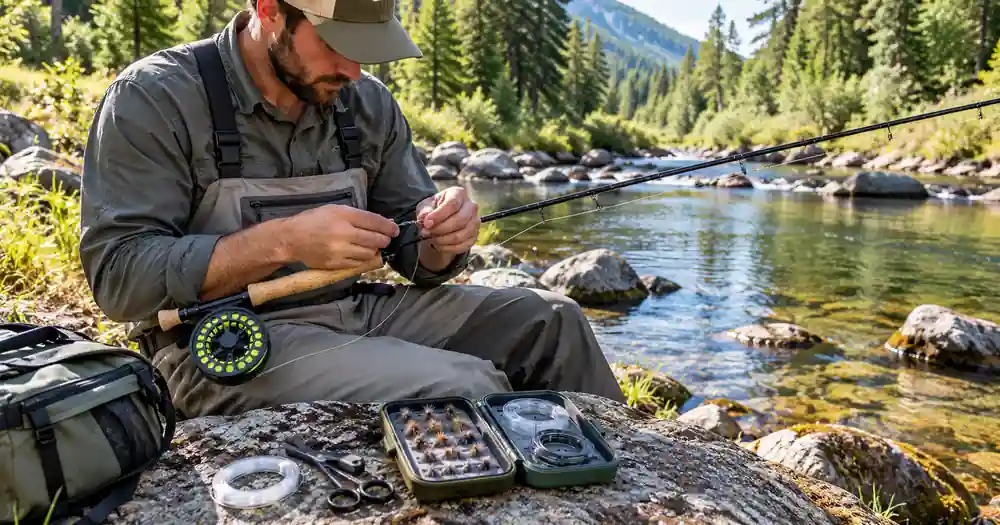
Fly Fishing Starter Kit: How to Choose the Right Rod Weight
The rod weight is the first major decision when choosing a fly fishing starter kit.
Do not choose based on the largest fish you hope to catch. Think about the flies and rigs you need to cast, the water you fish, wind, and the target species.
Why 5-Weight Is a Common Freshwater Starting Point
A 5-weight is popular for general trout fishing because it occupies useful middle ground.
It can handle:
- dry flies;
- many indicator nymph rigs;
- dry-dropper setups;
- small streamers;
- common river and lake trout situations.
For a beginner who does not yet specialize, that versatility is valuable.
When a 4-Weight Makes More Sense
A 4-weight can be a better fit when you mainly fish:
- small or medium trout streams;
- dry flies;
- lighter nymphs;
- smaller flies;
- situations where delicate presentation matters more than power.
The trade-off is reduced authority with bulky rigs, larger streamers, and wind.
When You Need a 6-Weight or Heavier
Move toward a 6-weight when larger flies, heavier rigs, bass, or stronger wind become regular parts of your fishing.
An 8-weight is common in many heavier freshwater and saltwater situations, though exact needs depend on the fishery.
The right rule is simple: buy the lightest practical setup that still casts the flies and rigs you expect to use effectively.
Why Saltwater Needs a Different Setup
Saltwater often adds wind, larger flies, heavier lines, stronger fish, and greater backing requirements.
A 5-weight trout outfit should not be treated as a universal beginner setup for saltwater.
If saltwater is your main goal, start with a kit built for the species and environment rather than adapting a light trout combo.
Fly Fishing Starter Kit: Rod, Reel, and Line Compatibility
One of the biggest advantages of a fly fishing starter kit is that the rod, reel, and line should already be selected to work together.
That convenience is valuable because beginner sizing language can be confusing.
Match Rod and Fly-Line Weight
A 5-weight rod normally starts with a 5-weight fly line.
A 6-weight rod normally starts with a 6-weight line.
Specific lines can be designed slightly heavier or lighter within their class, so the safest approach is to use the outfit manufacturer’s matched line or follow the rod and line manufacturers’ guidance.
FlyFishingScout’s guide to choosing the right fly fishing line explains line weight, taper, and floating versus sinking lines in more detail.
Check Reel Capacity
The reel needs enough room for both the fly line and the appropriate amount of backing.
Manufacturers use different reel-size labels, so do not assume a number means the same thing across every brand.
A matched outfit removes much of this uncertainty because the reel is selected around the line and rod.
For a deeper explanation, see FlyFishingScout’s guide to choosing the right fly reel.
Start With a General-Purpose Floating Line When Appropriate
For a beginner fishing general freshwater trout, a floating line is usually the most versatile first choice.
It can fish:
- dry flies;
- indicators;
- many nymph rigs;
- emergers;
- small streamers.
Specialty sinking and sink-tip lines should be added when a fishing situation creates a specific need.
Leader Compatibility
A basic tapered trout leader is a useful starting point for many 4- and 5-weight freshwater outfits.
Leader length and strength should eventually reflect the flies and presentation, but beginners do not need a huge leader collection before the first trip.
Fly Fishing Starter Kit Options by Budget
A fly fishing starter kit becomes easier to compare when you stop asking which product is “best” and instead ask what changes as the price increases.
Current prices below are reference prices and may change.
Around $250: Orvis Encounter
The current Orvis Encounter 9-foot 5-weight outfit is listed around $249.
It includes:
- four-piece rod;
- Encounter reel;
- 5-weight fly line;
- backing;
- leader;
- rod/reel case.
The current Encounter rod is covered by Orvis’ five-year guarantee for the original owner, subject to its terms and handling charge.
What it solves: It gives a beginner the main casting system in one matched purchase.
What is still missing: Tippet, flies, nippers, forceps, polarized glasses, and first-trip personal gear.
Best fit: A beginner who wants a straightforward branded outfit and does not need a higher-tier rod.
Around $250: Echo LIFT Kit
The current Echo LIFT 590 kit is a 9-foot 5-weight, four-piece, medium-fast outfit listed around $249.99.
Echo offers the LIFT kit in several line weights, including 4-, 5-, 6-, and 8-weight models.
What it solves: It gives buyers multiple weight choices within one starter-oriented family.
Main caution: Check the exact included reel, line, case, and warranty details on the current model before buying rather than assuming every kit is packaged identically.
Best fit: Buyers who want an alternative around the same budget as the Encounter.
Around $280: Redington Original Freshwater Kit
The current Redington Original Freshwater Kit 590-4 is listed around $279.99.
It includes:
- 9-foot 5-weight four-piece rod;
- Crosswater reel;
- backing;
- RIO Mainstream WF5F line;
- tapered leader;
- protective carrying case.
The rod uses a medium-fast action and is positioned as a general trout setup.
What the extra money buys: A known RIO line and a clearly documented matched freshwater package.
What is still missing: The same fishing and trip essentials that are commonly absent from rod/reel outfits.
Around $340: Redington Wrangler Trout Kit
The current Redington Wrangler Trout Kit 590-4 is listed around $339.99.
The package combines a 9-foot 5-weight, four-piece medium-fast rod with a Crosswater reel, RIO Mainstream line, backing, leader, and carrying case.
What changes from cheaper kits: You move into Redington’s Wrangler rod family while keeping the matched-kit convenience.
Who should consider it: A beginner willing to spend more on the rod platform while still avoiding separate component shopping.
Around $480+: Orvis Clearwater Outfit
The current Clearwater Fly Rod Outfit is listed around $479 to $519 depending on configuration.
The outfit includes:
- Clearwater rod;
- fly reel;
- fly line;
- backing;
- rod tube.
The rod currently carries Orvis’ 25-year guarantee.
What the higher price buys: A step-up rod family, broader configuration choice, and much longer rod guarantee compared with the Encounter.
What it does not automatically buy: Flies, tippet, tools, or fishing skill.
A beginner does not need to spend nearly $500 to begin fly fishing. The Clearwater tier makes more sense when the buyer wants a longer-term rod platform and has room in the budget after accounting for the rest of the setup.
Fly Fishing Starter Kit vs. Buying Components Separately
A fly fishing starter kit is not always the cheapest or highest-performance route, but it removes several compatibility decisions.
Advantages of a Matched Kit
A kit can simplify:
- rod/line matching;
- reel sizing;
- backing setup;
- leader starting point;
- storage;
- first purchase decisions.
That makes it attractive for someone who wants to begin fishing rather than research every component separately.
Advantages of Building Your Own Setup
Buying separately gives you more control over:
- rod action;
- reel design;
- fly-line taper;
- reel weight;
- warranty preferences;
- future upgrade path.
It becomes more appealing when you already understand what those differences mean.
Which Is Better for a First-Time Buyer?
For many true beginners, a matched kit is the simpler route.
Buy separately when you already know you dislike the reel or line included in the kit, need a specialized rod, or have enough experience to choose compatible components confidently.
Do not build a custom setup only because separate shopping feels more advanced.
Common Fly Fishing Starter Kit Buying Mistakes
A fly fishing starter kit should reduce complexity. These mistakes add it back.
Choosing by Accessory Count
A kit with 30 inexpensive accessories is not automatically better than one containing five correctly matched core components.
Start with the rod, reel, backing, line, and leader.
Buying the Wrong Rod Weight
A low price does not make a 3-weight, 5-weight, or 8-weight interchangeable.
Choose the weight for your water, flies, rigs, and target species.
Assuming “Complete” Means Nothing Else Is Needed
Read the actual box contents.
If tippet, flies, nippers, forceps, glasses, or other essentials are not listed, plan to purchase them separately.
Ignoring Fly-Line Quality
The fly line does much of the work during the cast.
A poor or badly matched line can make a beginner’s setup frustrating even when the rod is acceptable.
Do not evaluate a kit by the rod alone.
Buying a Cheap Kit With No Support
Check whether the manufacturer offers warranty service, replacement sections, or practical repair support.
A disposable outfit can become expensive if one damaged rod section forces you to replace the entire system.
Spending Too Much Before Knowing Your Fishing Style
Premium equipment cannot tell you whether you prefer dry flies, nymphing, streamers, small creeks, lakes, or saltwater.
For many beginners, a sensible matched outfit plus time on the water is a better first investment than an expensive specialized setup.
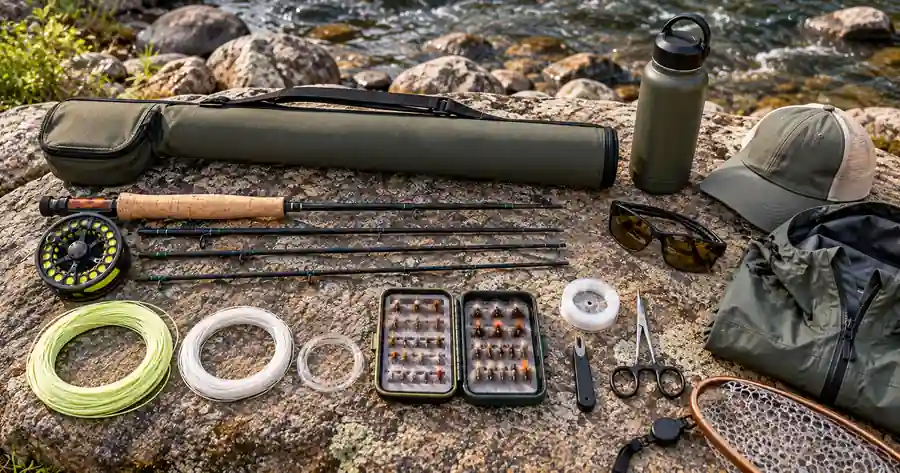
What to Do After You Buy a Fly Fishing Starter Kit
Buying a fly fishing starter kit is the beginning of the setup, not the end.
Check Reel Retrieve Direction
Confirm whether the reel is set for left- or right-hand retrieve according to your preference.
Many fly reels can be converted, but follow the manufacturer’s instructions instead of taking the reel apart randomly.
Attach Leader and Tippet Correctly
If the outfit comes pre-spooled, confirm how the leader connects to the fly line.
Then add or replace tippet as necessary for the flies you intend to use.
Add a Small Local Fly Selection
Buy a small selection suited to your local water and season.
A local fly shop can often help you avoid buying dozens of patterns that are irrelevant to your first trips.
Practice Casting Safely
Do not make your first cast beside other anglers with a hooked fly.
Use an open practice area, replace the hook with yarn, and learn to control a short amount of line before chasing distance.
FlyFishingScout’s guide on how to cast a fly rod walks through a simple beginner practice sequence.
Check Licence and Regulations Before Fishing
Before going to the water, check the correct fishing licence or permit and current rules for the exact place you intend to fish.
A complete tackle setup does not automatically make you legal to fish.
Fly Fishing Starter Kit FAQs
What Should a Beginner Fly Fishing Kit Include?
At minimum, look for a compatible rod, reel, backing, fly line, and leader. A protective case is useful.
Then check whether tippet, flies, nippers, forceps, and other essentials are included or need to be added separately.
Is a 5-Weight Starter Combo Good for Beginners?
For general freshwater trout fishing, yes.
A 9-foot 5-weight is versatile enough for dry flies, many nymph rigs, and smaller streamers.
It is not ideal for every fishery. Tiny creeks, heavy bass flies, salmon, and saltwater can require different weights.
How Much Should a Fly Fishing Starter Kit Cost?
Current branded matched outfits begin around the mid-$200 range, while step-up packages can approach $500 or more.
Price matters less than whether the rod, reel, line, and backing are compatible and suited to your intended fishing.
Do Starter Kits Come With Flies?
Some do, but many established rod-and-reel outfits do not.
Always read the contents list. If flies are not explicitly listed, assume you will need to buy them separately.
Is It Better to Buy a Combo or Separate Rod and Reel?
A matched combo is usually simpler for a first-time buyer because it reduces compatibility decisions.
Buying separately gives you more control and makes more sense when you already know which rod action, reel, and line you prefer.
Do You Need Waders With a Starter Kit?
Not automatically.
You may fish from the bank, a boat, a pier, or water shallow enough for wet wading in appropriate conditions. Waders become useful when cold water, access, or the style of fishing gives you a reason to enter the water.
A good fly fishing starter kit should make the complicated part simple: rod, reel, backing, fly line, and leader should work together from the beginning.
For many freshwater trout beginners, a matched 9-foot 5-weight outfit is a practical place to start. Then add the items the box does not include—usually tippet, flies, a couple of tools, polarized glasses, and the personal gear required for the trip.
Do not judge a fly fishing starter kit by accessory count or by the word “complete.” Buy the matched casting system first, identify what is missing, and spend the rest of your budget on gear that solves a real need.
Sources Used
Orvis — Encounter Fly Rod Outfit was used to verify the current $249 price for the 9-foot 5-weight outfit, four-piece construction, included reel, fly line, backing, leader, case, and current five-year rod guarantee.
ECHO Fly Fishing — LIFT Kit was used to verify the current $249.99 kit price and current 4-, 5-, 6-, and 8-weight configurations, including the 9-foot 5-weight four-piece medium-fast model.
Redington — Original Freshwater Kit 590-4 was used to verify the current $279.99 price, 9-foot 5-weight four-piece configuration, medium-fast action, Crosswater reel, RIO Mainstream WF5F line, backing, leader, and case.
Redington — Wrangler Trout Kits was used to verify the current $339.99 Wrangler Trout Kit pricing and the documented rod, Crosswater reel, RIO Mainstream line, backing, leader, and carrying-case package.
Orvis — Clearwater Fly Rod Outfit was used to verify the current $479–$519 price range, included rod, reel, fly line, backing, rod tube, and 25-year rod guarantee.