
Fly Fishing for Brook Trout: Gear, Flies, and Techniques
Fly fishing for brook trout is often less about casting far and more about approaching carefully, finding cold water, and putting the first fly in the right place.
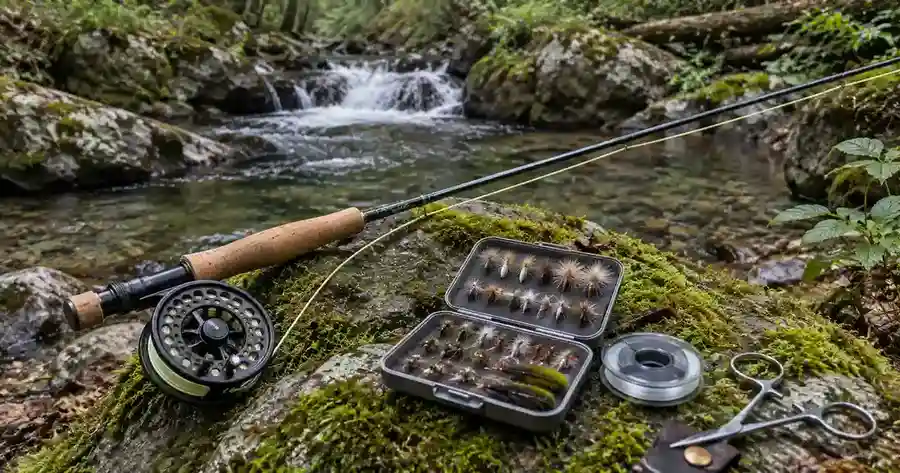
For a typical small-stream setup, a light 2- to 4-weight rod with a floating line, a simple leader and tippet system, and a compact selection of dries, nymphs, terrestrials, and streamers can cover many situations.
Use this five-step approach:
Cold Water → Stealth → Short Cast → Natural Drift → Move
Brook trout are members of the char family despite their common name. They are strongly associated with cold, clean water and can live in small streams, rivers, ponds, and lakes.
Table of Contents
What Makes Brook Trout Different to Fly Fish For?
Many brook trout fisheries are small enough that your approach becomes part of the presentation.
A trout holding in a narrow pool may detect:
- Your shadow
- Heavy footsteps
- A fly line landing over it
- Repeated false casts
- Sudden movement along the bank
That is why fly fishing for brook trout often rewards careful positioning more than long-distance casting.
Instead of standing directly beside the best-looking pool and making a long cast, stay farther back, fish the closest water first, and use short controlled presentations.
Small-stream brook trout are often opportunistic feeders. You usually do not need a box filled with dozens of nearly identical patterns to start.
However, brook trout are not limited to tiny streams. Some populations live in larger rivers and lakes where longer casts, heavier flies, and different tackle can become useful.
The right approach to fly fishing for brook trout changes when you move from a tiny headwater stream to larger water.
Gear for Fly Fishing for Brook Trout
A brook trout setup should match the water more than the name of the fish.
Rod
For small wooded streams, a 2- to 4-weight rod is a practical starting range.
A 3-weight around 7 to 8 feet long can work well when:
- The stream is narrow
- Overhanging branches limit casting room
- Most casts are short
- Flies are relatively small
- Fish are generally modest in size
For small-stream fly fishing for brook trout, a light rod makes short presentations and tight casting situations easier to manage.
Shorter rods can also be easier to move through brush and under tree cover.
But do not assume a short 3-weight is the universal brook trout rod.
If you are fishing larger rivers, lakes, heavier streamers, or places where longer casts are common, a 4- or 5-weight may make more sense.
Reel and Fly Line
The reel does not need to be complicated for most small brook trout streams.
Its primary jobs are to:
- Store the fly line
- Hold backing
- Balance the rod reasonably well
- Help you manage line
A floating fly line is the most versatile starting point for stream fishing because it can handle dries, dry-dropper rigs, many nymph presentations, and small streamers.
A floating line keeps fly fishing for brook trout simple because it allows you to cover several techniques without changing lines.
For small water, precise line control matters much more than maximum casting distance.
Leader and Tippet
Your leader needs to turn the fly over without creating unnecessary disturbance.
The exact leader and tippet size should depend on:
- Fly size
- Water clarity
- Current
- Fish size
- Cover
- Presentation
Fine tippet can improve presentation with smaller flies, but automatically using the lightest material available is not always wise around woody cover or larger fish.
For a deeper explanation, see our guide to choosing the right fly fishing tippet.
Best Flies for Brook Trout
When fly fishing for brook trout, a compact selection of proven fly types is usually more useful than carrying dozens of patterns.
You mainly want options for:
- Surface feeding
- Subsurface feeding
- Terrestrials
- Deeper pools
- Larger prey
If you are still learning the differences among fly categories, our guide to choosing the right fly fishing flies explains dry flies, nymphs, streamers, and other major types.
Dry Flies
Brook trout can be willing to rise when conditions are right.
Useful starting patterns include:
- Adams
- Parachute Adams
- Elk Hair Caddis
- Stimulator
- Royal Wulff
- Small attractor dries
The exact pattern often matters less than putting an appropriately sized fly into the feeding lane without spooking the fish.
Terrestrials
During warmer months, land insects falling from streamside vegetation can become useful.
Common options include:
- Ants
- Beetles
- Small hoppers
Terrestrials can be particularly useful on heavily vegetated streams where land insects regularly reach the water.
Nymphs
If fish are not rising, a nymph can help cover deeper pockets and runs.
Useful patterns include:
- Pheasant Tail
- Hare’s Ear
- Prince Nymph
- Copper John
- Small midge patterns
You can fish a nymph alone or below a buoyant dry fly.
Small Streamers
Brook trout can also respond to small streamers, especially in deeper pools or where larger prey is available.
A small Woolly Bugger is one of the simplest patterns to add to your box.
Keep the streamer and tackle scaled to the water.
Where to Look for Brook Trout
Successful fly fishing for brook trout starts with identifying water that provides both feeding opportunity and protection.
Do not fish every square foot of the stream equally.
Look for combinations of:
- Food
- Cover
- Suitable current
- Oxygen
- Shade
- Depth
- Protection from predators
Plunge Pools
Water falling over rocks can create deeper pockets immediately below.
Fish may hold:
- At the head
- Along current seams
- Behind rocks
- Near the tailout
Undercut Banks
Banks that extend over deeper water can provide cover and shade.
Approach carefully. A fish tucked under a bank may see movement before you ever cast.
Pocket Water
Small soft spots behind rocks can hold trout even when the surrounding current looks too fast.
Do not overlook pockets only a few feet across.
Current Seams
The boundary between fast and slow water can offer food without forcing trout to remain in the strongest current.
Shaded Water
Trees, banks, rocks, and woody cover can create concealment and cooler microhabitat.
Shade alone does not guarantee fish, but it is worth checking alongside depth and current.
How to Approach a Small Brook Trout Stream
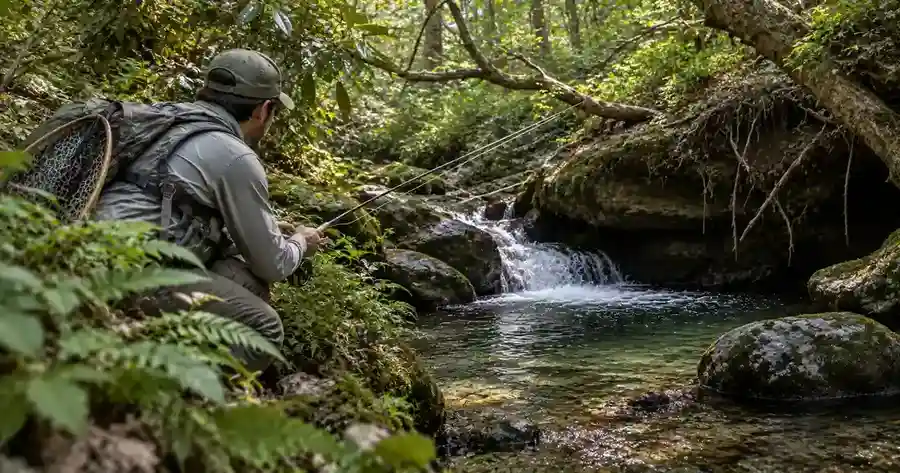
Stealth is one of the biggest advantages you can give yourself when fly fishing for brook trout in clear, shallow streams.
A practical approach is:
- Slow down before reaching the water.
- Look into the closest water before stepping forward.
- Stay low where practical.
- Avoid sudden movement.
- Keep your shadow off the pool.
- Approach from downstream when terrain and access make that practical.
- Fish close water before casting farther.
You do not need to crawl around every stream.
The goal is simply to avoid announcing your presence.
Limit False Casting
Repeated false casts can:
- Flash line above the fish
- Create shadows
- Catch branches
- Disturb tight water
Use enough false casts to make the presentation you need, then deliver the fly.
Casting in Tight Brook Trout Streams
Short, controlled casts are often more useful than maximum distance when fly fishing for brook trout under trees and around brush.
A 15-foot accurate presentation can be more valuable than a 50-foot cast that is difficult to control.
Useful casts include:
Short Overhead Cast
Use it when there is enough space behind you.
Roll Cast
A roll cast helps when trees or brush block a normal backcast.
If this technique is still unfamiliar, review how to cast a fly rod before moving into tighter stream situations.
Sidearm Cast
A lower casting plane can help keep the line below overhanging branches.
Bow-and-Arrow Cast
On extremely tight water, a bow-and-arrow-style presentation can place a fly where almost no conventional backcast is possible.
It is useful, but beginners do not need to master it immediately.
Fly Fishing for Brook Trout Techniques
The most useful fly fishing for brook trout techniques are simple methods that let you cover different depths without creating unnecessary disturbance.
Dry-Fly Prospecting
When fish are rising—or when you simply want to search shallow water—a dry fly is an easy place to begin.
Cast:
- Above likely holding water
- Into soft current edges
- Along seams
- Beside cover
The goal is a natural drift.
Dry-Dropper Fishing
A dry-dropper setup lets you cover two levels at once.
The dry can:
- Catch fish
- Act as a visual reference
- Suspend the nymph
Keep the dropper short enough to cast comfortably in tight water.
Nymphing Deeper Pockets
When trout are holding deeper, place a nymph where it can reach the target zone without snagging constantly.
Focus on:
- Plunge pools
- Deeper seams
- Slots between rocks
- Runs with enough depth to conceal fish
Fishing Small Streamers
Small streamers can be effective around:
- Deep pools
- Undercut banks
- Larger pockets
- Water with larger prey
Try different retrieves.
Short strips, swings, and controlled drifts can all have a place.

How to Fish a Pool Without Spooking It
This close-to-far approach makes fly fishing for brook trout more efficient because you avoid casting over fish that may be holding near you.
1. Fish the Tail
A trout may hold close to the downstream edge.
2. Fish the Near Edge
Cover nearby soft water before stepping closer.
3. Fish the Main Lane
Now cover deeper or central current.
4. Fish the Head
The head of the pool often concentrates food but may require a more precise cast.
5. Move On
After several good presentations to the likely holding water, continue upstream rather than repeatedly disturbing the same pool.
Adjust for Bigger Rivers and Lakes
Small-stream advice should not be forced onto every brook trout fishery.
On larger water, you may need:
- Longer rod
- 4- or 5-weight tackle
- More line control
- Longer leaders
- Larger streamers
- Sinking or intermediate lines in some lake situations
- Different presentations
The principle stays the same: match the setup to the water.
Common Brook Trout Fishing Mistakes
One of the most common fly fishing for brook trout mistakes is assuming that more casting distance automatically creates more opportunities.
Other mistakes include:
Walking Straight to the Best Pool
You may spook fish before casting.
False Casting Over Fish
Extra movement and shadow can hurt you.
Ignoring the Closest Water
Brook trout can hold surprisingly near the bank.
Carrying Too Many Flies
A small selection in several useful sizes is easier to use.
Assuming Every Brook Trout Stream Needs a 3-Weight
Rod choice depends on the actual fishery.
Ignoring Regulations
Wild trout streams can have:
- Special seasons
- Artificial-only rules
- Barbless requirements
- Harvest restrictions
- Protected sections
Always check the responsible state wildlife agency.
Brook Trout Conservation and Fish Handling
Brook trout depend heavily on cold, clean habitat.
When releasing fish:
- Wet your hands
- Minimize handling
- Support the fish gently
- Keep it in the water as much as practical
- Prepare tools before landing it
Warm periods deserve extra caution because brook trout are coldwater fish.
Do not rely on one universal water-temperature number for every stream. Follow current local guidance, restrictions, and temporary closures.
Quick Brook Trout Setup Checklist
For most small-stream fly fishing for brook trout, you can keep the equipment list simple:
- 2- to 4-weight rod
- Matching reel
- Floating line
- Leader
- Appropriate tippet
- A few dry flies
- A few nymphs
- Terrestrials when relevant
- Small streamer
- Forceps
- Nippers
- Polarized glasses
- Local regulations
- Weather and access information
FAQs
What Weight Fly Rod Is Best for Brook Trout?
For many small streams, a 2- to 4-weight rod works well, with a 3-weight being a useful middle ground. Larger rivers, lakes, heavier flies, or bigger fish can justify a 4- or 5-weight.
What Are Good Flies for Brook Trout?
Useful starting patterns include Adams-style dries, Elk Hair Caddis, Stimulators, Pheasant Tails, Hare’s Ears, terrestrials, and small Woolly Buggers.
Is a 3-Weight Fly Rod Good for Brook Trout?
Yes, especially on small streams where short casts and light flies are common. It is not the only option.
Do Brook Trout Take Dry Flies?
Yes. Brook trout can feed readily at the surface when insects are available.
How Do You Fly Fish Small Streams Without Spooking Trout?
Move slowly, stay back where practical, control your shadow, limit false casting, fish close water first, and prioritize short accurate presentations.
Final Takeaway
The most important part of fly fishing for brook trout is rarely owning more gear.
Find cold suitable water, approach carefully, make the shortest accurate cast that reaches the fish, and focus on a natural presentation.
A light setup and a small fly box can take you a long way when your first cast reaches the fish before your shadow does.
Sources Used
- U.S. Fish & Wildlife Service — Brook Trout (Salvelinus fontinalis)
https://www.fws.gov/species/brook-trout-salvelinus-fontinalis - U.S. Fish & Wildlife Service — Expert Tips to Hook the Perfect Fish
https://www.fws.gov/story/expert-tips-hook-perfect-fish - U.S. Fish & Wildlife Service — The Journey of Ike’s Creek
https://www.fws.gov/story/2026-07/journey-ikes-creek - Trout Unlimited — Why Anglers Love Brook Trout and How to Catch Them
https://www.tu.org/magazine/fishing/about-trout/why-anglers-love-brook-trout-and-how-to-catch-them/