
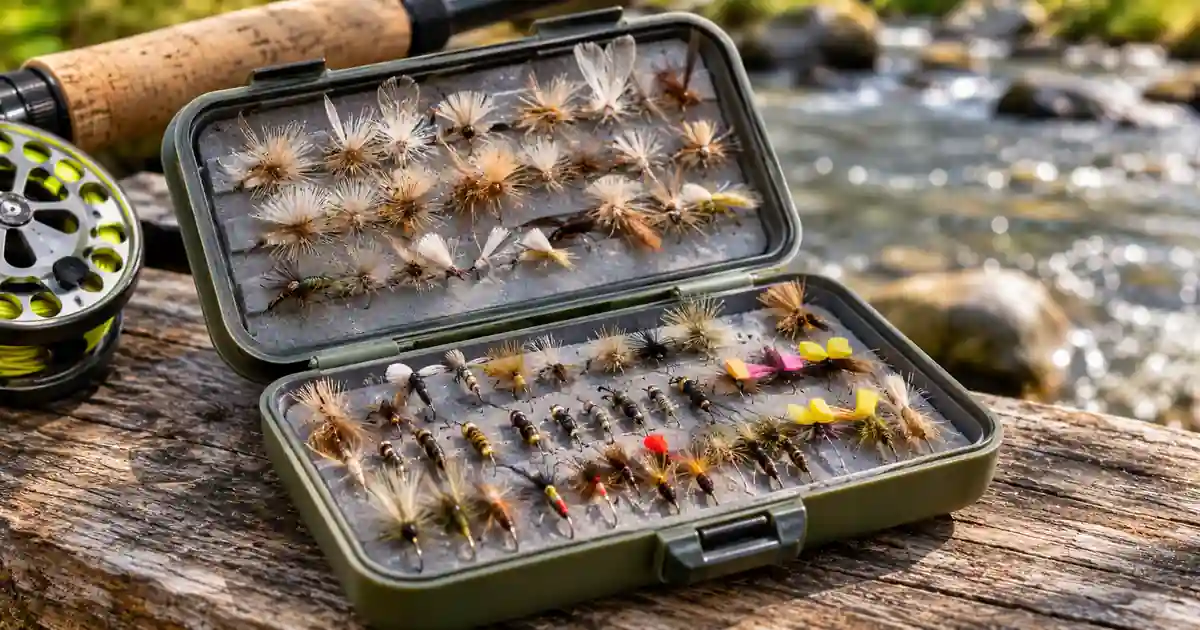
Dry Flies: Types, How to Choose, and Build a Useful Fly Box
Dry flies are artificial fishing flies selected to imitate insects or other food on or near the surface. When choosing dry flies, start by checking where fish are feeding, then identify the likely insect category, choose an approximate size, and decide whether a high-floating or low-riding imitation makes sense.
You do not need a huge collection to begin. A balanced set of dry flies should cover common mayfly, caddis, small-insect, and terrestrial situations without repeated purchases of almost identical patterns. This guide provides a surface-pattern comparison, a beginner fly-box worksheet, and an item-by-item buying checklist. FlyFishingScout has not field-tested or independently ranked the products discussed. Research checked November 23, 2026.
Table of Contents
What Are Dry Flies?
Dry flies are normally fished at the surface rather than deep in the water column. Some sit high on hackle or foam, while others rest almost flush with the surface film. Most imitate adult aquatic insects, insects from bankside vegetation, or food struggling at the boundary between air and water. For the larger distinction among flies, see our guide to the main types of fly fishing flies.
A rising trout does not prove it is eating fully developed adult insects. Fish can also take a mayfly emerging in the surface film, or spent adults after a spinner fall. Some surface-film emerger patterns therefore overlap with dry-fly choices, even though other emerger imitations are designed to fish underwater. This distinction helps you avoid buying only tall hackled patterns.
An insect category and a construction style describe different things. Mayfly, caddis, midge, stonefly and terrestrial are food groups. Parachute, comparadun, CDC, traditional hackle and foam refer to how a pattern is built. A Parachute Adams is a mayfly-style imitation with a parachute hackle arrangement, not a new insect family.
Main Types of Dry Flies: Mayflies, Caddis, and More
The quickest way to identify useful dry flies is to compare the insect silhouette with what you see on the river. A familiar name matters less than the size, wing shape, body length and intended surface position. Keep categories apart in the box so that a mayfly and a caddis are not treated as interchangeable merely because both float.
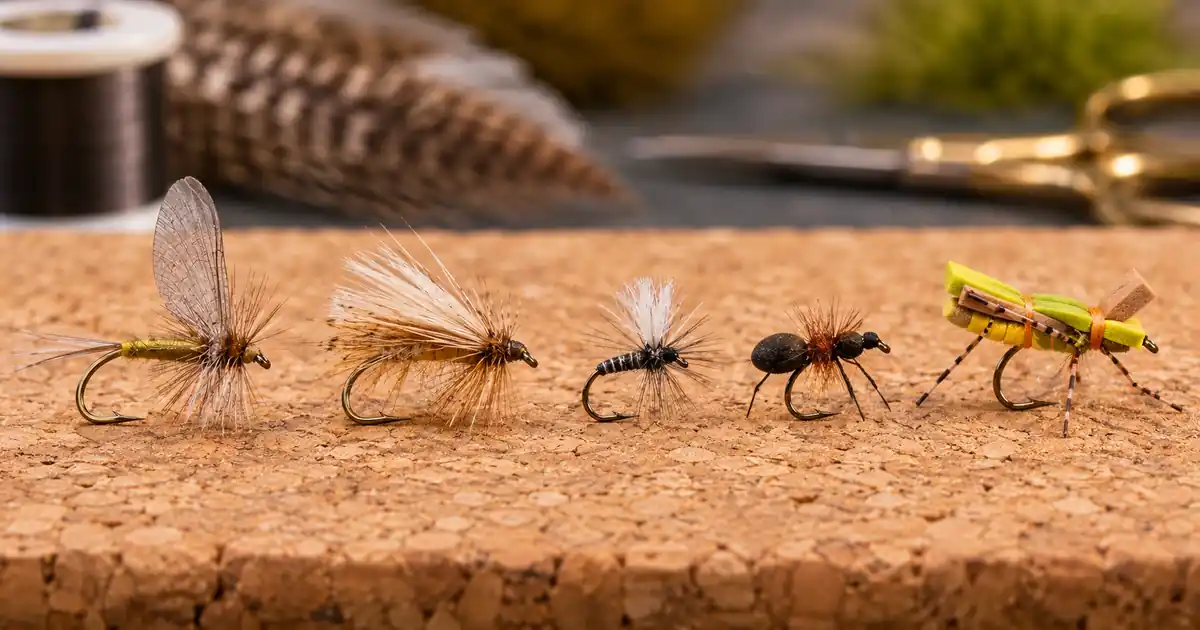
| Category | Visible food clue | Example fly | Buying consideration |
|---|---|---|---|
| Mayfly dun | Slim body and upright wings | Parachute Adams, Blue-Winged Olive | Approximate size and wing post |
| Spent mayfly spinner | Wings spread flat across surface film | Rusty Spinner | Sparse low-riding profile |
| Adult caddis | Tent-shaped, swept-back wings | Elk Hair Caddis | Wing shape and neighboring sizes |
| Midge | Very small adult insects or clusters | Griffith’s Gnat, small midge dry | Small hooks and visibility |
| Adult stonefly | Larger winged adult around water margins | Stonefly adult, Stimulator-style pattern | Correct adult stage and regional size |
| Terrestrial | Ants, beetles or hoppers from the bank | Foam ant, beetle, hopper | Proportion and foam construction |
| General attractor | No obvious insect but surface searching is plausible | Royal Wulff, suitable attractor | Visibility without an exact hatch claim |
Mayfly duns versus spent spinners
A mayfly dun has newly emerged wings and is generally represented with an upright-wing imitation. After mating, spent adults can lie flat on the water with extended wings. During a spinner fall, a realistic low-slung surface outline may matter more than a large upright post. A standard parachute can be useful for many mayfly situations, but it does not automatically replace every spinner pattern.
Carry mayfly dry flies in sizes that approximate insects you might actually observe. A general Adams and one small olive pattern cover different starting situations. If trout are taking small, thin-bodied adults, downsizing the entire imitation may be more useful than buying another color of a bulky fly.
Caddis and midge dry flies
Adult caddis often show tent-shaped wings, so an Elk Hair Caddis-type fly has a different silhouette from an upright-wing mayfly. Some are dressed to float prominently in riffles; others are tied to ride lower. In either case, match the approximate insect size rather than assuming all caddis are large and tan.
Small midges may become relevant when surface activity looks tiny and regular. A Griffith’s Gnat or small midge-style pattern gives you a noticeably different size and profile from a large caddis or foam hopper. These small dry flies are more difficult to see and tie onto fine tippet, which is a practical reason not to overbuy sizes you cannot use comfortably.
Adult stoneflies, terrestrials and searching patterns
Stonefly nymphs live below the surface, but adult stoneflies can be an appropriate surface food source. A surface stonefly dry is not the same as a weighted stonefly nymph. A large Stimulator may sometimes serve as a broad searching attractor, yet its usefulness depends on local insect activity and fish behavior.
Ants, beetles and hoppers can arrive from plants beside a river and make terrestrial dry flies relevant even without a hatch of aquatic insects. Foam may improve a fly’s buoyancy, but large bright patterns can be intrusive on quiet, clear water. An attractor works as a plausible searching option rather than a guaranteed imitation of one exact species.
Dry Flies by Construction: Parachute, Comparadun, CDC, and Foam
Construction style determines much of a fly’s visible profile and how it is intended to sit at the surface. Learning this second classification prevents you from buying four visually different patterns that nevertheless fulfill nearly identical jobs in the same size and water conditions.
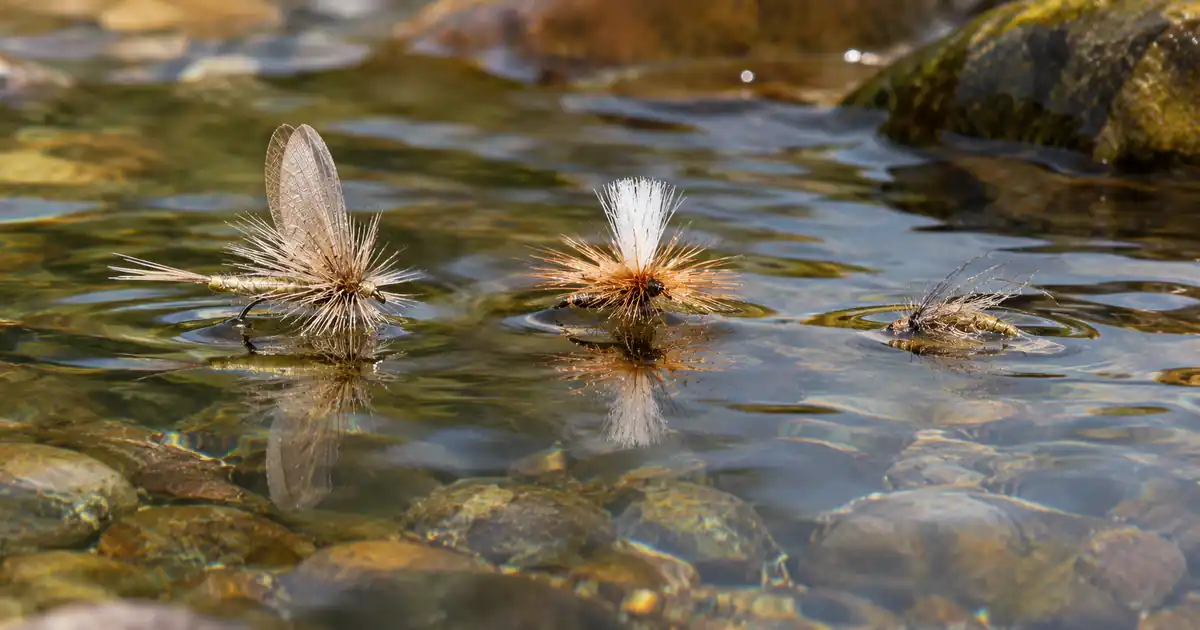
| Construction | Distinguishing feature | Usual role | Limitation to check |
|---|---|---|---|
| Conventional hackled dry | Hackle around thorax or body | Visible, relatively high-floating choice | Can look bulky |
| Parachute dry | Hackle wound around upright wing post | Mayfly-like body closer to surface film | Post helps angler see it, not necessarily fish |
| Comparadun | Fan-shaped wing, sparse lower profile | Subtle mayfly dun imitation | Harder to track in glare |
| CDC dry | Fine duck preen feathers in wing or body | Delicate surface presentation | Needs compatible drying and floatant |
| Foam dry | Buoyant foam body, sometimes rubber legs | Terrestrials and selected attractors | May be oversize for selective fish |
| Spent spinner | Low extended wings | Dead or spent adult imitation | Can be difficult to see |
Traditional hackle, parachute and comparadun
Traditional hackle provides surface support and can produce a distinctive high-riding outline. Parachute hackle wraps horizontally around a post, often letting the fly’s body sit closer to the film. Comparadun-style patterns usually have a fan-like wing and minimal conventional hackle, creating a sparse silhouette. The actual position of dry flies still depends on material, hook weight and current.
In broken water, a bushier or high-visibility dry may be easier to track. On flat water with repeated careful rises, a lower and slimmer option can make more sense. Do not confuse a style’s general tendency with a universal statement that it always floats or catches fish better.
CDC materials, foam and dropper capacity
CDC feathers are used in some dry flies to create fine wings and controlled surface flotation. These delicate materials are not all compatible with ordinary floatant gels. Loon Outdoors specifically lists Lochsa and several other treatments for CDC and directs users away from assuming its standard Aquel gel is the best choice. Always check product-specific instructions.
Foam-based dry flies can offer buoyancy and a visible profile. Some appropriately designed larger foam flies are used as part of dry-dropper rigs, but not every dry fly can support a nymph. Dropper compatibility depends on fly construction, hook, added weight, leader and current; it cannot be established from the word foam alone.
How to Choose Dry Flies for Your Water
Use this repeatable order: feeding level, food clue, category, approximate size, surface profile, visibility and fly-box inventory. Starting with the river rather than the catalog helps avoid purchases that fill no real gap.
Example: recognizable mayflies and visible rises
Imagine trout making regular small rises under drifting upright-wing mayflies in a clear run. Select a mayfly dry approximately matching those insects, perhaps a small parachute or dun pattern. If the silhouette is too high for fish taking insects trapped in the film, compare a low-riding comparadun, spinner or emerger-style imitation before changing only the color.
Notice that even visible rises are not proof that the trout took a completely emerged adult. Check the insects actually in the current, not only the flying insects over your head. The real feeding level can change through the same hatch.
Example: no clear hatch on a broken-water bank
If you see no identifiable hatch but believe fish may look upward along a vegetated bank, a modest caddis, attractor or terrestrial may be a reasonable searching starting point. Pick a size you can manage and a profile you can track. Do not claim that a foam hopper catches fish in every river or that dry-fly searching is always preferable to fishing below the surface.
When feeding is clearly subsurface, choose the relevant technique and fly family. Our nymph fishing flies guide explains a different category. Local shop advice and current water observations should refine these broad examples; no single U.S. hatch calendar works for all elevations and climates.
| Water | Reasonable surface pattern to compare | Main trade-off |
|---|---|---|
| Smooth run and delicate small rises | Sparse mayfly, midge or surface emerger | Subtle profile but lower visibility |
| Bubbly riffle and uncertain food | Visible parachute, hackled dry or caddis | Trackability without oversizing |
| Vegetated bank with falling insects | Ant, beetle or suitable hopper | Local evidence matters |
| No surface feeding observed | Reassess dry-fly plan or use plausible searching pattern | Avoid forcing a hatch match |
Dry Flies: Match Size, Silhouette, and Surface Position
When a trout is feeding selectively, approximate size and silhouette usually deserve attention before fine color adjustments. Consider whether the food sits high as a mayfly dun, lies flat as a spinner, or hangs partly within the film. A technically excellent imitation with the wrong surface position may be less appropriate than a simple one with the right outline.
Understanding dry-fly hook numbers
In familiar numbered fly-hook series, higher numbers normally indicate smaller nominal hooks. Thus #20 is generally smaller than #16, and #16 smaller than #12. These are not exact measurements of the natural insect. Hook shape, shank length, gauge and manufacturer vary, even at the same number.
Neighboring sizes can add more value than many redundant colors. Two sizes of a caddis pattern may let you cover common differences in observed food, while ten versions of the same large pattern will not cover small mayflies. Use a shop’s local information to decide whether your starter sizes should be shifted smaller or larger.
Color, light and visibility
Body color can refine a plausible imitation, but it should not override a clear mismatch in size, wing profile or surface position. A pale post may help an angler follow parachute dry flies in glare; it does not mean the natural insects have white wings. Visibility is an angling convenience, not necessarily a perfect insect match.
Riffles can make small low-riding dry flies hard to follow, while flat water can make a bulky attractor overly obvious. Select an appropriate compromise between subtlety and tracking the fly. Avoid claims that a particular construction always wins in clear water or that color never matters.
Build a Practical Beginner Box of Dry Flies
Build a fly box by functions, not by total count. A few mayfly imitations, a distinct caddis profile, small surface insects, terrestrials and one low-lying spinner cover more situations than twenty copies of the same size and color.
The following 18-fly worksheet is an editorial example for someone starting out, not a universal prescription for every American river. Local hatches, target fish, season and how small a hook you can comfortably handle should change the selection.
| Group | Illustrative sizes | Count | Why carry it |
|---|---|---|---|
| Parachute Adams | Two #14, two #16 | 4 | General mayfly profile |
| Elk Hair Caddis | Two #14, two #16 | 4 | Tent-wing caddis profile |
| Small mayfly dun | One #18, one #20 | 2 | Smaller hatch |
| Griffith’s Gnat / midge | One #18, one #20 | 2 | Tiny surface food |
| Ant or small beetle | One #14, one #16 | 2 | Terrestrial alternative |
| Foam hopper | One #10, one #12 | 2 | Larger searching form |
| Spent-wing spinner | One #18, one #20 | 2 | Low film silhouette |
| Total | 18 | Seven distinct jobs |
Review what is already in your fly box before buying. An assortment may include four different-looking Adams flies but no small caddis or spinner. A list of names is less helpful than a visible selection of categories and neighboring hook sizes. The site’s fly fishing tackle box guide discusses organizing hooks and flies safely.
Individual patterns or premade assortments?
Buying individual dry flies makes sense when you know the exact pattern, color and size missing. A preassembled assortment can be useful for a beginner when it lists every pattern, size, count and included storage box. Compare the real distribution: twenty-four flies that all perform the same function may be poorer value than a smaller set with multiple useful categories.
A local fly shop can help tailor the box to current waters. Ask which insects are actually appearing, what sizes are realistic, and whether the water favors sparse spinners or highly visible searching patterns. Do not purchase a huge nationwide kit solely because it advertises success everywhere.
How to Evaluate Dry Flies and Assortments Before Buying
Before ordering, inspect the exact retailer listing rather than relying on an assortment headline. Examine hook condition, secure thread, consistent wing shape, sizes, number of duplicates and the type of material used. Fly patterns with loose hackle or crooked hooks may be difficult to use even when the package contains many flies.
| Buying check | Useful information | Reason to hesitate |
|---|---|---|
| Pattern category | Named mayfly, caddis, midge or terrestrial | Unclear photos or misidentified submerged flies |
| Hook sizes | Actual sizes for each pattern | One vague assorted-size label |
| Quantity | Count per type and size | High total built from near-duplicates |
| Tying and hooks | Clear photos of point, eye, wings and finish | Bent hook, rust, loose materials |
| Flotation style | Hackle, CDC, foam, spinner, low riding | Blanket always-floats promise |
| Current terms | Variant, seller, included box, returns | Unverified or mismatched package |
Three distinct Amazon options to compare
Affiliate disclosure: As an Amazon Associate, FlyFishingScout earns from qualifying purchases. Buying through these links may earn us a commission at no extra cost to you. Product identities and ASINs were matched through external Amazon US product catalogs, but the current Amazon pages, sellers, stock and checkout could not be live-tested. Verify each current listing before ordering.
Feeder Creek 24 Dry Flies in 8 Patterns with Fly Box — Size 14 — 📦 For sampling several dry-fly patterns: a seller catalog identifies a 24-fly assortment covering eight patterns. The size 14 emphasis will not replace small dries needed for technical hatches; check the exact contents. Check this exact product on Amazon.
Feeder Creek Adams Dry Flies — 12-Piece Size Assortment — 🪶 For replenishing a mayfly-style option: the catalog describes twelve Adams dries across sizes 12, 14 and 16. Compare those sizes with your local river rather than automatically buying more Adams. Check this exact product on Amazon.
Feeder Creek Premium Elk Hair Caddis — 12 Flies, Four Sizes — 🎣 For a distinct caddis silhouette: the imported Amazon product catalog identifies a dozen Elk Hair Caddis dries in four sizes; verify the current color and size breakdown. Check this exact product on Amazon.
These are three different buying purposes, not field-tested winners. Buying the mixed set and both specialist packs at once may create unnecessary duplicates. Check which categories you already own, and remember that a small shop-selected selection may be more useful than any mass-market package.
Common Dry Flies Selection Mistakes and Fly Care
A common mistake is to assume that every rising trout is eating an adult floating high on the water. Fish may take emergers, spent spinners, or tiny insects in the film. An otherwise reasonable dry may be refused because of wrong size, surface silhouette, unnatural movement, obvious leader, or a fish that is no longer feeding. This guide concerns selection; detailed casting and drag-free drift belong in FlyFishingScout’s separate dry-fly technique article, which is currently a draft and not linked here.
When a dry fly becomes waterlogged, inspect it before repeatedly adding treatment. A damaged hook or disintegrating hackle should be replaced. Other patterns can be gently dried and redressed using material-specific instructions. CDC dry flies require particular care: Loon Outdoors identifies Lochsa and certain powder products as CDC-compatible but recommends alternatives to ordinary Aquel gel for this material.
Dry flies should be stored where they can dry rather than pressed wet into crowded compartments. Inspect for rust, bent points, crushed wings and tangled hackle before each trip. A small organized selection kept in good condition is often more practical than a packed box of damaged duplicates.
Dry Flies FAQs and Final Decision Tree
What dry flies should beginners start with?
Start with a mayfly dry, a caddis, a small midge or olive-style fly, a terrestrial and a low-riding option. Carry neighboring sizes for the patterns that fit your local water. Do not assume an eighteen-fly example is the only correct starter box.
Are emergers dry flies?
Some emergers are intended to ride within the surface film and overlap with dry-fly decisions, but many emergers fish below the surface. The pattern’s design and intended depth determine how to classify and use it.
Is a #20 fly bigger than a #14?
Usually no. Numbered fly hooks generally become nominally smaller as the number increases. Exact hook dimensions vary by style and maker, so hook numbers are not measurements of a natural insect.
Do big foam dry flies always float better?
No universal rule applies. Foam provides buoyancy, but hook weight, construction, dressing, water and any attached dropper matter. Not every foam dry is appropriate for a dropper, and a large pattern may be unsuitable for selective feeding.
Should I buy dry flies individually or in bulk?
Buy singles when a specific size or category is missing. Consider an assortment when its contents are transparent and genuinely add multiple jobs to your box. A high count alone does not establish better value or quality.
Why do fish ignore dry flies when they rise?
The fish may be eating a different life stage, or the fly’s size, profile or drift may be unsuitable. Verify the food and water position first; detailed presentation and refusal diagnosis are covered in a separate technique workflow.
What floatant works for CDC?
Use a treatment whose manufacturer specifically confirms CDC compatibility. Loon lists Lochsa and selected powders or drying products; do not assume every conventional gel is appropriate for CDC feathers.
A seven-step selection decision tree
- 1. Observe the feeding level: are fish taking surface food or food suspended in the surface film?
- 2. Identify food clues: upright mayfly, tent-wing caddis, tiny midge, adult stonefly, or bank-side terrestrial.
- 3. Choose the category: imitate recognizable food, or use a measured searching attractor when no hatch is obvious.
- 4. Match approximate size: select a plausible hook size and consider one neighboring size.
- 5. Match surface position: high hackle, parachute, sparse dun, spent spinner or surface-film emerger.
- 6. Check visibility and condition: can you follow the fly and keep its materials in the intended state?
- 7. Audit your box: purchase only a useful missing category or size after checking the seller’s exact listing.
Conclusion: Choose dry flies by the actual feeding layer, insect category, approximate size and surface silhouette. Build a compact box with recognizable alternatives and useful neighboring sizes, then add patterns based on local observations rather than universal claims about one fly catching fish everywhere.
References
- Orvis — Fly Fishing Dry Flies — definition and pattern examples.
- Umpqua — Freshwater Dry Flies — categories, spinner and CDC pattern descriptions.
- Orvis Learning Center — How to Fish Emergers — surface-film feeding and emergers.
- Orvis — How to Match the Hatch — insect stage, silhouette and size.
- Orvis — Tips for the Spinner Fall — spent-wing dry flies.
- Orvis — Which Dry Fly Without a Hatch? — searching patterns.
- Orvis — How to Match the Hatch Video — instructional resource.
- Umpqua — Comparadun — low-profile construction.
- Loon Outdoors — Lochsa — CDC floatant compatibility.
- Loon Outdoors — Aquel — different floatant-use recommendations.
- Cherry Picks — Feeder Creek Amazon Catalog — ASIN identification for mixed and Adams assortments.
- Tiendamia — Feeder Creek Elk Hair Caddis Amazon Import — ASIN and 12-fly package description.
- Feeder Creek — Dry Fly Collection — manufacturer pattern descriptions.