
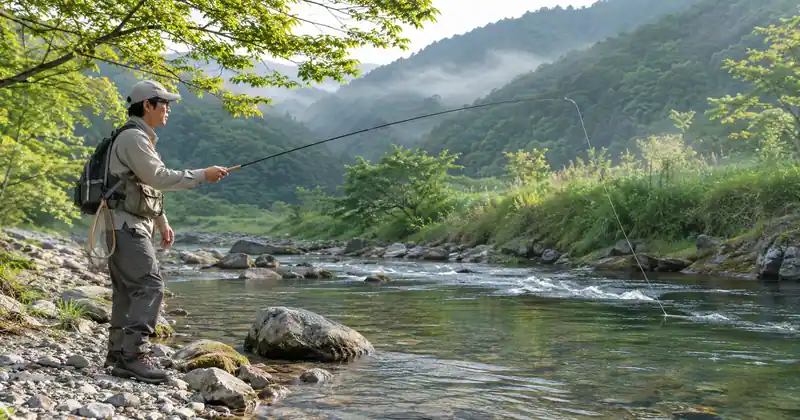
Tenkara Fly Fishing Rod: How to Choose the Right Length and Style
Choose a tenkara fly fishing rod by the space you have to cast and the distance you need to reach from a workable stance. A short rod helps in brush and a long rod can hold more line over fast current. If you fish different types of streams, an adjustable rod is worth comparing with a single-length rod and a spare line.
Table of Contents
Choose a tenkara fly fishing rod length for your water
A telescopic tenkara rod extends from its handle and fishes a fixed length of line attached at the tip. You can replace that line when conditions change, but you cannot feed line from a reel during a drift or let a fish run against a reel’s drag. Rod length therefore affects reach, clearance, and how you bring the line back to hand.
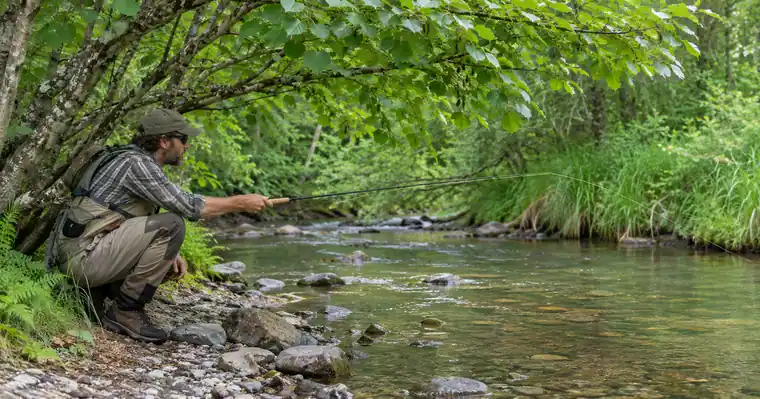
Think of a familiar stretch and pick three real targets. One might sit below an alder branch, another just beyond a fast seam, and a third in a short pool where you can move closer along the bank. Picture where the rod and line must travel to place the fly and how you would bring a fish into the net. That exercise helps identify whether clearance or reach limits you more often.
| Water you fish most | Rod to compare | What to test |
|---|---|---|
| Small streams with a low canopy | Short setting around 9–10½ ft | Check tip clearance behind and beside you, including on the retrieve. |
| Mixed water with pockets and open runs | One fixed length around 12 ft or a model with several settings | See if one length handles your usual stops and starting positions. |
| Open water with conflicting currents | A longer rod you can comfortably support | Check whether the added reach lifts line off the near current without tiring your wrist. |
These are starting points. A narrow stream with open banks may fish well with a longer rod, while brush on a bigger river can favor a short rod at the only available access. If you usually need to strip line to fish farther out or manage a running fish, compare a conventional trout fly rod before committing.
Before buying a tenkara fly fishing rod, walk a reach you know and identify three positions where you can stand or fish from the bank. Trace where a low branch would block the rod and where a seam would pull a long line downstream. Then walk a few steps along the bank and check whether you can solve the same reach problem by changing your position. A longer rod earns its place when it reaches the water you need from a practical stance. If the longer model makes you back out of several good spots, start shorter and plan to fish the closer water first.
Compare fixed and adjustable tenkara fly fishing rod designs
A single-length model suits a stream where your most useful reach rarely changes. An adjustable model gives you multiple manufacturer-approved fishing positions. A collapsed telescopic tenkara rod cannot automatically be fished at any partly extended length. If you want to switch lengths on the water, check which positions the maker supports and whether the chosen line is manageable with each one.
Tenkara USA lists its Rhodo at 8 ft 10 in, 9 ft 9 in, and 10 ft 6 in. Its Iwana gives you a single 12-ft fishing length. The Sato offers 10 ft 8 in, 11 ft 10 in, and 12 ft 9 in. These are examples of three shopping decisions: shorter settings for overhead clearance, a simple fixed length, or broader reach with a shorter option. They show documented dimensions without ranking the rods.
Check packed length with the case attached if that is how you hike. A rod that fits inside a pack without its protective tube may need a different carrying plan once the tube is on. Also check whether you can buy replacement tip sections and what part of the rod is actually included in a kit.
If you can handle a fixed and an adjustable tenkara fly fishing rod side by side, compare the position you expect to use most often. Hold each rod horizontally for a short interval, then raise and lower the tip as you would when lifting line off the water. Notice which one feels harder to hold steady. Balance matters. Also check how quickly you can change settings while keeping track of a loose line. If the extra lengths are awkward to use, a single-length model may fit your fishing better.
Match the feel and line of your tenkara fly fishing rod
Tenkara rod action describes how and where the blank bends under load. Maker terms and numerical action labels do not have to match across brands. Read the maker’s description and, if you can demo the rod, try it at the setting you would fish with the line you intend to use. Observe how the rod loads on a gentle cast and whether you can repeatedly place the fly without gripping harder.
Start with a tenkara line roughly around rod length, plus a short section of tippet. Tenkara USA describes tapered lines as easier to cast and level lines as lighter and easy to cut to a custom length. A light level line can make it easier to keep line clear of conflicting currents. A tapered line can give a beginner clearer feedback while practicing. Base the choice on your water and rod maker’s recommendations.
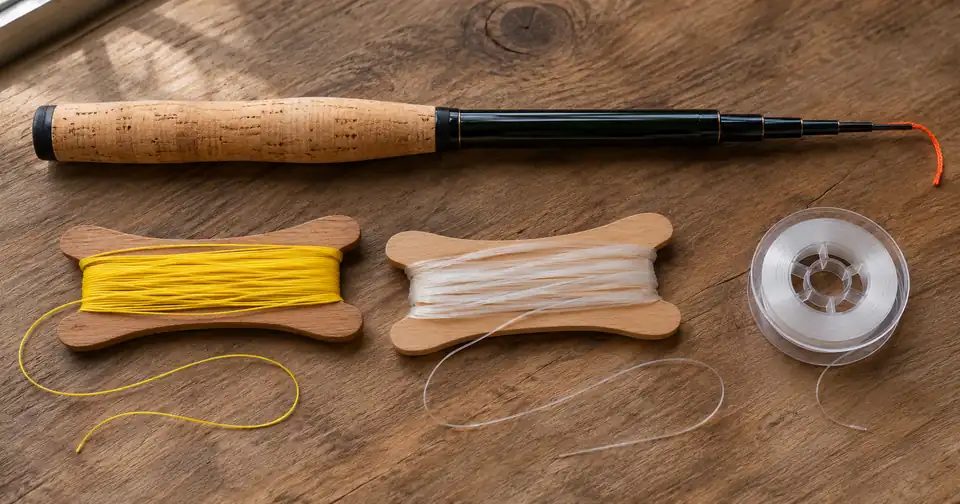
Line length also changes the landing routine. If the line plus tippet is much longer than your tenkara fly fishing rod, you may need to recover line by hand before netting. Try a shorter setup if you repeatedly have more line out than you can manage from a stable position. Use the maker’s tippet guidance for the chosen model so you understand its limits before fishing.
For a first test, use one recommended line and one small fly at a comfortable distance. Try the same target from the same position several times before switching anything. If the fly falls short and the line straightens cleanly, try a slightly different stance or a modest change in line length. If the line repeatedly collapses, test a shorter line before you decide the tenkara fly fishing rod lacks reach. Keep a note of the rod setting, line length, and conditions that worked. Next time you move to a tighter stretch, you can start from a known setup and change only the part that needs adjusting.
What to check before you buy
- Choose by your most common fishing position and the clearance around it.
- Use only the fishing lengths the maker specifies. Check the packed size against your bag or travel case.
- Check what the starter kit includes, especially line, tippet, and a way to store the rig.
- Compare bend and balance at the length you expect to fish most often. Treat label names as a starting point for a trial.
- Use your target water to decide if you need the line control of fixed-line gear or the extra reach and reel of a conventional outfit.
The most useful tenkara fly fishing rod lets you reach the holds you fish regularly and still control the line when space gets tight. For a first trip, keep the rig simple and change one variable at a time. If you are choosing between systems, the beginner fly fishing setup guide shows what a reel-based outfit requires.
References
Tenkara USA — Choosing a Tenkara Rod