
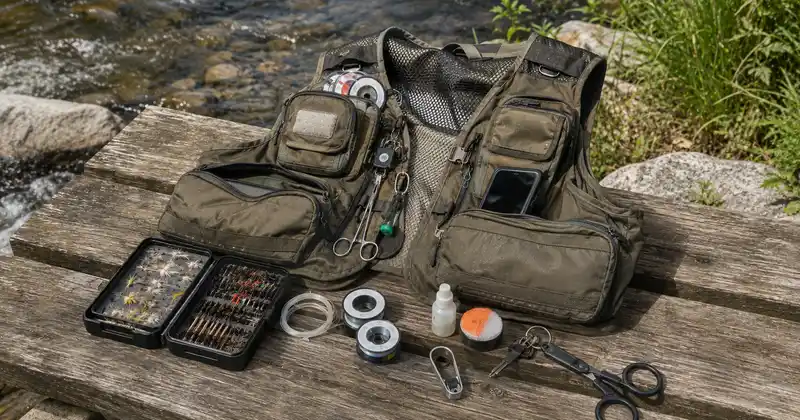
Fly Fishing Vest: How to Choose the Right One
A fly fishing vest should keep the gear you actually use organized, easy to reach, and comfortable to carry without restricting your cast. The right choice depends less on having the most pockets and more on five things: Load → Access → Climate → Fit → Fishing Style.
Start by listing what you normally carry. Then choose enough storage for that gear, check whether your main fly boxes fit the pockets, and make sure the vest remains comfortable when loaded. A lightweight mesh design may suit warm-weather minimalists, while anglers carrying several boxes, leaders, tools, and an extra layer may prefer more capacity.
Do You Need a Fly Fishing Vest?
A vest is useful when you want frequently used gear distributed around your torso and available without taking off or rotating a pack.
It can work especially well for walk-and-wade fishing because small items such as fly boxes, tippet, floatant, nippers, and forceps can stay close at hand.
But a vest is not automatically the best carry system for every angler. A sling, chest pack, hip pack, or backpack may make more sense if you carry bulky items, want less material around your torso, or need more room for water and extra clothing.
The important question is not whether vests are traditionally associated with fly fishing. It is whether a vest makes your own gear easier to carry and use.
Table of Contents
Start With What You Actually Carry
Before comparing models, put your normal fishing gear in front of you.
That may include:
- Fly boxes
- Leaders
- Tippet spools
- Nippers
- Forceps
- Floatant
- Indicators
- Split shot where permitted
- Phone
- Fishing license
- Keys
- Snacks
- Landing net
- Water
- Extra layer
This immediately tells you more than a manufacturer’s pocket count.
An angler carrying two compact fly boxes and a few tools has very different storage needs from someone carrying several large boxes, multiple leader systems, food, and an extra layer.
Tippet is a good example. If you carry several spool sizes, think about whether you want them inside a pocket or on an exterior tippet holder. If you are still deciding what sizes belong in your setup, see our guide to choosing the right fly fishing tippet.
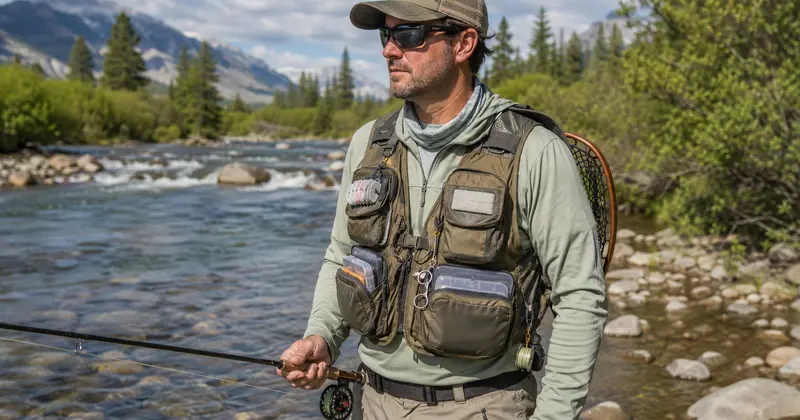
Fly Fishing Vest Pockets: Layout Matters More Than Count
It is easy to compare fly fishing vests by counting pockets, but raw pocket count tells you little about how useful those pockets will be.
A better way to judge the layout is:
Access → Size → Closure → Location
Frequently used items should be easy to reach. Less frequently used gear can go in rear or interior storage.
Fly Box Storage
Start with your actual fly boxes.
Check whether the main front pockets are:
- Wide enough
- Tall enough
- Deep enough
- Easy to open with one hand
- Positioned where you can reach them comfortably
Avoid buying a high-capacity vest and then discovering your favorite fly box barely fits inside the pocket opening.
The types of flies you carry can also influence how many boxes you need. If you are still building that system, our guide to the main types of fly fishing flies explains dry flies, nymphs, wet flies, streamers, and how to choose between them.
Security and Tool Storage
Small tools need a different type of storage from fly boxes.
Look for sensible places for:
- Nippers
- Forceps
- Floatant
- Tippet
- Leaders
- Indicators
- License
- Phone
- Keys
Zippered interior pockets can be especially useful for valuables. External attachment points can work well for tools you use repeatedly.
The goal is not to attach something to every available loop. Too much gear on the outside can create clutter and snag points.
How to Choose a Fly Fishing Vest for Fit
Fit matters before specialty features.
The vest should stay reasonably close to your torso without restricting your shoulders or casting arm. You should also have enough adjustment to wear it over the layers you normally use.
Try to evaluate fit with realistic clothing underneath.
A vest that fits perfectly over a thin summer shirt may become uncomfortable over a fleece or insulating layer. At the same time, a vest that hangs excessively loose can allow loaded pockets to swing around as you move.
Also consider how low the front pockets sit when you wade. Deeper wading can bring low storage closer to the water.
If possible, evaluate the vest with representative gear inside rather than trying it only while empty.
Comfort Changes When the Vest Is Loaded
An empty vest can feel almost weightless in a store.
Add several fly boxes, tools, leaders, a phone, and other gear, and the experience changes.
Pay attention to:
- Shoulder pressure
- Neck and collar padding
- How weight is distributed
- Whether front pockets pull the vest forward
- Whether the vest shifts while walking
- Whether anything interferes with casting
Good organization can improve comfort because you can spread weight more evenly.
It also helps to avoid carrying items simply because you have empty pockets. More storage often encourages overpacking.
The goal is enough capacity—not maximum capacity.
Lightweight, Mesh, or Higher-Capacity Vest?
There is no universal best fly fishing vest design.
| Vest Style | Main Strength | Main Trade-Off | Often Suits |
|---|---|---|---|
| Lightweight/low-profile | Less bulk | Less storage | Mobile or minimalist anglers |
| Mesh vest | Greater airflow | Less solid fabric structure | Warm-weather fishing |
| Higher-capacity vest | More organized storage | Easier to overpack | Gear-heavy anglers |
| Hybrid/pack-style vest | Larger storage and modular features | More complexity and bulk | Longer or varied outings |
A lightweight fly fishing vest does not automatically mean poor storage, and a high-capacity vest does not automatically mean better organization.
Choose according to the amount and type of equipment you carry.
Breathability and Weather
A vest covers part of your torso, so construction matters when temperatures rise.
Mesh panels can increase airflow compared with a mostly solid fabric design. Several current vest designs combine mesh with stronger fabric around pockets and high-wear areas.
A vest should not be confused with rain protection. A durable water-repellent finish can help fabric shed some moisture, but it does not make an ordinary fishing vest a waterproof shell.
For colder conditions, think about layering. Make sure the front closure and shoulder area still work when you add insulation underneath.
Net Holders, Rod Holders, and Tool Attachments
Small attachment features can be useful when they solve a real problem.
Common examples include:
- Rear net D-rings
- Integrated net slots
- Rod-holder loops
- Fly patches
- Forceps docks
- Retractor attachment points
- Tippet-bar loops
A net attachment deserves special attention because the net still needs to remain accessible without swinging excessively or interfering with movement.
If you are also deciding what style or size of landing net belongs in your setup, see our guide to choosing the right fly fishing landing net.
Rod holders can also help when changing flies or working with tippet, but they should be treated as convenience features rather than reasons by themselves to buy a particular vest.
Fly Fishing Vest vs Pack
A vest and a pack solve the same broad problem in different ways.
| Carry System | Main Advantage | Main Limitation |
|---|---|---|
| Vest | Fast access to distributed front storage | Can feel warm or bulky when heavily loaded |
| Sling pack | Can move between back and front for access | Must be rotated for many items |
| Chest pack | Compact front access | Front bulk may bother some anglers |
| Hip pack | Keeps much of the torso open | Can sit close to the water during deeper wading |
A vest often works best for anglers who want many small items available immediately.
A pack can be attractive when you prefer fewer items around your chest, want larger storage compartments, or carry items that do not fit naturally into vest pockets.
Neither system is universally better.
What Should a Beginner Prioritize?
A fly fishing vest for beginners does not need every accessory feature available.
Need to Get Right
Prioritize:
- Comfortable fit
- Enough storage for your actual gear
- Fly-box pockets that fit your boxes
- Secure storage for valuables
- Convenient tool access
- Enough adjustment for your clothing
- Breathability appropriate to your climate
- Comfort when loaded
Nice to Have Depending on Your Fishing
These may be useful but are not essential for everyone:
- Multiple tool docks
- Large rear storage
- Integrated tippet system
- Specialized molded pockets
- Rod holder
- Fly-drying patches
- Modular pack integration
- Hydration compatibility
Pay more for features you expect to use rather than features that simply make the specification list longer.
Current Vest Examples by Use Case
These current models illustrate different design priorities. They are examples, not a universal ranking.
Orvis Ultralight Vest — Low-Profile Example
The current Orvis Ultralight Vest uses a low-profile design with strategically placed mesh for ventilation. Orvis lists 11 pockets: six exterior, four interior, and one rear pocket. It also includes vertical fly-box storage, accessory organization, an adjustable front closure, fly patches, and a rear tri-ring net holder.
That combination makes it worth considering if you want organized storage without moving to one of the highest-capacity vest designs.
The trade-off is straightforward: anglers who carry a large collection of boxes and accessories may prefer more capacity.
Orvis Clearwater Mesh Vest — Simpler Mesh Example
The Orvis Clearwater Mesh Vest uses a hybrid construction combining mesh with recycled ripstop polyester. Orvis currently lists eight pockets—four zippered and four hook-and-loop—plus fly-drying patches, tool-docking tabs, tippet attachment loops, a padded collar, and a rear net holder.
Its lower pocket count makes it a useful contrast with storage-heavy models.
It may suit an angler who values ventilation and a simpler layout, but someone carrying many large fly boxes may find the storage more limiting.
Orvis PRO Vest — Higher-Capacity Example
The Orvis PRO Vest represents a more storage-focused design. Orvis currently lists 18 pockets—10 exterior, six interior, and two rear—along with abrasion-resistant nylon, molded lower-pocket construction, tool ports, fly-drying patches, an adjustable closure, padded collar, and rear net holder. The listed medium weight is 17½ oz.
This configuration can make sense for anglers who genuinely carry more gear and want dedicated organization.
The limitation is the same one that applies to every high-capacity vest: more space can encourage you to carry more than you need.
Simms Freestone Vest — Lightweight Traditional-Style Example
Simms currently lists the Freestone Vest at 0.8 lb. Its construction combines a nylon ripstop shell with polyester mesh, and the manufacturer lists fly-box storage, lower pockets, interior tackle storage, a rod holder, net D-ring, and padded collar.
That makes it a useful example of a traditional vest layout that keeps weight relatively modest while still providing several storage zones.
As with every vest, the important question is whether those storage areas match the boxes and equipment you actually carry.
Fishpond Sagebrush Pro — High-Storage Mesh Example
The current Fishpond Sagebrush Pro Mesh Vest combines a lightweight mesh body with padded, weight-distributing shoulder straps. Fishpond lists 17 interior and exterior pockets, a large rear pouch, tool attachment points, a zip-down fly bench, and an integrated rear net slot.
This gives anglers another way to combine substantial storage with an airflow-focused design.
A high pocket count still does not guarantee a good personal fit, so loaded comfort and organization should remain part of the decision.
Patagonia Stealth Pack Vest — Pack-Inspired Example
Patagonia’s current Stealth Pack Vest uses a breathable body made from recycled polyester mesh with stretch side panels. Patagonia lists multiple front and rear storage pockets, zippered security storage, side compression for fit, an adjustable front closure, a rod holder, fly patch, hemostat dock, and other attachment points.
Patagonia currently lists a gear capacity of 12 L and a weight of approximately 1 lb 5 oz (590 g).
It illustrates a more pack-influenced approach for anglers who want substantial storage and adjustment.
Common Vest Buying Mistakes
Buying by Pocket Count Alone
More pockets do not automatically mean better storage.
Look at whether those pockets fit your equipment and are located where you can use them.
Buying More Capacity Than You Need
Extra storage can encourage overpacking.
Choose enough room for your fishing instead of treating empty capacity as a benefit by itself.
Trying the Vest Only While Empty
Load changes fit.
Whenever possible, evaluate how the vest feels with representative fly boxes and tools inside.
Ignoring Fly Box Dimensions
A pocket labeled for fly-box storage is not guaranteed to fit every box.
Check dimensions when this is important to your setup.
Ignoring Layering
If you fish through changing seasons, make sure the vest adjusts over the clothing you actually wear.
Loading Too Much Weight in Front
Heavy front storage can alter comfort and balance.
Use rear and interior storage appropriately and leave unnecessary gear behind.
Treating Water Resistance as Waterproofing
A water-resistant fabric or DWR treatment is not the same as waterproof storage.
Protect electronics and other valuables accordingly.
Choosing a Vest When a Pack Fits Better
A fishing vest is one carry option—not a requirement.
If your gear or preferences fit a sling, chest, or hip pack better, choose that system.
Quick Fly Fishing Vest Buying Checklist
Before buying, ask:
- What gear do I actually carry?
- How many fly boxes do I need?
- Will those boxes fit the main pockets?
- Which tools need immediate access?
- Is there secure storage for my phone, keys, and license?
- Can I adjust the vest over my fishing layers?
- Is it comfortable when loaded?
- Is it breathable enough for the conditions I fish?
- Can my shoulders move freely while casting?
- Where will my landing net attach?
- Do I need rear storage for an extra layer or water?
- Am I likely to fill unnecessary pockets just because they are available?
- Would a sling, chest, or hip pack suit me better?
FAQs
What Should I Look for in a Fly Fishing Vest?
Look first at fit, useful pocket layout, fly-box compatibility, loaded comfort, breathability, secure storage, and easy access to frequently used tools. Then consider optional features such as a net holder, rod holder, rear storage, or specialty attachment points.
How Many Pockets Does a Fly Fishing Vest Need?
There is no ideal universal number. An angler carrying two fly boxes and a few tools may need far less storage than someone carrying several boxes, multiple leader systems, and extra clothing. Choose pockets by function and size rather than count alone.
Is a Lightweight Fly Fishing Vest Better?
Not automatically. A lightweight design can reduce bulk and may feel better during long days, but you still need enough storage and structure for your normal gear. Higher-capacity designs may suit anglers who genuinely carry more equipment.
Is a Fly Fishing Vest Better Than a Sling Pack?
A vest usually provides faster access to many small items because the storage is distributed around your torso. A sling pack can keep more gear off your chest and may handle larger items better. The better option depends on how much you carry and how you prefer to access it.
What Should a Beginner Put in a Fishing Vest?
Start with essentials: a suitable fly box, leader and tippet, nippers, forceps, required fishing license, and the small accessories needed for the techniques you plan to fish. Add items only when they solve a real need.
Should a Fly Fishing Vest Fit Tight or Loose?
It should fit securely without restricting casting or shoulder movement. Leave enough adjustment for the layers you normally wear, and check the fit with some gear in the pockets because a loaded vest can ride differently from an empty one.
Final Takeaway
The right fly fishing vest is the one that organizes your actual gear without adding unnecessary bulk or restricting movement.
Start with your normal load, then evaluate access, pocket dimensions, climate, fit, and fishing style. Choose enough capacity rather than maximum capacity, and pay for features that solve problems you actually have.
Once you narrow the choices, compare how each vest fits when loaded and whether its storage layout matches the fly boxes, tools, net, and layers you normally carry.
Sources Used — Not Part of the Article:
- Orvis — Ultralight Fishing Vest — specifications for pocket layout, materials, adjustment, storage, and net attachment.
Orvis — Ultralight Fishing Vest - Orvis — Clearwater Lightweight Mesh Fishing Vest — specifications for mesh construction, eight-pocket layout, tool docking, collar, and net holder.
Orvis — Clearwater Mesh Vest - Orvis — Orvis PRO Fly-Fishing Vest — specifications for the 18-pocket layout, materials, weight, tool features, fit adjustment, and net holder.
Orvis — PRO Vest - Simms Fishing — Freestone Vest — manufacturer information for construction, storage, rod/net attachments, and listed weight.
Simms — Freestone Vest - Fishpond — Sagebrush Pro Mesh Vest — specifications for mesh construction, storage, rear pouch, tool attachments, and net slot.
Fishpond — Sagebrush Pro Mesh Vest - Patagonia — Stealth Pack Fishing Vest — manufacturer specifications for materials, storage, adjustability, capacity, weight, and attachment features.
Patagonia — Stealth Pack Fishing Vest