
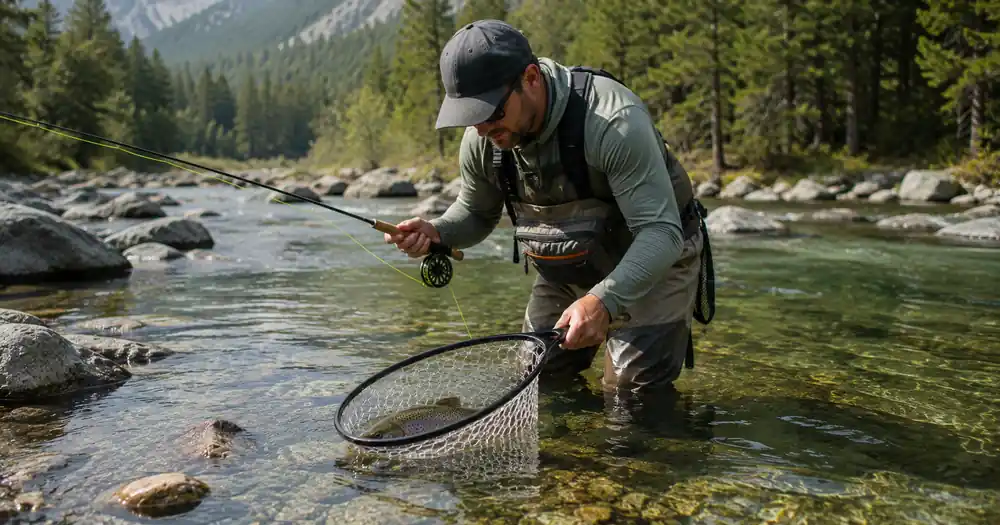
Fly Fishing Net: How to Choose the Right Landing Net
A fly fishing net should match the fish you expect to catch and the way you fish. Start with the largest fish you realistically need to land, then choose a hoop and bag that give you enough room without becoming awkward to carry. For catch-and-release fishing, a wet, soft knotless mesh or rubber-style bag is a strong choice, while handle length should fit whether you wade, fish from the bank, or use a boat.
You do not need the biggest or most expensive net. The goal is a landing net that is large enough, easy to control, practical to carry, and appropriate for how you handle fish.
Table of Contents
How to Choose a Fly Fishing Net
Use this order when comparing nets:
- Identify the fish you target. Think about the largest fish you realistically expect, not only the average fish you catch.
- Consider where you fish. Small creeks, larger rivers, banks, kayaks, and drift boats create different needs.
- Match the hoop and bag to the job. You need enough opening and bag depth without making the net unnecessarily bulky.
- Choose an appropriate net bag. If you release fish, soft knotless or rubber-style netting is worth prioritizing.
- Choose the handle and carrying method together. A good net is less useful if it is difficult to reach or constantly gets in the way.
This “configuration first, product second” approach is more useful than starting with brands or searching for one universal best fly fishing net.
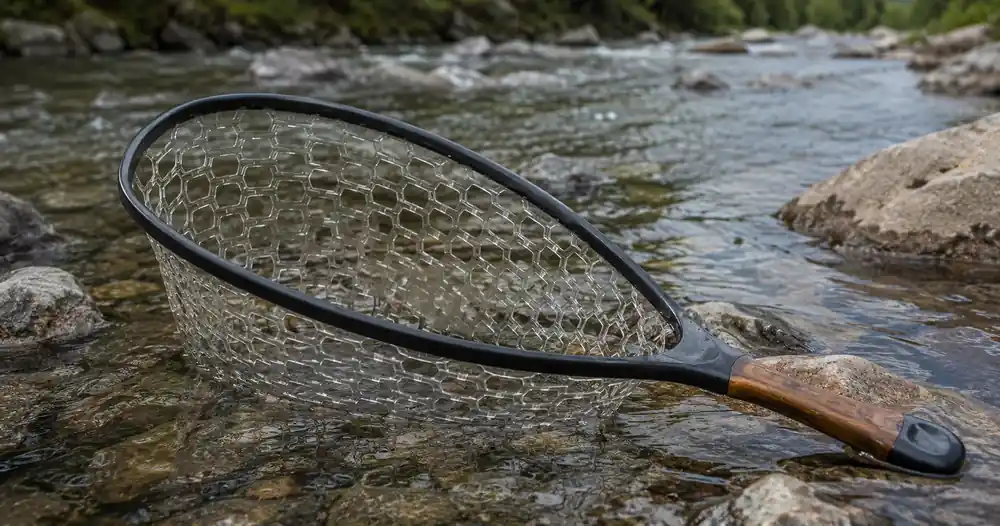
Start With the Fish You Expect to Catch
The first question is simple: what fish does the net need to handle?
A small trout landing net may be ideal on brushy creeks where portability matters. That same compact net can become frustrating if you regularly fish larger rivers where you may hook bigger trout or other species.
Do not size a net only for the fish you catch most often. Think about the upper end of what is realistic in your water. A more generous hoop can make it easier to guide a larger fish into the net, but oversized nets are harder to carry through brush and can feel clumsy while wading. Specialty landing-net guidance likewise recommends matching the hoop to expected fish size while accounting for the extra bulk of larger hoops.
The right choice is a balance: enough capacity for your realistic catch without carrying more net than you need.
Choose the Right Fly Fishing Net Size
There is no single fly fishing net size that fits every angler. Two measurements matter most: the hoop opening and the depth of the net bag.
Hoop Size
The hoop is the frame opening the fish must enter. A larger hoop gives you a larger target when guiding a fish toward the net, which can help when fishing alone or handling larger fish.
But bigger is not automatically better. If you fish narrow streams, hike through vegetation, or attach the net to a vest or pack, a compact hoop can be much easier to carry.
Net-Bag Depth
Bag depth is different from hoop size. The hoop determines the opening; the bag determines how much room the fish has once it is inside.
A shallow bag keeps a compact net easy to manage, while a deeper bag can provide more containment for larger fish. The goal is enough depth to hold the fish securely without choosing more bag than your fishing requires. Current manufacturer and specialty-retailer guidance also treats hoop size and bag depth as separate selection factors.
Quick Size Guide
| Fishing situation | What to prioritize |
|---|---|
| Small streams and smaller trout | Compact hoop, moderate bag depth, easy carry |
| General river trout fishing | Balanced hoop size, enough depth for larger trout, manageable wading size |
| Regularly targeting larger fish | Larger usable opening, deeper bag, stable frame |
| Boat or kayak fishing | Suitable hoop and bag plus enough handle reach for the fishing position |
These are use-case guidelines rather than fixed dimensions. Manufacturers shape hoops differently, so compare actual opening, bag depth, handle length, and total size rather than relying on one number.
Why Rubber Netting Matters for Catch-and-Release
For anglers who release fish, net-bag material deserves serious attention.
NOAA Fisheries recommends wet, soft knotless mesh or a rubber landing net for catch-and-release because these materials cause less damage to a fish’s eyes, fins, scales, and protective mucus coating. The U.S. Fish & Wildlife Service also advises using a rubber net and keeping fish as wet as possible when handling released fish. Wisconsin DNR specifically includes using a rubber net in its responsible-release guidance for trout.
That makes a rubber fly fishing net, or another soft knotless fish-friendly design, a sensible starting point for many trout anglers.
Rubber-style bags also have practical advantages. They can reduce hook tangling compared with some traditional mesh designs and are straightforward to rinse after use. The trade-off is that some rubber bags can be heavier than lightweight mesh, especially in larger nets.
Whatever material you choose, wet the net before landing a fish and minimize handling time when you plan to release it.
Choose the Right Handle Length
Handle length should match how close you can bring a fish before netting it.
Short Handles for Wading
Short handles are common for walk-and-wade fishing because they stay close to the body and are easier to carry on a pack, vest, or belt. They also work well in tight streams where a long handle can catch on vegetation.
A short handle requires you to bring the fish reasonably close before scooping, but for normal wading this trade-off often favors portability. Specialty fly-fishing retailers similarly recommend shorter handles for wading and tight quarters.
Longer Handles for Boats, Banks, and Extra Reach
A longer handle can help when you need more reach from a drift boat, kayak, high bank, or deeper-water position.
The downside is bulk. A long-handled landing net is harder to wear on your back and more awkward when hiking through brush. Purpose-built boat nets illustrate this trade-off by pairing larger nets with substantially longer handles, while compact wading models use shorter options.
Choose handle length based on where you stand or sit when landing fish, not on the assumption that longer is always better.
Fly Fishing Net Frame Materials
Frame material affects weight, durability, feel, buoyancy, price, and appearance. Common choices include wood, aluminum, and composite frames.
Wood
Wood nets have a traditional look and are common in trout fishing. Depending on the design and finish, they may also provide useful buoyancy.
Their trade-offs can include weight and maintenance. Inspect the finish and joints over time if the net is frequently wet or transported roughly.
Aluminum
Aluminum frames are available in both compact wading nets and larger boat-oriented designs. Current aluminum net systems can also use interchangeable or replaceable handles and bags, although those features depend on the manufacturer and model.
Do not assume every aluminum net has the same strength, weight, or corrosion resistance. Those details depend on the specific construction and finish.
Composite and Carbon-Fiber Frames
Some modern nets use carbon fiber and fiberglass composite frames. Manufacturers of individual models may describe these frames as waterproof, weather-resistant, or buoyant, but those characteristics should be checked on the specific net rather than assumed for every composite design.
Composite frames can appeal to anglers who prioritize low carrying weight, but they may cost more than basic alternatives.
For most anglers, frame material should come after fish size, hoop dimensions, bag material, handle length, and carry method.
How to Carry a Fly Fishing Net
How you carry the net matters almost as much as the net itself.
For wading, common options include:
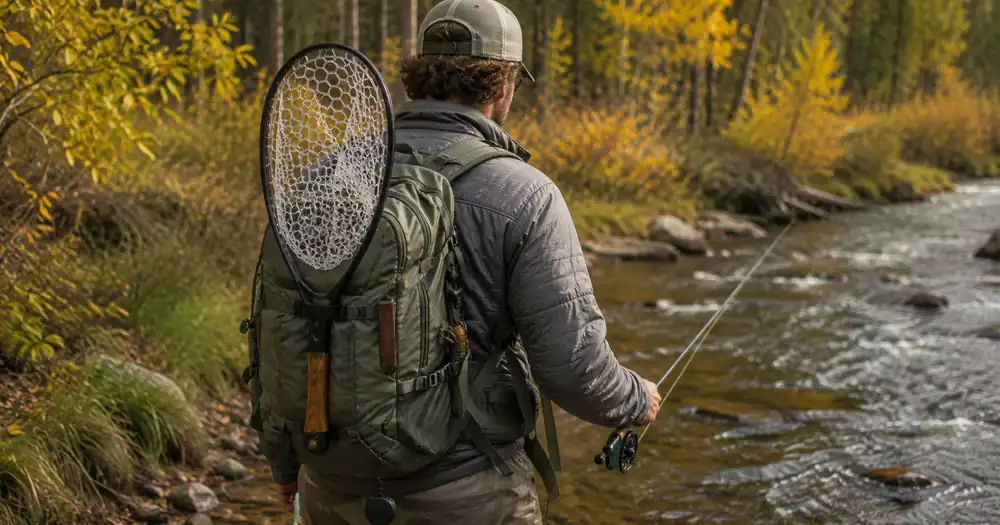
- Magnetic net release: Keeps the net high on a vest or pack and allows a quick pull when needed.
- Leash or tether: Adds security if you drop the net or current pulls it away.
- Net holster: Holds the handle or frame at the belt or waist.
- Pack or vest attachment: Works when the net stays accessible without swinging excessively.
Magnetic releases, leashes, holsters, and pack-compatible attachment systems are all currently used for fly-fishing nets.
A magnet is convenient, while a tether adds backup security; some anglers combine the two.
Before buying, picture how the net will sit on the equipment you already wear. Check whether the hoop may catch on brush and whether you can reach the handle with one hand. If you fish from a boat, secure storage may matter more than wearing the net.
Match the Net to How You Fish
| Fishing situation | Net characteristics to prioritize |
|---|---|
| Small-stream trout | Compact hoop, short handle, low snag potential, easy attachment |
| General river wading | Balanced hoop size, fish-friendly bag, manageable handle, secure tether |
| Larger fish | Larger opening, sufficient bag depth, sturdy frame and handle |
| Boat or kayak | More reach when needed, secure storage, suitable hoop and bag capacity |
If you split your time between environments, choose the net for the situation where the wrong size would cause the most trouble. A small-stream angler who only occasionally fishes from a boat may still benefit more from portability than extra reach.
Common Fly Fishing Net Buying Mistakes
Choosing by Appearance Alone
A beautiful wood frame or high-tech composite does not matter if the hoop is too small or the handle does not suit your fishing.
Buying Too Small
A compact net is easy to carry, but it still needs to handle the larger fish you realistically encounter. Do not size only for your average catch.
Buying Too Large
An oversized net can become a nuisance during a full day of wading. More capacity is useful only when your fishing requires it.
Ignoring Bag Material
For catch-and-release fishing, the bag is one of the most important parts of the net. Prioritize fish-friendly material before cosmetic details.
Confusing Hoop Size With Bag Depth
A wide hoop with a shallow bag and a smaller hoop with a deep bag behave differently. Compare both measurements.
Choosing Handle Length Without Considering the Water
A short handle can be excellent for wading and inconvenient from a high bank. A long handle can be helpful in a boat and annoying on a brushy creek.
Forgetting the Carry System
A net that swings, snags, or cannot be reached easily may stay at home. Decide how you will attach it before you buy.
Paying for Features You Do Not Need
Premium materials or modular systems can be useful, but only if they solve a real problem. Spend first on the right size, bag, handle, and carrying setup.
Fly Fishing Net Buying Checklist
Before choosing a net, check these points:
- What species do you target?
- What is the largest fish you realistically expect?
- Do you mainly wade, fish from shore, or use a boat or kayak?
- Is the hoop large enough without being unnecessarily bulky?
- Is the bag deep enough for your target fish?
- Is the netting suitable for catch-and-release if you release fish?
- Does the handle give you enough reach?
- Is the frame weight practical for how far you walk?
- Can you attach or store the net securely?
- Are replacement bags or parts available if that matters to you?
- Does the price make sense for your actual use?
If you can answer those questions, you are ready to compare individual nets without getting distracted by marketing labels.
FAQs
Do You Need a Net for Fly Fishing?
No. A landing net is not required for every situation, but it can make landing and controlling a fish easier, especially when you intend to release it. Use fish-friendly netting, wet the net before use, and keep handling time short.
Are Rubber Nets Better for Trout?
Rubber or other soft knotless netting is a strong choice for trout that will be released. NOAA Fisheries recommends wet, soft knotless mesh or rubber landing nets for catch-and-release because they can reduce damage to fins, scales, eyes, and the protective mucus coating.
What Size Fly Fishing Net Should I Use for Trout?
Choose a trout landing net based on the largest trout you realistically expect and the type of water you fish. Small-stream anglers usually benefit from a compact net, while anglers targeting larger trout or fishing bigger rivers may need a larger hoop and deeper bag.
How Do You Carry a Fly Fishing Net While Wading?
Common methods include a magnetic release, safety tether, belt-mounted holster, or a vest or pack attachment. The best setup keeps the net reachable with one hand while preventing it from swinging or floating away.
Is a Long or Short Landing-Net Handle Better?
Neither is universally better. Short handles are easier to carry and maneuver while wading, especially in tight streams. Longer handles provide more reach from boats, higher banks, or other positions where the fish cannot be brought close.
Final Takeaway
The right fly fishing net starts with your use case, not a brand name. Match the hoop and bag to the fish you realistically target, choose fish-friendly netting if you practice catch-and-release, and select a handle that works in your normal fishing environment.
Then decide how you will carry or store it. Once those details are clear, comparing individual landing nets becomes much easier.
Sources Used — Not Part of the Article:
- NOAA Fisheries — Catch and Release Fishing Best Practices — NOAA Fisheries source
- U.S. Fish & Wildlife Service — A Guide to Fishing for the First Time — U.S. Fish & Wildlife Service source
- Wisconsin Department of Natural Resources — Responsible Catch and Release — Wisconsin DNR source
- Trident Fly Fishing — Fly Fishing Landing Nets / How to Choose Landing Nets — Trident Fly Fishing source
- Rising Fishing — Choosing Your Net: A Guide to Hoop Shapes, Basket Depths, and Handle Lengths — Rising Fishing source
- Fishpond — Nomad Native Net 2.0 — Fishpond source