
Fly Fishing Leader: How to Choose Length, Taper and Material
A fly fishing leader is the clear or nearly clear connection between the thick fly line and the fly. Most everyday leaders taper from a relatively thick butt section to a fine end so a cast can turn over the fly while presenting it with less visible line. Beginners usually do not need to build one from scratch: a ready-made tapered leader that suits the fly and water is a sensible starting point.
Choose a fly fishing leader for the fly you intend to cast, the water you fish, and the presentation you need. This guide compares leader length, taper, nylon versus fluorocarbon, and the role of tippet so you can choose a practical setup without buying more than you need.
Table of Contents
What Is a Fly Fishing Leader in a Complete Setup?
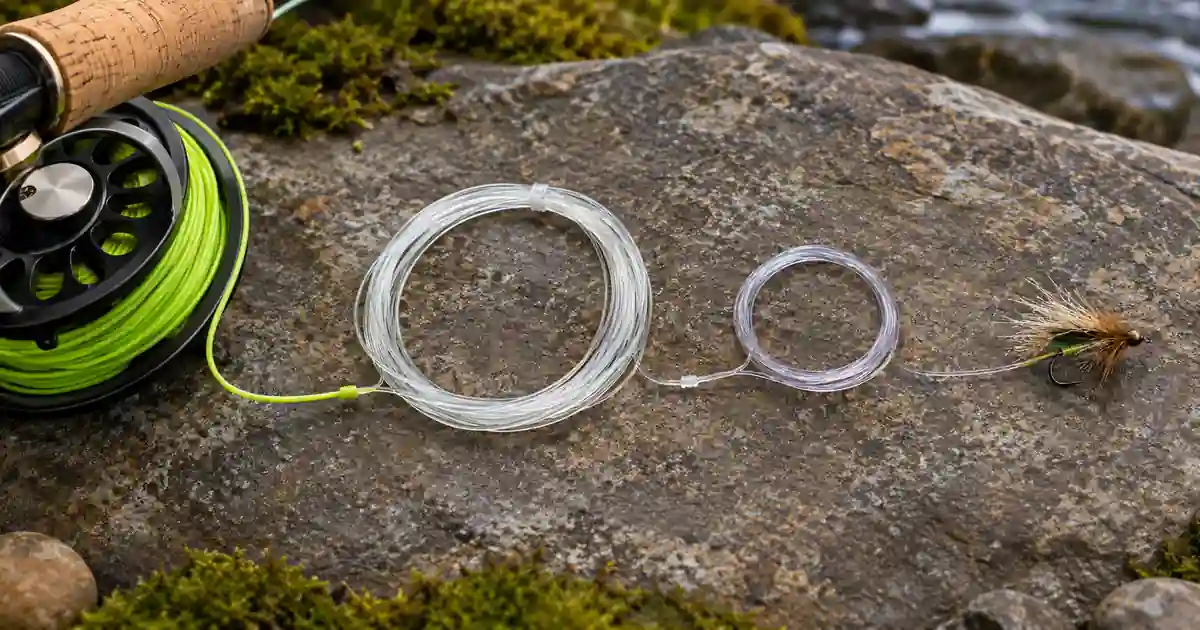
A complete fly rig generally runs from reel and backing through fly line, then leader, then fly. The fly line is the relatively thick casting line. The leader is a thinner transition intended to turn over the fly and achieve a suitable presentation. A spool of level monofilament is leader material, not automatically a complete manufactured tapered leader.

The leader consists of the thicker butt, the narrowing taper, and the fine terminal end, often called the tippet section. The butt connects to the fly line using an appropriate connector; the fine end connects to the fly or to an additional piece of tippet. Different manufacturers use different taper formulas and materials.
| Part | Position | Practical purpose |
|---|---|---|
| Fly line | Between reel and leader | Carries the main casting mass |
| Butt section | Thick end of leader nearest fly line | Receives and transfers energy from the fly line |
| Taper section | Middle transition | Gradually reduces diameter and changes turnover |
| Terminal tippet | Fine end nearest fly | Connects to fly with suitable diameter and movement |
Simple labeled layout: Fly line → thick leader butt → narrowing taper → fine terminal tippet → fly. This is a schematic of the order of components, not a fixed ratio or a universal leader formula.
How to Choose Fly Fishing Leader Length
A 9-foot tapered leader is a common starting point for many freshwater fly presentations, but there is no universally correct length. Orvis emphasizes that leader length depends on water conditions: shorter leaders can be easier to turn over in wind and tight casting spaces; longer leaders can help keep the fly line farther from wary fish on clear, flat water.
Affiliate disclosure: As an Amazon Associate, we earn from qualifying purchases. FlyFishingScout may earn a commission on qualifying purchases at no extra cost to readers.
📏 Compare tapered leader lengths. SF Pre-Tied Loop Nylon Tapered Fly Fishing Leaders — These tapered nylon leaders provide a ready-made option for suitable freshwater presentations. Choose the correct length and X-size for the fly and expected fish; do not use a fine trout leader for every bass streamer. 👀 Check Tapered Leaders ➜
For small streamers and bulky bass flies, a shorter and more assertive taper can be practical. For delicate dry flies on open, clear trout water, a longer leader may allow a more subtle placement. Do not choose a long leader solely because you own a long rod, and do not force a long delicate taper to throw a bulky weighted pattern.
| Situation | Reasonable starting approach | Adjust when |
|---|---|---|
| Small brushy stream | Shorter leader that turns over easily | Casting space or fish wariness changes |
| General river trout | About 9-ft tapered leader as a starting point | Fly size, drift, and clarity require change |
| Clear flat water and delicate dries | Consider a longer, finer presentation | Control or turnover becomes unreliable |
| Bass poppers or large streamers | Shorter, stronger turnover-oriented leader | Fly bulk and obstacles require a different diameter |
How to Choose Fly Fishing Leader Taper
A tapered leader progressively steps down in diameter so the fly line can transfer energy to the fly without presenting one uninterrupted thick line. A factory-made knotless taper is convenient for many beginners; a hand-tied leader provides specialized control but requires suitable material, knots, and consistent construction.
🎯 Compare a trout taper. RIO Powerflex Trout Tapered Leader 3-Pack — This trout-oriented tapered-leader multipack offers a way to keep backups of one selected length and diameter. Confirm the exact size on the listing; it is an alternative to other tapered-leader packs, not an add-on needed with each one. 👀 See Powerflex Leaders ➜
If your fly repeatedly collapses into a pile or the leader kicks too hard, first check casting technique, wind, fly bulk, and the taper’s intended use. A strong, heavy butt alone is not enough: the full taper must suit the presentation. Use actual manufacturer descriptions instead of assuming every leader advertised as “tapered” behaves identically.
Fly Fishing Leader Material: Nylon vs Fluorocarbon
Nylon monofilament is a versatile option often selected for dry-fly and everyday freshwater use. Fluorocarbon is commonly offered for subsurface presentations where manufacturers emphasize lower underwater visibility, abrasion resistance, and sink behavior. Those are application-based product claims, not proof that one material always catches more fish.
🧵 Match fluorocarbon tippet to the rig. Cortland Ultra Premium Fluorocarbon Tippet (5X) — A fluorocarbon tippet spool can be used for compatible terminal sections when you need to replace or extend tippet. Check strength and diameter against your flies and the existing leader; it is not a complete tapered leader. 👀 Check Fluorocarbon Tippet ➜
Cortland’s leader-material guidance recommends considering diameter, strength, visibility, sink rate, abrasion conditions, and intended use together. A full tapered nylon leader, a full tapered fluorocarbon leader, and a spool of level fluorocarbon material are different products. Make sure you are comparing the same component before making assumptions about price or performance.
Material is only part of the decision. Leader construction, stiffness, water temperature, fly size, and knots also influence the result. When fishing around sharp rock or wood, inspect the terminal section frequently. Replace damaged material rather than relying on any generic label such as “abrasion proof.”
Fly Fishing Leader and Tippet: What Changes After Fishing?
A ready-made tapered leader already includes a terminal section. Extra tippet is useful when you have shortened that section by repeated fly changes, want to fine-tune length, or need to repair the terminal end. It is not always necessary to add a second spool-length of material immediately after opening a new leader.
Suppose your 9-foot nylon leader works well with a small dry fly, but several fly changes shorten its terminal end. Rather than replacing the entire leader, you may attach a suitably matched length of tippet to restore the desired presentation. If the thick butt or long part of the taper is damaged, a simple end extension may not restore the original leader behavior.
For detailed reel-to-fly routing see Fly Fishing Line Setup. This guide is about selecting the complete leader, not knot diagrams or advanced tippet engineering.
Buying a Fly Fishing Leader: A Beginner Decision Process
- Identify what fly you will cast: fine dry fly, nymph, small streamer, or large air-resistant bass fly.
- Choose a leader length that you can cast comfortably in the available space and wind.
- Match taper and terminal diameter to the fly and likely snags; check the manufacturer’s intended application.
- Choose material for the presentation rather than assuming fluorocarbon or nylon always wins.
- Inspect the packaged length, X size or diameter, connector type, and number of leaders included.
- Carry compatible spare tippet for repairs when appropriate; replace material showing nicks, wind knots, or severe curling.
The first decision is what the leader must do, not the most expensive label. A simple purpose-specific tapered leader and a small amount of compatible tippet cover many beginner situations. Specialized tight-line nymphing, saltwater shock leaders, and bite-proof wires for toothy species require separate planning.
Fly Fishing Leader FAQs and Common Mistakes
Is the clear line tied to my fly line the leader?
Usually, yes. If it tapers from thicker near the fly line to finer near the fly, it is likely a tapered leader. A straight piece of level monofilament used as a connection may function as a simple leader but is not a factory tapered leader.
Do I always need to add tippet to a new tapered leader?
No. Many new leaders already provide a usable terminal tippet section. Add tippet when the presentation, repair, or extra length actually requires it.
Can I use the same fly fishing leader for every fly?
Not reliably. Delicate dries and bulky bass streamers place different demands on turnover, diameter, and length. A multipurpose leader may handle a moderate range, but very different presentations deserve a different setup.
Choose a fly fishing leader by fly size, water, and presentation first. Start with a reputable tapered model appropriate to that purpose, monitor how it turns over, and change one variable at a time. Inspect knots for damage and replace worn or abraded material before the next trip.