

Fly Fishing for Striped Bass: Gear, Flies, and Shore Fishing Tips
Fly fishing for striped bass does not require a boat or an extreme-distance cast. Stripers may follow baitfish into surf troughs, tidal creeks, estuary mouths, and other water you can reach from a safe shoreline. The real challenge is finding fish, choosing a fly line that keeps your imitation at the right depth, and managing loose line while waves and wind move around you.
An 8-weight rod is a useful starting point for many coastal situations, but a suitable 7-weight may work for smaller fish in sheltered water. A 9- or 10-weight becomes more attractive with large flies, persistent wind, or stronger fish. This guide explains what to reuse, what to change, and how to fish the water in front of you rather than buying a complete new outfit by default.
Table of Contents
Fly Fishing for Striped Bass: Quick Start From Shore
For a first trip, look for moving water beside an accessible feeding lane, match a baitfish fly to the local forage, and keep your cast under control. A short cast along a beach trough can be more useful than a long cast beyond fish feeding close to your feet. Start with a floating or intermediate line depending on depth, and use a small Clouser Minnow or Deceiver that you can cast comfortably.
| Shore situation | Practical rod starting point | First line to consider | First fly to try |
|---|---|---|---|
| Sheltered bay, small baitfish, light wind | Existing suitable 7–8 wt | Floating or intermediate | Small sparse Clouser |
| Open beach with moderate surf | 8–9 wt | Intermediate | Clouser or Deceiver |
| Very shallow fish breaking the surface | Manageable 7–9 wt | Floating | Gurgler or other surface fly |
| Deeper channel or strong tidal flow | Rod powerful enough for fly and conditions | Appropriate sink-tip or sinking line | Streamer at the target depth |
| Windy shore, large flies | Often 9–10 wt | Density selected for depth | Streamlined larger baitfish imitation |
These are starting points, not minimum standards. For fly fishing for striped bass from shore, water access, weather, fly size, and expected fish matter more than the number printed on the rod. Always check whether fishing is open and what rules apply at your chosen water before setting up.
Where Striped Bass Feed Along the Coast
Coastal striped bass use bays, estuaries, surf zones, and river mouths, following available food and suitable water conditions. Successful fly fishing for striped bass often begins with shoreline observation rather than another cast. Begin by looking for a place where moving water concentrates prey. You do not need to identify a famous fishing spot; you need to notice structure, baitfish, and reachable water.
Beaches and Troughs
A beach is rarely an even slope underwater. Waves can carve shallow depressions, troughs parallel to the shore, and breaks in sandbars. A trough or deeper cut can create a lane that fish use while feeding on small baitfish. Watch the breaking waves for gaps and changes in foam patterns, but do not mistake a rip current for a safe place to enter the water.
Start by casting parallel to the beach or diagonally along a visible trough while standing on firm sand. Fishing close is not a failure: stripers may be hunting in water within a short cast. Keep moving if you find neither bait nor useful structure.
Estuaries and Tidal Creeks
Narrow creek mouths, marsh edges, and small channels can move bait into a more confined area. Watch which way the water flows and where an edge separates faster current from slower water. A fly crossing that boundary may stay in a useful feeding lane longer than one stripped rapidly through uniform water.
Rocky Points, Rips, and Current Seams
Points and submerged structure redirect water and can form a current seam. The slower side may give a bass a place to hold while watching prey pass nearby. Cast across the seam, allow the fly to move into the likely feeding zone, and retrieve at a speed that keeps contact. Never step onto wave-washed rocks or a jetty just to get a better angle.
Flats and Channel Edges
In calm estuaries, stripers can move across shallows or patrol the edge of a deeper channel. If you can see fish, lead their path rather than dropping a heavy fly onto their heads. In stained water, look for surface disturbances, nervous baitfish, and changes in depth or current.
Fly Fishing for Striped Bass: Reading Tides and Current
Tides matter in fly fishing for striped bass because they change depth, current direction, and where small fish can move. But there is no reliable coastwide rule that the best fishing always occurs a fixed number of hours before high tide. A productive outgoing tide in a small creek may be unproductive at a nearby exposed beach.
Before arriving, review a relevant NOAA tide station, then check the local current, surf forecast, and weather. High and low tide times are not the same as the exact timing of current changes everywhere, particularly in complex estuaries. Observe what is happening on the water instead of relying on the printed tide time alone.
During a moving tide, test seams, narrow channels, and baitfish moving along shoreline structure. When water becomes nearly slack, look for a different area with noticeable feeding activity rather than assuming every fish has stopped feeding. Dawn and dusk may provide good visibility and feeding opportunities, but low light also makes hazards harder to see.
For fly fishing for striped bass around current, the presentation often works best when the fly looks vulnerable rather than racing unnaturally across the seam. Let the line and current move the imitation into position, remove excess slack, and use small strips if needed. If your fly never reaches the intended depth, adjust the line or sink time before changing patterns.
Fly Fishing for Striped Bass: Rods, Reels, and Leaders
The best striped bass outfit is one that casts your chosen fly safely, controls the fish you might hook, and tolerates the conditions. Build from the situation rather than a brand name.
Can You Use a Trout Rod?
For fly fishing for striped bass in a protected estuary with modest fish and small streamers, an existing 7-weight may be sufficient. A typical 5-weight trout outfit is a poor default for windy beaches, larger saltwater flies, and strong fish near rocks. There is no need to buy a 10-weight to throw a small baitfish imitation in calm water, either.
Choosing an 8-, 9-, or 10-Weight
A 9-foot 8-weight is an accessible all-around reference for many coastal stripers. An 8- or 9-weight gives more fly-delivery authority when conditions grow demanding; a 9- or 10-weight can help with larger flies and persistent wind. Rod action, fly bulk, line taper, and your casting ability also matter. Stronger gear does not make hazardous wading safe.
Reel, Backing, and Saltwater Care
Choose a reel compatible with your rod and the actual fly line plus backing. A smooth, adjustable drag and reasonable line pickup are more useful than unverified claims of extraordinary drag strength. Check the maker’s published capacity for your specific line and backing, leaving space so wound line cannot rub the frame.
Saltwater exposure adds maintenance. After a trip, rinse and dry the rod, reel, and tools according to manufacturer guidance, paying attention to sand and salt. A sealed drag helps protect internal components but does not make a reel maintenance-free. FlyFishingScout’s guide to choosing a fly fishing reel covers the underlying drag, sizing, and capacity decisions.
Leader and Tippet
Start with a leader that can turn over your fly and withstand relevant abrasion. A roughly 7–9-foot leader can be a workable beginning for many standard subsurface presentations, while large wind-resistant flies or sinking lines may call for shorter, more powerful arrangements. Length and strength depend on visibility, structure, fly size, and local restrictions. Inspect knots after contact with shells, rocks, or dock pilings.
For a more general packing and maintenance guide, see saltwater fly fishing gear, rather than treating this article as a full saltwater shopping list.
Fly Fishing for Striped Bass: Floating vs Intermediate Lines
The fly line often determines whether the fly stays in the feeding zone. An intermediate line is useful for many coastal presentations, but fly fishing for striped bass does not mean you must buy intermediate line for every outing. Choose by water depth, current, and the behavior of your fly.
| Line type | When it helps | Main limitation |
|---|---|---|
| Floating | Surface flies, shallow flats, easy pickup and line control | A deep target may be difficult to reach |
| Intermediate | Subsurface baitfish retrieves in surf and moderate-depth water | Can snag shallows and does not reach deep fast water automatically |
| Sink-tip | Keeping a streamer below the surface in channels and current | Tip can hang up and change casting feel |
| Full-sinking | Deeper presentations where the entire line must descend | Harder to retrieve and control in snaggy or shallow water |
A floating line is versatile for first-time anglers fishing Gurglers or shallow baitfish flies. Intermediate line sinks gradually, helping a streamer stay beneath surface disturbance while it is stripped. If water depth and flow are substantial, a suitable sink-tip or sinking line may be more practical—but the extra depth increases snag risk.
For fly fishing for striped bass in cool coastal weather, check the line’s intended temperature range as well as its taper and density. A line designed for tropical heat may handle poorly in cold surf. Some specialty saltwater lines are intentionally heavier than standard line ratings; confirm the pairing with your rod before purchasing. The FlyFishingScout guide to choosing the right fly fishing line explains these broader compatibility issues.
If your floating line gets a streamer where fish are feeding, keep using it. Buy a different density when a real depth problem remains unsolved, not because an equipment list declares intermediate line mandatory.
Fly Fishing for Striped Bass: Clouser Minnows and Other Flies
For fly fishing for striped bass, a short selection of baitfish imitations often makes a more practical starter box than dozens of specialized patterns. Striped bass often take prey that a fly angler can imitate with a small selection of baitfish profiles. Start with flies that match the approximate size and shape of forage you can observe. You rarely need a large fly collection for your first trip.
Clouser Minnow
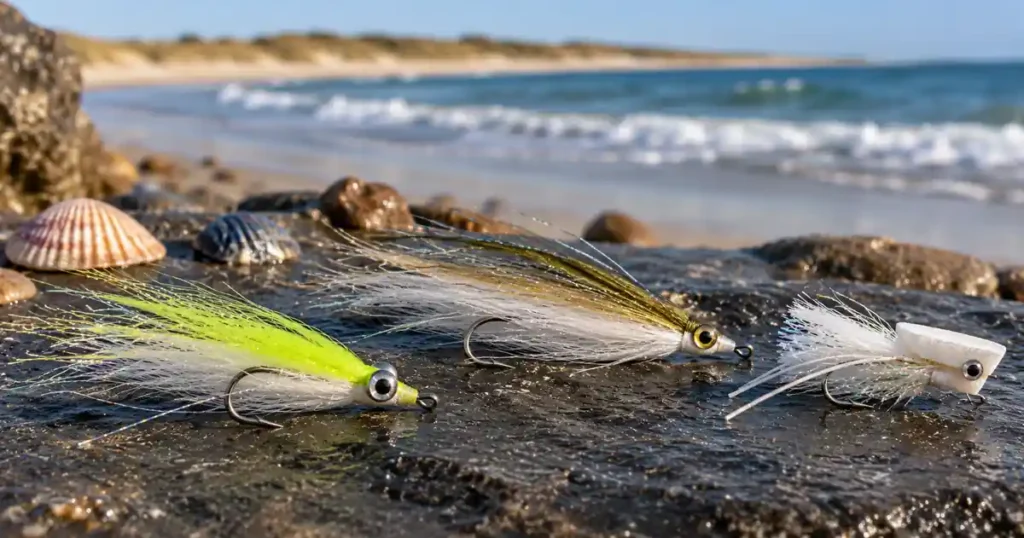
The Clouser Minnow is a strong first pattern because its weighted eyes help it sink and give it a distinctive movement when stripped. White with olive or chartreuse is a common starting color combination. Its sink rate changes with hook size, eye weight, and line choice. In shallow snaggy water, avoid using the heaviest version by default.
Lefty’s Deceiver
A Deceiver uses a longer, more flowing baitfish profile and can be useful where fish are chasing larger forage. Choose a size your rod can turn over comfortably. An oversized fly on a light rod can make otherwise simple shore casting frustrating and unsafe in wind.
Sand-Eel and Slim Baitfish Patterns
Where slender baitfish are present, a sparse sand-eel imitation can look more appropriate than a deep-bodied streamer. Use a retrieve that resembles the observed prey and allow the fly to stay at the needed depth. Pattern names matter less than the profile and presentation.
Gurglers and Surface Flies
A Gurgler or another floating surface fly can be useful when stripers are visibly pushing baitfish upward. Cast beyond or alongside the activity without landing directly on a fish, then move and pause the fly to test the response. Use a floating line, and stay alert for missed swirls before striking.
| Fly | Good first use | Watch out for |
|---|---|---|
| Small Clouser | General subsurface baitfish | Too-heavy eyes in shallow water |
| Deceiver | Longer baitfish profile | Large versions require casting power |
| Sand-eel imitation | Slim baitfish activity | Wrong depth or overly fast retrieves |
| Gurgler | Active surface feeding | Less helpful when fish stay deep |
For fly fishing for striped bass, carry a few sizes and profiles rather than many colors of one fly. If fish are chasing tiny bait, downsize before assuming you need a more elaborate pattern. Orvis’s verified fly-selection lesson is listed in References for a visual explanation.
Fly Fishing for Striped Bass From Shore: Casting and Stripping Baskets
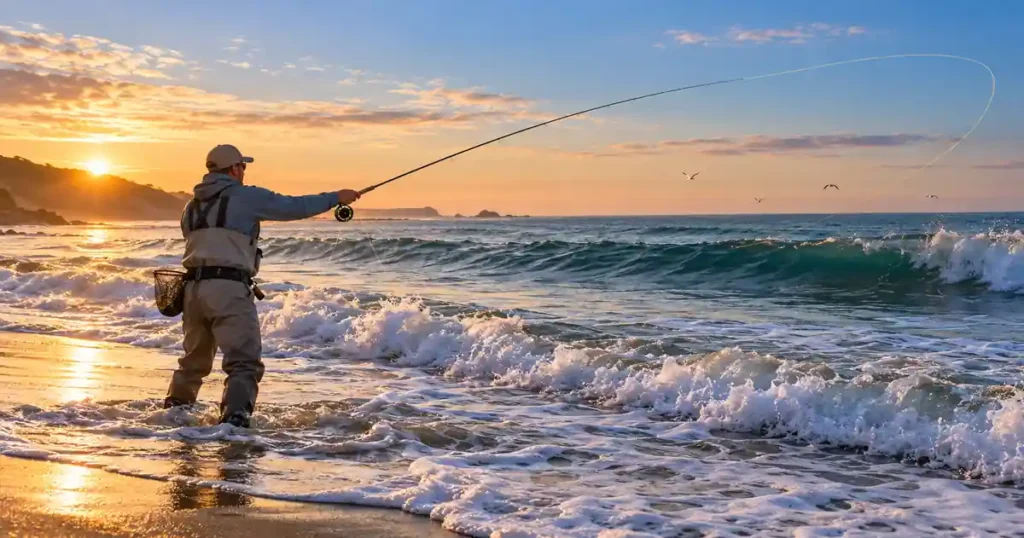
For fly fishing for striped bass from shore, an effective presentation starts before the first cast. Watch where the waves reach, keep the wind from blowing the fly toward your body, and scan behind you for people. A short accurate cast along a current edge is usually worth more than repeated uncontrolled long casts.
Cast Before Wading
On beaches and estuary banks, make several casts while standing on safe, dry ground. Fish may be close to the shoreline. Entering the surf unnecessarily can disturb feeding fish and expose you to waves, holes, and currents. Do not enter water simply to reach fish beyond your safe casting distance.
Manage Wind and Casting Space
Learn a clean overhead cast and a controlled double haul if wind or bulky flies demand more line speed. Avoid overpowering your stroke. With a side wind, position yourself so the fly passes downwind of your body; otherwise use a safe alternative casting plane or change location. For a deeper explanation, see FlyFishingScout’s fly fishing casting techniques.
Use a Stripping Basket When It Solves a Problem
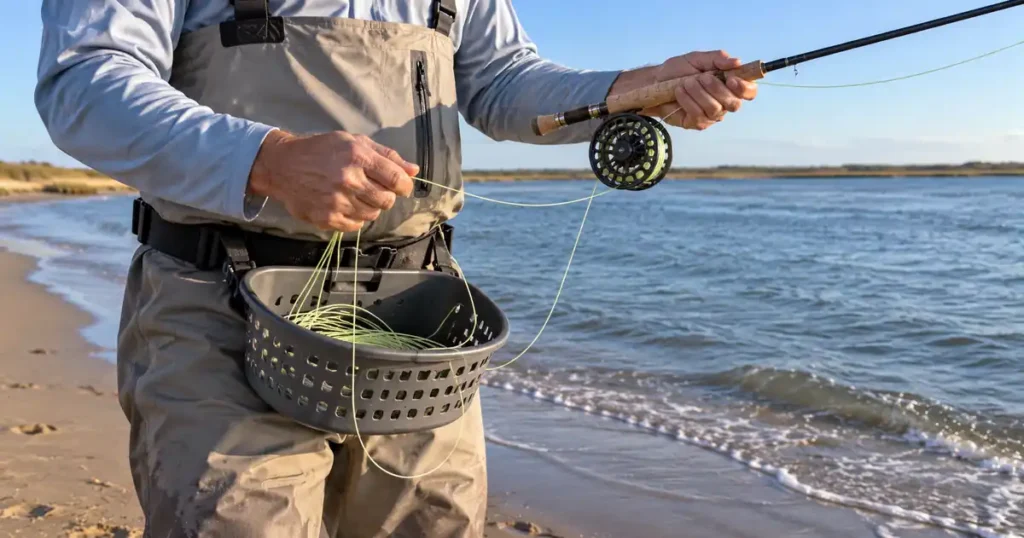
A stripping basket holds the loose line collected during retrieves, keeping it away from rocks, seaweed, shells, and wash moving over your feet. It can be especially helpful on an open beach. Check that line can release freely from the basket before making another cast. In a calm, clean estuary bank, a basket is helpful but not always essential.
Before each cast, separate any loops wrapped around the rod butt, your fingers, or the reel. Loose fly line under a boot can interrupt both a cast and the fight with a fish. Orvis provides an instructional surf-fishing video in References; use it as technique guidance rather than proof a particular beach is safe.
Fly Fishing for Striped Bass: Retrieves, Strip Set, and Landing
Fly fishing for striped bass rewards controlled depth and movement more than constant rapid stripping. Watch baitfish whenever possible. A small school fleeing fast may justify quick strips; baitfish drifting in a seam may call for a slower presentation.
Try Three Retrieve Patterns
- Short strips and pauses: A manageable first approach for a Clouser near shallow structure. Pause to let the fly change direction or sink slightly.
- Longer steady strips: Useful when bass are chasing moving baitfish in open water. Keep line contact instead of allowing uncontrolled slack.
- Current-assisted swing: Cast across moving water, let the fly work across a seam, and adjust line tension. Avoid dragging the fly unnaturally through the zone.
If the fly is riding above fish, allow more sink time or use a line suited to the depth. If it repeatedly hits bottom, shorten the sink time or switch density. A different color is rarely the first adjustment that resolves a depth mismatch.
Set With the Line, Then Fight Smoothly
When a striper takes a streamer, keep the rod relatively low and use a firm strip set with your line hand to establish contact, rather than a dramatic high trout-style lift. Avoid wrapping loose fly line around your fingers; a strong fish can take line very quickly. Let the reel’s drag manage longer runs, maintain steady pressure, and steer fish clear of structure without high-sticking the rod.
When fly fishing for striped bass from shore, plan how you will land a fish before casting. Avoid dragging a large fish across dry sand or rocks if it will be released. Use appropriate tools, keep the fish wet and supported, and shorten handling time, especially in warm water.
Fly Fishing for Striped Bass in Freshwater vs Saltwater
Striped bass are naturally associated with coastal and estuarine migrations, but landlocked populations also occur in inland lakes and reservoirs. Some inland fisheries depend on stocking, while others reproduce successfully. This makes fly fishing for striped bass in freshwater a different planning problem from fishing a tidal beach.
Freshwater anglers may locate stripers by observing baitfish such as shad, changes in reservoir depth, and feeding birds. The useful fly line depends on whether fish are working the surface, holding near a drop-off, or feeding deeper. Strong summer temperature layers and oxygen conditions can influence where fish can comfortably live; blindly choosing the deepest water is not a complete strategy.
A floating line and a modest baitfish streamer may work when fish push prey to the surface. When fish feed deeper, a more specialized sinking setup could be appropriate. Inland fishery regulations, stocked populations, and size limits are administered by the relevant state and waterbody; do not carry coastal striped-bass rules into a freshwater reservoir.
Striped bass are also biologically distinct from largemouth and smallmouth bass. Techniques may overlap, but species identification, habitat, and management rules are not interchangeable.
Shore Safety, Regulations, and Responsible Release
Surf and current can be dangerous even when the weather seems pleasant. Check the National Weather Service beach or surf-zone forecast before a trip. Watch for powerful shore breaks, rip currents, slippery rocks, changing tides, lightning, and cold water. A gap in breaking waves may mark a rip current, not a safe route to deeper water. Do not wade onto a jetty, into an inlet, or across a channel to retrieve a fly. Fish with a companion where practical and make a safe exit plan.
For fly fishing for striped bass along the Atlantic coast, check the exact state’s current recreational regulations before leaving home. Fishing seasons, licensing or registration, size and possession limits, no-targeting closures, and gear restrictions may differ. The Atlantic States Marine Fisheries Commission describes the coastal stock as overfished even though overfishing was not occurring in its 2024 assessment update. Addendum III, approved in October 2025, did not adopt proposed additional 2026 catch reductions; it did establish other changes, including standardized total-length measurement requirements for state implementation by January 2027. That background is not a substitute for a state’s current rules.
The Atlantic striped-bass circle-hook management provision concerns bait fishing; it should not be presented as a universal rule requiring circle hooks on ordinary artificial flies. Still, confirm state-specific tackle rules, including any special restrictions at your water.
Handle fish with wet hands and keep them in the water when practical. If release is required or chosen, minimize air exposure, remove hooks carefully, and avoid unnecessary exhaustion. Warm water can increase handling concerns. Fish with tackle able to land expected stripers promptly and follow the jurisdiction’s rules for handling and releasing undersize fish.
Fly Fishing for Striped Bass: FAQs and First-Trip Checklist
Can I Catch Striped Bass on a 7-Weight Fly Rod?
Yes, a suitable 7-weight can work for smaller stripers, small flies, and protected water. It is less appropriate as a default for an exposed windy beach or large flies. Evaluate the fly, reel, backing, and fish-control needs rather than the rod label alone.
Do I Need an Intermediate Fly Line for Stripers?
No. Intermediate line can be very useful in the surf and moderate subsurface water, but a floating line works for surface feeding and some shallow streamer presentations. A sink-tip or sinking line may solve a deeper-water problem. Choose line density by depth, not fashion.
What Is a Good First Fly for Striped Bass?
A small Clouser Minnow is a versatile starting point. If fish are visibly chasing longer baitfish, try a Deceiver or slim sand-eel pattern. When stripers are feeding on top, a Gurgler can be worth trying.
Is a Stripping Basket Essential?
Not everywhere. It is particularly helpful when fly line tangles in breaking surf, rocks, or shoreline debris. On an uncluttered, sheltered bank, you may manage without one. Use it when loose line is disrupting your fishing.
Can I Catch Stripers From a Beach Without a Boat?
Yes. Stripers can feed in troughs and channels within casting distance of shore. Finding a reachable feeding lane and remaining on safe ground matters more than producing the longest cast possible.
What Changes When Fishing for Freshwater Stripers?
Tides and saltwater exposure become less relevant in a landlocked reservoir. Look for baitfish, suitable water temperature and oxygen, and depth changes; select line density accordingly. Check the particular reservoir’s regulations rather than coastal limits.
First-Trip Checklist
- Check local striped-bass regulations, legal shore access, surf hazards, weather, and tides.
- Start with a suitable existing rod, compatible reel, line, and backing.
- Carry a small Clouser, a longer baitfish streamer, and an optional surface fly.
- Look for baitfish, current seams, troughs, and accessible edges before casting.
- Begin with manageable short casts and keep loose line under control.
- Change retrieve speed and depth before buying more gear.
- Plan for safe landing and efficient fish handling.
Fly fishing for striped bass is most approachable when you start with the water, not the equipment catalog. Find a safe shoreline where prey is moving, select a fly you can cast cleanly, and keep it in the feeding zone. Learn from what you see on each retrieve, and upgrade only when your existing setup no longer meets the conditions you actually fish.
References
- NOAA Fisheries — Atlantic Striped Bass
- Atlantic States Marine Fisheries Commission — Atlantic Striped Bass
- Atlantic States Marine Fisheries Commission — Atlantic Striped Bass Addendum III
- Texas Parks and Wildlife — Striped Bass (Morone saxatilis)
- Orvis — Striped Bass Fly Fishing Video Lessons
- Orvis — Best Fly Lines for Striped Bass Fishing
- Orvis — How to Find Stripers in the Surf
- Orvis — How to Pick Flies for Striped Bass
- Orvis — Retrieves to Use for Striped Bass
- Orvis — How to Fish for Striped Bass in the Surf
- Outdoor Life — Catching Striped Bass on the Fly From Shore
- NOAA Tides & Currents — Tide Predictions
- National Weather Service — Beach Safety
- National Weather Service — Rip Current Safety