
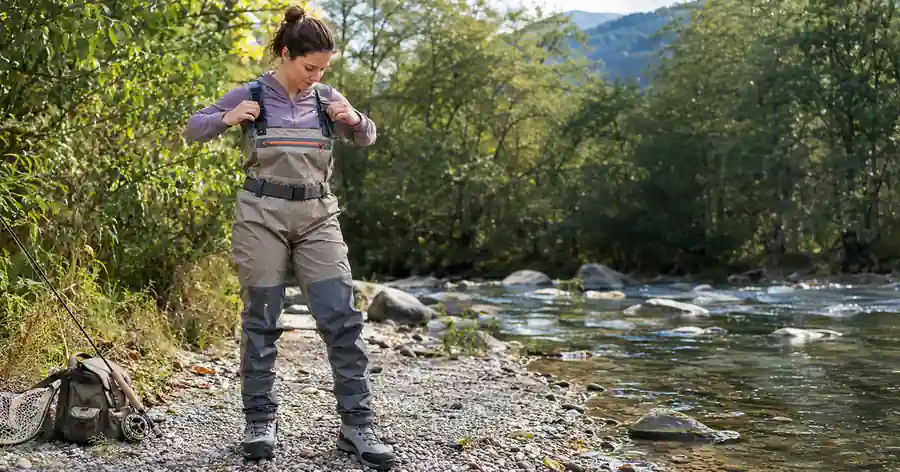
waders for women: Find the Right Fit for Your Body and Feet
Finding waders for women that fit can be frustrating when your hips need one size, your inseam needs another, and the attached neoprene stockingfeet seem designed for larger shoes.
Quick answer: Measure your bust, waist, hips, inseam, height, and street shoe size. Compare every measurement with the size chart for the exact wader model, then check its stockingfoot size and available Short, Regular, Tall, Petite, or Full configurations. Try the complete setup with your usual layers, socks, and wading boots before using it on the water.
Use this women’s wader measurement checklist to identify size conflicts and compare alternatives. For broader product comparisons, see our guide to choosing fly fishing waders.
Table of Contents
Waders for Women: The Quick Fit Answer
The right waders for women must satisfy three fit checks at once: body room, leg and torso length, and foot size. You also need enough movement for stepping onto a bank, bending over, and sitting down. Passing only one or two checks is not enough.
| Fit check | Question to answer | What a mismatch feels like |
|---|---|---|
| Body | Do chest, waist, and hips fit with normal layers? | Pulling across hips, torso, or stomach |
| Length | Is there room to squat and take a high step? | Tight crotch or shoulder straps; excess fabric bunching |
| Feet | Do neoprene stockingfeet fit inside suitable wading boots? | Curled toes, bulky folds, or movement inside the boot |
Use this sequence when shopping for waders for women: measure → shortlist sizes → check booties → try on with layers → move and decide. If no available size passes every check, stop and compare a different model. Do not buy based on your regular dress size alone.
How to Measure for Waders for Women
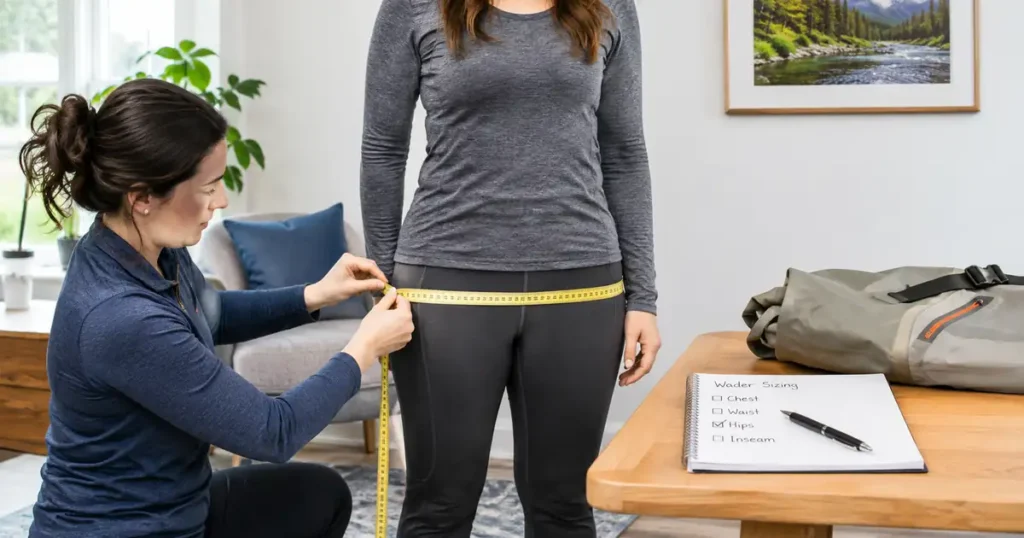
To measure waders for women correctly, use a flexible measuring tape and have someone help when a measurement is difficult to take accurately. Stand naturally rather than pulling your stomach inward. Record measurements in inches for U.S. charts and note the method required by the brand.
Measure Chest, Waist, and Hips
Measure around the fullest part of your bust or chest, keeping the tape level. Measure your waist at the location specified by the manufacturer rather than assuming every chart uses the narrowest point. Then measure around the fullest part of your hips and seat.
If you’ll wear thicker layers, record what they are, and check movement in those layers later; don’t arbitrarily add several inches to your measurements unless the manufacturer instructs you to.
Identify Your Largest Girth
Some brands, including Simms and Patagonia, organize women’s stockingfoot charts around the largest of chest, waist, or hip circumference. A 40-inch hip measurement can determine the relevant body category even when the chest and waist are smaller.
Other brands, including Orvis, show bust, waist, and hip ranges separately. Check each column and do not treat a single number as proof that the full shape will fit. A matching hip measurement does not guarantee a good length or bootie fit.
Measure Inseam Using the Brand’s Method
For its wader chart, Simms defines inseam as crotch to floor. Orvis uses a pant inseam up to measurement in its chart. Those descriptions are not interchangeable without checking exactly how the brand tells you to measure.
Take the relevant measurement while standing straight and keep the tape vertical. Measure twice, preferably with help. Also record your overall height because some size systems use it to guide Short, Regular, and Tall selection.
Record Foot Size and Intended Socks
Write down your usual U.S. street shoe size and note whether you generally need extra width or different sizes between feet. The wader’s stockingfoot size is distinct from its separate boot size. Your normal socks also affect how much room remains inside the boot.
Blank Women’s Wader Measurement Worksheet
Fill this out before comparing waders for women online. Leave the measurements blank until you have taken them; never substitute an estimated clothing size.
| Measurement or selection | Your information |
|---|---|
| Bust / chest circumference | __________ in |
| Waist circumference | __________ in |
| Hip / fullest-seat circumference | __________ in |
| Largest of the three girths | __________ in |
| Inseam and measurement method | __________ in / __________ |
| Height | __________ ft / in |
| U.S. street shoe size | __________ |
| Regular socks and lower-body layers | __________ |
| Brand and exact wader model | __________ |
| Candidate body size and length | __________ |
| Listed stockingfoot size range | __________ |
| Planned wading boot brand and size | __________ |
| Fit problem or unanswered question | __________ |
Reading Size Charts for Waders for Women
When comparing waders for women, an accurate chart is more valuable than choosing by Small, Medium, or Large. The same letter can mean different girth and bootie combinations across manufacturers.
Body Measurements Versus Garment Measurements
Some tables list body measurements. Others include product dimensions, height bands, or a maximum inseam. Read the heading and any notes before comparing your worksheet. Do not treat a maximum body girth as spare room or assume a published inseam describes the garment’s total leg length.
For example, Patagonia explicitly identifies its women’s girth, inseam, height, and shoe-size figures as body sizing guidance. Its Short and Regular options may also change the shoe-size combination, which can make one size code unsuitable even when the girth is right.
Compare Orvis and Simms Size Systems
Orvis publishes separate bust, waist, hip, inseam, and bootie fields for women’s waders. Its women’s Medium/Petite chart row lists a 39.5–41-inch hip range, pant inseam up to 30 inches, and US 7–9 booties. Medium Regular retains the same listed body measurements and bootie range but changes the inseam allowance to 32 inches. Those figures are chart references, not a guarantee that every model and color has every option in stock.
Simms uses largest girth first, then inseam, then stockingfoot range. Its general chart includes Medium Full / 8–9 Regular, listing a 40-inch largest girth, a 31–32-inch crotch-to-floor inseam, and US 8–9 stockingfeet. Simms also warns that its full company size chart contains configurations not offered on every individual model.
A Fit-System Example: Orvis Clearwater
Affiliate disclosure: As an Amazon Associate, we earn from qualifying purchases. FlyFishingScout may earn a commission from qualifying purchases at no additional cost to you.
⭐ Multiple-Length Comparison — Orvis Women’s Clearwater Waders. Orvis lists Petite, Regular, and Tall size-type selections for this women’s stockingfoot model. It’s worth checking if the body size seems right but leg length is the problem. Confirm the selected combination’s bootie range and seller’s exact variant before ordering. 👀 See Clearwater & Check Size Options.
Check the Exact Model, Not Just the General Chart
The final step is to open the product page and confirm that the exact model offers the size, length, and stockingfoot combination you’re considering. A company’s general guide is not an inventory list. The same caution applies when an Amazon page groups several variants under one product family.
Waders for Women: Petite, Tall, and Fuller Hip Fit
For waders for women, Petite and Tall describe proportions or length choices, not a judgment about overall body size. Fuller body configurations, where offered, address circumference rather than automatically shortening the legs or changing the foot size.
Shorter Inseam and Petite Proportions
If the body fits but the legs bunch excessively, check a Short or Petite configuration with a suitable inseam. Excess fabric alone does not mean the pair is unsafe, but bulky folds at the ankle or behind the knee can be inconvenient and may affect how the garment moves. Shorter legs do not guarantee smaller booties.
Taller Body Proportions
For taller women, check the full crouching and bending movement rather than relying on a standing mirror test. A pair that looks smooth while standing may pull across the seat or shoulders when kneeling. Some Tall options also change the manufacturer’s bootie range, so repeat the foot-size check.
Fuller Hips and Different Body Proportions
If your hips are your largest measurement, use that number when the chart requires largest girth. If a standard size does not leave enough room, look for a Full or roomier configuration where the specific model offers it. Do not automatically move up several sizes if that produces disproportionately long legs and oversized booties.
Why Youth Waders Are Not an Automatic Substitute
Some shoppers seek youth waders for women with very small feet or short inseams. But youth patterns have different chest and hip ranges and may restrict an adult body’s movement. Compare every dimension rather than assuming that matching height or foot size makes the whole garment suitable. If the full body and foot measurements cannot be met, skip that option.
Matching Stockingfoot Booties to Wading Boots
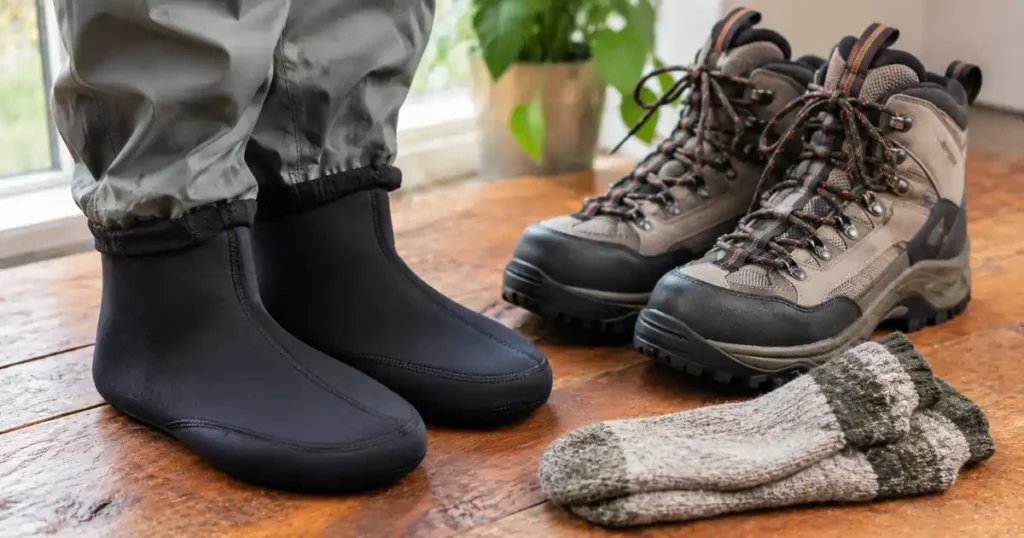
Stockingfoot waders for women end in attached neoprene socks. They require separate wading boots; the neoprene alone is not intended as an ordinary walking sole on rough riverbanks.
Check the Stockingfoot Range First
Find the manufacturer’s stated US shoe-size range for the exact wader size. The bootie should accommodate your foot and intended socks without forcing your toes to curl or leaving a large wad of neoprene at the front.
A roomier body size can sometimes have larger attached feet. That is a reason to check alternative configurations, not an instruction to force an overly large stockingfoot into a smaller boot.
Account for Socks and Neoprene Bulk
Test the wader with the socks you’ll use on the water. Thick socks can change boot fit; wearing additional pairs is not automatically warmer if the result compresses your feet. Check that you can wiggle your toes and that the neoprene does not fold underneath the foot.
Use the Wading Boot Manufacturer’s Chart
Do not apply one universal rule such as “always buy boots one size larger.” Simms’ women’s boot chart, for example, maps a US women’s street shoe size 8 to a Simms women’s wading boot size 9 or a Simms men’s size 7. Orvis says its wading boots are designed to accommodate stockingfoot waders and should not automatically require sizing up. Both statements apply to the manufacturers’ own products.
Try the actual waders inside the boots, lace them normally, walk indoors, and check toe clearance and heel movement. The boot and the attached stockingfoot must work together.
When Booties Are Too Big or Too Small
Booties that bunch heavily may shift and feel awkward inside boots. Booties that are too small can compress the toes. Neither problem should be hidden by selecting an inappropriate wading boot size. First look for another wader size configuration or different brand that matches your body and feet together.
When Waders for Women Have Conflicting Measurements
A mismatch when sizing waders for women is not unusual. The correct response is to identify which measurement fails rather than buying the next size up without checking the consequences.
Body Fits, but the Feet Do Not: Worked Example
Imagine a shopper with a 40-inch largest girth, a 32-inch crotch-to-floor inseam, and US women’s shoe size 6. Simms’ general chart lists Medium Full / 8–9 Regular at a 40-inch girth and a 31–32-inch inseam—but its stockingfoot range is US 8–9.
The body measurements may point to that row, yet the attached foot range does not match the shopper’s size 6 feet. This is not a recommended size. It illustrates why checking girth and inseam without bootie size can lead to a poor purchase. The next step is to search for a different configuration or model with a matching foot range, or ask the manufacturer about suitable alternatives.
Hips Fit but the Inseam Does Not
Compare Short, Petite, Regular, and Tall choices within the correct body category. If no offered length fits, do not automatically select a size with inadequate seat or torso room. Different brands distribute their available size combinations differently.
A Different Fit System May Help
A product with a completely different chart can offer a useful alternative when one brand’s bootie range conflicts with your body size. That is a reason to compare brands—not evidence that the alternative will necessarily fit.
🎣 Chart-First Alternative — Simms Women’s Tributary Waders — Stockingfoot. Simms publishes girth, Short/Regular inseam, and stockingfoot combinations for this women’s model, making it useful for a three-part sizing comparison. Skip any listed variant when its foot range conflicts with yours, and confirm the actual size before buying. 👀 View Tributary & Check Size Choices.
Fit-Conflict Decision Guide
| Problem during comparison | Check first | Sensible next step |
|---|---|---|
| Hips feel tight | Hip / largest-girth range | Seek a roomier body configuration |
| Legs are much too long | Chart’s actual inseam definition | Compare Short or Petite |
| Torso pulls when squatting | Torso length and shoulder adjustment | Try another length or body pattern |
| Stockingfeet are oversized | Exact bootie range | Find a smaller-foot configuration |
| Stockingfeet squeeze toes | Foot range and sock thickness | Try a suitable alternate size or model |
| Boots are too tight | Boot manufacturer’s fitting chart | Try correctly sized boots with the waders |
| No combination passes all checks | All three measurements | Switch models or request specialist help |
Trying On Waders for Women: Movement Checklist
A fitting test for waders for women should happen indoors, on a clean surface, while the waders can still be returned under the seller’s terms. Wear your normal base layers, the socks you’ll fish in, and your planned wading boots.
Sit, Squat, Step, and Bend
Put on the waders, adjust the suspenders, and fasten the belt correctly. Sit in a chair, squat carefully, bend forward, and step onto a low stable platform. Check whether the crotch pulls, the shoulders tug downward, or the knees lose room to bend. The fit should support normal movement without requiring the fabric to be stretched tight.
Look for Excessive Folds and Foot Movement
Some loose fabric is normal because waders need room for movement. But large bunches at the ankles, neoprene folds inside boots, or a heel that slides excessively should prompt another size check. Standing in front of a mirror is not enough to evaluate those issues.
Test the Actual Layers
Repeat with the insulating layers you reasonably expect to wear. If you regularly fish cold weather, choose appropriate moisture-managing layers without packing the waders so tightly that you cannot squat or lift a leg. Our guide to what to wear under waders explains how to plan those layers for different seasons.
When to Try a Different Brand
If booties or inseam do not match, compare another brand’s chart.
⭐ Alternative Sizing System — Caddis Women’s Deluxe Breathable Stocking Foot Wader. Caddis offers a women’s stockingfoot model in sizes Small through 2XL, giving you another model to investigate when the Orvis or Simms chart does not work. Its exact hip, inseam, and bootie measurements must be checked with the seller or manufacturer; it is not a proven petite or wide-hip solution. 👀 See Caddis Deluxe & Check Available Sizes.
If none of the available waders for women pass the movement and foot checks, do not fish in the closest-looking size merely because it has already arrived.
Buying and Returning Waders When You’re Between Sizes
When buying waders for women, check the return policy for the seller you actually purchase from, especially if shopping through a marketplace. A manufacturer’s own return terms may not govern an order fulfilled by an independent retailer.
Simms currently says direct purchases may generally be returned within 60 days, but items must be new and unused with original tags and packaging; custom waders are excluded. Orvis describes its own in-store and online return and exchange process and distinguishes purchases from authorized dealers. Policies can change, so verify the current conditions at checkout.
Keep your original packaging, note the precise size code and inseam selection, and complete all movement checks indoors. Do not remove tags, fish in the waders, or assume a wet pair is eligible for a standard size exchange.
If you are between sizes, contact the manufacturer or a specialist fly shop with your recorded bust, waist, hip, inseam method, height, and shoe size.
Waders for Women FAQs
Should Women’s Waders Fit Tightly?
No. Waders need enough room for layers and normal bending, stepping, and squatting. They should not feel stretched tight through the hips, crotch, or shoulders. Excessive fabric folds and oversized booties are also reasons to reconsider fit.
How Much Extra Inseam Is Normal?
There is no universal extra-inch rule. Follow the exact model chart, then test seated and crouching movement. Published inseam values may be body measurements or model fit guidance, so do not add an arbitrary allowance.
What If My Hips Fit but My Feet Do Not?
Try a different body/bootie combination or another manufacturer. Some waders for women combine a suitable girth with unsuitable stockingfeet. Do not assume larger boots solve oversized neoprene booties.
Should Wading Boots Be One Size Larger?
Not always. Use the boot manufacturer’s size chart with your stockingfoot waders and normal socks. Simms and Orvis give different model-specific guidance, so the same rule should not be applied to every brand.
Are Youth Waders Suitable for Petite Women?
Only when all required body and foot measurements suit the wearer and the waders allow comfortable movement. Youth-sized legs or feet alone do not guarantee enough space for adult hips or torso proportions.
What if No Standard Wader Size Fits?
Try another manufacturer, check whether a suitable Full, Short, Petite, or Tall combination exists, and contact a specialist retailer or manufacturer. Do not accept a pair that compresses your feet or prevents normal movement.
Conclusion
The best-fitting waders for women are not necessarily those that match your usual clothing label. Measure your chest, waist, hips, inseam, and feet, then verify the exact model’s available size and stockingfoot combinations. Test the complete outfit with socks, wading boots, and layers before using it in water.
If the hips fit but the feet do not—or the booties fit but you cannot squat comfortably—change the configuration or model. A complete fit matters more than the letter on the tag.
References
- Simms Fishing — Women’s Stockingfoot Wader Size Chart
- Orvis — Waders Size & Fit Guide
- Patagonia — Waders Size Chart
- Orvis — Women’s Clearwater Waders
- Simms Fishing — Women’s Tributary Waders
- Simms Fishing — Wading Boot Size Chart
- Orvis — How Do I Pick a Pair of Wading Boots?
- Caddis Fishing — Fishing Waders Collection
- Simms Fishing — Refund Policy
- Orvis — Returns & Exchanges
- River Gear Guide — Women’s Waders and Amazon Product Index