
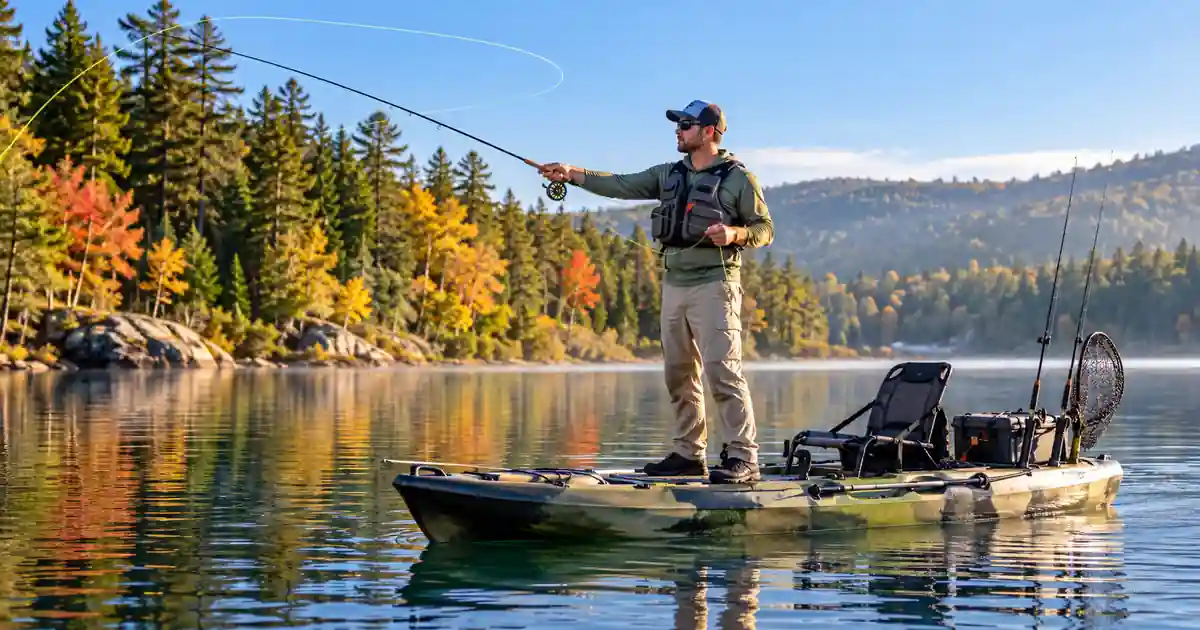
Fly Fishing Kayak: How to Choose for Stability and Easy Casting
A fly fishing kayak should make two things easier: keeping the boat under control and keeping loose fly line away from anything it can catch. A fishing kayak with five rod holders can still be frustrating if the running line wraps around exposed foot braces every time you strip a fly. Likewise, an enormous standing platform may be a poor purchase if you cannot get the boat onto your vehicle or handle the water you intend to fish.
This guide explains how to compare stability, deck layout, seating, paddle and pedal systems, storage, weight, and realistic capacity. It then evaluates five current kayak models using published manufacturer specifications rather than invented on-water tests. The goal is to choose a boat that matches your casting habits, transport options, and fishing conditions—not simply the one with the most features.
Table of Contents
Fly Fishing Kayak: Quick Buying Answer
The best first fly fishing kayak for many anglers is a stable, manageable sit-on-top paddle kayak with enough clear space in front of the seat for fly line, accessible gear storage, and a weight you can load without relying on unsafe lifting. Standing capability is useful in suitable calm water, but you do not have to stand to fly fish from a kayak. A seated angler with a clean casting lane can be more comfortable and controlled than a beginner struggling to balance while standing.
| Your priority | Start by comparing | Main trade-off |
|---|---|---|
| A fly-line-friendly deck | Jackson Mayfly | Specialized features; substantial hull weight |
| Standing and adjustable seating | Bonafide SS127 | Tall seat and fittings require a real fly-line check |
| Simpler paddle-powered fishing | Old Town Sportsman 120 | Paddle management during presentations |
| Moving while keeping hands available | Old Town Sportsman PDL 120 | Heavy assembled boat and pedal equipment |
| Open working space and custom rigging | NuCanoe Unlimited | Wide hull and configuration-dependent capacity |
These are use-case recommendations, not a laboratory ranking. Before paying for a fly fishing kayak, inspect the actual deck, simulate your cast and retrieve, confirm the manufacturer’s capacity definition, and work out how you will transport it. If possible, arrange a supervised on-water demo in conditions appropriate to your experience.
What Makes a Fly Fishing Kayak Different?
A fly rod carries and casts the weight of the line, and the angler often gathers several feet of loose line between casts. That line needs somewhere to land and somewhere to run freely when the next cast starts. Conventional fishing outfits typically do not create the same large loose coils around the cockpit. For that reason, a fly fishing kayak with fewer raised fittings can be preferable to a heavily outfitted general fishing model.
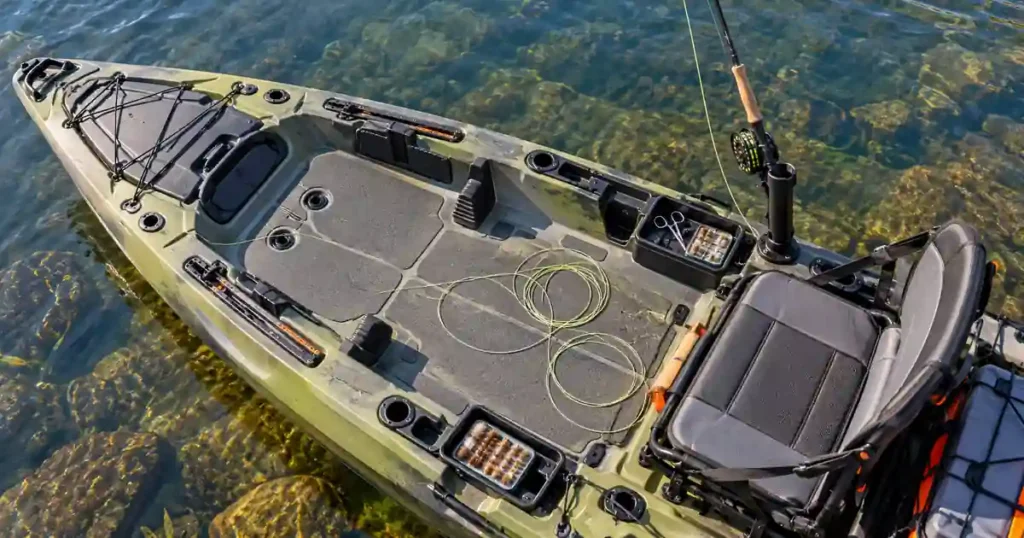
When inspecting a fly fishing kayak, look closely at the space directly in front of your seated or standing position. Exposed screws, high foot braces, open cup holders, vertical rod holders, bungee hooks, and even a shoe lace can trap a fly line. Consider the route from your stripping hand to the deck and back through the guides. If you cannot see a reasonably clear route, extra accessories may make the problem worse.
A usable casting area is not necessarily the kayak’s full width. Seat frames, pedal drives, hatch lids, tackle boxes, and standing aids all occupy space. Ask whether you can place your feet comfortably without stepping on line, reach the paddle when required, and keep the fly and leader away from other people and obstacles. A kayak for fly fishing should help you solve those practical problems before it provides space for electronics you might never use.
Fly Fishing Kayak Stability: Primary vs Secondary
Primary stability is the resistance you feel when a kayak first rocks slightly away from upright. Secondary stability describes how the hull supports you farther into a lean. These qualities depend on more than width: hull profile, load distribution, seat position, hull volume, and water movement all influence how a boat feels. Manufacturer claims of a ‘stable’ hull do not provide a universal standing guarantee.
A broad, flatter bottom may feel reassuring in calm water. A hull that behaves well through a greater lean may be helpful when conditions change, but a person cannot reliably judge that quality from a photo or width number. A 35-inch kayak is not necessarily safer than a 33.75-inch kayak for every paddler. The weight of the paddler, seat height, gear placement, and the actual water matter.
Standing Changes the Balance
Standing in a fly fishing kayak raises your center of gravity. Sudden hook sets, side winds, awkward reaches, and passing boat wakes can also shift your weight. Even in a standing-oriented fly fishing kayak, start by practicing seated. Try standing only where conditions are calm, where the manufacturer supports standing use, and where you have a suitable way to recover from a capsize. A standing pad adds grip; it does not turn challenging water into safe water.
Seating Height Is a Trade-off
A higher seat can help with visibility and make it easier to change position, but it can also raise the center of mass and expose your body to more wind. A lower seat can feel more connected to the hull, yet may make high back casts or certain reaches less comfortable. Test both positions if the model has an adjustable system. Your preferred seat height may differ between paddling and fishing.
Ask for a Water Demo
Before judging kayak standing stability, arrange a dealer or qualified instructor demonstration under controlled conditions. Sit, turn, reach toward the bow, and practice returning to the seat without sudden movements. Learn how the boat behaves when a small wave reaches its side and what to do after a capsize. A store-floor balance test is not evidence of safe performance on water.
Fly Fishing Kayak Deck Layout, Snags, and Casting Space
Think of your deck as an open landing area for the line. On a well-organized fly fishing kayak, the feet, rod butt, paddle, and accessories have defined places that do not compete with the route of the running line. Look for recessed or protected foot braces, smooth hatch surfaces, and low-profile mounting points. Inspect both the sitting position and the standing position if you intend to use both.
The Fast Snag Check
When examining a fly fishing kayak at a dealer, imagine stripping 15–25 feet of line toward yourself. Where would the coils collect? Now pretend to lift the rod and shoot the line. Identify anything the line could pass behind or hook underneath. Check the seat feet, buckles, gear-track edges, exposed screws, cooler handles, crate corners, and fishing-tool lanyards. A claimed snag-free deck is worth checking with your own normal clothing and footwear.
Keep Gear Behind or Beside the Working Area
Store spare fly boxes and heavier items securely, preferably where they will not obstruct the cast. Do not stack tackle in front of your feet simply because there is space. Mount rod holders and electronics only where they do not catch the fly line or interfere with paddling, exit, or rescue. A low-profile attachment can be more useful than a tall accessory with extra functions.
Do You Need a Stripping Basket?
On a fly fishing kayak, a small secured line basket or simple removable line mat may help keep coils together, especially in wind. A towel can temporarily cover snag points, but loose fabric must not cover drains, foul pedals, restrict your feet, or create an entanglement hazard. Test any organizer on land first. If the line naturally piles on a clean deck, you may not need another product. The Salt Strong fly-line demonstration listed in References is a useful example of the problem rather than proof that one homemade solution works for every kayak.
Learn the casting mechanics separately through FlyFishingScout’s fly fishing casting techniques guide. The purpose of this buying guide is to choose enough safe room for those casts, not to turn kayak selection into a full casting lesson.
Kayaks for Fly Fishing: Paddle, Pedal, and Sit-on-Top Designs
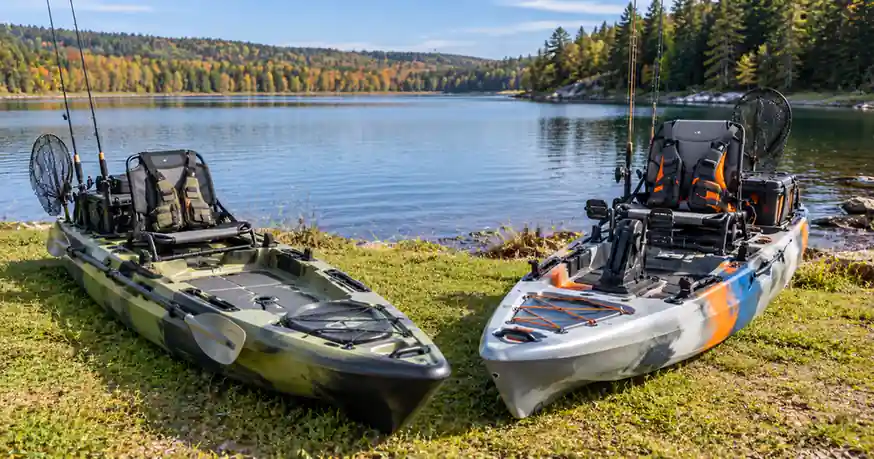
Most models in this fly fishing kayak comparison are sit-on-top models. Their open cockpits can make gear organization and changing position straightforward, while scupper openings allow drainage when correctly used within the boat’s operating load. The trade-offs include greater exposure to wind and water, and potentially substantial hull weight. A sit-inside kayak may work for a competent seated caster in suitable conditions, but a small cockpit and restricted exit make standing and line handling different problems.
Paddle Kayak: Simple and Direct
A paddle kayak generally offers a less complex deck because there is no pedal unit in front of the seat. It may cost less and be easier to maintain. The drawback is that you must put the paddle somewhere secure while you cast, and wind or current can move the boat during the retrieve. A light, uncluttered paddle model can be the better kayak for fly fishing when you launch alone or fish short outings on sheltered water.
Pedal Kayak: Convenience With Added Weight
Pedal propulsion lets you adjust position or continue moving while your hands are more available, depending on the situation and drive. But the pedals and drive well occupy space near the very area where loose fly line may fall. A fly line wrapped around a drive can interrupt both fishing and propulsion. Check whether the drive can be raised in shallow water and how you will handle a failure while away from shore. A pedal kayak still needs an appropriate backup plan and paddle.
Do Not Choose by Propulsion Alone
The best kayaks for fly fishing differ by transport and water. A pedal drive may help on a broad sheltered lake but be unnecessary for a small pond. Neither a wide sit-on-top nor a pedal drive makes fast current, breaking surf, or high wind safe for a beginner. Compare the layout with the actual conditions you will encounter, and verify propulsion-specific local rules if a motor is added later.
Fly Fishing Kayak Storage, Seating, and Transport
A fly fishing kayak should hold a paddle, a protected spare rod if carried, a small fly box, tools, drinking water, and emergency gear without blocking the casting zone. Dry compartments and rear tankwells solve different storage needs. A hatch described as water-resistant should not automatically be treated as completely watertight; use properly sealed dry bags for essentials and communications.
The bigger question is often whether you can move the boat when you are not fishing. Manufacturer figures may state hull weight, fitted hull weight, or assembled boat weight, and those numbers are not the same. Seats, pedal drives, batteries, accessories, and transport wheels can make a surprisingly large difference. If a kayak weighs around 85–116 pounds assembled, plan how it will reach the water and return to your vehicle without lifting beyond your capability.
Understand Load Capacity Before Comparing Models
For every fly fishing kayak under consideration, ask what the manufacturer includes in its capacity figure. Old Town states both total weight capacity and usable capacity; usable capacity represents people and gear after the assembled boat’s weight is accounted for. The Sportsman 120 lists 500 pounds total and 415 pounds usable, whereas the PDL 120 lists 500 pounds total and 384 pounds usable. The pedal boat is not carrying the same available payload despite the same total figure.
NuCanoe uses different terminology: its Unlimited is rated for 650 pounds maximum payload with scuppers plugged, versus 400 pounds self-bailing payload with scuppers open, counting passengers and gear. You cannot place that 650-pound value next to Old Town’s 415-pound usable figure and declare one safer or stronger. Configuration and the operating condition matter. Keep margin for water, clothing, tackle, cooler, and unexpected additions, and never plan to operate at a stated maximum simply because the number exists.
Test the Storage and Loading Routine
If you fish alone, measure the actual loading path: garage to vehicle, roof rack height or trailer, parking to launch, and retrieval after a tiring day. Confirm vehicle and rack limits, approved tie-down points, storage space, and whether a cart can traverse the launch surface. Protect rods from crushing during transport. An excellent fly fishing kayak that you cannot conveniently launch is unlikely to serve you well.
For anglers still assembling basic tackle, FlyFishingScout’s beginner fly fishing setup can help keep the fishing gear compact and avoid loading unnecessary duplicates. If you’re choosing what line to carry, the guide to choosing the right fly fishing line covers that separate decision without adding more gear to your kayak than you need.
Best Fly Fishing Kayak: Verified Model Comparison
These five fly fishing kayak models illustrate different design decisions, not boats FlyFishingScout claims to have tested. Specifications and listed manufacturer prices were checked on October 23, 2026. Prices, inventory, accessories, and exact configurations can change. Product links below go to original manufacturer pages; they are not fabricated affiliate links.
| Kayak | Length × width | Published weight type | Published capacity information | Propulsion |
|---|---|---|---|---|
| Jackson Mayfly | 12 ft 8 in × 35 in | 89 lb listed weight | 450 lb capacity | Paddle |
| Bonafide SS127 | 12 ft 7 in × 33.75 in | 94 lb fully rigged | 475 lb manufacturer-defined capacity | Paddle |
| Old Town Sportsman 120 | 12 ft × 33.5 in | 85 lb assembled | 415 lb usable / 500 lb total | Paddle |
| Old Town Sportsman PDL 120 | 12 ft × 36 in | 116 lb assembled | 384 lb usable / 500 lb total | Pedal |
| NuCanoe Unlimited | 12 ft 6 in × 41 in | 84 lb hull | 400 lb self-bailing / 650 lb maximum payload | Paddle; configurable |
The weight types in this table are not interchangeable. Read each model’s specifications and capacity notes before making a purchase decision.
Jackson Kayak Mayfly — Best Match for a Fly-Specific Deck
Why it made the list: The Mayfly is specifically designed around fly-line management. Jackson identifies an open standing area, protected footrests, molded reel pockets, fly patches, line-management features, and rod-butt supports. Its published dimensions are 12 feet 8 inches long, 35 inches wide, and 89 pounds, with a 450-pound rated capacity. Jackson also identifies a Comfort Seat 5.0 in its 2026 fishing range.
Who it suits: An angler whose frequent frustration is fly line catching on the boat rather than a lack of rod holders. Its layout is particularly relevant to calm ponds, lakes, slow rivers, and suitable sheltered flats, where standing or seated casting can be considered according to conditions.
Trade-offs: This is still a substantial boat to transport. It is not an automatic choice for exposed current or surf, and its specialized design may be unnecessary if you fish seated only a few times per year. The manufacturer listing showed $1,599, but availability depends on the exact model and seller; do not assume a particular color is in stock.
Bonafide SS127 — For a Sit/Stand Fishing Platform
Why it made the list: Bonafide’s SS127 has adjustable HiRise seating, a stand-friendly deck, traction pads, accessory tracks, and equipment-management features. The published length is 12 feet 7 inches, beam 33.75 inches, and fully rigged weight 94 pounds. Bonafide lists 475 pounds capacity using its own definition, which counts the kayak, paddler, and gear and includes a performance threshold.
Who it suits: Someone who values seating adjustability and a deck intended for changing between seated and standing fishing in appropriate conditions. It is a good design candidate to try in person if long seated sessions are uncomfortable.
Trade-offs: Its features were developed for fishing broadly, not just fly-line control. Check the seat frame, tracks, foot braces, and rod-management fittings with actual loose line. High seating is not automatically the most stable position. The manufacturer page listed $1,649 and directed buyers to dealers.
Old Town Sportsman 120 — Simpler Paddle-Driven Option
Why it made the list: Old Town specifies a 12-foot paddle kayak, 33.5 inches wide, with a Double-U hull, adjustable seat, deck pads, accessory tracks, and storage. The boat weighs 85 pounds assembled and provides 415 pounds usable capacity under Old Town’s definition. The maker’s listed price was $1,099.99, depending on current dealer and color availability.
Who it suits: An angler who wants a general fishing platform and prefers to paddle rather than pay for pedal propulsion. It is a useful comparison for someone choosing one kayak for conventional tackle and occasional fly fishing.
Trade-offs: Paddle stowage interrupts some fishing movements, and rails, foot braces, and holders need a careful fly-line snag test. It is not an ultralight roof-loading boat even without a drive unit. A stable hull design does not guarantee safe standing in rough weather.
Old Town Sportsman PDL 120 — Pedal Convenience, More Weight
Why it made the list: The Sportsman PDL 120 adds a pedal drive with forward and reverse propulsion and a 36-inch beam. Old Town lists 116 pounds assembled, including its drive and outfitting, and 384 pounds usable capacity. Its official page showed $2,999.99, subject to changes in price and availability.
Who it suits: Anglers who value propulsion without constantly holding a paddle, have a transport solution for the extra weight, and fish waters suited to a pedal drive. Moving the kayak while keeping hands available can be useful, but it depends on managing the rod and loose line safely.
Trade-offs: The drive takes up forward cockpit space, which can snag line if the layout is careless. Its assembled weight is notably higher than the paddle Sportsman 120, and the extra drive requires its own care and shallow-water planning. Choose it because propulsion solves a genuine problem, not because it is automatically better for fly casting.
NuCanoe Unlimited — Wide, Configurable Working Space
Why it made the list: NuCanoe describes the Unlimited as an open-deck, configurable fishing and hunting platform. The manufacturer publishes a 12-foot-6-inch length, 41-inch width, and 84-pound hull weight. Its current page distinguishes 650 pounds maximum payload with scuppers plugged from 400 pounds self-bailing payload with scuppers open, counting passengers and gear. The page showed $1,999 MSRP with a 360 Fusion Seat.
Who it suits: An angler who prioritizes a wide, customizable deck, specialized seating, or room to organize equipment. The open space can be useful when you want to choose exactly where line and gear will sit.
Trade-offs: A 41-inch-wide hull brings storage and transport implications, and adding tracks, propulsion systems, and accessories can recreate line snags. The 84-pound figure is for the hull, not necessarily the fully equipped boat. Neither of its capacity ratings is a guarantee of safe standing in moving water.
Which is the best fly fishing kayak for you? Choose the Mayfly when fly-specific deck design is the priority; compare the SS127 for adjustable sit/stand fishing; start with the Sportsman 120 when you want a simpler paddle boat; consider the PDL 120 only when hands-free propulsion justifies its weight and cost; and inspect the Unlimited if configurable open deck space matters most. A retailer demo is more useful than treating that order as a universal top-five ranking.
Fly Fishing Kayak Buying Choices by Water Type
A fly fishing kayak should be selected for the water where you will actually use it, not every environment mentioned in a manufacturer’s marketing copy. Boat suitability changes with wind, waves, current, temperature, and distance from a safe landing.
| Fishing water | Prioritize | Avoid assuming |
|---|---|---|
| Sheltered pond | Manageable weight, simple deck, seated comfort | You must stand to cast |
| Calm lake | Tracking, gear access, weather awareness | Calm at launch means calm all day |
| Slow river or backwater | Maneuverability, current awareness, legal access | An anchor will hold safely everywhere |
| Sheltered tidal creek | Saltwater care, current and tide planning | An estuary is always calm |
| Exposed coast or swift river | Specialized training and boat suitability | A wide fishing kayak is enough for difficult conditions |
For a fly fishing kayak used on a pond, a practical loading routine and uncluttered deck often matter more than sophisticated propulsion. On a bigger lake, travel distance and returning against wind may affect whether you prefer paddle or pedal. In a slow river, current can turn a small positioning mistake into a difficult recovery. Tidal water adds changing flow and potentially long trips back to the launch.
A fly fishing kayak built for relaxed sight fishing on a sheltered flat does not automatically belong in surf, offshore water, or whitewater. If your usual water regularly requires technical paddling or rescue skills, seek instruction and compare kayaks designed for that environment rather than using this calm-water buyer’s shortlist as a safety endorsement.
Fly Fishing Kayak Safety, Capacity, and Anchoring
When selecting a fly fishing kayak, safety equipment and recovery ability are part of the buying decision. Wear a properly fitted, U.S. Coast Guard-approved life jacket appropriate for your activity. Dress for the water temperature, not just the air, and carry suitable means of communication and signaling. Local rules may impose additional requirements; verify them for your state and waterbody.
Prepare for a Capsize
Before taking a fly fishing kayak away from shore, practice rescue and reentry in supervised, controlled conditions. Keep essential items secured without tying yourself into a system that could trap you underwater. Learn to exit safely, and do not assume you can climb back aboard simply because the kayak has a large standing deck. Keep a paddle accessible even with pedal propulsion, and tell someone your route and expected return.
Treat Weather as a Limit
Check a location-specific forecast and wind trend before launching. Storms, cold water, large boat wakes, and strong current can create conditions beyond the boat and paddler’s abilities. A stable-looking kayak cannot compensate for bad weather or a lack of rescue skills. Stay close to suitable landings while learning and turn back before conditions become difficult.
Anchoring in Current Is Not a Beginner Shortcut
An anchor can catch in submerged structure and put a kayak broadside to the current, increasing the risk of capsize or entanglement. Anchor points, lines, retrieval systems, and quick-release arrangements require specific training and suitable conditions. Avoid casual anchoring in fast flow, navigation channels, or places with passing traffic. Beginners can often choose a calm backwater or safe shoreline position instead of trying to hold a boat stationary in current.
Capacity Is Not a Target Load
Do not confuse a published maximum with the load you should routinely carry. Count paddler, clothing, water, fishing tackle, safety equipment, cooler, and every installed accessory using the manufacturer’s exact definitions. Allow margin and maintain appropriate trim. Even a fly fishing kayak with an apparently large published capacity can handle poorly if gear is distributed badly or the boat is operated in unsuitable conditions.
How to Demo a Kayak Before Buying
A kayak demo should answer practical questions that a specification sheet cannot. Ask a reputable dealer whether you can try the correct model and seat configuration in safe, supervised conditions. If a water demo is unavailable, perform a careful dry-land inspection and acknowledge that it cannot prove on-water stability.
1. Simulate your seated fly cast. With no hook attached, check whether the rod clears the seat and whether the line has a free route past the foot braces and fittings. Confirm you can recover the paddle without setting your rod or tools loose.
2. Check reach and seating. Can you adjust the seat without leaning dangerously? Are the fly box, tools, and emergency items reachable without twisting far beyond your comfortable balance?
3. Evaluate standing only when appropriate. If the maker supports standing, arrange a controlled demonstration with a qualified person. Check how the boat feels changing from seated to standing, but do not treat a calm-water test as proof of safety in current or wind.
4. Inspect transport weight. Identify whether the figure includes the seat and drive. Rehearse the real loading process with appropriate assistance and equipment. Ensure the kayak fits your rack, trailer, or storage area.
5. Confirm the exact version and total cost. Ask about paddle inclusion, seat type, drive, rudder, scuppers, warranty, replacement parts, dealer support, and current stock. A fly fishing kayak sold without a required accessory may cost more to make ready than its headline price suggests.
6. Check recovery and access. Know how to exit and reenter, where you can launch, and whether the route is suitable for your skills. If an essential safety procedure is unfamiliar, seek instruction before an independent trip.
Fly Fishing Kayak FAQs and Final Checklist
Do I Need a Special Kayak for Fly Fishing?
No. Many general fishing kayaks can work if they have suitable stability, a clear line area, and a comfortable casting position. A purpose-built fly fishing kayak may reduce line snags, but specialized branding alone is not a reason to replace a boat that already works.
Can You Fly Fish While Sitting in a Kayak?
Yes. Seated casting is a normal and practical approach, especially for beginners or conditions where standing would be unwise. Keep the line organized and use casts that fit your available space. Standing can be optional rather than the goal.
What Makes a Fishing Kayak Stable Enough to Stand In?
Hull design, load distribution, seat position, water conditions, and the paddler’s balance all matter. Follow the manufacturer’s intended use and practice in a controlled environment. No width or capacity figure alone certifies safe standing in all conditions.
Is Paddle or Pedal Better for Fly Fishing?
Paddle boats often offer simpler, less obstructed layouts and lower cost. Pedal models help with propulsion and positioning but add weight and cockpit hardware. Choose the system that solves your actual transport and fishing problems.
How Much Weight Capacity Do I Need?
Count the paddler plus all carried gear, then compare that load with the manufacturer’s applicable usable or payload rating. Check whether scupper configuration changes the figure, and keep a sensible operating margin. Do not subtract kayak weight twice or compare differently defined ratings as equals.
Which Kayak Accessories Should I Buy First?
Begin with a properly fitted life jacket, appropriate paddle and backup plan, secure storage, and necessary safety gear. A line basket or snag cover can wait until you confirm the layout actually needs it. Electronics and extra rod holders should come after your basic deck organization works.
Final Purchase Checklist
- Choose a hull intended for your usual water and skill level.
- Check primary and secondary stability, not width alone.
- Inspect the casting area for line snags from seated and intended standing positions.
- Compare paddle and pedal systems using actual weight, cost, and cockpit space.
- Check the capacity definition and calculate your real operating load.
- Confirm loading, storage, launching, and transport arrangements.
- Budget for an appropriate PFD, paddle, communication, and rescue preparation.
- Inspect the exact model, stock, included items, and warranty before purchasing.
A successful fly fishing kayak purchase starts with the things you cannot easily fix later: hull suitability, safe stability, deck space, transport weight, and the capacity needed for your gear. Choose the boat that makes your actual fishing simpler. Then add accessories only when they solve a problem you have identified, rather than buying equipment to fill every available mounting point.
References
- Jackson Kayak — Mayfly Sit-on-Top Fishing Kayak
- Bonafide Fishing — SS127 Kayak
- Old Town — Sportsman 120
- Old Town — Sportsman PDL 120
- NuCanoe — Unlimited
- Salt Strong — Fly Fishing From a Kayak: Fly Line Tips & Tricks
- United States Coast Guard — Coast Guard Urges Paddle Craft Safety in the Pacific Northwest
- Connecticut Department of Energy and Environmental Protection — Paddlers Safety Checklists and Equipment
- National Weather Service — Small Craft Advisories