

Fly Fishing Casting Techniques: Essential Casts and When to Use Them
Fly fishing casting techniques are most useful when you think of them as solutions to fishing problems. The overhead cast handles open space, the roll cast works when a normal back cast is blocked, the reach cast helps control drag before the fly lands, and the double haul adds line speed when wind, larger flies, or extra distance demand it.
You do not need dozens of specialized casts to become effective. Start with clean loop control, learn a few essential fly fishing casting techniques, and choose the cast that matches the water in front of you.
Table of Contents
Fly Fishing Casting Techniques: Quick Guide
Use this table as a practical starting point.
| Situation | Best Starting Cast | Why |
|---|---|---|
| Open room behind you | Overhead cast | Efficient basic delivery and good all-around line control |
| Trees, brush, or steep bank behind you | Roll cast | Delivers the line without a normal aerial back cast |
| Mixed currents likely to drag the fly | Reach cast | Repositions the line before it lands |
| Wind, larger flies, or a need for more line speed | Double haul | Adds line speed without relying only on the rod hand |
| Strong side wind | Adjust casting side or rod plane | Keeps the fly and line farther from your body |
| Very tight casting space | Roll cast or another anchored presentation | Avoids forcing an unsafe overhead back cast |
The key is to identify the problem first. More power is not automatically the answer. These fly fishing casting techniques work best when you first correct slack, timing, and rod-tip path, then choose the cast that fits the situation.
Fly Fishing Casting Techniques: Core Mechanics
Before adding specialized fly fishing casting techniques, make the basic mechanics repeatable. Good casts can look slightly different from one angler to another, but several principles remain useful.
Start Without Unnecessary Slack
Slack delays the moment when the moving rod begins to load against the fly line.
For a basic pickup, begin with the rod tip low and the line reasonably straight. If several loose curves lie between the rod tip and the fly, part of your casting stroke is spent removing that slack instead of moving the line efficiently.
This does not mean every fishing presentation must be perfectly straight. Slack can be useful after the cast when you deliberately want a drag-free drift. The important distinction is between intentional presentation slack and accidental slack during the casting stroke.
Smoothly Accelerate
Avoid jerking the rod at the beginning of the stroke.
A useful casting motion builds speed smoothly and finishes decisively. Think of acceleration rather than brute force.
When anglers try to create distance by hitting the rod harder from the start, the cast often becomes less controlled. A smoother stroke gives the rod and line time to respond.
Make a Clear Stop
The stop helps the rod straighten and forms the loop that carries the line.
A clear stop does not need to be violent. The hand slows or stops, the rod recovers, and the line continues traveling.
If you let the rod drift forward without a meaningful stop, the loop may become unnecessarily wide and lose efficiency.
Let the Line Straighten
Timing changes with the amount of line outside the rod tip.
A short line straightens quickly. More line generally needs a longer pause.
Starting the next stroke too early can create a cracking sound, collapsed loop, or sudden loss of tension. Waiting too long lets the line fall and adds slack.
Watch the back cast during practice when it is safe to do so. That is often more useful than memorizing a fixed pause.
Control the Rod-Tip Path
The fly line tends to follow the path created by the rod tip.
For a straight presentation, aim for a controlled tip path that supports the loop shape you want. If the tip travels in a large curved path when you do not intend it, the line will reflect that.
This is one reason rigid “10 and 2” rules can be misleading. Clock positions can help a beginner visualize a starting movement, but the correct casting arc changes with line length, rod bend, trajectory, and the cast you are trying to make.
Change the Casting Arc as the Load Changes
The casting arc should not stay identical for every cast.
With more line outside the rod tip, the rod can bend more and often needs a wider casting arc. With less line, a shorter arc may be enough.
The goal is not to force the rod between two fixed positions. The goal is to control how the rod bends, recovers, and moves the line.
If you want a full first-cast tutorial before working on these fly fishing casting techniques, see FlyFishingScout’s guide on how to cast a fly rod.
Fly Fishing Casting Techniques: Overhead Cast
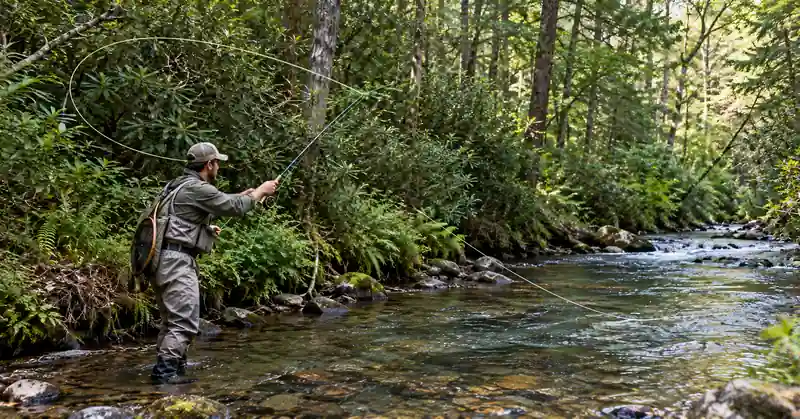
The overhead cast is the foundation for many fly fishing casting techniques because it teaches pickup, acceleration, stop, pause, and forward delivery.
When to Use It
Use an overhead cast when you have enough clear space behind and in front of you for the line to unroll safely.
It is appropriate for:
- general trout fishing;
- open banks;
- lakes and ponds;
- many boat situations;
- changing direction with controlled false casts.
Before casting, always check the back-cast area for people, pets, trees, fences, boats, and other obstacles.
Basic Motion
Start with the rod tip low and the line straight in front of you.
Lift smoothly, accelerate into the back cast, and make a clear stop. Pause while the line unrolls behind you. Then accelerate forward and stop again. Let the line extend before lowering the rod tip toward the target.
This is the same basic pickup-and-lay-down sequence covered in more detail in FlyFishingScout’s how to cast a fly rod guide.
False Casting: When It Helps and When It Does Not
False casting means keeping the line moving back and forth in the air without making the final delivery.
It can help you:
- change direction;
- adjust casting distance;
- dry some surface flies;
- reposition line before the presentation.
It becomes wasteful when you do it automatically.
Every extra false cast creates another chance for timing errors, tangles, fatigue, or a spooked fish. Among fly fishing casting techniques, false casting is useful only when it serves a purpose. Use as many as the situation needs, not as many as you can perform.
Common Overhead-Cast Mistakes
Rushing the forward cast: Wait until the back cast has nearly straightened.
Starting with too much slack: Lower the rod tip and straighten the line before pickup.
Using too much force: Accelerate smoothly instead of punching the rod.
Dropping the tip immediately: Hold the forward stop long enough for the loop to extend before lowering.
Casting around the body: Keep the rod moving in a controlled plane unless you are deliberately changing that plane for wind or another reason.
Fly Fishing Casting Techniques: Roll Cast
Among essential fly fishing casting techniques, the roll cast is one of the most practical because it works when a normal aerial back cast is unavailable.
When Backcast Space Is Limited
Use a roll cast when trees, brush, a steep bank, or another obstruction makes an overhead back cast difficult or unsafe.
It is also useful for removing slack, repositioning line on the water, or preparing for another cast.
A roll cast still needs some space behind the rod for a D-loop. It is not a cast with zero rear space, but it requires much less room than a full aerial back cast.
Build the D-Loop
Start with the rod tip low and line on the water in front of you.
Move the rod slowly upward and back so a curved D-shaped loop forms behind your casting shoulder. Keep the motion controlled rather than ripping the line off the surface.
The D-loop stores the line position you need for the forward delivery.
Keep an Anchor
Part of the line or leader should remain in contact with the water during setup.
That contact provides the anchor for the cast. If you pull everything off the water too early, you lose the anchor and the cast can collapse.
Keep the line positioned away from your body and make sure the D-loop is aligned with the intended forward direction.
Forward Delivery
Once the D-loop is formed, accelerate the rod forward and stop clearly.
The line should roll forward in a loop toward the target. Lower the rod tip only after the line has extended.
A common mistake is trying to muscle the forward cast without first creating a useful D-loop. Fix the setup before adding power.
Common Roll-Cast Mistakes
- forming a weak or tiny D-loop;
- losing the anchor before the forward stroke;
- aiming the D-loop in a different direction from the target;
- starting the forward cast before the setup is complete;
- using an overly wide casting arc;
- standing so the line passes too close to your body.
Practice the roll cast on water when possible because surface tension makes the anchor easier to understand.
Reach Cast: Controlling Drag Before the Fly Lands
The reach cast is one of the fly fishing casting techniques used to control line position before touchdown. Often described as a reach mend, it is an aerial line-positioning move made after the casting stroke but before the fly line, leader, and fly land.
Its purpose is not simply to cast farther. It is to place the fly line where the current is less likely to pull the fly immediately into an unnatural drift.
When to Use a Reach Cast
Use it when the fly and part of the fly line will land in currents moving at different speeds.
For example, you may cast across a faster current toward slower water. If the line lands straight across both currents, the faster water can pull the line and drag the fly.
A reach places part of the line upstream or downstream before it lands, creating more time before that drag develops.
Upstream vs. Downstream Reach
Reach the rod in the direction you want the line repositioned after the forward stop.
An upstream reach can place extra line upstream of the fly. A downstream reach can solve the opposite current problem.
The correct direction depends on the current relationship between you and the target. Do not memorize “always reach upstream.” Read the water first.
Reach Cast vs. Water Mend
The timing is the main distinction.
A reach is made in the air after the casting stroke and before the line lands.
A conventional water mend is made after line is already on the water.
Both can reduce drag, but making the adjustment before touchdown can give the fly a cleaner first part of the drift.
Common Reach-Cast Mistakes
The most common error is reaching too early and changing the direction of the actual cast.
Make the casting stroke and stop first. Then move the rod laterally while the line is still unrolling.
Another error is reaching so aggressively that you pull the fly off target. The goal is to reposition line, not yank the entire presentation sideways.
Fly Fishing Casting Techniques: Double Haul
The double haul is one of the fly fishing casting techniques worth learning after your basic loop control is stable.
It uses the line hand during both the back cast and forward cast to increase line speed.
What the Double Haul Actually Does
During a haul, your line hand pulls fly line through the guides while the rod hand makes the casting stroke.
On a double haul, you make a haul during consecutive casting strokes and then return the line hand toward the rod hand during the pause so it is ready for the next haul.
The haul adds line speed without requiring the rod hand to do all the work.
When It Helps
A double haul is especially useful when you need:
- more line speed;
- extra distance;
- better wind penetration;
- help turning over a larger fly;
- quicker presentations to moving fish.
It is not required for normal short trout casts.
Haul and Reposition
Think of the line-hand movement as two separate actions:
- Pull the line during the casting stroke.
- Move the line hand back toward the rod hand during the pause.
Beginners often remember the pull but forget to reposition the line hand. Then the next haul has nowhere to go.
Start with small line-hand movements. A long, dramatic haul is not necessary during early practice.
Why It Should Not Replace Basic Loop Control
A double haul magnifies what is already happening in the cast.
If the rod hand is producing inconsistent loops, poor timing, or excessive slack, hauling harder does not fix the underlying problem.
Learn to make a stable overhead cast first. Then add the line hand without changing the rod-hand mechanics more than necessary.
Simple Practice Drill
Practice the haul at short distance.
Make one back cast and one forward cast while adding a short pull with the line hand during each stroke. Concentrate on returning the line hand toward the rod during each pause.
Do not chase distance.
When the coordination feels natural, gradually lengthen the line.
Fly Fishing Casting Techniques for Wind and Tight Spaces
Good fly fishing casting techniques should adapt to conditions rather than forcing the same overhead motion everywhere.
Headwind
Into a headwind, a controlled loop and appropriate trajectory matter more than simply casting harder.
A double haul can help create more line speed. You can also direct the forward cast on a slightly lower trajectory while keeping the back cast higher when conditions make that useful.
Avoid overpowering the rod. More force with poor loop control often makes the cast worse.
Tailwind
A tailwind can help the forward cast but make the back cast more difficult.
Give the back cast enough room and time to straighten. Depending on conditions, a slightly lower back-cast trajectory and higher forward trajectory can help the wind work with the delivery.
Side Wind and Hook Safety
A side wind can push the line, leader, and fly toward your body.
Safety comes first.
Change the casting plane, cast from the opposite side when you can do so competently, use a backhand presentation when appropriate, or reposition yourself so the hook travels downwind of your body.
Do not continue making the same cast if the wind is repeatedly blowing the fly toward you.
Limited Backcast Room
When the backcast is blocked, switch techniques rather than squeezing an overhead loop between branches.
The roll cast is usually the first technique to consider.
More advanced anchored casts can expand your options later, but you do not need them to solve every tight-space situation.
When a Roll Cast Is Better Than Forcing an Overhead Cast
Use the roll cast when an overhead back cast would strike vegetation, people, a bank, or another obstacle.
A technically imperfect roll cast is often more useful than repeatedly snagging or making an unsafe back cast.
Common Casting Mistakes and Fixes
Different fly fishing casting techniques can expose different faults, but several problems appear again and again.
Too Much Slack
Symptom: The rod moves but the line responds late or weakly.
Fix: Start with the rod tip lower, straighten the line, and remove unnecessary slack before the casting stroke.
Rushing the Forward Cast
Symptom: The leader cracks or the loop collapses.
Fix: Pause longer and allow the back cast to extend before changing direction.
Applying Power Too Abruptly
Symptom: The line kicks, the loop becomes unstable, or the rod tip dips unexpectedly.
Fix: Accelerate smoothly and save the strongest part of the motion for later in the stroke rather than hitting the rod hard at the start.
Wide Loops
A wide loop can come from too much casting arc for the amount of rod bend or from an uncontrolled rod-tip path.
Narrow the arc gradually and focus on a clear stop. Do not try to fix the loop by squeezing the grip and casting harder.
Tailing Loops
A tailing loop occurs when the rod tip travels along a concave path and part of the line crosses another part of the loop.
Possible causes include abrupt power application, an arc that is too narrow for the rod bend, or poorly timed hauling.
There is no single universal fix. Change one variable at a time.
Dropping the Rod Tip Too Early
If you lower the rod immediately after the forward stop, the line may follow the tip downward and pile up before it fully extends.
Hold the stop briefly, let the loop unroll, and then lower the tip.
Trying to Fix Everything by Casting Harder
Power is often the wrong first correction.
Check:
- slack;
- timing;
- rod-tip path;
- casting arc;
- trajectory;
- line-hand control.
Only then decide whether you genuinely need more line speed.
Practice Plan for Better Casting
You can improve fly fishing casting techniques faster when practice has a specific purpose. Treat fly fishing casting techniques as separate skills and work on one movement or problem at a time.
Practice With Yarn, Not a Hook
Use a short piece of yarn instead of a real fly during casting practice.
Wear glasses or sunglasses for eye protection and choose an open area clear of people, pets, vehicles, power lines, and other hazards.
Start With Short Line
Do not begin by trying to cast as far as possible.
Use enough line to feel the rod load while keeping timing manageable. Clean short casts make a better foundation than uncontrolled long casts.
Work on One Skill at a Time
A useful progression is:
- remove slack;
- make a smooth pickup;
- control the back cast;
- pause correctly;
- make a clean forward stop;
- improve accuracy;
- add the roll cast;
- add the reach cast;
- add the double haul.
Do not try to rebuild every part of the cast in one session.
Add Accuracy Before Distance
Place safe targets at realistic fishing distances.
Try to land the yarn near the target with one or two false casts rather than carrying increasing amounts of line in the air.
Accuracy and repeatability are more useful on the water than one occasional long cast.
Practice Roll and Reach Casts Separately
Work on the roll cast until you understand the D-loop and anchor.
Then practice reach casts where you can see the line layout clearly. Focus on making the reach after the stop rather than steering the entire cast sideways.
Add the Double Haul After the Basic Cast Is Stable
Once you can form controlled loops with the rod hand alone, add a short haul.
Keep the line-hand movement small at first and concentrate on the pull-and-reposition rhythm.
Distance can come later.
When to Consider a Casting Instructor
If the same problem keeps returning despite focused practice, outside feedback can save time.
A qualified instructor can see rod-tip tracking, timing, loop shape, and line-hand problems that are difficult to diagnose from feel alone.
FlyFishingScout’s guide to fly fishing lessons near you explains what to look for when choosing instruction.
Fly Fishing Casting Techniques FAQs
What Are the Most Important Fly Fishing Casts to Learn First?
Start with the overhead cast and roll cast. Then add the reach cast for drag control and the double haul when you need more line speed.
Those four fly fishing casting techniques cover a large range of common fishing situations.
What Cast Should I Use When Trees Are Behind Me?
Use a roll cast when a normal aerial back cast is blocked.
It still needs room for a D-loop behind the rod, but much less than an overhead cast.
What Is the Difference Between a Reach Cast and a Mend?
A reach cast or reach mend repositions the line while it is still in the air after the casting stroke.
A water mend moves line after it has landed.
Do I Need a Double Haul for Trout Fishing?
Not for ordinary short and medium trout casts.
A double haul becomes more useful when wind, larger flies, moving targets, or additional distance require more line speed.
Why Does My Fly Line Crack Behind Me?
You may be starting the forward stroke before the back cast has finished unrolling.
Pause slightly longer and reduce unnecessary force.
Should Beginners Practice Distance Casting?
Distance can wait.
Beginners usually benefit more from clean loops, accuracy, safe line control, and repeatable timing.
Fly fishing casting techniques become easier to learn when every cast has a purpose. Use the overhead cast when you have room, switch to a roll cast when the back cast is blocked, reach to control line position before touchdown, and add the double haul when you genuinely need more line speed.
Practice each skill separately, watch what the line is doing, and fix timing or slack before adding more force. That approach builds fly fishing casting techniques you can actually use on the water instead of a collection of cast names.
Sources Used
Fly Fishers International — FFI Fly Casting Definitions
Used to verify current terminology for casting strokes, aerial mends, hauling, double hauling, anchored casts, and roll casts. The definitions page was updated August 1, 2025.
Fly Fishers International — Pick-Up and Lay-Down Cast
Used to verify basic pickup-and-delivery mechanics and current safety guidance recommending a yarn practice fly and eye protection.
Fly Fishers International — Roll Casting
Used to verify the roll cast’s purpose, D-loop setup, limited-backcast use case, and current instructional sequence.
Fly Fishers International — Reach Mend
Used to verify that the reach mend is an aerial mend performed after the casting stroke but before the line, leader, and fly land, with the purpose of reducing drag.
Orvis Learning Center — How to Fly Cast
Used as a secondary instructional source for overhead casting, false casting, roll casts, common casting faults, double hauling, and other casting applications.
Orvis Learning Center — The Basic Double Haul
Used to cross-check the practical role of the double haul for increasing line speed in wind, with larger flies, and when additional distance is needed.