
Fly Tying Hooks: How to Choose the Right Type and Size
Choosing fly tying hooks gets easier when you stop treating the size number as the entire specification.
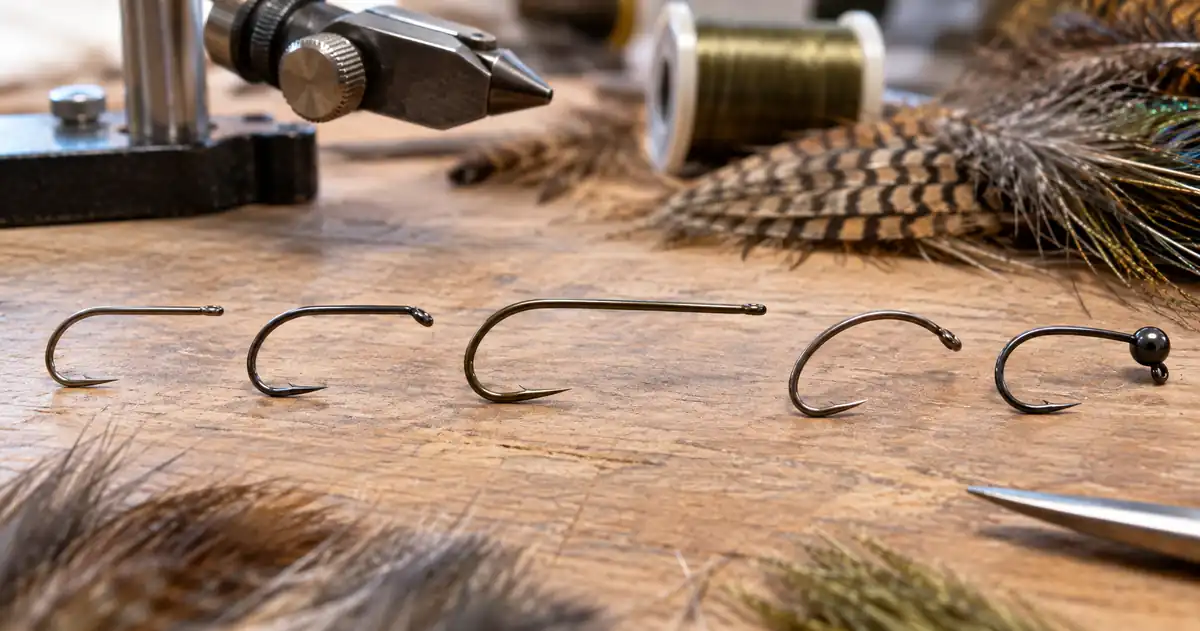
A hook should fit the fly you are building. That means considering its bend, wire weight, shank length, gap, eye, size, and barb—not just whether the package says #12 or #16.
Use this order:
Pattern → Shape → Wire → Shank → Size → Barb
A #14 dry-fly hook and a #14 curved nymph hook may create very different flies even though the size number is the same.
Table of Contents
Fly Tying Hook Anatomy in Plain English
Before comparing hook models, learn the basic parts.
Eye
The eye is where the leader or tippet connects to the finished fly.
Common configurations include:
- Down eye
- Straight eye
- Up eye
The eye orientation can also affect how a bead fits on some hook styles.
Shank
The shank is the main section where most of the fly body is tied.
It may be:
- Standard length
- Extra long
- Extra short
- Straight
- Curved
Shank length strongly affects the proportions of the finished fly.
Bend
The bend is the curved section connecting the shank to the lower part of the hook.
Different hook families may use:
- Round bends
- Sproat-style bends
- Curved emerger/scud profiles
- Jig-style bends
Gap
The gap is the open distance between the hook shank and point.
A bulky fly can effectively reduce that opening if too much material fills the gap.
Point
The point penetrates the fish.
It should remain unobstructed when you finish the fly.
Barb
A traditional hook may have a barb behind the point.
Barbless models omit it, and some waters require barbless hooks.
Always check the rules for the water you intend to fish.
How Fly Tying Hook Sizes Work
Hook sizing can look backward at first.
Standard Numbered Sizes
Within normal numbered hook sizes:
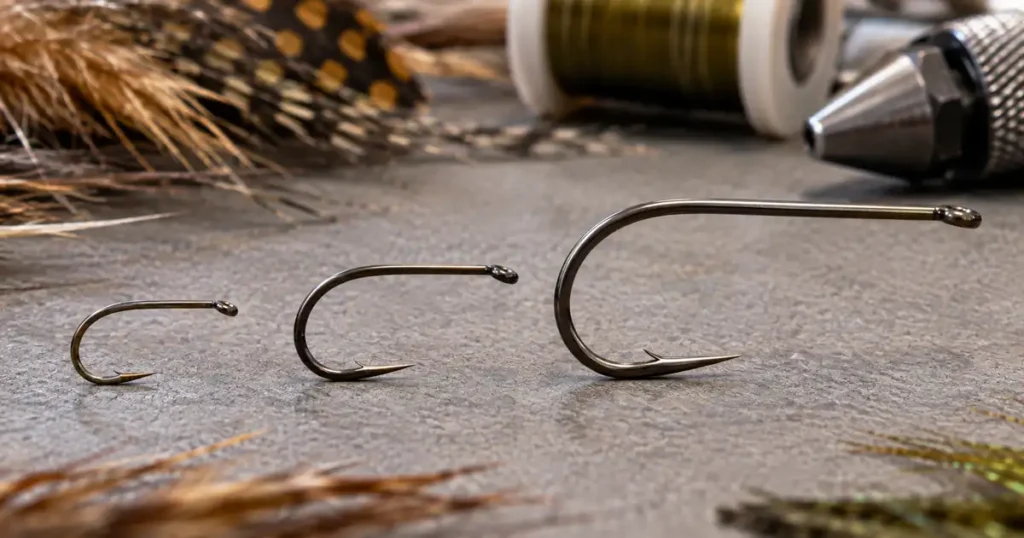
The larger the number, the smaller the hook.
For example:
- #8 is larger than #12
- #12 is larger than #16
- #18 is smaller than #14
That basic convention is useful, but it does not mean every #14 from every manufacturer has identical dimensions.
Aught Sizes
Once you move into larger hooks, you may encounter:
- 1/0
- 2/0
- 3/0
- 4/0
In aught sizing, the pattern reverses:
The larger the number before /0, the larger the hook.
So 3/0 is larger than 1/0.
These sizes are more common in large streamers, saltwater flies, bass flies, and predator patterns than in ordinary trout dries and nymphs.
Why a Size 14 Is Not Identical Across Every Brand
Fly-hook sizing is not precise enough to assume that any two hooks with the same number have exactly the same:
- Shank
- Gap
- Bend
- Wire
- Overall profile
Compare the actual hook model rather than purchasing only by number.
Match the Hook to the Fly Type
If you are still learning how dry flies, nymphs, wet flies, and streamers differ, start with our guide to the main types of fly fishing flies.
Then choose the hook that supports the pattern you plan to tie.
Dry Fly Hooks
Dry flies generally benefit from lighter hook construction when flotation matters.
Common characteristics include:
- Fine wire
- Standard shank
- Down or straight eye
- Enough gap for the pattern
The Tiemco TMC100 is a useful current example.
Umpqua currently specifies it as:
- Dry-fly hook
- 1X fine
- Down eye
- Wide gape
- Forged bronze construction
- Available across a broad dry-fly size range
The point is not that every dry fly must use a TMC100.
It shows what a standard dry-fly specification looks like.
Nymph Hooks
Nymphs can require heavier or differently shaped hooks because they are usually fished below the surface.
Depending on the pattern, you may use:
- Standard nymph hook
- Longer shank
- Curved hook
- Jig hook
- Heavy wire
The current Tiemco TMC3761 illustrates a classic wet-fly/nymph configuration.
Its current specifications include:
- 1X-long shank
- 2X-heavy wire
- Sproat bend
- Down eye
That longer/heavier format suits different patterns than a fine-wire dry-fly hook.
Streamer Hooks
Streamers often need a longer profile.
Common characteristics can include:
- Longer shank
- Heavier wire
- Larger sizes
- Enough gap for bulky bodies
The current Tiemco TMC5262 is a good example.
It is currently specified as:
- Nymph/streamer hook
- 2X long
- 2X heavy
- Down eye
- Perfect bend
Again, use it as a specification example rather than a universal streamer answer.
Wet Fly and Emerger Hooks
Traditional wet flies can use standard or slightly heavier hooks.
Emergers may benefit from curved designs that help create the profile of an insect transitioning toward the surface.
Do not buy curved hooks simply because they look specialized.
Use them when the pattern calls for that shape.
Jig Hooks
Jig hooks are widely used for modern nymph patterns.
Their angled eye arrangement works with specialized bead configurations and can change how the fly rides.
If a pattern specifies a jig hook and slotted bead, check compatibility rather than forcing an ordinary countersunk bead onto the wrong hook.
What X-Long, X-Short, X-Fine, and X-Heavy Mean
Hook packaging often uses X designations.
They describe how a hook differs from a reference hook within that maker’s sizing system.
X-Long
A hook marked:
- 1X long
- 2X long
- 3X long
has a progressively longer shank relative to the normal reference.
This is useful for:
- Streamers
- Extended nymph bodies
- Stonefly-style patterns
- Other elongated flies
X-Short
A short shank can help create compact bodies while retaining a useful gap.
X-Fine
Finer wire reduces hook mass.
That can be useful for dry flies where unnecessary hook weight works against flotation.
X-Heavy
Heavier wire can:
- Increase strength
- Add weight
- Suit subsurface patterns
Do not assume “heavier is better.”
A heavy hook can be undesirable in a delicate dry fly.
Also remember that X designations can vary somewhat among manufacturers.
Hook Gap and Bend
The hook gap needs to remain functional after the fly is finished.
Imagine tying a very bulky body on a hook with a narrow gap.
The finished materials can occupy part of the available opening.
That is why hook shape matters before you start tying.
A wide-gap dry-fly hook, curved nymph hook, and long streamer hook can all be the same nominal number and still create completely different proportions.
Barbed vs. Barbless Fly Tying Hooks
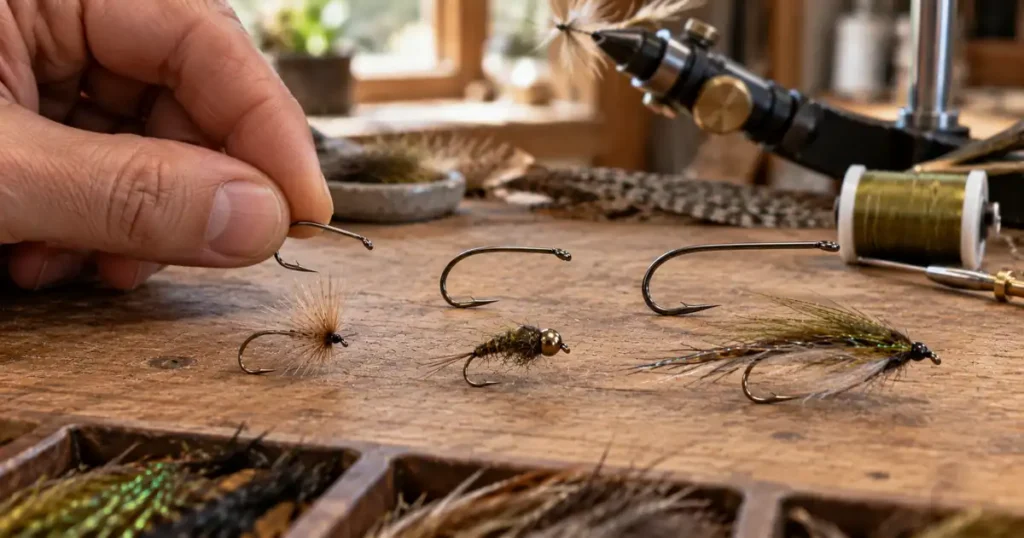
There is no universal answer that makes one correct for every angler.
Barbed Hooks
Traditional barbed hooks can be used where regulations allow them.
Barbless Hooks
Barbless hooks can:
- Make hook removal easier
- Be required on particular waters
- Be preferred by catch-and-release anglers
Some anglers also pinch down the barb on a barbed hook.
If you do this, inspect the point afterward.
Most importantly, check current local fishing regulations before selecting the hook.
How to Choose Hook Size for a Pattern
Do not start by asking:
“What hook size should I buy?”
Start by asking:
“What fly am I trying to tie?”
Then work through this process.
1. Identify the Hook Family
Is the pattern a:
- Dry fly
- Nymph
- Emerger
- Wet fly
- Streamer
- Jig fly
2. Check the Required Shape
Does the fly need:
- Straight shank
- Curved shank
- Long shank
- Jig profile
- Wide gap
3. Check Wire Weight
Will the pattern float?
Does it need to sink?
Will a bead provide most of the weight?
4. Check Shank Length
A longer body may need a longer-shank hook without dramatically increasing the hook gap.
5. Choose the Size
Now select the approximate overall fly size.
6. Confirm Materials and Beads Fit
Before tying a dozen flies, assemble one.
Make sure:
- Bead passes around the hook bend when required
- Bead sits correctly at the eye
- Materials do not crowd the gap
- Finished proportions look right
That one test fly can prevent an entire batch from being tied on unsuitable hooks.
A Simple Beginner Hook Box
A beginner does not need twenty hook models.
Start with a few useful families.
Standard Dry-Fly Hook
Useful for:
- Adams-style flies
- Caddis dries
- Attractors
- Basic mayfly patterns
General Nymph/Wet Hook
Useful for:
- Pheasant Tails
- Hare’s Ears
- Soft hackles
- Many classic nymphs
Longer Nymph/Streamer Hook
Useful for:
- Woolly Buggers
- Longer nymph bodies
- Small streamers
Add Specialty Hooks Later
Add:
- Curved emergers
- Jig hooks
- Barbless specialty hooks
- Large streamers
- Saltwater hooks
only as your patterns require them.
Current Hook Examples
| Hook | Typical Use | Wire | Shank |
|---|---|---|---|
| TMC100 | Dry flies | 1X fine | Standard |
| TMC3761 | Nymphs/wet flies | 2X heavy | 1X long |
| TMC5262 | Nymphs/streamers | 2X heavy | 2X long |
These examples show why the size number is only part of the decision.
Common Hook Buying Mistakes
Buying Only by Size Number
A #14 alone does not tell you enough.
Ignoring Shank Length
A long-shank #14 can create a much longer body than a standard #14.
Using Fine Wire for Every Fly
Fine wire has a purpose, but heavy subsurface patterns may require different construction.
Buying Specialty Hooks Too Early
You do not need curved, jig, predator, and saltwater hooks before you tie patterns that use them.
Assuming Brands Size Hooks Identically
Compare the exact model.
Ignoring Barbless Rules
The water you fish can dictate the hook choice.
Buying Beads Without Testing Them on the Hook
Eye shape, wire diameter, bead hole, and bend can all affect fit.
Quick Hook Selection Checklist
Before buying, ask:
- What pattern am I tying?
- What hook family does it use?
- Do I need straight, curved, jig, or long-shank?
- Should the wire be fine or heavy?
- What size/profile should the finished fly have?
- Is the gap large enough after materials are added?
- Does the bead fit if one is used?
- Do I need barbless?
- Does the manufacturer actually make the model in that size?
- Do I need 25 hooks or a larger bulk pack?
FAQs
What Hook Size Is Best for Fly Tying?
There is no single best size. The correct hook depends on the fly pattern, target species, material proportions, and intended presentation.
Why Do Fly Hook Sizes Get Smaller as the Number Goes Up?
Standard hook sizing uses an inverse numbering convention. For example, #18 is smaller than #12. Once hooks move into aught sizes such as 1/0 and 3/0, the larger aught number indicates the larger hook.
What Is the Difference Between Dry Fly and Nymph Hooks?
Dry-fly hooks often use finer wire to reduce weight. Nymph hooks can use heavier wire, curved shapes, longer shanks, or jig configurations depending on the pattern.
What Does 2X Long Mean on a Fly Hook?
It means the shank is longer than the manufacturer’s standard reference for that hook size. The exact relationship can vary somewhat between brands and hook families.
Are Barbless Fly Tying Hooks Better?
Not universally. They can make removal easier and may be required by local regulations. Choose according to the fishing situation and rules.
Final Takeaway
The easiest way to choose fly tying hooks is:
Pattern → Shape → Wire → Shank → Size → Barb
Start with what you are tying. Then choose the hook construction that gives the finished fly the correct proportions and function.
Once you use that process, hook labels become much easier to understand—and you stop buying hooks based on one number alone.
Sources Used
- Dakota Angler & Outfitter — Fly Tying Hook Reference Guide — hook anatomy, size-number convention, X designations, and manufacturer variation.
Dakota Angler — Fly Tying Hook Reference Guide - Umpqua Feather Merchants / Tiemco — TMC100 — current dry-fly hook specifications and size range.
Umpqua — TMC100 - Umpqua Feather Merchants / Tiemco — TMC3761 — current nymph/wet-fly specifications.
Umpqua — TMC3761 - Umpqua Feather Merchants / Tiemco — TMC5262 — current nymph/streamer specifications, pack sizes, and available hook sizes.
Umpqua — TMC5262 - Fly Tying Hooks