
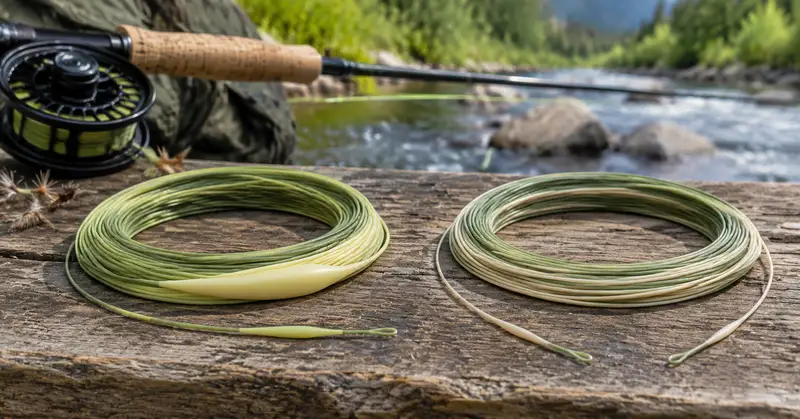
Fly Fishing Line: How to Choose the Right Type and Weight
Choosing fly fishing line gets much easier when you break the decision into four parts:
Rod → Depth → Taper → Conditions
For many beginners using a general-purpose 5-weight freshwater rod, the simplest starting point is a 5-weight, weight-forward floating line, usually written as WF5F.
Start by matching the line weight to your rod. Then decide whether the line needs to float or sink, choose a taper that suits your fishing, and check whether the line is designed for the water temperature and conditions you normally fish.
You do not need the most expensive or specialized line available. You need a line that fits the job.
Table of Contents
What Does Fly Fishing Line Actually Do?
Fly line is one of the main things that makes fly fishing different from conventional fishing.
With spinning tackle, the lure or sinker provides much of the weight used to make the cast. Many artificial flies weigh very little, so in fly fishing, the line itself provides much of the mass needed to load the rod and carry the leader and fly forward.
A typical setup runs:
Backing → Fly Line → Leader → Tippet → Fly
The reel stores the backing and fly line, but the line is doing much of the work during the cast.
If you are still putting your complete setup together, our guide to choosing the right fly fishing reel explains reel sizes, line compatibility, and backing capacity.
Fly Fishing Line Weight: Match the Rod First
Fly rods and lines are commonly classified by numbered weights such as:
- 3-weight
- 4-weight
- 5-weight
- 6-weight
- 8-weight
The easiest beginner rule is:
Match the fly-line number to the rod’s rated weight unless the rod or line manufacturer gives you a specific reason not to.
A 5-weight rod normally starts with a 5-weight line.
A 6-weight rod normally starts with a 6-weight line.
Fly fishing line weight is not breaking strength. A 5-weight line does not mean the line breaks at five pounds. The number describes the line class the rod is designed to cast.
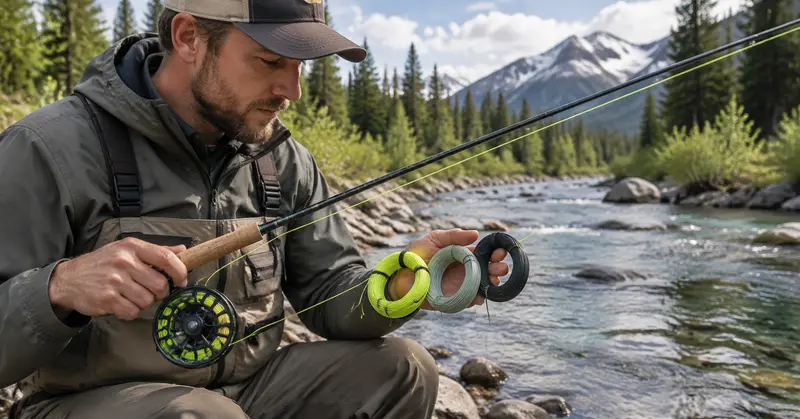
Fly Line Weight Chart
This chart is a practical starting point, not a strict species rule.
| Fly Line Weight | Common Starting Uses | Main Consideration |
|---|---|---|
| 2–3 weight | Small streams, small flies, delicate presentations | Limited with large flies and wind |
| 4 weight | Lighter trout fishing, dries, smaller water | Less power for bulky rigs |
| 5 weight | General trout and versatile freshwater fishing | Excellent starting point, but not universal |
| 6 weight | Larger flies, heavier nymph rigs, stronger wind | More power with some loss of delicacy |
| 7–8 weight | Bass, larger streamers, stronger fish, heavier applications | More line than most light trout fishing needs |
| 9 weight and up | Larger species and specialized applications | Usually unnecessary for ordinary trout fishing |
Do not choose weight from fish size alone.
You should also consider:
- Fly size
- Rig weight
- Wind resistance
- Water type
- Casting distance
- Rod design
- Technique
A trout angler fishing tiny dry flies on a creek may want a different setup from someone throwing weighted streamers for trout on a large river.
Why Some Lines Are Heavier Than Their Label Suggests
This is where fly-line shopping can become confusing.
Two lines labeled 5-weight do not necessarily distribute their mass in exactly the same way.
Some manufacturers intentionally make certain tapers slightly heavier than the nominal line class.
For example, the current Scientific Anglers Frequency MPX is described by the manufacturer as half-size heavy.
That additional mass is part of the line’s design. It does not mean you should automatically buy an even heavier line.
A safer process is:
- Match the line number to the rod first.
- Check the exact line’s specifications.
- Look for terms such as true-to-weight, quarter-size heavy, or half-size heavy.
- Consider what problem the heavier design is intended to solve.
Do not automatically “overline” your rod just because you heard that a heavier line is easier to cast.
How to Read a Fly Line Label
Once you understand the abbreviations, labels become much easier.
Take:
WF5F
It means:
- WF = Weight Forward
- 5 = 5-weight
- F = Floating
Another example:
DT5F
means:
- DT = Double Taper
- 5 = 5-weight
- F = Floating
You may also see abbreviations for intermediate, sink-tip, or multi-density lines.
Manufacturers do not always label every specialty line exactly the same way, so check the product specifications whenever the code is unclear.
For a typical beginner with a 5-weight freshwater rod, WF5F is a very logical place to start.
Floating, Intermediate, Sink-Tip, or Full-Sinking?
Once you know the weight, decide where the line needs to sit in the water column.
| Line Type | Where It Generally Sits | Common Role |
|---|---|---|
| Floating | Surface | Dries, many nymph rigs, general river fishing |
| Intermediate | Slowly below surface | Shallow subsurface and stillwater fishing |
| Sink tip | Front section sinks | Streamers and targeted subsurface fishing |
| Full sinking | Most or all of line sinks | Deeper water and specialized subsurface fishing |
Floating Fly Line
For many beginners, floating fly line is the most useful first line.
It works with:
- Dry flies
- Indicators
- Many nymph rigs
- Emergers
- Wet flies
- Smaller streamers
A floating line is also easier to see and manage while you learn casting, mending, and line control.
One important misconception is that you need a sinking line whenever your fly goes underwater.
You do not.
A floating line can fish nymphs and other subsurface patterns using:
- Weighted flies
- Split shot where appropriate
- Longer leaders
- Indicators
- Sinking leader systems
That versatility is one reason floating line makes sense as a first purchase.
Intermediate Fly Line
Intermediate lines sink slowly beneath the surface.
They can be useful when you want a fly to stay just under the surface instead of floating or dropping quickly toward deeper water.
Common applications can include:
- Stillwater fishing
- Shallow subsurface presentations
- Certain saltwater situations
For most stream-focused beginners, an intermediate line is a specialty purchase rather than an essential first line.
Sink-Tip Fly Line
A sink-tip line has a sinking front section while the main body remains floating or stays higher in the water.
This creates a useful middle ground.
You can get the fly deeper without having the entire line sink.
Sink-tip lines can be especially useful for:
- Streamers
- River fishing
- Working flies below the surface
- Situations where easier line pickup still matters
Different sink tips can also have different sink rates, so do not treat every sink-tip line as interchangeable.
Full-Sinking Fly Line
A full-sinking line is designed to get much more of the line below the surface.
It can make sense when fishing:
- Deeper lakes
- Stillwater
- Deeper streamer presentations
- Specific subsurface techniques
With sinking lines, sink rate becomes an important specification.
A line designed to sink slowly behaves very differently from one intended to reach depth quickly.
For a beginner fishing general trout rivers, a full-sinking line is usually something to add because a specific fishing situation requires it—not something you need automatically.
Weight Forward vs. Double Taper Fly Line
After weight and density, the next major decision is taper.
For many freshwater beginners, that means understanding weight forward vs. double taper.
| Feature | Weight Forward | Double Taper |
|---|---|---|
| Mass distribution | More mass toward the front/head | Symmetrical taper from both ends |
| Beginner general use | Excellent default | More specialized |
| Shooting line | Usually better suited | Less focused on shooting |
| Presentation | Depends on specific taper | Often useful for presentation-focused fishing |
| Roll casting and line control | Depends on head design | Can work very well |
| Reversible | Usually no | Many DT lines can be reversed |
Why Weight Forward Is the Beginner Default
A weight forward fly line concentrates more of its casting mass toward the front of the line.
That makes WF lines highly versatile.
They are available for:
- Trout
- Bass
- Streamers
- Nymphing
- Saltwater
- Stillwater
- Small streams
- Larger rivers
However, “weight forward” does not describe one exact shape.
Two WF5F lines may have very different:
- Head lengths
- Front tapers
- Rear tapers
- Grain distribution
- Intended fly sizes
- Intended rod actions
So choosing WF is only the beginning.
When Double Taper Makes Sense
A double taper fly line has similar tapering at both ends with a longer central belly.
Double-taper lines can appeal to anglers who prioritize:
- Delicate presentations
- Smaller water
- Roll casting
- Line control
- Mending
- Traditional or slower casting styles
Another practical advantage is that many double-taper lines are reversible. When one end becomes worn, you may be able to reverse the line and use the other end.
The current Orvis Hydros Trout Double Taper is one example of a modern floating double-taper trout line.
For most first-time buyers, however, a weight-forward floating line remains the simpler all-around choice.
Match the Line to the Flies and Rigs You Cast
The fly line needs to cast more than itself.
It also needs to deliver:
- Leader
- Tippet
- Fly
- Indicators
- Split shot
- Multi-fly rigs when used
Dry Flies
For most dry-fly fishing, start with a floating line.
If delicate presentation becomes especially important, look more closely at the front taper rather than simply choosing a line with the most aggressive head.
Nymph Rigs
Many nymph rigs work well with a general floating line.
A typical indicator setup can be handled with a standard trout line, although heavier multi-fly rigs, large indicators, or added weight can be easier to turn over with a line designed with more mass toward the front.
Specialty nymph lines exist, but beginners should not assume they need one immediately.
Streamers
Small streamers can often be cast effectively on a general-purpose floating line.
As the flies become:
- Larger
- Heavier
- More wind-resistant
a more aggressive taper can become useful.
If getting the streamer deeper becomes the main goal, a sink-tip or sinking line may make more sense.
If you are still learning how dry flies, nymphs, streamers, and other patterns differ, see our guide to choosing the right fly fishing flies.
Freshwater, Saltwater, and Temperature Matter
Do not choose a line based only on weight and taper.
The environment matters too.
Fly-line coatings and cores can be designed for different temperatures.
A line intended for cool freshwater may become too soft in extreme tropical heat. A tropical saltwater line designed to remain relatively stiff in high temperatures may behave poorly in cold conditions.
When buying, check whether the manufacturer describes the line for:
- Coldwater
- Moderate climates
- Warmwater
- Tropical conditions
- Freshwater
- Saltwater
Saltwater lines may also be built around larger flies, stronger wind, different tapers, and particular species.
Do not assume that every 8-weight floating line is interchangeable simply because the number matches your rod.
How Fly Line Connects to Leader and Tippet
Fly line is not usually tied directly to the fly.
The system typically progresses:
Fly Line → Leader → Tippet → Fly
The leader gradually transitions from the much thicker fly line toward the finer material near the fly.
Tippet is the final section of that connection.
This matters when choosing a line because your full setup must work together.
A general trout line may need to turn over:
- A long leader and small dry
- An indicator and weighted nymph
- A short heavier leader and streamer
Those are different jobs.
For more detail on the final part of the system, read our guide to choosing the right fly fishing tippet.
What Should a Beginner Buy First?
For a general beginner focused on freshwater trout, use this process:
- Check your rod’s weight rating.
- Choose the matching fly-line weight.
- Start with a weight-forward taper.
- Choose a floating line.
- Make sure it is intended for your normal water temperature.
- Check whether the taper is true-to-weight or intentionally heavier.
- Avoid specialty designs unless they solve a specific problem.
For example:
9-foot 5-weight trout rod → 5-weight WF floating line
That is not the correct setup for every angler, but it is a practical reference point for general trout fishing.
You may want something different if you mainly fish:
- Tiny creeks
- Large streamers
- Heavy nymph rigs
- Stillwater
- Saltwater
- Tropical environments
- Specialty techniques
Current Fly Line Examples by Use Case
These are examples of different current line designs—not a universal best-to-worst ranking.
Scientific Anglers Air Cel WF — Simple General-Purpose Example
The Scientific Anglers Air Cel WF is a straightforward weight-forward floating line.
Scientific Anglers currently offers it in weights 4 through 9 and describes it for general freshwater fishing with dry flies, nymphs, and streamers.
Who it may suit: An angler who wants a basic floating weight-forward line without paying specifically for a highly specialized taper.
Main limitation: It does not offer the same specialized taper options found across more advanced product families.
RIO Mainstream Trout WF — General Trout Example
The RIO Mainstream Trout WF is a floating weight-forward trout line.
RIO currently positions the line primarily for dry flies and indicator fishing, with lighter streamer work as a secondary use.
Who it may suit: A beginner or recreational trout angler who wants a simple general-purpose trout line.
Main limitation: Anglers regularly throwing very large streamers or specialized rigs may eventually prefer a more purpose-built taper.
Orvis Hydros Trout — Longer-Head Trout Example
The Orvis Hydros Trout is another weight-forward floating line, but its design illustrates why not every WF trout line is the same.
The current product is offered in weights 3 through 8. Orvis lists a 45-foot head, 90-foot total length, a braided multifilament core for cold-to-moderate conditions, and welded loops at both ends.
Who it may suit: Trout anglers interested in a longer-head floating design for line control and general river fishing.
Main limitation: Someone wanting a shorter, more aggressive head for large flies or very short casting situations may prefer another taper.
Scientific Anglers Frequency MPX — Half-Size-Heavy Example
The Scientific Anglers Frequency MPX shows why reading product specifications matters.
Scientific Anglers describes the current line as:
- Weight forward
- Floating
- Half-size heavy
- Available in weights 3 through 8
The additional mass toward the front is intentional.
Who it may suit: Someone whose rod and casting application benefit from an easier-loading, more front-loaded design.
Main limitation: A beginner should not assume that “heavier” automatically means better. If your setup already loads easily, you may prefer a different profile.
Orvis Hydros Trout Double Taper — DT Example
The Orvis Hydros Trout Double Taper provides a current example of a traditional taper that still has practical uses.
Orvis currently offers it in DT3 through DT5. The line is floating, 90 feet long, and reversible.
Who it may suit: Anglers who prioritize presentation, line control, roll casting, and traditional trout applications.
Main limitation: A beginner wanting one highly versatile line for mixed casting situations may find weight forward more straightforward.
Common Fly Line Buying Mistakes
Buying Line Without Checking the Rod
Always check the rod’s rated line weight first.
Do not buy based on fish species alone.
Assuming Every 5-Weight Line Is the Same
A label such as 5-weight tells only part of the story.
Taper and actual mass distribution can differ significantly.
Automatically Overlining
Putting a heavier line on a rod can sometimes be useful, but it should solve a specific problem.
Remember that some lines are already intentionally heavy for their labeled class.
Buying Sinking Line Just Because You Fish Nymphs
Many nymphing situations work perfectly well with floating line.
Choose sinking line when the depth and presentation actually require it.
Assuming Floating Line Is Only for Dry Flies
Floating line can handle:
- Dries
- Nymphs
- Wet flies
- Indicators
- Some streamers
That versatility is why it is such a strong beginner option.
Ignoring Fly Size
A line that casts tiny dry flies beautifully may not be ideal for repeatedly turning over large, wind-resistant streamers.
Match the taper to the job.
Ignoring Water Temperature
A line designed for tropical heat and one designed for cold trout water can behave differently.
Check the intended environment.
Buying a Specialty Line Too Soon
Streamer lines, nymph lines, technical dry-fly lines, sink tips, and full-sinking lines all have legitimate purposes.
You do not need them all on day one.
Ignoring Reel Capacity
Make sure the reel can hold the intended fly line plus appropriate backing.
The reel manufacturer’s capacity guidance is useful here.
Quick Fly Line Buying Checklist
Before buying, ask:
- What weight is my fly rod?
- What line weight does the rod manufacturer recommend?
- Is the line true-to-weight or intentionally heavier?
- Do I need floating, intermediate, sink-tip, or full-sinking?
- If it sinks, what sink rate do I need?
- Do I want weight forward or double taper?
- What flies will I cast most often?
- How heavy are my typical rigs?
- Am I fishing freshwater or saltwater?
- Will I fish cold, moderate, warm, or tropical conditions?
- Does the line fit my reel’s capacity?
- Does a specialty feature solve a real problem for me?
If you can answer those questions, most of the confusing marketing language becomes much easier to evaluate.
FAQs
What Fly Fishing Line Should a Beginner Use?
For many beginners fishing general freshwater, start with a floating weight-forward line that matches the rod’s weight. For example, a 5-weight rod would usually start with a WF5F line. Specialized fishing may require a different taper or density.
What Does 5-Weight Fly Line Mean?
A 5-weight fly line belongs to the line class designed around a 5-weight fly rod. It does not refer to five-pound breaking strength or the physical weight of the entire spool of line.
Should Fly Line Weight Match Rod Weight?
Yes, matching the line number to the rod’s rated weight is the normal starting point. Some lines are intentionally designed slightly heavy within their labeled class, so check the manufacturer’s specifications before deciding to use a different nominal weight.
Is Floating or Sinking Fly Line Better?
Neither is universally better. Floating line is more versatile for many freshwater anglers, while sinking lines are useful when you need to maintain a deeper presentation. Choose according to fishing depth and technique.
Is Weight Forward Better Than Double Taper?
Weight forward is the simpler general-purpose choice for many beginners. Double taper can be useful for presentation-focused fishing, roll casting, line control, and certain small-stream or traditional applications.
Can You Put 6-Weight Line on a 5-Weight Rod?
Sometimes anglers deliberately use a heavier line to change how a rod loads, but it should not be the automatic beginner choice. Start with the rod manufacturer’s recommended weight and check whether the specific line is already intentionally overweighted.
Final Takeaway
Choosing fly fishing line comes down to four decisions:
Rod → Depth → Taper → Conditions
Match the line weight to the rod first. Then choose whether you need floating or sinking line, select a taper that fits the flies and presentations you use, and make sure the line is designed for your environment.
For many beginners fishing freshwater trout, a matching-weight, weight-forward floating line is the simplest and most versatile place to start.
After that, add specialized lines only when your fishing creates a specific need for them.
Sources Used
- Orvis — How Do I Choose a Fly Fishing Line? — general fly-line selection, rod/line weight matching, floating and sinking line guidance.
Orvis — How Do I Choose a Fly Fishing Line? - Orvis — Should I Use a Sink Tip or Full Sink Fly Line? — functional differences between sink-tip and full-sinking fly lines.
Orvis — Sink Tip vs. Full Sink Fly Line - Orvis — Which Fly Line Is Better for Trout: Double Taper or Weight Forward? — current educational guidance on WF and DT designs.
Orvis — Double Taper vs. Weight Forward - Scientific Anglers — Air Cel WF — current manufacturer specifications and intended general freshwater uses.
Scientific Anglers — Air Cel WF - Scientific Anglers — Frequency MPX — current manufacturer specifications, including its half-size-heavy weight-forward floating design.
Scientific Anglers — Frequency MPX - RIO / Far Bank — Mainstream Trout WF — current manufacturer specifications and stated trout applications.
RIO — Mainstream Trout WF - Orvis — Hydros Trout Fly Line — current manufacturer specifications including available line weights, head length, total length, core, and loops.
Orvis — Hydros Trout - Orvis — Hydros Trout Double Taper — current manufacturer specifications for the reversible double-taper trout line.
Orvis — Hydros Trout Double Taper