
Fly Fishing Tippet: What It Is, Sizes, and How to Choose
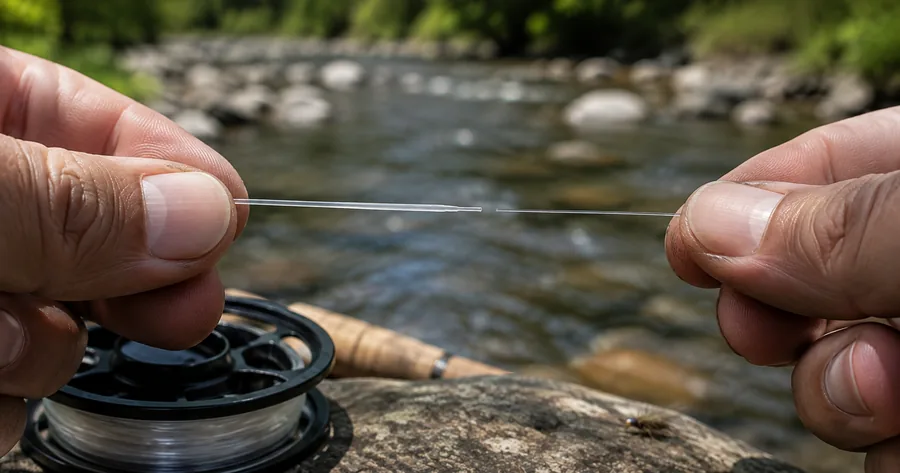
Fly fishing tippet is the thin terminal part of your leader system—the material closest to the fly. A new tapered leader already ends in a fine tippet section, while separate material sold on small spools lets you replace that section as it becomes shorter or change its diameter and material for different fishing situations.
For a beginner, choosing tippet becomes much easier once you understand three things: how the X sizing system works, how leader and tippet differ, and how the fly and fishing conditions affect the diameter you should use.
You do not need every X size or both materials before your first trip. A few appropriate sizes are usually a much better place to start.
Table of Contents
What Is Fly Fishing Tippet?
A basic terminal setup follows this order:
fly line → leader → tippet → fly
The leader is tapered. It begins relatively thick near the fly line and gradually becomes thinner toward the fly. The finest terminal portion is the tippet.
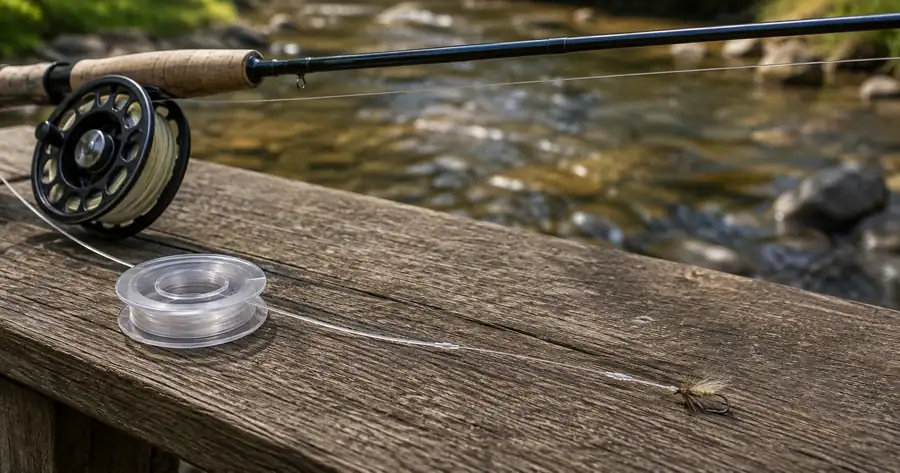
Separate spool tippet is different because it normally has a uniform diameter from one end to the other. You can use it to replace material lost through repeated fly changes, extend the terminal section, or change to another diameter or material.
Is Tippet Already Part of a New Leader?
Yes. This is an important distinction for beginners.
If you buy a knotless tapered leader marked 5X, its thin terminal end is already a 5X section. You can normally tie your fly directly to that end.
As you cut off flies and tie on new ones, the fine end becomes shorter. Eventually, you begin working farther into the thicker taper.
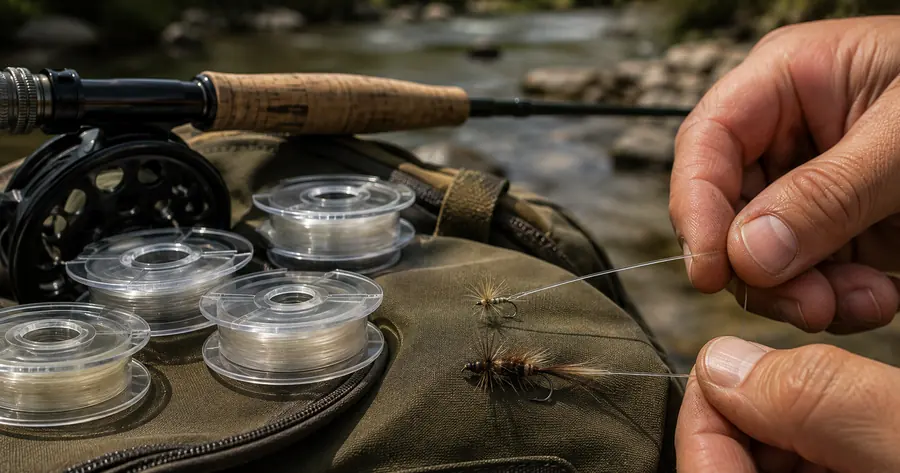
Adding fresh material from a spool allows you to restore that terminal section instead of replacing the entire leader every time it gets shorter.
Fly Fishing Tippet vs. Leader: What’s the Difference?
Leader and tippet work together, but they perform different jobs.
| Feature | Leader | Tippet |
|---|---|---|
| Position | Between fly line and terminal section | Closest to the fly |
| Construction | Tapered | Level, uniform diameter |
| Main purpose | Transfer casting energy through a gradual taper | Provide the final connection to the fly |
| Replacement | Less frequent | More frequent |
| Common sizing | Length plus terminal X size | X size or diameter |
A tapered leader creates a gradual transition from thick fly line to fine terminal material. That taper helps transfer energy during the cast while allowing the fly to land with a more appropriate presentation.
Tippet gives you a replaceable final section.
How Fly Fishing Tippet and Leader Work Together
Think of the leader as a gradual narrowing system.
The butt section near the fly line is the thickest. The middle becomes progressively finer. The final section is the smallest diameter.
Every time you remove a fly, you lose a little material. After enough changes, the remaining leader becomes shorter and thicker at the end.
Adding replacement tippet helps preserve the useful taper and gives you the terminal diameter needed for the fly you want to use.
How Fly Fishing Tippet Sizes Work
Tippet is commonly marked with an X rating, such as 2X, 4X, 5X, or 6X.
The basic rule is simple:
Higher X number = thinner diameter.
For example:
- 3X is thicker than 5X.
- 4X is thicker than 6X.
- 6X is finer than 4X.
The numbering can feel backward at first, but it becomes easier when you remember that the X rating describes diameter rather than a universal strength rating.
What Does the X Rating Mean for Fly Fishing Tippet?
A traditional way to understand the system is the Rule of 11.
Subtract the X number from 11 to estimate the nominal diameter in thousandths of an inch.
For example:
11 − 5 = 6
So 5X corresponds to a nominal diameter of 0.006 inch.
The same pattern continues across the standard range.
Fly Fishing Tippet Size Chart
| X Size | Nominal Diameter | Relative Size |
| 0X | .011 in | Thick |
| 1X | .010 in | |
| 2X | .009 in | |
| 3X | .008 in | |
| 4X | .007 in | |
| 5X | .006 in | |
| 6X | .005 in | |
| 7X | .004 in | |
| 8X | .003 in | Very fine |
This chart is useful for understanding diameter, but it should not be treated as a universal strength chart.
Fly Fishing Tippet Size vs. Pound-Test
X size and pound-test are not the same thing.
An X rating mainly describes nominal diameter. Breaking strength can vary according to material, manufacturing process, and specific product.
That means two spools marked 5X can have the same nominal diameter class while carrying different stated breaking strengths.
When actual strength matters, check the current specifications on the spool or manufacturer information rather than relying on a generic X-to-pound conversion table.
How to Choose Fly Fishing Tippet
The easiest selection method is to start with the fly and then adjust for the actual fishing situation.
Step 1: Start With the Fly
Fly size gives you an initial idea of the terminal diameter you may need.
A small dry fly usually does not require the same material as a large, wind-resistant terrestrial or a weighted streamer.
Hook size matters, but so do:
- Fly weight
- Bulk
- Air resistance
- Desired movement
- Presentation style
Two patterns with the same hook size can require different choices if one is sparse and light while the other is bulky and difficult to turn over.
Step 2: Choose a Starting Fly Fishing Tippet Size
A commonly taught shortcut is to divide the fly size by roughly three to estimate a starting X rating.
For example:
| Fly Size | Rough Starting Point |
| Size 8 | About 3X |
| Size 12 | About 4X |
| Size 16 | About 5X |
| Size 18 | About 6X |
Treat this as a starting point rather than a strict rule.
A bulky size 12 fly may need heavier material than a sparse size 12 dry. A weighted pattern can also behave differently from an unweighted one on the same hook size.
Use the chart to get close, then consider the actual fly.
Step 3: Adjust for Fishing Conditions
Conditions can change the best choice even when the fly stays the same.
You may want heavier material when:
- The fly is bulky or heavy.
- Wind makes turnover difficult.
- You expect larger or stronger fish.
- The water is stained and an extremely fine presentation offers little benefit.
- Abrasion or structure is a concern.
You may consider finer material when:
- The water is very clear.
- Fish are especially cautious.
- You are using very small flies.
- Drag reduction is important.
- A delicate presentation matters more than extra turnover power.
Avoid automatically going finer whenever fishing becomes difficult. Sometimes changing the presentation, fly, position, or drift is more useful than reducing diameter.
Step 4: Use the Heaviest Practical Diameter That Presents Well
A useful beginner principle is to avoid using material that is finer than the situation requires.
A suitable diameter should:
- Turn the fly over effectively.
- Handle the expected fish.
- Reduce unnecessary break-offs.
- Be manageable when tying knots.
- Still provide the presentation you need.
The goal is balance.
Thinner is not automatically better, and heavier is not automatically safer if it prevents the fly from behaving naturally.
Nylon vs. Fluorocarbon Fly Fishing Tippet
Neither nylon nor fluorocarbon is universally better.
The better choice depends on how and where you plan to fish.
| Factor | Nylon | Fluorocarbon |
| Density | Less dense | Denser |
| Water behavior | Tends to remain higher in the water column | Tends to sink more readily |
| Flexibility | Often relatively supple | Often somewhat stiffer |
| Dry-fly use | Common choice | Can be used, but density may matter |
| Subsurface use | Fully usable | Common choice |
| Abrasion considerations | Product dependent | Often selected around abrasive structure |
| Typical cost | Usually lower | Usually higher |
These are general material tendencies. Individual products can differ.
When Nylon Tippet Makes Sense
Nylon is a versatile starting material for many beginners.
It can work well when:
- Fishing dry flies.
- Using general-purpose trout setups.
- You want relatively supple material.
- You want to keep costs lower.
- You do not need the additional density of fluorocarbon.
Nylon is not restricted to surface fishing. It can also be used successfully for nymphs and other subsurface techniques.
When Fluorocarbon Tippet Makes Sense
Fluorocarbon is denser than nylon and tends to sink more readily.
That can make it useful when:
- Fishing nymphs below the surface.
- Using streamers.
- Working around rocks or other abrasive structure.
- Additional sinking behavior is useful to the presentation.
Fluorocarbon should not be treated as an automatic upgrade.
It usually costs more, can feel different when tying, and its advantages may not matter in every situation.
Claims that fluorocarbon is completely “invisible” underwater should also be avoided. Visibility depends on more than one material property.
Can You Mix Nylon and Fluorocarbon Tippet?
Yes.
For example, you might use a nylon tapered leader and add a fluorocarbon terminal section for a subsurface presentation.
You do not need the entire system to be made from one material.
What matters is that the transition makes sense for the rig and that the connection between the materials is tied correctly and inspected before fishing.
How Much Fly Fishing Tippet Should You Add?
There is no single length that works for every rig.
The right amount depends on:
- How much of the original leader remains.
- Fly size.
- Fly weight.
- Leader design.
- Water depth.
- Presentation style.
- Whether you are extending the rig intentionally.
For a standard tapered leader, the goal is usually to maintain a useful fine terminal section without creating an unnecessarily long length of very fine material that becomes difficult to cast.
If repeated fly changes have left the end noticeably thicker than it was when the leader was new, adding fresh terminal material can restore the setup.
When Should You Replace Fly Fishing Tippet?
Inspect the terminal section regularly rather than waiting for it to fail.
Consider replacing it when:
- You see abrasion or nicks.
- The material near a knot looks damaged.
- A snag or break-off may have weakened it.
- Repeated fly changes have made it too short.
- You change to a fly requiring a different diameter.
- The current material no longer fits the presentation.
- The line has contacted rocks, branches, or other abrasive structure.
Run the material carefully between your fingers and inspect any suspicious area in good light.
Replacing a short damaged section is usually better than knowingly fishing with questionable material.
Common Fly Fishing Tippet Mistakes Beginners Make
Thinking Higher X Means Thicker
The scale works in the opposite direction.
Higher X means finer diameter.
Choosing Only by Pound-Test
Breaking strength matters, but diameter also affects turnover and presentation.
Use the X rating to understand diameter and check manufacturer information when specific strength matters.
Using One Size for Every Fly
A tiny dry fly and a bulky streamer require different considerations.
Start with the fly rather than choosing one X size for every situation.
Going Too Fine
Beginners sometimes assume finer material always produces better results.
It does not.
Using material that is unnecessarily thin can make handling more difficult and reduce your margin when fighting fish.
Ignoring Fly Weight and Bulk
Hook size is only one factor.
A bulky foam fly or weighted nymph can require more turnover power than a lighter pattern tied on a similar-sized hook.
Cutting Too Far Into the Leader
Every fly change removes material.
If you keep cutting without replacing the terminal section, you eventually reach a thicker portion of the taper.
Add fresh material when needed instead of continually shortening the leader.
Assuming Fluorocarbon Is Always Better
Fluorocarbon has useful properties, especially for many subsurface applications, but nylon remains a practical option in a wide range of situations.
Choose according to the presentation rather than assuming the more expensive material is automatically superior.
Assuming Every Spool With the Same X Rating Has the Same Strength
The X rating describes nominal diameter.
Check the actual product specification when breaking strength is important.
Ignoring Abrasion
Fine material can be damaged by rocks, wood, vegetation, or other structure.
Inspect it after snags or contact with abrasive surfaces.
A Simple Fly Fishing Tippet Selection Checklist
When you are unsure what to use, follow this process:
- Look at the fly. Consider hook size, bulk, and weight.
- Choose a reasonable starting X size.
- Check the leader. Avoid an extreme jump in diameter.
- Consider the conditions. Think about wind, clarity, current, and presentation.
- Consider the fish. Use enough material for the fish you reasonably expect.
- Choose nylon or fluorocarbon. Match the material to how you plan to fish.
- Check actual strength when necessary. Use the current manufacturer specification rather than assuming X size equals a fixed pound-test.
- Inspect the terminal section. Replace damaged material before casting.
This decision process is more useful than memorizing a large chart for every species and fly combination.
Frequently Asked Questions
What Does 5X Fly Fishing Tippet Mean?
5X refers to a nominal diameter of .006 inch in the traditional X sizing system.
It identifies diameter rather than one guaranteed breaking strength. Two 5X products can have different stated strengths depending on their material and construction.
Is 4X or 5X Tippet Thicker?
4X is thicker.
The nominal diameter of 4X is .007 inch, while 5X is .006 inch. As the X number increases, the diameter becomes finer.
Do You Need Tippet if Your Leader Already Has a Tippet Section?
Not necessarily when the leader is new.
A tapered leader already ends in a fine terminal section. Additional spool material becomes useful as that section gets shorter, becomes damaged, or needs to be changed for another fly or presentation.
Can You Tie a Fly Directly to a Tapered Leader?
Yes.
When you tie a fly directly to the fine end of a new tapered leader, you are effectively using its built-in tippet section.
As fly changes shorten that section, you can add replacement material instead of immediately replacing the entire leader.
What Fly Fishing Tippet Size Should a Beginner Carry?
There is no universal set for every angler, but trout anglers using common dry flies and nymphs often find mid-range sizes such as 4X, 5X, and 6X useful.
Larger or bulkier flies may require heavier material, while very small flies can require finer diameters.
Before buying several spools, look at the flies, fish, and water you expect to encounter most often.
Is Fluorocarbon Better Than Nylon?
No.
Fluorocarbon’s greater density can make it useful for many subsurface applications, while nylon is versatile, commonly used with surface presentations, and typically costs less.
Choose based on the job rather than assuming one material is superior in every situation.
Final Takeaway
Understanding fly fishing tippet is easier when you focus on the system rather than memorizing every possible size.
Remember that a tapered leader already has a fine terminal section, higher X numbers mean thinner diameters, and the fly should usually be your starting point when choosing a size.
Then adjust for wind, water, fish, and presentation before deciding between nylon and fluorocarbon.
A small selection of useful sizes that fits the fishing you actually do is more valuable than carrying every X rating available.
Sources Used — Not Part of the Article:
- Fly Fishers International — Fly Fishing Glossary
https://www.flyfishersinternational.org/Learn-About-Fly-Fishing/Fly-Fishing-Glossary - Orvis — Fly Fishing Leader & Tippet
https://www.orvis.com/fly-fishing/leader-tippet/leader-tippet - Orvis — Pro Tips: A Simple Approach to Leaders
https://news.orvis.com/fly-fishing/pro-tips-a-simple-approach-to-leaders - Orvis Learning Center — Tippet Chart
https://howtoflyfish.orvis.com/how-to-articles/tippet-chart/