
Euro Nymphing Flies: Best Patterns, Sizes, and Bead Weights
Buying euro nymphing flies gets easier once you stop asking which pattern is the most famous and start asking what the fly needs to do. A good selection should cover several depths and current speeds without filling a box with near-identical colors. This guide compares common patterns, explains hook sizes and tungsten bead weights, and shows how to build a practical starter box for trout.
The short version: start with slim Perdigons, natural-looking Frenchies or Jig Pheasant Tails, and one buggy pattern such as Walt’s Worm. Carry useful differences in weight and size before purchasing every color. The right fly is the one that reaches the feeding zone with a believable profile and controllable drift.
Table of Contents
Euro Nymphing Flies: Quick Picks by Water Condition
Use this comparison of euro nymphing flies as a starting point rather than a guarantee. Depth, current, insect activity, and fly construction all affect which option makes sense.
| Water or situation | Useful starting fly | Weight direction | Why consider it |
|---|---|---|---|
| Shallow, slower run | Small Frenchie or slim Perdigon | Light | Less disturbance and less bottom dragging |
| Moderate riffle | Frenchie or Jig Pheasant Tail | Medium | Useful mix of natural profile and sinking weight |
| Fast pocket water | Slim Perdigon | Medium to heavy | Compact body meets less water resistance |
| Deeper, strong run | Appropriately weighted Perdigon or jig nymph | Heavy enough to reach depth | Depth may matter more than a tiny color difference |
| Trout responding poorly to slim profiles | Walt’s Worm or lightly dubbed jig | Match the depth first | Adds a rougher, less streamlined silhouette |
| Stained water or an attractor opportunity | Hot-spot jig or Blowtorch-style nymph | Depends on depth | Adds a visible accent without changing the whole box |
There is no fixed bead size for an entire water category. A three-foot run with fast surface flow may demand a different fly from a three-foot run with gentle, even current. Test whether your fly gets down and stays controllable before changing patterns.
What Makes a Euro Nymph Different?
Euro nymphing is a close-contact approach to fishing subsurface flies. Many purpose-built euro nymphs use dense beads and compact bodies to help the angler reach a selected depth while keeping contact with the fly. But the method does not require one special hook or a branded pattern: conventional weighted nymphs can work, too.
Tungsten Beads and Concentrated Weight
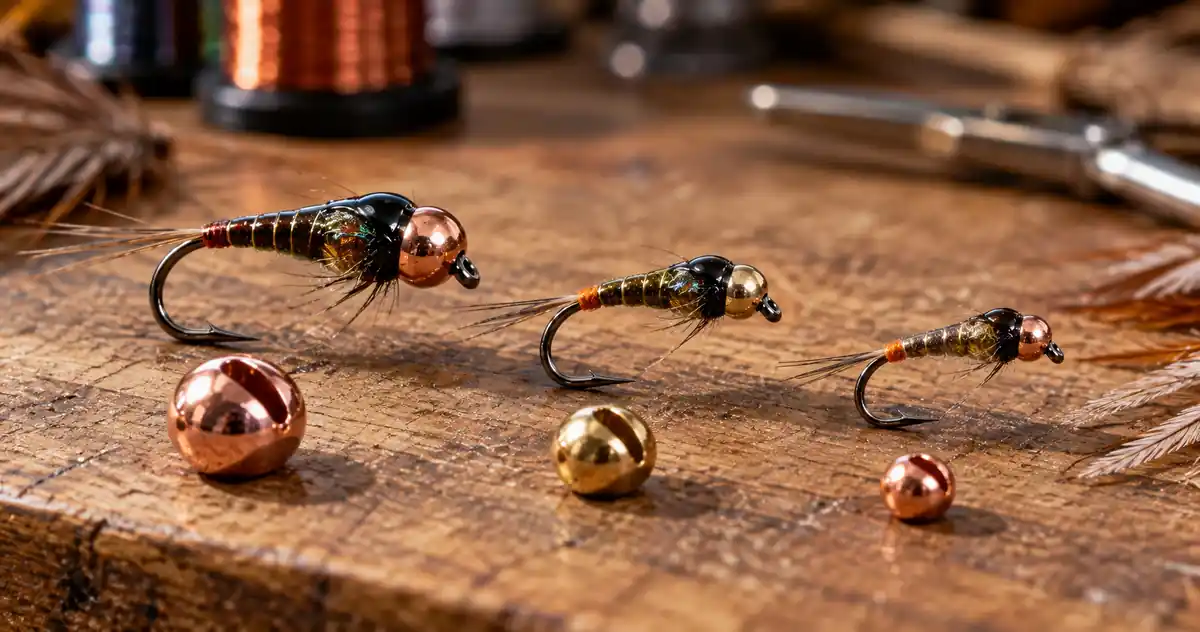
When choosing euro nymphing flies, remember that tungsten is denser than common brass bead material, so a compact tungsten head can add meaningful weight without making the entire fly bulky.
A heavier fly can reach depth sooner, but only when its profile, rig, current, and presentation allow it. Maximum weight is not always desirable; shallow water may call for a lighter landing and a slower descent.
Slim Versus Buggy Bodies
A resin-coated Perdigon usually offers a narrow, smooth shape. A dubbed nymph adds texture, but that texture can also create more resistance as the fly sinks.
This trade-off is useful: buy both a compact option and a rougher alternative instead of accumulating six nearly identical slim flies.
Jig Hooks Versus Standard Hooks
A jig hook has an angled eye or shank geometry designed for jig-style presentations, often paired with a slotted bead.
Such designs can encourage a point-up orientation when weighted and rigged appropriately, but they are not snag-proof and do not always ride identically.
Conventional hooks with suitable bead heads also remain legitimate options. Check hook gap, wire strength, eye clearance, and any local barbless-hook requirements before purchasing.
Best Euro Nymphing Flies: Perdigon, Frenchie, and Jig Patterns
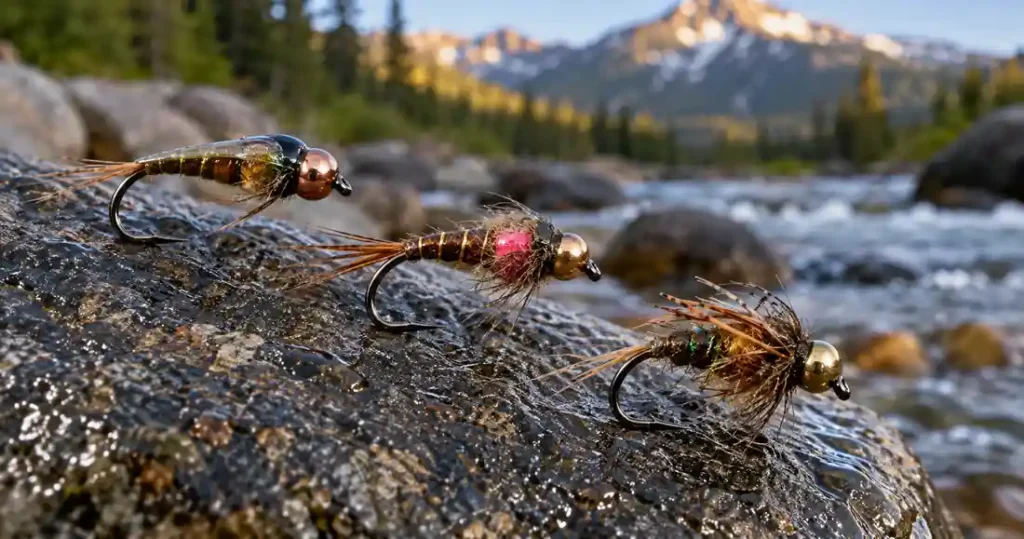
A useful buying list for euro nymphing flies starts with different jobs, not a contest over a universal winner. The following patterns cover several profiles without requiring a large collection.
Perdigon Nymphs: Compact Depth Control
Perdigons generally use a narrow body finished with resin or another smooth coating, plus a weighted bead on many modern versions.
That smooth profile makes them a sensible first choice when a fly must cut through current. Natural dark, olive, or brown versions offer restrained options; bright-bodied variations can serve as contrast.
Buy first if: You fish riffles, pocket water, or moderately deep runs and need a compact weighted fly.
Trade-off: A dense Perdigon may reach the bottom too quickly in very shallow water; its smooth body may also be a poor match when fish respond to a fuzzier silhouette. A heavier bead is not automatically an upgrade.
Frenchie Nymphs: Familiar Insect-Like Profile
A Frenchie commonly uses pheasant-tail fibers, fine ribbing, and a small colored hot spot near the head. Variations can be tied on conventional or jig hooks.
Umpqua’s Egan’s Frenchie Jig, for example, is listed in hook sizes 12, 14, 16, and 18; a specialty retailer describes that version as using a tungsten bead.
Buy first if: You want a versatile mayfly-like nymph with a subtle point of contrast.
Trade-off: A Frenchie with a bulky collar will not sink exactly like a slim Perdigon of comparable bead size. When comparing store listings, inspect the actual bead and body rather than assuming the pattern name fixes the weight.
Jig Pheasant Tails: A Straightforward Natural Option
A Jig Pheasant Tail adapts a recognizable mayfly-nymph profile to a jig-style hook. Some versions include a visible bead and thorax; others stay comparatively sparse.
It makes sense as a second natural-looking pattern when trout are taking small subsurface food and you want a different silhouette from a Frenchie.
Buy first if: You see mayfly nymphs or want a restrained, familiar pattern for ordinary trout runs.
Trade-off: Some heavily dressed versions lose the slim profile that helps a fly sink quickly. Hook sizes and beads vary by manufacturer, so compare the actual specifications.
Walt’s Worm: A Buggy Contrast
Despite the name, Walt’s Worm is commonly tied as a simple dubbed nymph rather than a precise worm imitation. Modern jig versions may use a tungsten bead.
A lightly fuzzy tan, cream, or brown variation gives the box a noticeably different shape from a hard-bodied Perdigon.
Buy first if: Your box contains only sleek flies and you want one general subsurface alternative.
Trade-off: Loose dubbing increases bulk and can slow descent relative to a similarly weighted streamlined fly. Some versions are quite heavily weighted, so the name alone tells you little about depth.
Blowtorch or Hot-Spot Jigs: Optional Contrast
A Blowtorch-style fly usually introduces bright thread, a tag, or another colored accent, sometimes combined with a modest soft-hackle collar.
Consider it when you want one higher-visibility attractor option for off-color water or experimentation.
Buy later if: Your basic natural and slim patterns already cover the depths you fish.
Trade-off: Bright accents do not guarantee more takes. A different bead weight or drift may be a better purchase than several new hot-spot colors.
What to Compare When Buying Actual Flies
Check the seller’s hook size, bead diameter, bead material, hook style, barb status, and number of flies included.
The Umpqua Egan’s Frenchie Jig is an identifiable manufactured example, while Orvis sells a Deluxe Euro Nymph Fly Assortment as a ready-made option.
Those listings establish that the products exist; they do not prove superiority, identical bead weights across sizes, or that a boxed assortment fits your home river. Current prices and availability can change.
A premade assortment saves selection time, but individually chosen flies may give you better control over weights. Compare the contents rather than assuming a larger box is automatically better value.
Euro Nymphing Flies by Hook Size and Profile
Hook sizes usually run backward: a size 18 hook is smaller than a size 12 within a comparable hook style.
Numbers are not a perfect physical standard across brands, and a long-shank hook may look larger than another maker’s hook with the same number.
| Common hook size | Practical interpretation | Starting use |
|---|---|---|
| 18 | Small nymph profile | Small food, clear water, lighter presentation |
| 16 | Small-to-medium nymph | Useful general trout option |
| 14 | Medium nymph | Flexible everyday profile |
| 12 | Larger nymph | More substantial food or heavier builds |
Smaller euro nymphing flies can be useful when trout feed on tiny insects. Larger sizes can represent bulkier food or accept some heavier bead-and-hook combinations.
Neither size guarantees depth: a heavily weighted size 16 fly may be denser than a lightly weighted size 12.
For a first order of euro nymphing flies, sizes 14 and 16 make practical comparison points on many trout streams.
Add size 18 only when local insects, conditions, or refusals suggest a smaller profile. Pick size 12 when bigger food, heavier construction, and hook compatibility actually justify it.
Remember the profile: A size 14 Perdigon and a size 14 shaggy Walt’s Worm may behave differently even with beads of the same diameter.
Look at body thickness, collar material, and total weight, not just the hook number.
Euro Nymphing Flies by Tungsten Bead Weight
Bead diameter is measured in millimeters; bead weight is measured in grams. They are related but not interchangeable.
A 3.0 mm bead from one maker can weigh differently from another company’s 3.0 mm bead because of the slot, drilled hole, alloy, and shape.
Added wire or other body weights also change the complete fly’s mass.
The following figures are manufacturer-published weights for Firehole Outdoors Stone slotted tungsten beads, not verified weights for every finished nymph or every brand. Firehole’s separate hook-fit guide supplies the approximate hook-size ranges.
| Slotted bead diameter | Firehole bead weight | Firehole’s general compatible hook sizes |
|---|---|---|
| 2.0 mm | 0.05 g | 18–22 |
| 2.5 mm | 0.11 g | 14–18 |
| 3.0 mm | 0.21 g | 12–16 |
| 3.5 mm | 0.33 g | 10–14 |
| 4.0 mm | 0.48 g | 8–12 |
These are manufacturer-specific pairing guidelines, not rules for every hook. The displayed weights describe an individual bead, not a completed fly.
Check whether the hook gap stays open and whether the bead seats correctly. Some specialty jig hooks are designed to take oversized beads, while others are not.
Choose Weight by the Problem You Need to Solve
Lighter euro nymphing flies help when your drift is short, shallow, or easily disturbed.
Medium weight is often a practical starting point in ordinary runs. Heavier designs make sense when the fly repeatedly fails to reach deeper or faster water.
The precise threshold varies with current, leader, fly profile, and casting position.
A useful buying tactic is to order a favorite pattern in two bead weights before adding multiple color variants.
You can then learn whether your problem is insufficient depth or an unsuitable pattern.
Do Not Confuse Bead Diameter With Sink Rate
Two flies with the same bead may descend differently because a Perdigon’s smooth body meets less resistance than a heavily dubbed collar.
The angle of the leader, current seams, and the time allowed for descent also matter.
There is no trustworthy universal “3.5 mm sinks X inches per second” rule for an entire river.
Orvis’s instructional lesson, How to Pick Flies for Euro Nymphing, demonstrates this weight-and-profile approach. It is useful viewing alongside this section; the original lesson is linked in References.
Match Euro Nymphing Flies to Depth and Current
When selecting euro nymphing flies, start with a simple sequence:
Depth → Current → Approximate food size → Body profile → Weight adjustment
Avoid treating color as your first correction every time.
Shallow or Slower Water
A smaller Frenchie or lightweight Perdigon can reduce the chance of repeatedly dragging the bottom.
Where trout are easily disturbed, a lighter fly and controlled entry may matter more than using maximum tungsten.
If fish are feeding higher in the column, a dense point fly can pass beneath them.
Moderate Riffles
Start with a size 14 or 16 natural-looking nymph in a moderate bead configuration that fits the hook.
If the fly never reaches the target depth, increase weight or allow more time to sink.
If the fly repeatedly hangs up, lighten it or change the presentation before replacing it with a new color.
Fast Pockets and Deeper Runs
A slim, appropriately weighted Perdigon often makes sense because its shape limits unnecessary drag.
A heavier jig pattern with a suitable hook gap is another option.
But depth alone does not justify endless additional weight: an unmanageable drift or repeated snagging is feedback that the selection or approach needs adjustment.
When the Fish Seem Selective
If depth and drift appear reasonable yet the pattern is refused, compare available insects and switch the size or body profile.
Move from a shiny slim body to a subdued Frenchie, for example, or from a sparse nymph to a buggy Walt’s Worm.
Try one meaningful change at a time.
The broader principles of matching subsurface food and feeding depth also apply beyond Euro-specific flies. FlyFishingScout’s guide to brown trout fly selection discusses those choices across dry flies, nymphs, and streamers.
Build a Compact Box of Euro Nymphing Flies
You do not need an enormous assortment of euro nymphing flies to begin.
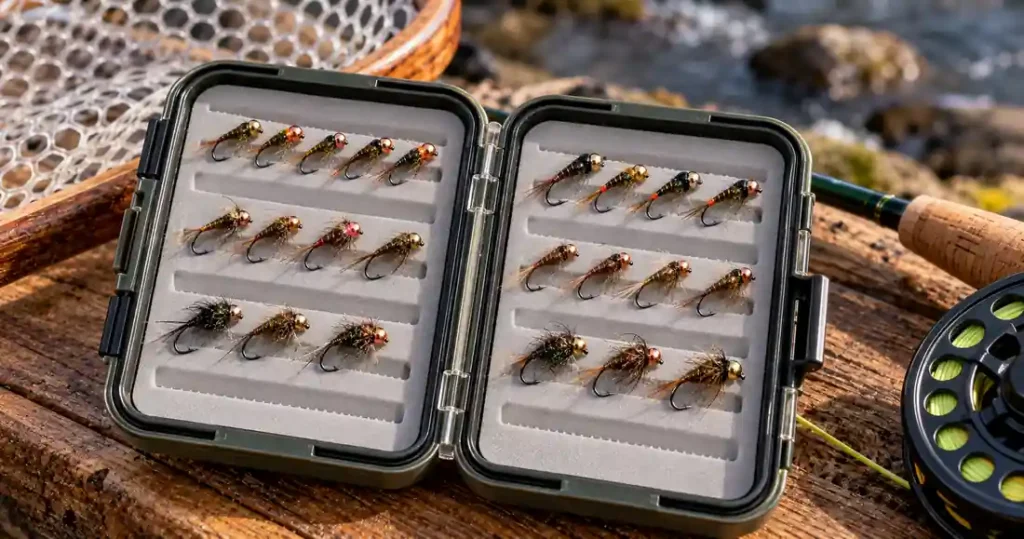
A suggested 18-fly example gives you five practical styles, repeat flies for break-offs, and distinct weights.
It is an illustrative shopping plan, not a claim that all manufacturers sell the exact same hook-and-bead combinations.
| Pattern group | Example starting purchase | Quantity |
|---|---|---|
| Slim Perdigons | Size 16 light, size 16 medium, size 14 heavier; two of each | 6 |
| Frenchies | Size 16 lighter and size 14 medium; two of each | 4 |
| Jig Pheasant Tails | Size 16 lighter and size 14 medium; two of each | 4 |
| Walt’s Worm | Size 14 medium, natural dubbed body | 2 |
| Hot-spot jig | Size 14 medium, one contrasting accent | 2 |
| Total | Five styles with weight and size variation | 18 |
“Light,” “medium,” and “heavier” describe relative choices within a compatible hook-and-fly family, not universal gram thresholds.
Use the manufacturer’s actual bead information when you select products.
Why Duplicates Matter More Than Extra Colors
Two copies of a fly you trust give you a replacement when a snag or damaged hook ends a drift.
A second bead weight changes the useful fishing depth.
A fourth body color may add much less capability.
That makes duplicates and weight alternatives sensible early purchases.
Keep the Box Easy to Read
Arrange euro nymphing flies in rows by light, medium, and heavy weight, then group similar profiles together.
Where beads are hard to distinguish, keep a small reference note in your phone or use separate compartments.
Check that the box protects hooks and has enough depth for larger beads.
If you are sorting out the rest of your essential carrying tools, FlyFishingScout’s guide to fly fishing accessories explains when a simple box and basic tools are enough.
When a Ready-Made Assortment Makes Sense
A curated assortment of euro nymphing flies can suit an angler who needs a quick starting selection.
But read the listing carefully: an attractive collection may emphasize pattern variety while offering few useful differences in bead weight.
Compare the price with buying targeted two-packs or individual flies, and check whether the stated contents are current.
Do not buy a premium collection merely for the number of patterns on the package.
Shopping Mistakes and FAQs
A good collection of euro nymphing flies should solve water problems rather than create more decisions.
These are common avoidable mistakes:
- Buying ten colors in one weight. Start with two or three useful weight classes before expanding colors.
- Treating hook size and bead size as the same measurement. One describes the hook; the other describes the bead’s diameter.
- Assuming all jig hooks are snag-proof. Weight distribution, hook geometry, and drift affect how a fly travels.
- Oversizing beads indiscriminately. A bead that crowds the hook gap can interfere with function.
- Believing a store’s “best fly” label applies everywhere. Local insects and water conditions should guide the final choice.
- Ignoring local rules. Waters can differ on barbless hooks, legal fly definitions, weighted flies, and the number of hooks or flies permitted on a rig. Check current regulations for the exact water before fishing.
Which Euro Nymphing Flies Should a Beginner Buy First?
Begin with a small set of Perdigons and Frenchies or Jig Pheasant Tails in two compatible bead weights, then add one buggy option.
If your river is shallow, prioritize the lighter choices; if you fish deep pocket water, include an appropriately heavier fly.
Is a 3.0 mm Tungsten Bead a Good Starting Size?
It can be on a compatible mid-sized hook, but it is not a universal recommendation.
Firehole lists its 3.0 mm slotted Stone at 0.21 g and pairs that bead with approximately size 12–16 hooks.
Another maker’s bead or a different hook may require a different choice.
How Many Patterns Do You Really Need?
Three or four complementary patterns can teach you a great deal, especially if they come in sensible weights.
The example box above includes five styles for flexibility, not because five are mandatory.
Add new patterns only when they address a missing size, profile, or local feeding situation.
Are Heavier Euro Nymphing Flies Always Better in Fast Water?
No. More weight may help a fly descend through current, but can cause excessive bottom contact or make a short drift difficult to control.
Choose enough weight to reach the intended zone without making the presentation unmanageable.
Should I Buy Barbless Jig Nymphs?
Barbless hooks may be required in some fisheries and can simplify some hook removal.
But a barbless jig fly is not automatically legal everywhere, and jig geometry alone does not prevent snagging.
Check the exact local rules and choose the hook style appropriate to your presentation.
Final Thoughts on Euro Nymphing Flies
A useful set of euro nymphing flies is built around depth, profile, and realistic food size, not the longest pattern list.
Start with a slim Perdigon, a Frenchie or Jig Pheasant Tail, and a buggy alternative. Buy compatible variations in weight before collecting every color.
On your next trip, watch how the fly reaches the feeding zone and change one thing at a time. That simple habit will tell you which euro nymphing flies deserve a permanent place in your box—and which purchases can wait.
References
1. Orvis — How to Pick Flies for Euro Nymphing
2. Firehole Outdoors — The Stone Stack
3. Firehole Outdoors — Tungsten Bead Size Chart for Fly Tying
4. Firehole Outdoors — Oversizing Tungsten Beads for Euro Nymphing
5. Umpqua Feather Merchants — Frenchie Jig Egan’s
6. Fly Fish Food — Egan’s Jig Frenchie
7. Loren Williams Fly Tying Tutorials — Walt’s Worm
8. Fly Fish Food — Sexy Walt’s Worm
9. The Fly Bench — Blowtorch Nymph Fly Pattern
10. Orvis — Deluxe Euro Nymph Fly Assortment
11. California Department of Fish and Wildlife — 2026 Freshwater Sport Fishing Regulations