

Fly Fishing for Trout: A Beginner’s Guide to Flies and Techniques
Fly fishing for trout gets much easier when you stop searching for one perfect fly and start with a simple sequence: find likely trout water, decide where the fish are feeding in the water column, choose a fly category that matches that depth, and focus on presentation.
For a beginner, three main fly categories are enough to start: dry flies on the surface, nymphs below the surface, and streamers that imitate moving prey. You do not need dozens of patterns. You need to understand when each type makes sense and how to present it effectively.
This guide gives you a repeatable approach to fly fishing for trout so you can walk up to a river, read the water, make a sensible first choice, and adjust without changing flies at random.
Table of Contents
Fly Fishing for Trout: Quick Beginner Method
Use this simple order when fly fishing for trout:
Water → Trout position → Feeding depth → Fly type → Presentation → Adjustment
| What You See | Good Starting Approach |
|---|---|
| Trout repeatedly rising | Try a dry fly |
| No rises and likely subsurface feeding | Start with a nymph |
| You want to search water or imitate larger prey | Try a streamer |
| Good-looking water but no takes | Check depth, drag, and presentation before changing flies |
That last point matters.
Beginners often blame the fly first. Sometimes the pattern is perfectly reasonable, but it is drifting several feet above the trout, dragging unnaturally across the current, or missing the actual feeding lane.
A good fly presented badly is still a poor presentation.
Fly Fishing for Trout: Basic Setup
You do not need complicated equipment to begin fly fishing for trout. For many freshwater trout situations, a general-purpose 5-weight outfit with floating line, leader, tippet, and a small fly box is enough to learn the main techniques.
Rod and Reel
A 9-foot 5-weight is a common starting setup for general trout fishing because it can handle:
- dry flies;
- many nymph rigs;
- dry-dropper setups;
- smaller streamers.
It is not universal.
A shorter 3- or 4-weight may make more sense on tiny creeks. A 6-weight can be more useful when larger streamers, heavier rigs, bigger rivers, or strong wind are common.
The reel mainly stores line and backing in ordinary trout fishing. It should be sized for your line and balance the rod reasonably well.
For the complete first-trip setup rather than only trout technique, see FlyFishingScout’s fly fishing gear for beginners guide.
Floating Fly Line
A weight-forward floating line is a practical starting choice because it can handle several trout techniques without requiring constant line changes.
You can use it for:
- dry flies;
- indicator nymph rigs;
- dry-dropper rigs;
- many small-streamer presentations.
Specialty sinking and sink-tip lines become useful when the water or technique gives you a specific reason to use them.
FlyFishingScout’s guide to choosing the right fly fishing line explains fly-line weight, taper, and floating versus sinking lines in more detail.
Leader and Tippet
The leader transfers energy from the fly line toward the fly while creating a thinner connection near the fish.
Tippet forms the final section connected to the fly.
Choose leader and tippet based on:
- fly size;
- water clarity;
- fish size;
- cover;
- presentation.
Do not automatically choose the finest tippet available. Lighter material can improve delicate presentation, but it also provides less strength and abrasion resistance.
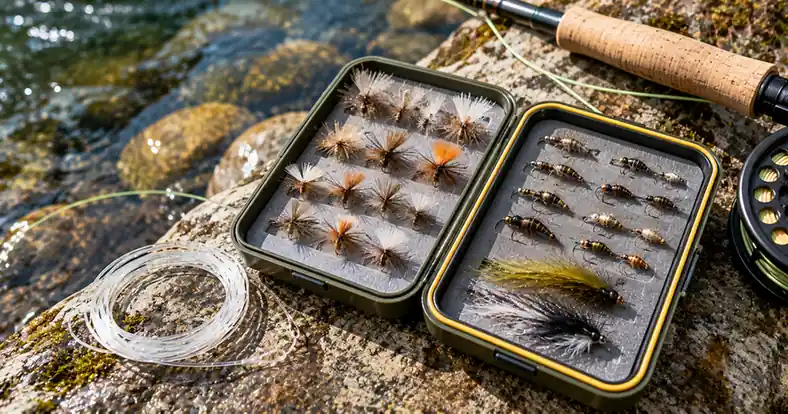
Small Fly Box
A beginner does not need fifty patterns for fly fishing for trout.
Start with a compact selection of locally useful:
- dry flies;
- nymphs;
- streamers.
Learn what each category does before buying dozens of variations.
Fly Fishing for Trout: How to Read the Water
Reading water is one of the most useful skills in fly fishing for trout because trout are not distributed evenly through a river.
A useful beginner formula is:
Food + manageable current + cover
Look for places where current brings food toward the fish without forcing it to spend excessive energy holding position.
Current Seams
A seam occurs where water moving at different speeds meets.
These edges can create useful feeding lanes. Food may drift along the boundary while trout hold in slightly slower water beside it.
Try to land the fly in or near the feeding lane without placing your fly line where faster current immediately drags the presentation away.
Riffles
Riffles are shallow, broken areas where water moves across rocks.
The broken surface can provide cover while current carries food downstream.
Do not assume every part of a riffle is equally productive. Look for:
- slower edges;
- depressions;
- deeper slots;
- transitions into runs;
- softer pockets around rocks.
Runs
Runs are generally smoother and deeper than riffles while still carrying useful current.
They often provide a good combination of depth, food delivery, and manageable flow.
Fish the near side first.
Then cover the center and far side. Starting immediately with your longest cast can put line over trout that were holding much closer.
Pools
Pools provide depth and cover, but trout do not always sit in the deepest center.
Pay attention to:
- the head where current enters;
- current seams along the sides;
- structure within the pool;
- the tail where water begins to accelerate.
Different parts of the same pool can hold feeding and resting fish.
Pocket Water
Pocket water forms around rocks and other current breaks.
Trout may hold:
- directly behind a boulder;
- along the softer edge;
- in the slower cushion immediately upstream;
- in a deeper slot between rocks.
These targets are often small. Short accurate presentations can be more useful than long casting.
Rocks, Logs, and Bank Cover
Boulders, roots, vegetation, submerged logs, and undercut banks can create protection and reduced current.
Approach carefully.
Some of the best trout water may be only a few feet from the bank. Walking directly to the edge before casting can spook the fish you were hoping to catch.
Fly Fishing for Trout With Dry Flies
Dry-fly fly fishing for trout is visually intuitive because the fly remains on the surface and you can often see the take.
When to Choose a Dry Fly
A dry fly is an obvious starting option when trout are repeatedly rising or insects are clearly active on the surface.
You can also prospect with a dry fly when conditions make surface feeding plausible even if no trout are visibly rising.
A lack of rises does not prove a dry fly cannot work. It simply gives you less evidence that surface feeding is currently important.
Watch Rising Fish
Do more than notice a splash.
Watch:
- where the fish rises;
- whether it rises repeatedly;
- whether several trout are rising;
- what insects are present;
- whether the trout takes directly from the surface or just below it.
Those observations help determine both fly choice and casting position.
Make a Drag-Free Drift
For many dry-fly presentations, the fly should move naturally with the current.
Your fly line may land in water traveling faster or slower than the water around the fly. When the line pulls the fly unnaturally, you have drag.
Use positioning, reach-style presentations, and mending to delay that drag.
Detect the Take
When the trout takes the dry fly, respond with a controlled lift rather than an explosive strike.
Jerking the rod hard can pull a small fly away or break light tippet.
Common Beginner Mistakes
Common dry-fly mistakes include:
- excessive false casting;
- casting line directly across the fish;
- allowing immediate drag;
- changing flies after one poor drift;
- striking before the fish actually takes.
Improve the presentation before assuming the pattern is wrong.
Fly Fishing for Trout With Nymphs
Nymph fly fishing for trout is important because trout frequently feed below the surface.
A nymph commonly represents an immature aquatic insect or another small subsurface food item.
Why Fish Below the Surface
When you see no consistent surface feeding, subsurface fishing deserves consideration.
For beginners, the biggest problem is often not choosing the wrong pattern. It is failing to get the nymph to the depth where the fish are actually feeding.
Choose Depth Before Changing Pattern
If your nymph never enters the trout’s feeding zone, changing from one pattern to another may accomplish very little.
Adjust depth gradually by changing:
- indicator position;
- legal added weight;
- fly weight;
- casting angle;
- drift path.
Change one variable at a time.
That tells you much more than simultaneously changing the fly, depth, indicator, and position.
Indicator Basics
A strike indicator helps you track the drift and can suspend the fly at a selected depth.
It can also reveal subtle takes.
Do not wait only for the indicator to disappear dramatically.
A take may look like:
- a pause;
- a twitch;
- a sideways movement;
- an unexpected slowdown;
- a change that does not match the surrounding current.
Respond with a controlled hook set when something looks different.
Natural Drift
For many nymph presentations, you want the flies moving with the current rather than being dragged across it by your fly line.
Mend when needed, but avoid moving the indicator and flies unnecessarily.
The objective is to reposition the line while preserving the drift.
Adjusting Weight and Depth
If you believe trout are present but get no takes, depth deserves attention before a complete pattern change.
Add or remove legal weight gradually.
You want the nymph in the feeding zone without spending every drift snagged on the bottom.
There is no universal indicator-depth formula that works on every river.
Fly Fishing for Trout With Streamers
Streamer fly fishing for trout uses flies designed to suggest larger moving prey rather than drifting insects.
Streamers can help you search water more actively than many dry-fly or nymph methods.
What Streamers Imitate
Many streamers resemble baitfish, but they can also suggest:
- leeches;
- crayfish;
- larger aquatic larvae;
- other swimming prey.
Sometimes movement and profile can matter as much as an exact imitation.
When to Try One
Consider a streamer when:
- you want to search unfamiliar water;
- the water is stained;
- trout are not showing obvious surface activity;
- larger prey may be important;
- you want to cover more water.
Streamers can also be useful around structure where a moving fly may draw an aggressive response.
Cast, Swing, and Retrieve
There is no single universal streamer presentation.
You can:
- cast across current and let the fly swing;
- retrieve with short strips;
- use longer strips;
- pause between movements;
- work the fly beside cover;
- in some situations, dead-drift it.
Treat the retrieve as a variable.
Vary Retrieve Speed
If one presentation fails, change:
- strip speed;
- strip length;
- pause duration;
- depth;
- casting angle.
Do not assume faster is always better.
When a Streamer Is a Poor Choice
If trout are repeatedly feeding on small surface insects, a large streamer may be a less efficient first choice.
Likewise, bulky streamers can be awkward on tiny creeks with small fish and little casting room.
Use the technique that matches the water rather than automatically choosing your favorite method.

Fly Fishing for Trout: Presentation Matters More Than the Perfect Fly
Beginners often spend too much time changing patterns and too little time improving presentation.
In fly fishing for trout, the same fly can produce completely different results depending on where it lands, how deep it fishes, and whether the current pulls it unnaturally.
Approach Carefully
Do not immediately step into the water.
Stop away from the bank and observe.
Trout may be holding close to:
- the bank;
- a current edge;
- submerged cover;
- the head of a pool;
- a nearby pocket.
Move carefully and avoid unnecessary splashing.
Cast From a Useful Angle
Choose your position so the current helps rather than immediately destroys the presentation.
Think about where both the fly and the fly line will land.
If basic casting is still difficult, FlyFishingScout’s how to cast a fly rod guide covers the beginner overhead cast step by step.
Mend Without Moving the Fly
Mending repositions fly line after the cast.
A good mend moves enough line to improve the drift without jerking the fly or indicator out of its lane.
Mend early. Once strong tension develops, fixing the drift becomes harder.
Watch for Drag
Drag matters particularly with dry flies and many nymph presentations.
Compare your fly, indicator, or leader with nearby bubbles and current.
If the fly suddenly accelerates or slides sideways while everything else continues downstream naturally, the fly line may be pulling it.
Change Depth Before Changing Flies Repeatedly
If you are nymphing likely water without takes, ask:
- Is the nymph deep enough?
- Is it drifting naturally?
- Is the indicator positioned appropriately?
- Is the fly passing through the best lane?
- Is the fly line creating drag?
Pattern changes matter, but they should not be your only adjustment.
Fly Fishing for Trout: A Simple First-Pool Strategy
A beginner needs a repeatable fishing plan more than a huge fly box.
Use this sequence when fly fishing for trout in a new pool, run, or pocket.
Stop Before Entering the Water
Stay back and observe.
Look for:
- rises;
- current seams;
- depth changes;
- cover;
- visible insects;
- visible trout.
Decide where the first useful holding water begins before moving closer.
Fish the Closest Good Water First
Trout may sit only a few feet from shore.
Make your first casts to nearby productive water before sending line across the river.
This reduces the chance that your line or wading disturbs close fish before you have presented a fly to them.
Cover the Feeding Lane
Pick one likely seam or lane and make several quality presentations.
Do not scatter random casts across the entire pool.
Several controlled drifts usually teach you more than repeated inaccurate casting.
Work From Near to Far
Increase distance gradually.
Use this order when possible:
- near water;
- middle water;
- far water.
It prevents your fly line from landing over close fish before you have fished to them.
Change One Variable at a Time
If the first approach fails, change one thing:
- depth;
- fly category;
- pattern;
- size;
- retrieve;
- casting angle.
Changing everything at once makes it difficult to learn why the next presentation worked.
Move After Good Presentations
Do not stay indefinitely in one unproductive place.
If you have covered the likely water at appropriate depths with reasonable flies and clean presentations, move to the next piece of structure.
Effective fly fishing for trout becomes a cycle:
Observe → Present → Adjust → Move
Common Beginner Mistakes When Fly Fishing for Trout
Many beginner mistakes in fly fishing for trout come from positioning and presentation rather than expensive gear or unusual fly patterns.
Wading Into the Best Water
Fish before you wade.
The trout may already be close to shore.
Casting Too Far
Distance adds slack, complicates mending, and reduces strike detection.
Start close and increase range only when the water requires it.
Changing Flies Constantly
A new fly cannot fix poor depth or heavy drag.
Improve the presentation before cycling through your whole box.
Ignoring Depth
Depth is particularly important when nymph fishing.
If trout are feeding near the bottom and your fly remains several feet above them, pattern changes may accomplish little.
Ignoring Drag
A detailed imitation moving unnaturally can be less convincing than a simpler fly drifting correctly.
Watch the current.
False Casting Too Much
Repeated false casts create more chances to:
- spook fish;
- hit vegetation;
- make a timing error;
- tangle the leader.
False cast when it solves a specific problem rather than automatically.
Using the Same Technique Everywhere
A shallow riffle, deep pool, small pocket, and undercut bank may require different presentations.
Read each piece of water before choosing the technique.
Forgetting Regulations and Water Conditions
Before fly fishing for trout, check the current rules for the exact water.
That may include:
- fishing licence requirements;
- seasons;
- harvest or catch-and-release rules;
- fly-only or artificial-lure restrictions;
- hook restrictions;
- emergency closures;
- current water conditions.
Use the responsible fisheries authority rather than relying on an old blog post for current rules.
Fly Fishing for Trout FAQs
What Fly Should a Beginner Use for Trout?
There is no single fly that covers every trout situation.
Start with a small selection of locally useful:
- dry flies;
- nymphs;
- streamers.
Choose between them based on visible activity, feeding depth, and the type of water you are fishing.
Is Dry-Fly or Nymph Fishing Easier for Beginners?
Dry-fly fishing is easier to visualize because you can see the fly and often see the take.
Nymph fishing can be harder to interpret because the fly is underwater, but it is an important skill because trout often feed below the surface.
Learn both rather than treating one as the only beginner method.
Where Should You Cast for Trout in a River?
Look for likely feeding lanes and current breaks such as:
- seams;
- riffle edges;
- runs;
- pool heads and tails;
- pockets around rocks;
- undercut banks;
- cover beside manageable current.
Fish productive nearby water before casting farther away.
How Do You Know When Trout Are Feeding on the Surface?
Repeated rises are the clearest sign.
Also watch for insects on the water, emerging insects, and fish holding high in the water column.
One isolated splash does not necessarily mean the fish are consistently feeding on the surface.
Should You Fish Upstream or Downstream for Trout?
Both can work.
Dry flies and many nymph presentations are often cast upstream or up-and-across so they can drift naturally.
Streamers and wet flies are often cast across or downstream and then swung or retrieved.
Choose the casting direction according to the presentation you need.
Do You Need to Match the Hatch to Catch Trout?
No.
Matching the size and general type of available food can help when trout are feeding selectively, but successful fly fishing for trout does not always require an exact insect imitation.
Before obsessing over tiny pattern differences, check:
- trout location;
- feeding depth;
- drift;
- drag;
- presentation.
Fly Fishing for Trout: Final Takeaway
Fly fishing for trout becomes much more manageable when you follow a repeatable process instead of searching for a magic fly.
Find likely trout water. Decide where the fish are feeding. Choose a dry fly, nymph, or streamer that fits that depth. Then focus on making a clean presentation.
Start close, read the current, change one variable at a time, and move after you have made several good presentations.
That approach gives a beginner a practical way to learn fly fishing for trout while building skills that transfer to different rivers, different trout species, and changing conditions.
Sources Used
Iowa Department of Natural Resources — Trout
Used to verify general trout holding-water concepts, including current edges, boulders, bank cover, vegetation, riffles, pools, logs, and the balance between food availability and manageable current.
Pennsylvania Fish & Boat Commission — Trout Tactics: On the Fly
Used to verify the beginner framework of dry flies, nymphs, and streamers and their basic positions in the water column.
Pennsylvania Fish & Boat Commission — Types of Flies
Used to cross-check dry-fly, nymph, and streamer definitions and basic presentation guidance.
Orvis Learning Center — Getting a Natural Drift
Used to verify the importance of avoiding unintended drag during many dry-fly and nymph presentations and the role of line positioning and reach-style presentations.
Orvis Learning Center — When to Use Streamers and What They Imitate
Used to cross-check streamer use as a searching technique and the range of prey that streamer-style flies can suggest.