
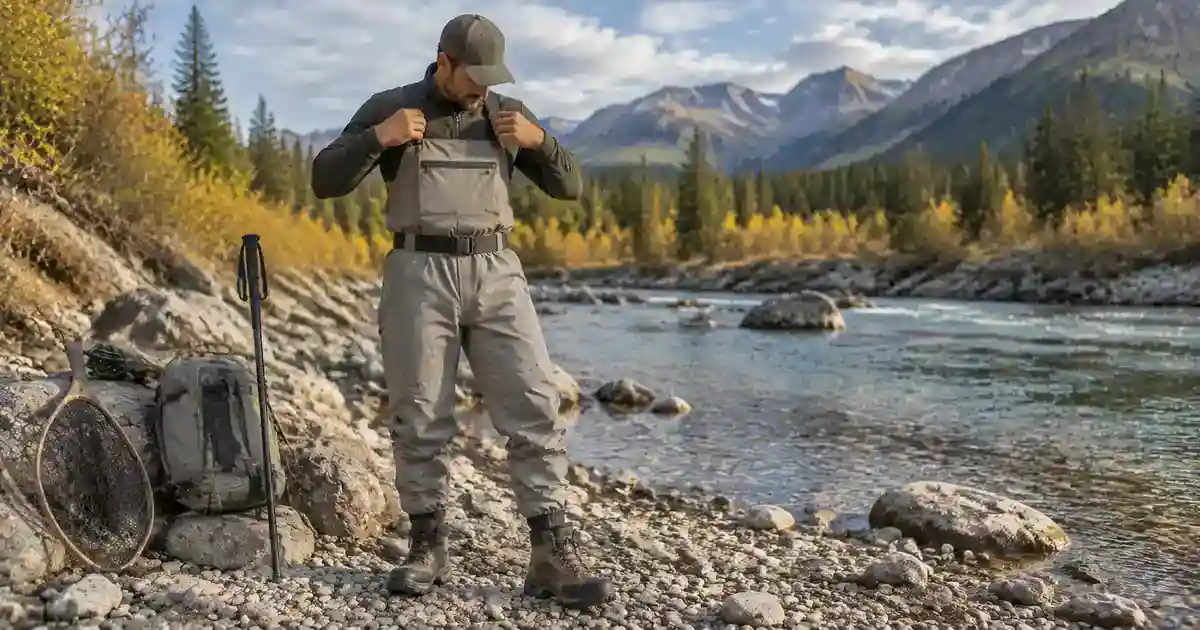
Best Fly Fishing Waders: Top Picks for Every Budget
The best fly fishing waders are not automatically the most expensive pair. The right choice depends on how well they fit, how often you fish, where you wade, and whether the extra durability or convenience of a premium model is worth paying for.
For a quick starting point:
- Tight budget: Frogg Toggs Canyon II
- First serious pair: Orvis Clearwater
- Regular use: Simms Freestone
- Premium: Simms G3 Guide
- Abrasion-focused premium use: Orvis PRO
- Bootfoot option: Simms Freestone Z Bootfoot
Use this buying framework:
Fit → Frequency → Water → Durability → Service → Price
If a premium pair fits poorly, choose the less expensive model that fits correctly. Waders bend at the knees, crotch, ankles, and booties every time you move, so fit matters as much as the material printed on the specification sheet.
Table of Contents
Best Fly Fishing Waders at a Glance
Prices below were checked on September 11, 2026 and can change.
| Pick | Best For | Type | Current Research Price |
|---|---|---|---|
| Frogg Toggs Canyon II | Tight budgets | Breathable stockingfoot | $165 |
| Orvis Clearwater | Beginners | Breathable stockingfoot | $298 |
| Simms Freestone | Regular use | Breathable stockingfoot | $450 |
| Simms G3 Guide | Premium | GORE-TEX stockingfoot | $600 sale / $750 regular |
| Orvis PRO | Abrasion-focused premium use | Breathable stockingfoot | $698 |
| Simms Freestone Z Bootfoot | Cold-weather/bootfoot preference | Breathable bootfoot | $650 |
These are not ranked from universally best to worst. Each model makes the most sense for a different buyer.
How We Chose These Waders
FlyFishingScout did not claim personal field testing of these products. The recommendations are based on current manufacturer specifications, current pricing, product design, repair support, sizing, intended use, and current independent gear research.
The main criteria were:
- Fit options
- Waterproof/breathable construction
- Fabric and layer design
- High-wear reinforcement
- Stockingfoot or bootfoot construction
- Bootie fit
- Wading belt
- Gravel guards
- Mobility
- Storage
- Repair support
- Warranty
- Fishing frequency
- Current price
- Overall usefulness for the intended buyer
Price matters, but it is not the first criterion.
A $700 pair does not make sense if you fish five days a year and a $300 pair already covers your needs. On the other hand, someone who spends much of the season hiking through brush and wading rocky rivers may have a stronger reason to pay for heavier-duty construction and repair support.
Frogg Toggs Canyon II — Best Budget Fly Fishing Waders
At a current manufacturer price of $165, the Frogg Toggs Canyon II is the lowest-cost breathable stockingfoot option in this shortlist.
Current specifications include:
- Four-ply nylon upper
- Stockingfoot construction
- 4 mm double-taped neoprene booties
- Attached gravel guards
- Integrated lace hooks
- Adjustable wading belt
- Y-back suspenders
- Zippered chest storage
- One-year warranty listed for the product
Frogg Toggs Canyon II Breathable Stockingfoot Wader
Who It Suits
The Canyon II makes sense for:
- Beginners on a strict budget
- Occasional anglers
- Someone unsure how often they will use waders
- A backup pair
- Anglers who would rather preserve budget for boots and other essential equipment
It gets you into a breathable stockingfoot setup without immediately moving into the $300–$700 range.
Main Trade-Offs
The lower price means you are getting a simpler product.
You do not get the same range of advanced materials, fit options, reinforced constructions, or premium storage systems found farther up the price ladder.
That is not necessarily a problem for an occasional user.
Also remember that stockingfoot waders require separate wading boots, so $165 is not the cost of a complete wading setup.
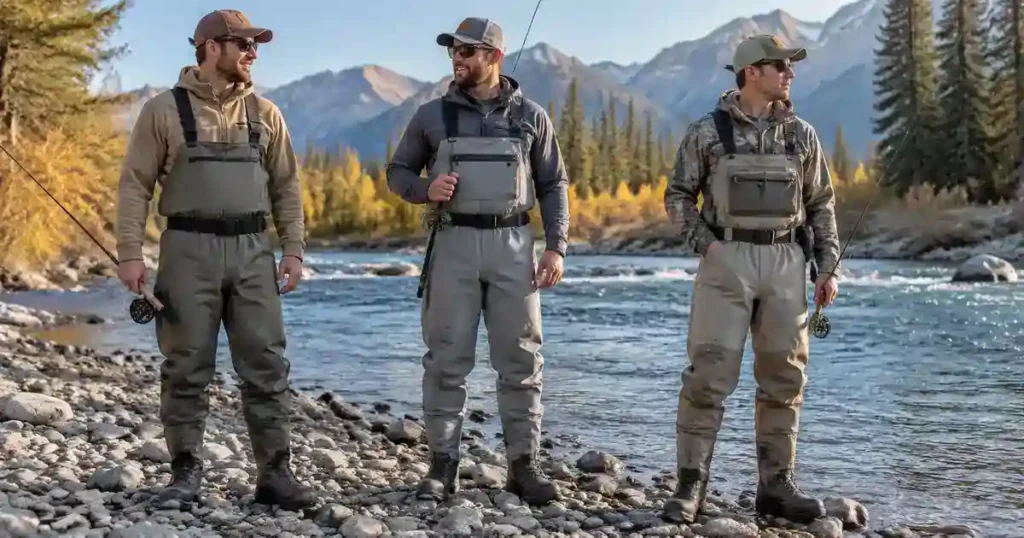
Orvis Clearwater — Best Fly Fishing Waders for Beginners
The Orvis Clearwater is a strong next step for someone who wants a more complete first pair without jumping into premium pricing.
The current price is $298.
Current specifications include:
- Four-layer waterproof/breathable nylon construction
- Manufacturer-listed 30K waterproofness
- Manufacturer-listed 8K breathability
- Stockingfoot design
- Anatomical neoprene booties
- Integrated neoprene gravel guards
- Included wading belt
- External storage pocket
- Handwarmer pocket
- Side-release buckles that allow waist-high conversion
- Multiple body and inseam sizing options
Who It Suits
The Clearwater is a practical choice if you are:
- Buying your first serious wader
- Fishing more than a few isolated trips
- Looking for a breathable all-around design
- Interested in more fit options than many entry-level models provide
- Not ready to pay $450 or more
The waist-high conversion can also be useful when you do not need the full chest height.
Main Trade-Offs
The Clearwater does not have the reinforced premium construction of the Orvis PRO or the GORE-TEX lower of the Simms G3.
That is part of why it costs substantially less.
For a beginner, spending the difference on properly fitting wading boots can often be more useful than immediately moving into a premium wader.
Simms Freestone — Best Overall for Regular Anglers
The current Simms Freestone Stockingfoot costs $450 and occupies the middle of this shortlist.
It uses:
- Four-layer Toray QuadraLam construction in the upper and lower
- Stockingfoot design
- Integrated gravel guards
- Wading belt
- Multiple torso, inseam, and stockingfoot combinations
- Current men’s and women’s versions
- Simms repair and warranty support
Simms Freestone Stockingfoot Waders
Why It Earns the Regular-Use Pick
The Freestone is the point where someone who fishes regularly can get broader sizing, a four-layer construction throughout, and established repair support without moving immediately into $600–$1,100 premium models.
It is particularly sensible for the angler who thinks:
“I use my waders enough to care about durability and fit, but I don’t need a front zipper or the most expensive laminate available.”
Current independent testing also continues to identify the Freestone as a strong value choice among higher-use waders.
Main Trade-Offs
At $450, it is significantly more expensive than the Canyon II or Clearwater.
It also uses Toray QuadraLam rather than GORE-TEX. That fact by itself does not make it inferior, but buyers specifically looking for GORE-TEX construction need to move higher in the Simms range.
Storage is also less elaborate than on some premium designs.
For many anglers, that simplicity is a feature rather than a weakness.
Simms G3 Guide — Best Premium Fly Fishing Waders
The Simms G3 Guide moves into guide-tier construction.
As of September 11, 2026, Simms lists the G3 at $600 on sale, down from a regular listed price of $750. Availability can vary by size, so check the current product page rather than assuming the sale or your size will remain available.
Key current specifications include:
- Three-layer waterproof/breathable GORE-TEX upper
- Four-layer waterproof/breathable GORE-TEX Pro lower
- Stockingfoot construction
- Approximately 50.1 oz. in size medium
- Short, regular, and long inseam options across applicable sizes
- Multiple stockingfoot-size combinations
- Wading belt
- Simms warranty and repair support
Simms G3 Guide Stockingfoot Waders
Who Should Pay for the Upgrade
The G3 makes the most sense for:
- Frequent anglers
- Anglers who walk and wade extensively
- Long fishing seasons
- Buyers who want reinforced lower-body construction
- Anglers who benefit from Simms’ wider fit range
- Someone willing to pay for premium materials without reaching G4Z pricing
The combination of a three-layer upper and more reinforced four-layer lower places extra material where waders tend to see more contact with rocks, brush, and repeated bending.
Who Should Skip It
You probably do not need the G3 if:
- You fish only a few times each year
- Your fishing is mostly from easy banks
- The purchase would force you to compromise on boots
- A $300–$450 model already gives you an excellent fit
A premium wader should solve a real use problem.
Orvis PRO — Best for Abrasion-Focused Premium Use
The Orvis PRO provides a different approach to premium construction.
The current price is $698.
Orvis currently specifies:
- Four-layer CORDURA fabric in the upper
- Five-layer CORDURA fabric in the lower legs
- Approximately 46 oz. in medium regular
- Low-profile seams
- Gusseted crotch
- Anatomical neoprene booties
- PU-reinforced mesh gravel guards
- Removable 6 mm knee pads
- Adjustable suspenders
- Waist-high conversion
- Included belt
- Current Orvis repair eligibility
Why It Is Different From the G3
This is not a simple question of “Orvis PRO vs. G3: which wins?”
The PRO emphasizes reinforced CORDURA construction, including a five-layer lower section and removable knee pads.
That makes it worth considering if your fishing involves:
- Brushy approaches
- Frequent kneeling
- Rocky riverbanks
- Heavy lower-leg wear
- Long seasons where abrasion is a recurring concern
Main Trade-Offs
At nearly $700, it is firmly premium gear.
The extra construction and features can be unnecessary for someone fishing occasionally on easy-access water.
It also remains a stockingfoot model, so proper wading boots are another purchase.
Simms Freestone Z Bootfoot — Best Bootfoot Fly Fishing Waders
Most models in this list are stockingfoot waders. The Simms Freestone Z Bootfoot fills a different role.
Its current price is $650.
Current specifications include:
- Four-layer Toray QuadraLam upper and lower
- Integrated rubber-soled boot
- Waterproof center-front TIZIP zipper
- Wading belt
- Chest storage
- Handwarmer pockets
- Approximately 110.8 oz. in size medium
Simms Freestone Z Bootfoot Waders
Who Bootfoot Makes Sense For
Bootfoot waders can make sense if you prioritize:
- Quick on-and-off convenience
- Cold-weather fishing
- An integrated boot
- Avoiding the separate boot-and-stockingfoot setup
- Shorter approaches where footwear customization matters less
You step into one integrated system rather than pulling boots over neoprene stockingfeet.
Who Should Stay With Stockingfoot
Stockingfoot waders are usually more flexible for anglers who:
- Hike long distances
- Want to choose their own boot
- Need different traction systems
- Want to replace boots independently of the waders
- Care about dialing in footwear fit separately
Neither system is universally better.
How Much Should You Spend on Fly Fishing Waders?
A useful budget is based on how often you fish and how hard you are on equipment.
Around $150–$200
This is the basic breathable entry point.
The Canyon II shows what this tier can offer: breathable stockingfoot construction, gravel guards, booties, and a belt without premium materials or complex storage.
This tier makes sense for occasional use and strict budgets.
Around $300
This is where a first serious pair becomes easier to recommend.
The Clearwater adds a four-layer breathable design, broader fitting options, waist conversion, and Orvis repair support while remaining well below premium prices.
Around $400–$500
This is a strong range for regular anglers.
The Freestone represents this tier with four-layer material throughout, more sizing combinations, and established repair support.
If you expect to use waders frequently, this price band can offer a good balance between cost and construction.
Around $600–$750
Now you are buying premium construction and features.
Products such as the G3 Guide and Orvis PRO add materials, reinforcement, more refined fit systems, and features aimed at frequent use.
These upgrades become easier to justify when your waders spend many days each season moving through brush and rocky water.
Around $1,000 and Up
This is the no-compromise tier.
The current Simms G4Z costs $1,100 and uses a three-layer GORE-TEX Pro upper, four-layer GORE-TEX Pro lower, molded stockingfeet, and a waterproof YKK AQUASEAL front zipper.
That is impressive equipment, but most recreational anglers do not need to spend $1,100 to stay dry and fish effectively.
The G4Z makes more sense as a reference point for what the top price tier adds than as the automatic answer for every angler.
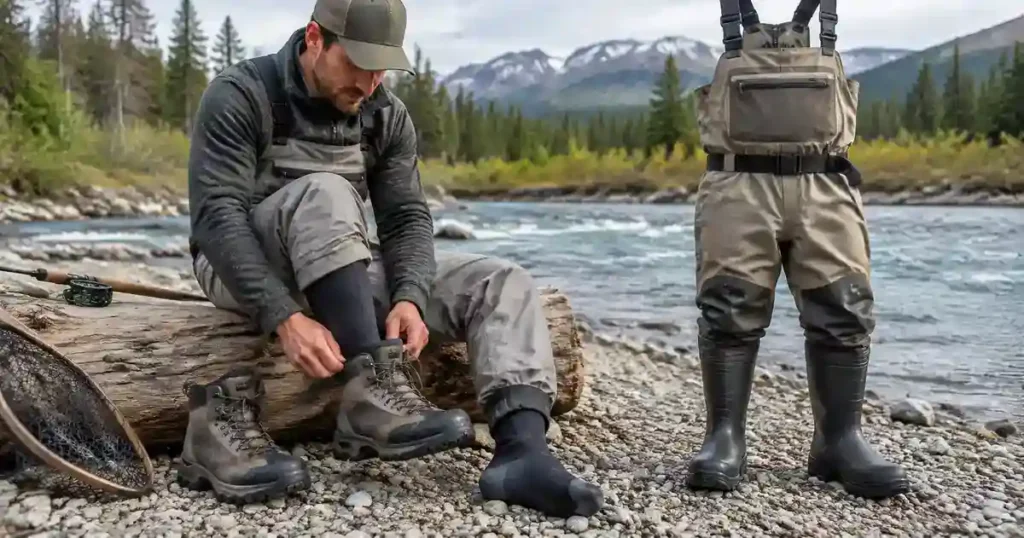
Stockingfoot vs. Bootfoot Waders
This is one of the biggest decisions when shopping for waders.
| Feature | Stockingfoot | Bootfoot |
|---|---|---|
| Foot design | Neoprene stockingfeet | Integrated boot |
| Separate boots needed | Yes | No |
| Footwear choice | High | Limited to built-in boot |
| Hiking | Usually better suited | Heavier/bulkier |
| Quick setup | More steps | Faster |
| Cold-weather convenience | Good with correct layers | Often attractive |
| Boot replacement | Independent | Boot and wader are one system |
| Traction choice | More flexible | Depends on integrated sole |
For most general fly fishing, stockingfoot waders provide greater versatility because you can choose your boots separately.
Bootfoot construction becomes more appealing when integrated footwear and quick setup solve a specific need.
Do not forget the budget implication: a stockingfoot price is only part of the total system.
Breathable vs. Neoprene Waders
Breathable waders are the general-purpose choice for most fly anglers because you can adjust insulation underneath them.
The wader itself is primarily the waterproof shell.
When temperatures drop, add appropriate base and insulating layers rather than expecting breathable fabric to provide heavy insulation by itself.
Neoprene waders still have a place, especially for consistently cold conditions where warmth matters more than ventilation and hiking comfort.
For varied river fishing across spring, summer, and fall, breathable designs are generally easier to adapt.
Avoid comparing breathability numbers across manufacturers too literally. Different brands can use different materials and testing systems.
How Fly Fishing Waders Should Fit
Fit should come before brand loyalty.
A useful sizing process is:
- Measure your largest torso or girth point.
- Measure your inseam.
- Check your shoe size against the stockingfoot size.
- Account for the layers you will wear underneath.
- Compare those measurements with the exact manufacturer’s chart.
Waders should allow you to:
- Bend your knees
- Step onto a high bank
- Squat
- Sit comfortably
- Wear cold-weather layers
- Move without pulling aggressively at the crotch
At the same time, excessively baggy waders create extra folds and loose fabric.
Do Not Ignore the Stockingfeet
An oversized neoprene bootie can bunch inside a wading boot.
A bootie that is too small can compress the foot and feel uncomfortable, especially with heavier socks.
Some manufacturers provide separate combinations of body size, inseam, and stockingfoot size. Use them.
Consider Women’s-Specific Fit
Current wader lines from brands including Simms and Orvis include women’s-specific models or sizing.
If a women’s pattern fits your body better than a generic cut, use it. Fit and freedom of movement are more important than choosing a particular model simply because it is featured in a men’s comparison.
Do Beginners Actually Need Waders?
No. Waders are useful, but they are not mandatory for every beginner.
You may not need them immediately if you mostly:
- Fish from shore
- Fish local ponds
- Fish from a boat
- Wet wade in appropriate warm-weather conditions
- Have easy access without entering the water
If you are still figuring out your first complete setup, our guide to what fly fishing is and the gear beginners need can help you decide where waders belong on your purchase list.
A beginner with a limited budget may be better off buying the correct rod, reel, line, leaders, flies, and safe footwear before buying premium waders that are rarely needed.
Features Worth Paying For
Wader marketing can make every pocket and zipper sound essential.
They are not equally important.
Prioritize These First
1. Correct fit
Nothing compensates for waders that restrict movement or fit poorly.
2. Waterproof/breathable construction
This is the basic job of a general fly-fishing wader.
3. Reinforced high-wear areas
Worth paying for if your fishing regularly involves rocks, brush, kneeling, and long approaches.
4. Correct bootie fit
Important for comfort inside your wading boots.
5. Wading belt
Simple, important equipment that should be used with chest waders.
6. Repair support
A repairable pair can be more useful over time than one with more pockets but limited service options.
Convenience Features Come Second
Depending on your use, these can be worth paying for:
- Waterproof front zipper
- Waist-high conversion
- Knee pads
- Large chest storage
- Handwarmer pockets
- Tool attachment points
- More advanced suspenders
A front zipper can be convenient. It does not automatically make a wader worth hundreds of dollars more for you.
Wader Safety Basics
Waders help keep you dry. They do not make moving water safe.
When wading:
- Wear your wading belt
- Check the current before stepping in
- Move slowly and deliberately
- Avoid water beyond your experience
- Consider a wading staff
- Use appropriate boot traction
- Dress for the water temperature
- Check river flow and weather
- Avoid taking unnecessary risks to reach fish
Cold, deep, or fast water deserves extra caution.
A premium wader does not replace judgment.
How to Make Waders Last Longer
Even premium waders are wear items.
Basic care can reduce unnecessary damage.
Dry Them Properly
Dry the inside and outside before long-term storage.
Do not leave damp waders balled up in a vehicle or bag.
Protect the Neoprene Stockingfeet
Do not walk across gravel, pavement, or sharp ground directly on stockingfeet.
Put your wading boots on as soon as practical.
Rinse After Saltwater
If you fish saltwater, rinse the waders and associated equipment with fresh water according to the manufacturer’s care instructions.
Clean According to the Manufacturer’s Instructions
Dirt and oils can affect technical fabrics.
Follow the care instructions for your exact product rather than treating every membrane identically.
Repair Small Problems Early
A small puncture is easier to address before it becomes a larger tear.
Brands such as Simms and Orvis currently offer repair programs, and both also provide care or repair guidance for smaller issues.
Common Wader Buying Mistakes
Buying by Brand Before Fit
Start with measurements.
A famous model that fits badly is still the wrong wader.
Buying Too Tight
Remember that you may eventually need insulating layers underneath.
Try to preserve mobility through the knees and crotch.
Forgetting the Cost of Boots
Stockingfoot waders need wading boots.
A $298 pair of Clearwater waders plus boots can cost more as a complete system than the wader price initially suggests.
Assuming Expensive Means Indestructible
Premium fabrics can improve construction and reinforcement, but no breathable wader is immune to:
- Sharp branches
- Barbed wire
- Hooks
- Abrasion
- Falls
- Material aging
Buying Bootfoot Without Thinking About Walking
Integrated boots offer convenience, but they also create a heavier, less customizable system.
Consider how far you normally hike.
Assuming Neoprene Is Required for Cold Weather
Breathable waders can be used in cold conditions with appropriate layers.
Choose neoprene because its insulation suits your actual use, not because winter automatically requires it.
Ignoring the Repair Policy
Check what happens when the waders eventually leak.
Current Simms and Orvis programs treat manufacturing defects differently from ordinary wear and damage, so read the actual terms before buying.
Paying for Features You Will Not Use
A waterproof front zipper, removable knee pads, or elaborate storage can be valuable.
They are still wasted money if your fishing does not benefit from them.
Quick Buying Decision
If you want the simplest answer:
Strict budget: Choose the Frogg Toggs Canyon II if you want breathable stockingfoot waders at the lowest price in this shortlist.
Beginner: Choose the Orvis Clearwater if you want a more refined first pair with broader features and fit options without reaching mid-range pricing.
Regular angler: Choose the Simms Freestone if you fish often enough to justify stronger mid-range construction and repair support.
Premium: Consider the Simms G3 Guide if you fish frequently and want GORE-TEX construction with more reinforcement in the lower section.
Abrasion-focused premium: Consider the Orvis PRO if reinforced CORDURA construction and knee protection fit the way you fish.
Bootfoot: Choose the Simms Freestone Z Bootfoot if an integrated boot and cold-weather convenience matter more than separate-boot flexibility.
The final decision should still begin with fit.
FAQs
What Are the Best Fly Fishing Waders for Beginners?
The Orvis Clearwater is a strong first serious pair because it combines four-layer breathable construction, multiple sizing options, included gravel guards and belt, and current repair support without premium-tier pricing. For a tighter budget, the Frogg Toggs Canyon II costs significantly less.
Are Expensive Fly Fishing Waders Worth It?
They can be if you fish frequently enough to benefit from reinforced materials, broader sizing, premium laminates, front zippers, and repair support. Occasional anglers often gain more value from a correctly fitting mid-priced pair.
Are Stockingfoot or Bootfoot Waders Better?
Stockingfoot waders are more versatile for most fly anglers because you choose the boots and traction separately. Bootfoot waders are convenient and can make sense for cold conditions or anglers who prefer an integrated system.
Are Breathable Waders Warm Enough for Winter?
Breathable waders can work in cold weather when paired with suitable insulating layers. They are primarily a waterproof shell, so winter warmth depends heavily on what you wear underneath.
How Long Should Fly Fishing Waders Last?
There is no honest universal lifespan. Longevity depends on fishing frequency, abrasion, fit, care, punctures, storage, and the materials used. Even premium waders can eventually develop leaks and need repair.
Do You Need Special Boots With Stockingfoot Waders?
Yes. Stockingfoot waders have neoprene feet rather than built-in boots. They are designed to be worn inside separate wading boots that provide support and traction.
Final Takeaway
The best fly fishing waders are the pair that fits correctly and matches how often and where you fish.
You do not need a $1,100 wader to begin. A budget or mid-range breathable model may be the smarter purchase if you fish occasionally.
Spend more when the extra money buys something you will genuinely use: better fit options, reinforcement, repair support, a premium material package, or a feature such as a waterproof front zipper.
Start with fit, account for the cost of wading boots, wear your belt, and choose the least expensive pair that reliably meets the demands of your actual fishing.
Sources Used — Not Part of the Article:
- Frogg Toggs — Men’s Canyon II Breathable Stockingfoot Chest Wader. Current manufacturer page confirms the $165 price, four-ply nylon upper, 4 mm neoprene booties, gravel guards, belt, and one-year warranty designation.
Frogg Toggs — Canyon II - Orvis — Men’s Clearwater Breathable Fishing Waders. Current manufacturer page confirms the $298 price, four-layer nylon construction, 30K/8K manufacturer ratings, waist-height conversion, anatomical booties, gravel guards, and belt.
Orvis — Clearwater Waders - Simms Fishing — Men’s Freestone Waders — Stockingfoot. Current manufacturer page confirms the $450 price, four-layer Toray QuadraLam construction, and current sizing.
Simms — Freestone Stockingfoot Waders - Simms Fishing — Men’s G3 Guide Waders — Stockingfoot. Current page lists $600 sale pricing against $750 regular pricing and confirms the three-layer GORE-TEX upper, four-layer GORE-TEX Pro lower, 50.1 oz. medium weight, and size range.
Simms — G3 Guide Stockingfoot Waders - Orvis — Men’s PRO Fishing Waders. Current manufacturer information confirms the $698 price, four-layer CORDURA upper, five-layer lower, approximately 46 oz. medium-regular weight, anatomical booties, and removable 6 mm knee pads.
Orvis — PRO Waders - Simms Fishing — Men’s Freestone Z Bootfoot Waders — Rubber Sole. Current page confirms the $650 price, four-layer Toray QuadraLam construction, TIZIP waterproof front zipper, integrated boot, and 110.8 oz. medium weight.
Simms — Freestone Z Bootfoot Waders - Simms Fishing — Men’s G4Z Waders — Stockingfoot. Current page confirms the $1,100 price, three-layer GORE-TEX Pro upper, four-layer GORE-TEX Pro lower, YKK AQUASEAL front zipper, molded stockingfeet, and 50.8 oz. medium weight.
Simms — G4Z Stockingfoot Waders - Simms Fishing — Wader and General Warranty. Current policy lists 60-day no-questions-asked replacement for wader leaks, first-year repairs, and a current post-first-year repair program for U.S./Canada purchases.
Simms — Wader Warranty - Orvis — Fly Fishing Waders Care & Repair. Current policy confirms the first-60-day replacement/refund provision, defect handling, paid repair eligibility for current models, and wader-care guidance.
Orvis — Wader Care & Repair - Field & Stream — Best Fly Fishing Waders of 2026, Tested. Independent August 2026 comparison identifies the Simms G4Z as its overall pick, Simms Freestone as its value choice, and Orvis Clearwater as its budget pick; used as supporting independent context rather than FlyFishingScout testing.
Field & Stream — Best Fly Fishing Waders of 2026